Topic

Advanced-Beginner Trips in the GC?

  • This topic is empty.
Viewing 25 posts - 1 through 25 (of 44 total)
PostedDec 18, 2014 at 6:59 pm

Been doing a lot of reading trying to plan my next spring trip to the Grand Canyon. I just started a couple books that will help with the itinerary, but I'm looking for voices of experience here as well. I hike a lot (at least once a week, usually at least 10 miles at a time) all over socal, have done some moderately intense backpacking and am generally fit, and want to do a preferably non-corridor-trail trip with a couple friends in the spring. I'm definitely very intimidated by the thought of backpacking in the GC but I gotta do it! Wondering what other seasoned canyoneers would recommend for an advanced beginner trip, 3-4 nights. I'm reading through a lot of old threads too!

PostedDec 18, 2014 at 7:53 pm

" … trying to plan my next spring trip to the Grand Canyon"

Do you mean spring of 2015? Because if that is the case you need to get a permit application in asap.

"canyoneers" usually refers to folks who rappel over pour-offs, swim through pools, understand that "retreat" is not an option, and generally hike at an expert level. Am correct to assume you are using that term loosely?

[Monte…..?]

PostedDec 18, 2014 at 8:42 pm

ha yes, by that I only meant people who have hiked/backpacked in the Grand Canyon, a bit of a pun. Perhaps I should have used quotation marks. And yes, I know I need to apply for a permit soon. I've been there before and understand the permit process.

PostedDec 19, 2014 at 6:34 am

If you have never hiked in the Grand Canyon before, I would recommend a corridor trip first, so that you will appreciate the Canyon's unique features, especially that you descend first, beating up your legs, and then you get to climb out.

If the corridor is absolute anathema, do the Hermit loop,climbing out via the BA…

David Chenault BPL Member
PostedDec 19, 2014 at 7:12 am

It's a fairly big leap to go from the corridor backpacks to anything else, but it is way mo better in every respect.

For 3-4 days I'd point you towards going down the Grandview trail, west along the Tonto, and up either the South Kaibab or Bright Angel. There are some tough stretches (Grandview is very steep and has a bit of exposure, the Cremation stretch is rough) but the water carries aren't too bad (nothing more than a day) and the scenery is excellent.

Valerie E BPL Member
PostedDec 19, 2014 at 10:07 am

You didn't specify whether you wanted South Rim or North Rim… so I'll give you a North Rim option.

My first GC backpacking trip was the Thunder River/Tapeats Creek/Deer Creek loop (from Monument Point). Spectacular scenery, world's shortest river thundering out of a sheer cliff, Deer Creek narrows (slot canyon without the technical stuff)… what a great loop!

For a very fit person, it is do-able in 4 days, and now that the river route between Lower Tapeats Creek and Deer Creek is so well-defined, you won't have any navigational issues. Take a look at some on line trip reports to get a flavour for this area of GC.

Ralph Burgess BPL Member
PostedDec 19, 2014 at 12:01 pm

The corridor trails do give you great scenery, but they are packed with people, and the mass campgrounds are not a wilderness experience. So it's great to have the ambition to be more adventurous, but as Dave said – non-corridor trail conditions are immediately far more challenging.

Mid/late April is a great time to be in the Canyon, because it's flower time – the Tonto platform especially is spectacular when the cactus bloom. However, permit applications for April opened at the begnning of December, and you are probably already too late for any popular area. Early May is also a fine time to be there (and will still have flowers), and you have time to get your application in. Don't go any later than mid-May, temperatures quickly become intolerable and downright dangerous in the inner canyon.

I'd agree with the two S Rim loops mentioned as the easiest next choices:

Hermit Trail. You can combine this with a Tonto (West) traverse and Bright Angel to make a loop. It might be sensible to descend BA with the heavy pack, and hike out via Hermit. The Hermit loop is probably the most popular route outside the corridor. Permits will be difficult, and you will always be staying at specific designated campsites with pit toilets. You will have company, but the number of people will still be an order of magnitude less than the corridor trails. Hiking is easy along this part of the Tonto. All the trail is well made and maintained, albeit not of the "highway" quality of the corridors. The hike down Bright Angel is an easy 4.5 miles, so you can certainly get further than the corridor Indian Garden campground for your first night; but bear in mind that the water at the first Tonto campsite, Horn Creek, is to be avoided (heavy metals I think), so you'll just need to carry water the couple of miles from Indian Garden if you camp at Horn. West of Horn Creek, all the other sites along the Tonto there have good water.

The Grandview Trail and the Tonto (East) section between Grandview and S Kaibab is slightly more adventurous, but as mentioned by Dave only the Cremation section is tricky, but I think it's probably within your abilities. On this route, you will have more of a wilderness experience camping "at large" along the Tonto. To complete the loop, you may prefer using the Bright Angel rather than the South Kaibab, because S Kaibab is completely dry and shadeless. A great 4-night itinerary would be to go down Bright Angel, first night at Indian Garden, then camp at Lonetree Canyon (short easy hike downcanyon for good water), Grapevine Canyon (perennial flow at Tonto crossing), Cottonwood (perennial water), out via Grandview. Indian Garden and Cottonwood permits will be in high demand.

The next most difficult trail is probably Tanner. But there's no suitable loop for you: the Escalante Route running West from Tanner is considerably more difficult than the Tonto, and not for an advanced beginner. Then New Hance and Boucher. Boucher is gorgeous, but has sections of "trail" that are almost Class 3 (hands on rock).

Not all of this is immediately necessary for something straightforward like the Hermit Loop, but if you plan to progress to more difficult terrain in the GC, here are some general things to think about:

– Water is always the big issue in the canyon. Always know your next source, and the contingency plan if it's dry. Know the perennial sources. Know when it last rained, to judge whether potholes are likely. Know which canyons give access to the Colorado. If the Colorado will be a water source, be equipped to clear sediment. Be equipped to carry a lot of water if necessary.

– Be as light as possible in non-essential areas, because (a) you need agility on difficult terrain, (b) you may need to carry a lot water. Ditching your tent is the most obvious strategy. It rarely rains, and I camp cowboy style 95% of the time, and I know where the overhangs are for most of the other 5%. If I carry a shelter, it's a 5oz tarp, and never tent pegs – on the rare occasions when I do pitch, it's rarely on a surface that's suitable for pegs, and one thing you can ALWAYS find is rocks!

– Think carefully about the daytime highs and nighttime lows that you will encounter on your planned route and considering the elvations of your planned campsites. There's a huge variation between the rims and the inner canyon. You can go from risk of hypothermia to sunstroke within a few hours. There is very little shade when the sun is high. Even in the hottest weather, I always wear long sleeves and long pants and a wide-brimmed hat. If you get in trouble with heat & lack of water, a good escape strategy may be to rest up when the sun is high and move only early/late or in darkness, so always have an adequate light and batteries. Know what the moon is doing.

– Tricky terrain often involves traversing loose unstable rock. I find that using one hiking pole is the best arrangement. You keep the pole in your downcanyon hand for stability, and the other hand is free to find holds. Wear gloves to protect your hands. Pockmarked limestone is vicious if you grab hold of it to save a slip. I find the Gorilla Grip gloves (disposable, $5 from Home Depot) are ideal, because they have just enough protection, but they are thin enough that you can wear them on the whole time. They will also stop the skin on your hands from painful cracking in the low humidity.

David Chenault BPL Member
PostedDec 19, 2014 at 3:55 pm

The Deer-Thunder loop is sick. Extra points for the long cool drive in and the TH out in the middle of nowhere.

I'd say it's a bit harder than the S Rim loops discussed thus far, if nothing else solely because the haul from last water back to the rim is pretty burly.

A few months ago I took my mom up the Thunder/Bill Hall exit, and given that she's probably like the typical GC backpacker who isn't going to do well over 10 vertical m/minute (and thus go 3 hours or less river to rim on the S Kaibab, for example) I think our strategy worked well. Dinner at the last water access by the Thunder River source, start a late push up to the Esplanade, camp there. Dawn start, top of Bill Hall around noon. Minimal heat exposure, but you'll still want to haul ~24 hours of water or put a water cache in on the way down.

Dan Magdoff BPL Member
PostedDec 19, 2014 at 8:10 pm

This may be a stupid question…but what is meant by a "Corridor Trail"?

Ralph Burgess BPL Member
PostedDec 19, 2014 at 8:40 pm

Bright Angel, South Kaibab and North Kaibab. They connect the South Rim Village via the only Colorado bridges to the North Rim visitor area. They are wide switchbacked trails with modest gradients to take mule trains, actively maintained.

PostedDec 20, 2014 at 9:49 am

These responses are so great; thanks everyone. I went to the GC (first time, I'm from the midwest/southeast, moved to LA) earlier this year and have been yearning to go back ever since. Since then I have been doing a lot of reading/research–to try to determine what to do on my next trip there, and a lot of hiking, because I love it. Lately I've been hiking on some rocky trails trying to condition my legs a bit more (I wear barefoot shoes on the trail almost always), and I just started doing a lot of stairs, a tip I read somewhere. It's not always easy for me to determine how difficult a trail is from so many varying reports, though. And many things I read are all focused on corridor trails. I have absorbed so much info from this forum, and have certainly come to trust the experiences and opinions found here at BPL, so I really appreciate y'all taking time to reply.

Valerie, Deer Creek loop has been number one on my list since it's the north rim, lots of water, and the narrows! I've seen a lot of great pictures. I'm glad you said the trail is now well-defined; I'm not very good at navigation (yet) so that was definitely a concern for me. A lot of the trip reports I've read are older and I always wonder how accurate they are, or how my experience level relates to them. 20-30 miles will be no problem for me/us over 4 days. But maybe doing a water cache, as David suggested, would be a smart idea. I think that will be my first choice.

Ralph, your Grandview itinerary is one I have definitely considered, although looking at those exposed parts of the trail make me nervous! If all goes well on this trip I may go back in the fall and try that route. I really want to start at the North Rim though, and my hiking partner wants to avoid the corridors (he's been more than I have). This year we went in mid-April, and the weather was amazing, but I wouldn't mind a few degrees warmer, so I thought we'd try May this time. Also thanks for the glove idea: will definitely pick some up. And the reminder about the moon! We were there during the blood moon–unbelievable.

Ralph Burgess BPL Member
PostedDec 20, 2014 at 10:37 am

Barefoot shoes? You were not thinking of wearing them in the GC, were you? If you're a diehard fan, they'd be fine on the corridor trails, and probably the Hermit Loop… but anywhere else they are not suitable. You need a rigid edge to dig into steep loose surfaces for stability, and you just need to protect your feet from sharp rock and vicious plants. There is also much greater chance of turning an ankle on GC-type terrain than you'll find elsewhere. I do routinely now wear trail runners on any of the made trails, and a few easy off-trail areas like Utah Flats; but for anything more difficult off-trail, the GC is one of the few fair-weather places where I still wear boots. For what you're considering, I think you need at least trail runners like Cascadias with a substantial sole, and with limited experience a boot is more sensible.

For what it's worth – I use the Salewa Mountain Trainer boot. I think it's the ideal boot design for hiking & scrambling around in difficult terrain in hot weather like the GC.

PostedDec 20, 2014 at 11:09 am

Ralph,
you said you use the Salewa Mountain Trainer boot. I see a high top one that is GTX and a low cut SMT 'shoe'. which are you talking about?
Surely you don't use GTX in that hot environment do you?

billy

Ralph Burgess BPL Member
PostedDec 20, 2014 at 11:39 am

Billy, it's the high top boot that I use – Mountain Trainer "Mid" they call it.
http://www.salewa.us/product/alpine+approach/ms-mtn-trainer-mid-gtx-1

Yes, it has Goretex, and I would prefer not, but it only comes that way. I don't know anything about Goretex for footwear, but it appears to be their "Extended Comfort" version which they claim is designed for hot weather. I do have quite sweaty feet, and all I can say is in practice the breathability in hot weather is fine. It's a very lightweight boot overall given how much robust protection it gives.

PostedDec 20, 2014 at 12:02 pm

Thanks Ralph…
I've been using the Garmont Zenith mid for off train/rocky places… comes in GTX and non- GTX… noticeably dryer feet with the non-gtx. By PBL standards they are not light… but when it comes to foot protection off-trail weight is not my priority.

billy

Valerie E BPL Member
PostedDec 20, 2014 at 12:15 pm

Lydia,

If you decide to do the Thunder/Tapeats/Deer loop, PM me, and I'll be happy to give you lots of tips, suggestions, and details. I've done it 7 times (didn't mean to, but we kept taking folks who hadn't been and really wanted to go there); my husband has done it 9 times. We always do a water cache.

No sense going into too much detail in the forums and boring others! ;^)

Ralph Burgess BPL Member
PostedDec 20, 2014 at 12:23 pm

Just from looking at it, I have no doubt the Zenith would win for breathability, and I'm sure that would be a great choice too.

I guess I've been using the Salewa almost exclusively in low-humidity desert environments, which may be why I've not found the Goretex to be a problem.

Some features that I really like about the Salewa in the GC are
– the Vibram "Mulaz" sole has great sharp edges to dig into loose surfaces, and a particularly good toe area for basic non-technical climbing
http://www.vibram.com/index.php/us/node_160/node_161/Products/Mountaineering/Mulaz-Sole
– the all-round rubber rand is substantial enough to protect against cactus spines etc.

Also, as with any footwear, most important thing is just the subjective fit of course. The last shape of the Salewa just seems to be great for me, it's as comfortable as any boot I've tried for covering regular hiking mileage.

Ralph Burgess BPL Member
PostedDec 20, 2014 at 12:30 pm

Valerie/Lydia, please don't go PM with that conversation, unless you are hooking up for a private trip.
I think that's exactly the kind of info that the forum's for — I haven't done that loop, and I love to hear your insights, I'm sure others would too.

David Chenault BPL Member
PostedDec 20, 2014 at 12:53 pm

I'd agree with Ralph that most GC hikes will demand a shoes on the burlier side of what you normally use, but that doesn't necessarily mean boots. So long as your feet are up to the task anything fairly durable with a good sticky sole will do.

PostedDec 20, 2014 at 1:36 pm

I was thinking of trying it in some trail runners. I have boots but they are heavy, I rarely hike in them anymore because they slow me down so much. I mentioned my barefoot shoes only to say that my legs, feet and ankles are pretty strong. Spiny plants are a concern, but I'd rather do as little shoe as possible. And no GTX; I am a hot hiker. But, those Salewas do look pretty nice and light for a boot. Worth investigating. Though they don't seem to be carried in any stores nearby. I will check out the Cascadias though, those look great. Anyone else want to chime in about footwear?

Valerie I am wide open to all tips and suggestions! Please please please share your knowledge with me.

PostedDec 20, 2014 at 1:57 pm

If you're going to go with the Cascadias, I would strongly suggest purchasing a pair of Superfeet inserts (can be found at Dick's Sporting Goods). They are far more rigid than what comes stock with the Cascadias. They'll stand up to the rocky rugged trails much better. You won't be near as apt to go lame.

If you're looking for a light mid-weight hiking boot check out the Lowa Zephyr. They're not waterproof and that's one of the reasons they are so much lighter (who needs waterproof in the GC anyway)?

Lowa is the highest quality, made in Slovakia. They aren't cheap, but I believe footwear is the most important piece of hiking gear.

Ralph Burgess BPL Member
PostedDec 20, 2014 at 2:09 pm

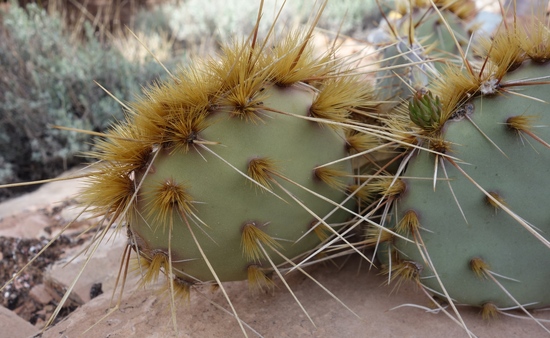
On the nasty plant issue… cactus spines give a horrible sharp pain of course, but it's immediately gone when they are pulled out, doesn't usually cause further problems. Make sure your tetanus immunization is current, and take suitable tweezers (with flat tips for gripping, not pointed tips). Also, if you have old man eyes like me, make sure you have your reading glasses or a magnifier! Glochids are the most annoying, because if you get them in you there will be dozens, and hard to see.
glochids
You often see dead pancake pear on the Tonto waiting to assault you from beyond the grave… the big spines fallen out, but the glochids just waiting for the unwary.

Ralph Burgess BPL Member
PostedDec 20, 2014 at 3:06 pm

"I would strongly suggest purchasing a pair of Surefeet inserts… They are far more rigid than what comes stock with the Cascadias. They'll stand up to the rocky rugged trails much better. You won't be near as apt to go lame."

Monte, Shoe inserts are highly subjective. Some people swear by rigid shoe inserts like Surefeet; but other people (myself included) find rigid support under the arch intolerable. In fact, I can quite happily remove the inserts altogether on most shoes and boots – your feet would probably hate that!

Once you've figured out what kind of insert are comfortable for you own particular feet, imo you should stick with it – I don't think that's something that will vary with terrain. In other words, I'd change the footwear according to terrain, but not the type of insert. If a rigid insert is uncomfortable for me walking on carpet, it will be equally uncomfortable hopping across talus.

PostedDec 20, 2014 at 3:20 pm

I'm sure you're correct Ralph, it depends on the individual. I just found that for me the Superfeet inserts make all the difference in the world with the Cascadias. Of course I weigh 200 lbs and wear a size 12.

Without the Superfeet it seemed like I felt every rock I stepped on. My feet would hurt so bad I'd almost cry. With the Superfeet no problem. But then again I do mainly summit hiking in the most rugged terrain imaginable.

It's just like packs I suppose, it's what works for the individual. That's why it's always good to test out new footwear before embarking on a long multi-day hike.

Viewing 25 posts - 1 through 25 (of 44 total)
Loading...