


" Friggin thing blended into the orange lichen perfectly."
Go figure. If something can go wrong, it generally will. How about neon red, like surveyors tape?
Topic
Become a member to post in the forums.
" Friggin thing blended into the orange lichen perfectly."
Go figure. If something can go wrong, it generally will. How about neon red, like surveyors tape?

I think there's a name for that phenomenon, where our brains try to make landmarks seem consistently perpendicular or parallel.
I don't know the name for it, but have experienced it. And it isn't just straight lines.
The most "lost" I've been is climbing Monument Pk here in the Bay Area. Totally fogged in, I might as well have been blindfolded.
Kept going uphill, I eventually reached the top, where a signpost declared it to be Mission Peak. Afterwards, I recalled how I had a mental image of a map of my route that had convinced me I was heading up the other mountain the whole time. I even drew out my imaginary map, and while wrong, it didn't seem to look like some MC Escher drawing that defied the laws of topology.
But, as I tell my wife, I've never been lost, just temporarily "misplaced," since I always find my way back home.
I had a similar experience on the way down from Camp Muir in a whiteout many years ago.
A small herd path in the snow was relatively easy to follow, and eventually we came to what looked like a steep ridge. We figured either it was one of the slight rises on the way to Paradise made to look like a ridge by the fog, or it was the edge of the Nisqually glacier and a whole bunch of people ahead of us had walked off a cliff!
After a brief discussion my friend said to stay put and he'd have a look. I figured if he didn't come back soon it was a cliff above the glacier and all I had to do was hang a left. Fortunately after a short time he appeared out of the fog and we kept going.
I've been lost once and very disoriented twice. The first time I got lost was near Muir Trail Ranch after crossing the river to get to the hot springs. I found the hot springs but crossed the river back to the wrong location and rather than re-crossing the river and trying to figure out what I did wrong, I decided to push onward and get back to the trail. I ended up in a dense forest with no landmarks whatsoever. I knew that I could find my way back to the JMT if I just went north, but that would involve bushwhacking quite a bit. At that point, I found my way back to the river and realized that I had moved and it was not safe to ford at the new location. I decided to just pick a direction and walk in hopes of finding a trail. I eventually did, followed it back to a trail I could recognize, and realized that I must have been some 30 feet from the trail the entire time but was too disoriented to realize it.
The second time I got lost, I was trying to summit Mt. San Gorgonio early in the morning. I followed the trail by moonlight and headlamp and ended up in this large somewhat clear area which I realized later was a campground. The trail disappeared into a large open area with scattered trees. I wandered around for a good 30 minutes and found dozens of footpaths which deadended but could not find the trail up to the mountain. I eventually gave up and waited for the sun to rise and immediately found the trail with a little better visibility.
I've had a few times when I got up in the night to use the facilities and had a heart-pounding moment when I could not find my way back quickly. I always was right on track, but just being in the dark was disorienting enough. I now try to stay close.
It turns out that without any references, humans have very poor senses of directions. It has been studied scientifically. People tend to walk in circles…
http://scienceblogs.com/notrocketscience/2009/08/20/do-lost-people-really-go-round-in-circles/
"I've had a few times when I got up in the night to use the facilities and had a heart-pounding moment when I could not find my way back quickly. I always was right on track, but just being in the dark was disorienting enough. I now try to stay close."
I leave a keychain light on hanging on/in my shelter on those really dark nights.
I got turned around in Shining Rock Wilderness in North Carolina late this past spring, and later discovered that the trail I turned onto on the way out, then backtracked to get off of, was the trail I was supposed to have been on to begin with, having been on a parallel trail the day before that turned away but ended up at the same place. Or something like that. Freaking place has unmarked trails going every which way.
I actually get turned around a lot for someone who's had training and done day and nighttime land nav solo in heavy woods and swamps. I have a habit of wandering offtrail to follow waterways, drainages, game trails, ridgelines, etc. and pick up the trail further on. Sometimes it turns away, so has "disappeared" when I curve back around to it a mile or three later.
That's when those maps I hate to pull out come in handy…
I have another bad habit of not paying attention to where I'm going in nice conditions, and I walk off the trail on occasion.
One beautiful spring day I was the last of four of us heading back to the car after a so-so day of fishing. I was carrying my rod (pointing backwards) and was listening to the birds or looking at flowers or whatever.
All of a sudden I found myself in the woods with no trail in sight. I could hear my friends so I called out to them. They responded by saying "what the (expletive deleted) are you doing way up there?" Apparently I missed a switchback and just kept going. walking over rocks and roots oblivious to the fact I wasn't on a trail, at least the main trail.
My strategy these days is simple: I'm usually at the end of the group, my wife is the navigator, and I insist she stop at each trail junction and wait for me. I haven't been out solo for decades, I guess I'd have to start paying more attention if I did!
A couple times I've left the trail for a break and rejoined it quite a ways away. So now I use my compass and take a reading, just to be safe. I especially do this when berry picking or mushroom hunting.
Kelly
D. Chenault : said "I had almost no evidence to support my decision to walk that direction, but stuck with it out of laziness and haste."
well folks, that about covers it.
so if it's cold, and i'm tired and ancient, and too frikk'n a slob to nav check a compass (hanging in front of my chest even ..), well, we can get misplaced for a while.
this is like paying retail for a lesson bought several times before.
laziness and haste… yup.
that's it right there.
v.
once, we were climbing a desert peak in the fog. We got to the top, and sat and rested. the fog lifted a bit, and we saw a higher peak a little ways off. We headed over there, and soon found a higher peak. Turns out the peak was an old volcano, and we went round in a circle at the rim of the peak.
Descending from Camp Muir on Mt. Rainier. It was a whiteout, with blowing snow and ice pieces. You could not open your eyes in the strong wind gusts with blowing ice pieces. We tied a guy who had ski goggles into the end of a rope, gave him a compass, set the bearing on the compass, and said walk so that the arrow of the compass is always right there in the little red box. The others at camp muir grabbed the rope, and we walked down holding the rope, mostly with our eyes closed. we hit the lodge at Paradise, thankfully.
Headed up a trail to the Goat Rocks in WA, and took a wrong fork in the trail, a trail which was not on the map. The trail we were on got thinner and thinner, then dissapeared. We kept going a bit, till we got to the top of a ridge, and it was obvious we were not going to hit the lake we were headed for. Luckily the wife was a good sport about it.
But I have gotten mighty confused in desert canyons. Just ask BPL members Craig Wisner or Chad Eagle. On different trips with each, in areas I am familiar with, I got "confused" and navigation required going into canyons that were basically not hikable. Of course I just told them I was testing their fortitude :)

I've been very very very lost. Most of that was military stuff and a result of moving at night in areas lacking prominent terrain features and the few GPS we had didn't work as good as an iPhone.
I find myself in situations from time to time where the terrain around me doesn't look like where I think I am on the map. Clear my head, compare multiple data points, and I'm usually back in service before too long.
Edit fat thumbs and autocorrect are driving me bonkers

Hey Nick, if that was getting "lost" then I want no part of being "found". Being unsure about what canyon to take was one of the highlights of the trip for me…a spectacular evening. I can remember quite clearly how hard the wind was whipping up on the ridge.
Beautiful country out there, and definitely easy to pick the wrong canyon.
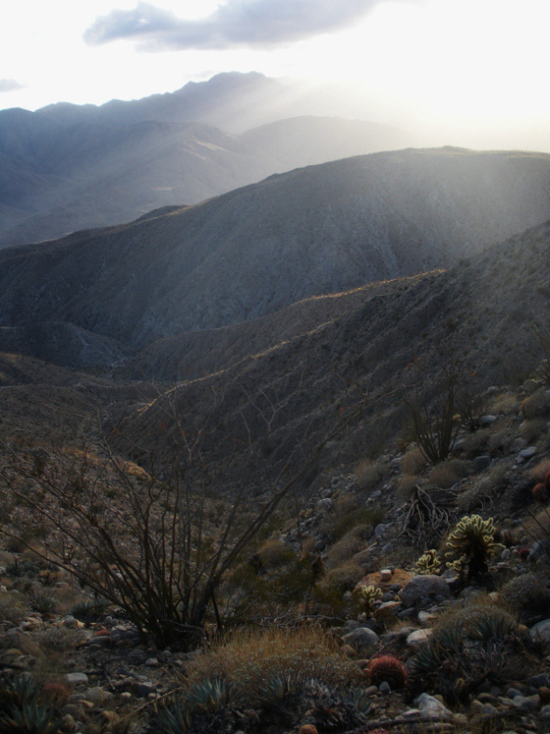
The abundance of flora in Anza Borrego is staggering. Its variety of shapes and colors are the closest thing on land to what I see when diving.
I was lost for the better part of a night with a friend.
We were climbing a local peak and used a mixed class 4 and 5 approach to the summit. We got to the top as the sun was setting. Aside from climbing gear, I had a headlamp, a fleece jacket, an apple, and a quart of water. Tents and the rest of our gear were waiting at the bottom for us.
The climbing had become somewhat sketchy (loose rock) and we thought it would be a bad idea to get off the summit the way we came, especially given the darkness. We were also concerned about getting off-route in the dark and running out of rope to finish a rappel.
So we hiked off the backside instead, hoping to loop back around to our camp. By this time it was dark. We descended and somewhere along the way we found we were not in the canyon we thought we were in. By the time we realized this, we were in an entirely different area. I remember the night being especially dark with no moon and combined with tree cover, it was almost impossible to spot peaks as navigation landmarks. We were so turned around that we couldn't even retrace our steps back to the peak. Everything looked the same. We couldn't even discern North with any certainty. The steepness of the surrounding canyons made travel difficult; a few times we started down small canyons by headlamp only to turn back at drop offs too steep to see the bottom of with headlamps.
We settled on spending the night at the base of a tree, huddling for warmth, and waiting for light in order to get our bearings again. We were fortunate it was in the low 40s and not below freezing. A very long night, mostly out of frustration and boredom. Just cold enough to not be able to sleep but not cold enough to freeze. Once it was light we were able to get our bearings and find camp. We were within a mile of it the entire time.
I was nineteen when that happened. Like most of us, I've learned a few things since then.
Its almost always better to wait for daylight to descend of climbs
The chances of fallin off something is quite high, or not finding the proper rappels
However with my 900 lumen headlamp that fits in a pocket i might chance it if absolutely neccessary … Note bring the longest lasting most powerful headlamp that is a reasonable weight for long climbs
Everyone gets lost on a climb or descent sooner or later, its only a matter of time
"Hey Nick, if that was getting "lost" then I want no part of being "found". Being unsure about what canyon to take was one of the highlights of the trip for me…a spectacular evening. I can remember quite clearly how hard the wind was whipping up on the ridge. Beautiful country out there, and definitely easy to pick the wrong canyon."
Agree, it was a great trip.
For everyone else…
We needed to get into a large canyon and hike down to a spring to get water. We didn't have enough water to cook dinner, but we weren't going to die of thirst either. There is only one easy way down into this canyon, which required hiking the proper ridge. Craig and I were walking a ridge and the wind was getting pretty serious, I think both of us were thinking it was going to blow us off the ridge to serious injury.
Suddenly the ridge ended at an almost vertical edge. Crapola. I then saw the correct ridge was ahead of us, meaning we would have to back-track to a saddle and then get on the correct one. Too much time and too much wind.
We started walking back and Craig looked down into this side canyon and said, "How about this way?" It was steep, lots of shrubs/cacti and we couldn't see all the way down, so there was the possibility of impassable pour overs… not to mention I was wear cross country flats, not the best footwear for that kind of hiking.
But what the heck? We went for it. Probably took us an hour to hit the main canyon (gravity does have its advantages). We got to the spring right at sunset. With the wind we had to set up our shelters to keep half of the blowing sand out of our food.
But it was an excellent adventure!!
just to re-iterate the dangers of getting lost in the dark, when one thing goes wrong compounding it with additional errors happens quite a bit .. in this case leading to a fatality … this was posted recently on ANAM fbook page
The party arrived at the start of the crux technical section (the Four Aces) at approximately 9:45 a.m. They spent the rest of the day on the 16th negotiating this technical section in winter conditions, and finished the Fourth Ace around 7 p.m. Given that they were moving slower than anticipated, and with darkness imminent, they discussed descending a northeast-facing couloir just west of the Fourth Ace into the Fay Lakes drainage. They elected not to descend here due to concerns about avalanche conditions and wind loading in the couloir, and instead opted to continue toward the summit and less technical terrain.
They continued their ascent at 7:30 p.m. and climbed through the night of March 16, getting off route due to darkness. They veered into more technical terrain to the north of Blitzen Ridge, which further slowed their progress. By dawn of March 17, they were still making their way toward the summit. They crossed the Northeast Couloir, north of Blitzen Ridge, below the upper wind-loaded slopes, and climbed to a notch in the ridge about 200 vertical feet below the summit of Ypsilon Mountain around 5 p.m. on the 17th.
At their high point (13,300 feet), David was exhibiting obvious signs of fatigue and mild hypothermia. They discussed the hazardous avalanche conditions, but their predicament led them to conclude that descending the Northeast Couloir was the best option at the time. They began their retreat via that route. Because they had a 60-meter rope and a light alpine rack, they couldn’t rappel all of the rocky technical terrain. The climbers stayed roped together, using their entire length of rope. They simul-climbed down the right side of the couloir, with Lisa in the lead and placing rock protection into the adjacent rock face.
The pair was approximately halfway down the narrow portion of the couloir when a soft wind slab released above David. It is unclear whether he triggered the slide from below or if it released naturally from wind-loading, but given the start zone and the position of the climbers at the time of the avalanche, wind-loading was suspected. There were two pieces of protection in place (a nut and 0.75 Camalot) at this time. Both climbers took a violent fall of approximately 100 feet, hitting rocks and ice on the way down. The Camalot arrested their fall, with David coming to rest about 30 feet above Lisa. (The nut pulled loose and was dangling from the rope after the avalanche.) The majority of the avalanche debris ran by the climbers and cemented the rope into place, rendering it irretrievable. David indicated that he was not injured, but the coroner’s report later indicated he had minor injuries. Lisa sustained broken ribs, a torn MCL, a broken coccyx, and damage to her wrist ligaments.
full accident report at link
http://publications.americanalpineclub.org/articles/13201213012
Happens to me too… and when it does and nothing seems familiar and different thoughts go racing through my mind…I force myself to sit and enjoy an energy bar. I've found that after just 2-3 minutes of calm — my mind thinks much more clearly and I make better choices.
Become a member to post in the forums.
 Vaer C4 Tactical Field SolarDurable timepiece for wilderness users - 20ATM (200m) water resistance, 120-click bezel, 316L SS casing, sapphire glass, solar-powered, Epson VS-42 Japanese movement, C3 Lume, USA assembly.
 © Beartooth Media Group Inc.
 Loading...