


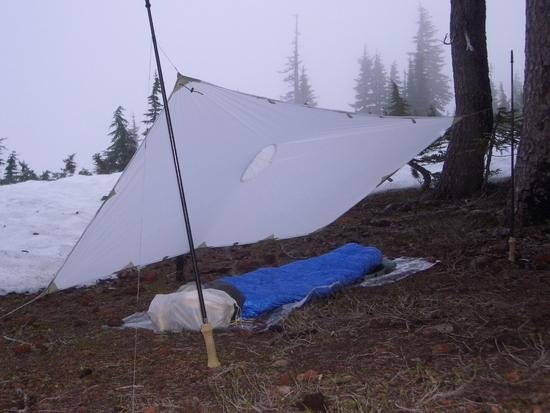
please look over these pics and critique

Topic
Become a member to post in the forums.
please look over these pics and critique
I'm no expert, but it looks pretty tight. How well does it cover you?
Tom
Hi Tom
This is new for me. I think like I will have adequate coverage. I'm going to use a bivy with it, too.
Was playing in my backyard tonight.
For what it's worth, it looks good to me. Of course, I've never done the poncho/tarp thing myself exactly (got a Gatewood Cape instead), so take my opinion with a grain of salt ;)
Tom


That doesn't look bad, but I find that a poncho tarp is better set up in this fashion. This puts less tension on the hood area, which is the weak spot of the tarp. It's really easy to tension as well. Lots of ways to pitch a tarp though!
This is a BMW tarp, by the way.
dj
Hi Doug
That makes sense about the hood's weakness.
I will try the 'lean to' approach tomorrow.
I also highly recommend sealing the seams around the neck. This adds a lot of strength.
The lean-to is a good deal- especially if you can put the down side into the wind.
Have fun- poncho tarps are cool stuff!
Man, I have to ditch my tent and get a tarp. I've never tried one, but they do look like a lot of fun.
It IS fun David! So simple and minimal.
I especially love the ponchotarp/UL bivy combination in dodgy weather. Living in Washington, I HATE a tarp in heavy bug season, but other than that, they are sweet.
Yeah, yeah- I know there are bug options for tarps, but I just love a Tarptent during bug season.
Tarps are COOL.
Good point about bugs and wet conditions. Offset more bugs and wet with more protection…
[ more weight ]
//
Tarptent (Contrail) – more bugs – wetter
//
Poncho tarp with bivy – somewhere between
//
Poncho tarp – less bugs – dryer
//
[ less weight ]
I have the GoLite and I love it in wet weather. I don't, however, use it in place of a tent. I use it for a lunch stop shelter for two and for a cooking shelter in camp.
The lean-to was easier to set up than the A frame.
Also tried using the center and one end for the poles, and this made the front open part more taunt.


I think my next step is go into the "wild" with it.
Nice setup, I like to stake out the side middles as well, but I really like to use the modified lean-to set-up as well. I personally find the bivy a personal choice, 1/2 the time i go with it and the other 1/2 without, really depends on the situation. Anyways have fun!
Do you bring the map that shows all of those numerous guylines…lol
Hi John,
Unfortunately, a map will not do.
Only thing that works is praying!
: )
Doug:
What are you using for your drop cloth in that pic?
I set mine up in the half-pyramid shape, using a couple of trekking poles. I get easier access and better coverage on three sides. (But you need to make sure that the weather is coming from the covered side.)

Now that I look more closely, this is not my Golite poncho tarp, but rather a 6×10 homemade version. But the poncho tarp sets up well the same way.
ok so im confused on this set up thing….would a piece of tyvek work well enough under you if it started to rain pretty hard. i just don't understand how this is going to protect me like my rei quarterdome t1 tent. i want to lose the weight but i love the protection. HELP ME!
Here's the thing about poncho-tarps. You are providing very little protection for yourself, so you need to take advantage of all that mother nature provides. As far as locations to set it up, you need to be in relatively soft ground (which absorbs water) and be at a higher level than the surrounding terrain. That way, any rain water will drain AWAY from you. Don't ever take the nice little gully as your site, because that's right where the rainwater will flow. I've used ponchos for two years now, and won't go back to a tent. There's a feeling of achievement in taking a little scrap of silnylon and blocking the wind and rain so you can sleep tight all night. I gotta say, I always find a new way to set it up, and I'm always so proud of myself that it stays put throughout the night! Have fun!
Hi Brett; and Welcome!
Tyvek will work very well, provded two things don't happen:
1) you aren't camped in a site where water will pool (down bags don't float:) )
2) the open edges of the tarp aren't exposed to driving rain
There are lots of posts, and a great article or two on this site, some of which require you becoming a member – WELL worth the modest fee, by the way. Also, I highly recommend Ryan Jordan's book (available here, as well) and specifically the chapter on advanced tarp techniques.
Have fun, and report back with what you decide to do!
Todd
Hi Brett,
A tarp alone cannot give you the protection of a full tent. That is why many of us use a combination of tarp and bivy. With a bivy that is waterproof on the bottom but water resistant and breathable on the top with a tarp, you get full weather protection, good bag breathability, and really, really light weights.
You give something up (much nicer to lounge in a tent), and you gain something (much lighter, simple). A poncho tarp simplifies the system further by leaving the raingear at home.
I love tarps and I think they're really fun- but there are lots of ways to get out there and backpack!
Best, Doug
thanks guys, i will check out the book!
Is there a BEST way to set up a tarp? and for 1 person, what is the best size for the best protection against mother nature?
For a beginning tarper, I would highly recommend an 8×10-foot silnylon tarp, set up in a A-frame configuration. The Equinox tarp available from Campmor is not too expensive and makes a great starter tarp. With guy lines and stakes, the whole package comes in just over a pound. It provides plenty of shelter for 1-2 hikers and all their gear. The 8×10 has a huge "sweet spot" which allows for minor mistakes in setup or orientation.
For the A-frame, you'll need two trekking poles or two trees, two long guy lines (8-10 feet), four short guy lines (2-3 feet), and six good, solid stakes (MSR Groundhog or similar.) I prefer to use trekking poles because I can set up in more places, without worrying about finding two perfect trees. If you look at the photos at the very top of this thread, that's what an A-frame set up looks like. (Your tarp won't have the hood opening in the middle, so ignore that.)
The most important part of tarp camping is SITE SELECTION. You can't just plop down in any old spot — especially not one of those hard-packed, heavily used tent sites. A good tarp site is on loose duff or grass, in a flat area that is slightly higher than the surroundings. Take a good, hard look at your site — is there any chance that a hard thunderstorm will cause water to run through it? (Look for evidence that this has happened in the past.) If so, don't camp there. With a careful eye and some experience, it's easy to find a good tarp spot.
A gatewood cape is going to be about as good as it gets, but if you are set on a tarp and want more room build as below.
It works. Just one full width continuous piece of sil, spinnaker or cuben 5'x11' and an extra 6' long full width piece to make the beak. Seam the edges. Tuck 2' of it up to become a poncho, maybe more for you but I am tall. Add a 2'6" beak the entire width on one side. That can velcro under for poncho use. Can be glued with mcnett aquaseal or sewn and sealed.
That gives you more coverage over the door and becomes a half pyramid with a semi protected entry similar to a forrester. Held up with one trekking pole. The beak can be varied in pitch. Pitched low, perfect for nasty weather.
You end up with 3 sides closed and about 5' x 8'9 area. Big and roomy. Around a 4' peak depending on how its pitched.
A SMD 7 oz bug tent will fit right in. I would suggest building one with tyvek doors for a tarp like this.
Build a bivy with a cuben floor and a 1.25 oz tyvek top big enough to put you mat in, add 1 oz polycro ground sheet for about 7 oz and you are good to go.
Built out of 1.1 sil – 13-14 oz
Built out of cuben about 6-7 oz
Cuben version with a SMD bug tent or clone and bivy with ground sheet – 21 oz. Sil version +7 or 28oz
Seam the edges, tieouts, add the beak, add a hole for the hood if you want to use it as a poncho.
Here is a sketchup of it.
Become a member to post in the forums.
 New Gear with Aluula FabricsLighter, stronger, more abrasion-resistant, and highly water-resistant - explore ultralight backpacking gear made with ALUULA Graflyte fabrics. Engineered for exceptional strength, durability, and lightweight performance, ALUULA Graflyte helps reduce pack weight without sacrificing reliability, making it ideal for demanding backcountry adventures.
 © Beartooth Media Group Inc.
 Loading...