Topic

DWR Down: whats are folks thoughts now

  • This topic is empty.
Viewing 17 posts - 1 through 17 (of 17 total)
Stephen M BPL Member
PostedNov 1, 2014 at 6:49 am

Morning all,

Was down the pub last night and my buddy was saying he is going to purchase a new down parka and had I any recommendations, I told him he might want to consider one with DWR down.

I see a lot of folk on here and other sites calling DWR down the best thing since sliced bread and others not who are not pushed about it.

When it first came out I purchased a parka with it but ended up sending it back, now
I dont specifcially go out of may way to purchase DWR down items but if the item
is a good fit I will purchase it.

So whats the general consensus.

Bob Moulder BPL Member
PostedNov 1, 2014 at 7:13 am

I got one of the EB Downlight hooded jackets (w/Downtek) and it looks very good.

The shell material is more durable and has a stiffer hand than the Montbell stuff I am used to but I think it will work fine as my main winter parka down to about -15F. No field testing yet, of course.

However, I got the medium size and sent it back to exchange for a large. The medium fit fine over a fleece jacket, but in order for it to fit over all potential layers a large is necessary for me.

Ryan Smith BPL Member
PostedNov 1, 2014 at 7:31 am

My personal opinion is that it works, but not sure to what extent. I only really need it to fight prolonged humid conditions. I did take several plumes of DWR down and dunked them in the sink several times. They came out dry and puffy as normal. So I think it does work somewhat.

Ryan

Jesse Anderson BPL Member
PostedNov 1, 2014 at 7:40 am

My thoughts are that even if the DWR coating on the down washes off or wears out its not hurting anything in the mean time. All other things being equal I may as well purchase the item with the DWR down. For example I just bought a Marmot Lithium bag earlier this year. Every competitor's bag was non-DWR down and at a similar if not greater price. Why not buy the Marmot with DWR down for the same price?

It's getting to the point now where DWR down is so cheap I don't see a reason not to get it. Sure it's no replacement for synthetics in some environments but it does work better than standard down when its wet. It's not a make or break item for me but it certainly influences my decision if pricing is similar.

PostedNov 1, 2014 at 8:47 am

I'm with Jesse. Even if it helps 10% with moisture control and costs the same as non treated down then it is a win-win.

I have it in my Ghost Whisperer jacket and so far am impressed. So much so that I sold my two synthetic filled jackets.

PostedNov 1, 2014 at 9:20 am

I'm sold on the Hyperdry 850 in my Katabatic Palisade after getting to see the difference between how it and my (untreated)800 fill Marmot bags handle challenging conditions, and think it definitely keeps the down from absorbing moisture.
You don't necessarily see evidence of moisture in a bag when you stuff it. Unpacking it the next day tells the story, though. When you remove the compressed bag from the stuff sack, it can be damp to the touch, and slow to loft.
This is something I've seen several times with my Marmot Arete and Pinnacle, from humidity, condensation, and breathing into the bag.
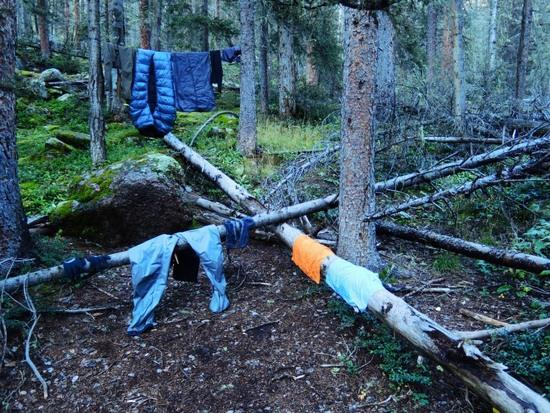
None of that with the Palisade, even after being put away damp 2 days in a row. I hung it the following evenings after unpacking. It lofted normally, and both times the shell dried quickly, seemingly within minutes.
The first of those 2 nights, I spent 14hrs basically inside a rainstorm at ~11,500', and had the worst condensation I've ever seen. The underside of the TT Notch fly I used for shelter(with Zpacks Solo floor, no inner) was soaked, and the rain hitting the outside had it continuously spraying the inside. Also sprung a leak somewhere on the top seam, and had water dripping directly on me.
It rained all night the next night, too, but at least I was at lower elevation, instead of in a cloud. Putting my rain jacket and softshell both on top of the Palisade helped, but even my sleeping pad was wet and got hung up to dry along with the quilt.

Pic from my TR:
cbten

http://www.backpackinglight.com/cgi-bin/backpackinglight/forums/thread_display.html?forum_thread_id=95583
I was using an OR waterproof pack liner, plus a Granite Gear eVent drybag for the quilt, so it wasn't getting wet in the creek crossings, even when they were higher than the bottom of the pack…

PostedNov 1, 2014 at 9:22 am

How do we know it can't hurt?
what if it shortens the life of the down?
its not like it's been tested for 20 years.
billy

PostedNov 1, 2014 at 9:25 am

Yes Ryan, it does seem to boost actual temporary exposure to water. Those more critical of down dwr, i think, question it's effectiveness in providing much, if any help, to prolonged atmospheric humidity because a DWR coating cannot completely prevent moisture regain which by itself could collapse the down somewhat.

It may be that stripping out the natural oils of down, may even worsen that issue because those natural oils are more permeating by nature than the man made DWR's which just coat the very surface. Hence, with less innate natural dwr oils inside, it may absorb more moisture than it would normally and thus take longer to dry out.

This is only a very tentative hypothesis. I would like to see more research in this area.

Edit to add, Owen's experiences seem to speak against the above.

PostedNov 1, 2014 at 9:41 am

Interesting. Well I am not sure the "natural oils" on the down of my Feathered Friends bag has ever helped with keeping moisture out of the down. That is, it's effect is zero.

PostedNov 1, 2014 at 10:17 am

Eddie Bauer says from their tests Down Tek is the best DWR available. I'll take that as the ONLY professional word (so far) on the subject of testing down DWRs and base my future purchases on it. LL Bean also uses Down Tek.

BTW, I say this because I know EB has a professional mountaineering test staff. Also I'm a fan of their design and quality.

Bob Moulder BPL Member
PostedNov 1, 2014 at 10:33 am

>>>How do we know it can't hurt?
what if it shortens the life of the down?
its not like it's been tested for 20 years.
billy

We don't, but waiting 20 years to find out isn't a good option.

I imagine that EB and LLB have the testing resources to cycle washing, compression, etc to simulate aging effects. With their warranties the last thing they want to see is a lot of returns. Of course, the average person will not put them through the wringer like some folks here…

PostedNov 1, 2014 at 11:01 am

Well, I guess it is rather personal and I am not necessary against it, but the downgear I have is of the non-hydrophobic type and has never let me down (well, perhaps one time a bit, but this were testconditions and I was pushing some stuff to their limit so kind of unfair to that stuff). Unless I meet conditions regularly where untreated down fails (and yes, I live in a humid climate), having treated down is rather low on my need to have list for future gear.
Further, I'd like to see enough independant research and relevant experience that shows such treatments have no negative side-effects (and no, claims from manufacturers that showed a certain treatment came out as the best, are pretty funny as their choice (from the different treatments) shows always as the best in tests … miraculously).

PostedNov 1, 2014 at 5:07 pm

They say a 4WD only means you get stuck in worse places. I wonder whether DWR will lead folks to push down beyond its intended use with worse consequences.

One potential positive, and this is admittedly speculation on my part, is that it may obviate the need for a vapor barrier on cold weather bags. Anyone have any knowledge on the point?

Jim Colten BPL Member
PostedNov 2, 2014 at 5:43 am

One potential positive, and this is admittedly speculation on my part, is that it may obviate the need for a vapor barrier on cold weather bags.

I don't think so … it's a Scotty thing (Star Trek allusion there)

While treatment may well prevent or at least limit the down absorbing water it will not prevent it condensing at the dew point and freezing at 32F/0C. That won't be a severe problem for a night or two but you'll want to avoid it for anything longer.

An extreme example of that … The 1986 North Pole Expedition's synthetic insulation sleeping bags acquired about 40 pounds of condensed/frozen water vapor over 56 days. The experience led Steger to use vapor barrier liners on subsequent far north (and south) expeditions.

edit: clarification and typos(s)

PostedNov 2, 2014 at 8:11 am

"Interesting. Well I am not sure the "natural oils" on the down of my Feathered Friends bag has ever helped with keeping moisture out of the down. That is, it's effect is zero."

In higher quality goose down, a lot of the oils are washed off. You may want to test this with lower fill quality, cheap, Chinese duck down that isn't as thoroughly washed and still has more of the oils. This stuff will have a stronger smell. Think Walmart Ozark duck down sleeping bag.

I liken it to wool and history of it some. Some of my ancestors, to whom i bear the most resemblance, were the Scottish Highlanders. Their wool was rather different than our modern wool in some ways. Besides tending to be courser, it also tended to have a lot more of the natural oils in same–particularly lanolin. It was noticeably "greasier" wool.

Well, in their damp to wet, cool to cold climate, having this greasy wool was a real benefit, and was one of the primary material means of their survival in this harsh environment. I'd make a wager that naturally greasy wool, would probably dry out faster than modern wool with very little oil in it, but say has a human made DWR coating on the surface.

Most everyone knows that oil and water don't mix well in their normal forms. If a certain amount of the protein structure is actually permeated with oil(s), then it makes sense that not as much water could be absorbed into it at the same time. Problem is, with animals, their bio systems "update" the amounts and levels of oils needed for this effect, but when we use their wool, fur, or feathers/down, it eventually strips out and also becomes rancid.

To some extent, human made DWR's is trying to copy what nature does already, but as far as i know, most if not all human made DWR's, only coat the outer layer/surface of whatever fiber they are put on.

Ironically, some of the synthetic fibers are good at absorbing oils, particularly polypropylene, but are the same ones that need this least or not at all. In their case, it's bad because it contributes to smell and odor buildup and/or can negatively impact a human made DWR (not that PP needs this, it doesn't).

Ken Thompson BPL Member
PostedNov 2, 2014 at 8:25 am

My thought. Not needed. I agree with Western Mountaineering the the advances will be in shell fabrics that better protect the insulation whether it is down or synthetic.

We always think we can improve upon nature. Usually not.

Stephen M BPL Member
PostedNov 2, 2014 at 10:13 am

Hi folks,

Thanks all for the replies, I will pass this great wealth of information on to my buddy.

Cheers,

Stephen

Viewing 17 posts - 1 through 17 (of 17 total)
Loading...