This is a list for a pack that should contain everything needed for up to 7 days of hiking in the southeastern US during any season and any weather conditions. The pack should handle hikes both through populated areas (e.g., beside highways) and designated hiking/wilderness areas (e.g., the AT or national forest). At the extremes, this pack should handle 10 hour hikes freezing rain (rain during temps above freezing but below 40) ice and snow, as well as full sun in temps up to 115F. It is important to note that this list assumes access to clean water will be unreliable or non-existent; instead, water sources are assumed to be generally muddy, polluted, and undrinkable without treatment.
PACKING & NAVIGATION
This section includes gear for packing and carrying gear.
50-65 liter hiking pack under 3lbs w/ compression straps
http://www.amazon.com/Granite-Gear-Blaze-AC-Backpack/dp/B004W1YY00
The weight of an empty pack is very important. A pack weighing more than 3 pounds is too heavy, and anything larger than a 3500 to 3900 cu in (~65 liters) unnecessary. Everything should fit inside the pack with the exception of maybe a sleeping pad, rolled tightly under the pack lid. Compression straps and waist pouches center the pack's weight along the spine and on the hips, where the bulk of the weight belongs due to the large muscle groups residing in these areas. 50 liters is the minimum for thru-hikes, but more is needed in winter. Picking a pack for the right torso length is critical for properly distributing weight. Find a flexible tape measure and measure the distance between the C7 vertebra (the most noticeable protrusion of the upper spine) and the rear "shelf" of the hips. According to REI, Medium/Regular packs fits torsos 18" to 19½".
Kitchen garbage bags
Please do not be tempted to purchase a water-proof pack, water-resistant pack, pack cover, or rain cover; instead, stuff everything inside garbage bags and pack with them. Despite adverts to the contrary, backpacks are never waterproof (due to seams and zippers) and pack covers such as ponchos blow off in the wind. Garbage bags also act as effective ground sheets to stand on while changing clothes, packing, eating, and anything else that can't or shouldn't be done in a bivy sack or tent. Garbage bags are good for stringing clothes, food, and other gear up in the trees at night for safety from roaming beasties. Finally, when cut down to size, garbage bags can be worn between liner socks and hiker socks during rain to keep feet dry.
Ziploc sandwich bags
Anything that's too small for a garbage bag goes in these. Food, fire starter, toothbrush, maps, wallet, etc. all go in here.
National Geographic Topo! Software
http://www.topoware.com/nationalgeographic/index.htm
In the wilderness, a few dozen feet can mean the difference between food and going hungry and/or water and going thirsty… which can get ugly fast in the summer heat. Accurate navigation in the wild must be facilitated by judging elevation and tracking the location of landmarks like streams. Highways, railroads, and power lines serve the same purpose closer to civilization. All of this requires and accurate topographical map, a compass, and (ideally) prior knowledge of the route. Printed topo maps are high resolution but expensive due to the large number required for mapping hiking routes. Online versions are low-resolution and difficult or impossible to print. By contrast, software versions support drawing routes, calculating elevation profiles, adding notes, and printing copies. In short: they can be customized to the exact scope of the planned trip. Unlike smart phones (which require heavy, bulky solar chargers that need hours of sun bathing), printed maps will always work.
Base-plate Compass
http://www.amazon.com/Suunto-SS012063013-A-10-Compass/dp/B000FEXZGW
Good compasses have rulers (in inches and centimeters) etched into the "straight edges" of the plate. These are helpful when measuring distances on a map. More expensive compasses usually complicate things. Compasses should also have a nonmagnetic directional arrow that helps orient the compass to the map.
The essential function of a compass is to take, plot, follow, and measure a "bearing". A bearing (or "azimuth") refers to the direction of travel to be followed to arrive at a destination. A compass' bezel measures the direction towards a given object in terms of the clockwise angle between a straight line pointing due north and a straight line pointing toward the object. Thus, the angle of any specific direction can be expressed as a number between 0° and 360°, depending on how far away the direction is in a clockwise rotation from the north. Once the current location is known on the map, the compass can be used to take a bearing on an unseen target elsewhere on the map. Detailed instructions should come with the compass but are also online: http://ns.suunto.com/Manuals/A-30/Userguides/SUUNTO_BASEPLATECOMPASSES_UG_EN.pdf.
First aid medical kit
http://www.amazon.com/Ultralight-and-Watertight-Medical-Kit/dp/B00BAV6C5U
Everything together should weigh no more than 5 ounces. To plan for every possible emergency, one would need to bring an entire emergency room. Knowledge is the most important thing to carry, so learn how to use the kit and the surroundings. Pre-assembled first-aid kits take the guesswork out of building one, though many people personalize these kits to suit individual needs. The medkit should include:
– A few Band-Aids in various sizes
– 2 to 4 butterfly bandages or Steri-strips
– 4-6 ibuprofen
– 2-4 Immodium
– 2 3×3 or 4×4 gauze pads
– moleskin
– medical tape
Do not bother with "snake bite" kits that claim to draw venom. They do not. The only treatment for snake bites is antivenom, but the best treatment is prevention. Walk with care in the underbrush and wear nylon gaiters with long nylon pants.
Emprizone
This is a Mannatech product which dramatically accelerates the healing of wounds such as blisters. It is light and effective.
Pea-/tongue-less emergency whistle
http://www.amazon.com/Ultimate-Survival-Technologies-JetScream-Whistle/dp/B007FUZ2W4
Tongueless whistles never rust or freeze up. Do not get a cheap one as they are not loud enough to be of any value.
Umbrella
http://www.amazon.com/Campmor-euroSCHIRM-Birdiepal-Outdoor-Umbrella/dp/B003LXW3R6
Umbrellas stop rain in the winter and sun in the summer. The winter umbrella provides great value by dramatically boosting the effectiveness and lifespan of other waterproofing gear while keeping warmth-draining precipitation from direct contact with the body. The value of an umbrella in the *summer* cannot be overrated, however. Murderous rays which would otherwise wither the hapless hiker will bounce harmlessly off an umbrella while allowing precious breeze to pass through below. Thus, unlike hats, umbrellas block the sun while also allowing heat to escape from the head. Nothing – *nothing* – can survive in the sun for long without shade, and that is an umbrella. Rain in the summer would simply cook someone wearing a rain jacket, but the umbrella sheds moisture while still venting heat. In both summer and winter, the umbrella is the only piece of gear "agile" enough to deal with light, intermittent rain storms. In short: nothing can compare to the versatility of the humble umbrella.
SUMMER CLOTHES
During summer, clothes protect against insects (including ants, mosquitoes, ticks, and chiggers), rain, sun, poisonous plants, snakes, and the unrelenting shock of Mother Nature's rock-hard hide on feet, ankles, calves, and hips.
Lightweight trail sneakers with synthetic, breathable mesh upper
http://www.zappos.com/new-balance-mo790-black-red
Keep away from loud colors. It's more important to dry fast than keep out water. Weight on the feet weighs much more than any other piece of hiking gear. Shoes must breathe well to control heat during long, summer hikes. Feet swell during a hike, so go larger rather than smaller in size. A good wool sock and a light, breathable shoe can dry out in thirty minutes to an hour. "Water-Proof / Breathable" (WP/B) shoes will
eventually get wet inside no matter what. Once wet, they will take forever to dry out because the water is trapped behind the WPB membrane.
Low-cut nylon gaiters
http://www.amazon.com/Outdoor-Research-Bug-Out-Gaiters/dp/B009Q19AZA
Gaiters are not optional. They are essential to protect against ticks and mites which can carry serious diseases. They also provide an extra layer of protection against snake bites, which are usually directed toward the ankles or lower calf. Avoid extremely high-cut gaiters since long hikes will require airflow.
Breathable, quick-drying liner socks w/ 0% cotton (x4)
http://www.amazon.com/Fox-River-CoolMax-9-11-5-10-12-5/dp/B000G7XWZC
Liner socks are a thin sock worn inside other socks (usually). Until the afternoon, there will be patches of wet grass which will soak through shoes and socks. Though it isn't possible to stay dry all the time, carrying extra
socks to change into will keep feet dry most of the time. Rotate into dry pairs of socks every few hours and hang wet socks from the pack to dry out. Wet feet with the attendant blisters are a major show-stopper when it comes to moving forward for hours upon hours with a pack.
Quick-drying, breathable polyester underwear
http://www.amazon.com/gp/product/B001M0MN16
Quick-drying swim shorts
http://www.amazon.com/Columbia-Whidbey-Hybrid-Water-Short/dp/B006WHJPEW
Wear these to bed to keep cool in sweltering summer nights. Swim when possible to stay clean (and cool).
Loose, nylon fishing shirt w/ roll-up sleeves
http://www.amazon.com/Columbia-Bahama-Sleeve-Shirt-XX-Large/dp/B00DNNOPKM
Roll the sleeves down for bug protection. Roll them up to keep cool.
Permethrin
http://www.amazon.com/gp/product/B001ANQVZE
Longer-lasting, equally effective, and less hazardous to health than DEET, permethrin is essential for deterring pests such as ticks. Make sure every inch of clothing is fully sealed with this stuff per the manufacturer instructions. This includes shoes, gaiters, socks (outside), hat, shirt, and pants.
Lightweight nylon pants
http://www.amazon.com/gp/product/B001VIQ7LG
Don't worry about the convertable variety. It will rarely or never be desirable to expose the lower legs.
Mosquito head net
http://www.amazon.com/gp/product/B003F5WGNG
No amount of DEET will protect the face from flying pests as effectively as a $5 head net. Avoid no-see-um nets as they are too stuffy to breathe or see through well.
Nylon boonie hat
http://www.amazon.com/Outdoor-Research-Sombriolet-Sun-Hat/dp/B003S3RFNQ
As always, do not buy cotton here. It's hot and heavy. Boonie hats are incredibly versitile. In the bush, a boonie will protect the head from invasion by branch-born ticks, mites, spiders, and God-knows-what-else. Out of the bush, they fold up and fit in a pocket, unlike visors and baseball caps. They also make handy seat pads to avoid the inevitable insect invasion resulting from making rear-end contact with the earth.
WINTER CLOTHES
Don't discount the danger of 30 degrees Fahrenheit with rain. This is the most miserable and probably dangerous weather you can hike in. For proof, read this: http://www.backpackinglight.com/cgi-bin/backpackinglight/ihike_hypothermia.html. Make sure to have a proper rain jacket and make sure to have dry insulating materials. Due to internal body heat generated by exertion, insulation while hiking can be kept minimal so l ong as there is a good shell to keep dry in. In *camp*, body heat is low, so it's essential to have warm, dry insulating layers to sleep in. The upshot is that clothing should be kept comparatively light during the day while insulating layers are kept dry in the pack until camp is pitched. If conditions become so bad that moving forward is not producing enough body heat alone, pitch shelter and bundle up. Do not become so cold that zippers and guy line can no longer be manipulated.
Moisture-wicking polyester quarter-zip shirt
http://www.amazon.com/Under-Armour-Mens-Tech-bc/dp/B00DQG1R02
The main functions of this top are to 1) wick sweat away from the body and 2) layer with long underwear at night. Tight-fitting crew tops will not layer with long underwear at night as well as quarter-zip pullovers, but looser-fitting full zip shirts will not wick moisture as well. Quarter-zip shirts strike a nice balance, providing the best versatility among the base-layer options.
Expedition weight thermal crew top & bottom
http://www.amazon.com/Duofold-Expedition-Two-Layer-Thermal-Tagless/dp/B0019RRZTW
http://www.amazon.com/Duofold-Mens-Expedition-Weight-Bottom/dp/B006SRSYFM
Since a full-blown winter coat is too bulky for backpacking, a solid base layer is critical. Keep these heavy base layers dry during the hike at all costs, then bundle up at night when internal and external temperatures can drop precipitously.
Merino wool hiker socks
http://www.amazon.com/Minus33-Merino-Wool-Hiker-Sock/dp/B00FLRL5QK
Combine these with the liner socks mentioned in the Summer Clothes section for complete protection. Bring an extra pair of dry ones to sleep in after it rains. During the rain, wool will retain heat better than cotton. Waterproof socks are heavier and don't provide enough benefit while neoprene are designed for constant submersion in streams rather than periodic drenching in rain or snow. Keep moving during the day, keep dry at night, and hypothermia and blisters should not be a problem. To always have dry socks, pack one or two extra pairs in ziploc and/or garbage bags.
Fleece hat
http://www.amazon.com/Carhartt-Mens-Fleece-Headwear-Moss/dp/B005441LSC
It's been said that a fleece hat or balaclava provides more warmth for weight than any other clothing article. This is because 15% of all body heat is lost through the head, making it inch-for-inch arguably the single fastest way to lose heat.
Lightweight, compressible down hoody
http://www.amazon.com/Outdoor-Research-Transcendent-Hoody-Medium/dp/B003XMOOVI
Hoodies protect against wind better than non-hooded jackets can. Down jackets provide superior warmth to fleece so long as they are kept dry, so it's important to pair them with a solid rain jacket. At night, the extra warmth will be essential when internal heat drops during sleep.
Waterproof / breathable packable hardshell rain jacket
http://www.amazon.com/Marmot-Precip-Jacket-Black-Large/dp/B004J23KXY
In a sustained downpour, nothing can replace a rain jacket; however, heavy rubber rain jackets are far to heavy, bulky, and stuffy for backpacking. Although all rain jackets will trap perspiration, being damp and warm is better to being wet and cold, especially in good winds. Get a high quality "waterproof / breathable" (WP/B) jacket that's lightweight and can pack down to "pocket" size. Avoid thin varieties (such as FroggTogg or Dri Duk) in favor of the thicker and tougher variety (e.g., Marmot, Columbia, or ExOfficio). Get one with a storm hood, if at all possible, as enormous amounts of heat are lost through the head. Keep in mind, all rain jackets require periodic treatment with rainproofing spray or wash.
Waterproof / breathable nylon shell pants
http://www.amazon.com/Columbia-Ridge-Black-Medium-Regular/dp/B00AAGIO4I
It's important to get shell pants with belt loops. Varieties with elastic or a draw cord will not stay up. The pants should use waterproof-breathable nylon fabric to be tough and light. The "shell" variety come without insulation. This allows proper layering for many different temperatures and it keeps them lighter.
Waterproof modular mitt w/ removable glove liners
http://www.amazon.com/Outdoor-Research-Classic-Modular-Mitts/dp/B00AMQ12ZY
A modular mitt can handle both wet and cold conditions while remaining breathable during dry conditions when waterproofing isn't needed.
CAMPING
In this section are listed those items which are used to establish a place to sleep and recover. This doesn't include food and water, but it does include sleeping gear, a shelter, and some similar odds-and-ends. When choosing a campsite, arrange things so that it is about 100ft away from 1) the road, 2) food, 3) water sources, and 4) waste. Each of these locations should ideally be over 100ft away from each other as well, so a full campsite can cover quite a lot of ground.
Camping quilt under 3lbs
http://www.amazon.com/gp/product/B00B2LYXUY
Versatility is the primary reason to choose a quilt over a traditional style bag with a zipper. This is extremely important in a climate where temperatures can vary from the 20s to 115 degrees fahrenheit. Quilts are also lighter and more compressible. Combine with thermal underwear and a hoodie for winter nights and strip down to swimming shorts during muggy summer ones.
Lightweight bug-bivy w/ waterproof bottom
http://www.amazon.com/Outdoor-Research-Bivy-Black-Size/dp/B0001VQLMY
Bug bivies keep insects off while remaining cool and breathable. This keeps them cool on summer nights (beef up on base layer clothing in winter) and allows respiration to escape.
Lightweight hammock rain fly/tarp
https://www.amazon.com/dp/B009R9FUI2
Hammock tarps can be used for ground-based shelters. Get one with guy lines sewn-in or else buy cordage separate and tie them on with bowline knots. Once on, don't worry about taking them off, just secure the ends to stakes. Tarps designed with fewer tie-downs will be simpler to set up than hex tarps with lots of extra cordage to manage. Finding one with stakes included is a handy bonus.
Lightweight Foam Sleeping Pad
http://www.amazon.com/Therm–Z-Lite-Sleeping-Regular-Coyote/dp/B00453NA1E
Inflatable pads are heavy and easily punctured. Cut a full-length foam pad to make a torso-length one that will be more compact and lightweight. A pad is needed to insulate the bivy from the cold, wet ground in winter. Otherwise, the bare ground acts as a thermal conductor which sucks the heat from the body during sleep.
Earplugs (Noise Reduction Rating 32+)
http://www.amazon.com/Hearos-Ultimate-Softness-Plugs-20-Pairs/dp/B0002CZYRA
The woods are deafening in the summer. Get to sleep early despite the relentless roar of the insects so as to put in some early-morning hiking before the sun starts burning.
LED headlamp
http://www.amazon.com/Energizer-Finder-Headlamp-Batteries-Included/dp/B002MFK7H2
Flashlights take up a free hand, headlamps do not, and a headlamp can be used for hiking before and after dawn. Hiking before dawn in the summer is ideal as temps can climb above 100 in the afternoon. To make 25+ miles / 10+ hours per day, a significant portion of the daily hike will need to be done before noon.
Duck tape
This is the universal fix-it product. To save weight, it can be wrapped around a water bottle or trekking poles. It can be used to repair tents, packs, boots, shoes, clothes, rain gear, and everything in between and beyond.
FOOD & WATER
Gluten-free grains
http://www.care2.com/greenliving/eleven-gluten-free-grains.html?page=1
Gluten-free grains like amaranth, quinoa, and millet are easier to digest than their glutenous brethren but are still easy to pack and cook on the trail. They also pack some fiber into the diet while providing quick energy from the starch content.
Coconut oil
http://www.amazon.com/Nutiva-Certified-Organic-Virgin-Coconut/dp/B00BAHA4R6/
Oils & fats pack more calories for their weight than any other food source. Coconut oil keeps well in the heat, unlike other plant-based oils which go rancid quickly. Alternatives such as butter or ghee are typically more expensive, though they work just as well. Coconut oil contains medium-chain fatty acids which are absorbed directly into the blood for energy from the small intestine instead of going through an energy-intensive digestion process associated with long-chain fatty acid found in other plant oils.
Protein powder
http://www.amazon.com/Now-Foods-Pea-Protein-Pound/dp/B001DB4MFO/
Protein powder doesn't need refrigeration or cooking, so stock up! The "holy trinity" of vegetable-based proteins are rice, pea, and hemp protein (spirulina is good, but gross). Non-vegan proteins such as whey are also good, but can be more expensive.
Magnesium fire starter & denatured alcohol
http://www.amazon.com/PACK-Magnesium-Fire-Starter-Survivalist/dp/B00M9UOZO6
More reliable in wet weather and longer-lasting than matches, fire starters are perfect for lighting small alcohol stoves whose fuel ignites easily in contact with sparks.
DIY backpacking cat tin alcohol stove
http://andrewskurka.com/2011/how-to-make-a-fancy-feast-alcohol-stove/
Matches and alcohol are extremely easy fuels to acquire (unlike specialized solid fuel tabs or liquid-fuel canisters) and carry (unlike wood). The alcohol can be a useful part of a medkit as well while the stove itself (a.k.a., the tin) is ridiculously light, durable, cheap, and easy to make. Use it to make tea, boil water, or start a campfire. Remember that hardened fats will become rock-hard in winter and will need to be warmed-up before heating.
Folding titanium spoon
http://www.amazon.com/TOAKS-Titanium-Folding-Spoon/dp/B00GLFVZVG/
This is for fuleing up on nuts, seeds, oil and protein powder.
Lightweight, gravity-based, & collapsible water filter kit (4 liters)
http://www.amazon.com/Platypus-07014-GravityWorks-Filter/dp/B00453R308
Water in the south is always muddy and often packed with agricultural runoff, trash, or worse things. Chlorine dioxide or other chemical treatments will only handle microbial plagues, so filtration is also necessary. Collapsible, gravity fed filter kits are lightweight and work at night. Combined with chemical treatment and some kind of water source, these systems can provide a steady supply of "blue gold". 4 liters should be sufficient for 1 day of hiking in summer for most people, but to calculate water requirements exactly, hike an hour or so of the planned route in the hottest part of the day and track how many ounces of water are consumed per mile.
Electrolytes
http://www.amazon.com/gp/product/B00EISFBYA
Hiking in summer requires a tremendous amount of water, but as it leaves the body, electrolytes are lost with it. These need to be replaced to maintain performance.
Titanium cup w/ folding handles
http://www.amazon.com/gp/aw/d/B008NOYQ6E
This is to mix oil with nuts, seeds, and powders at mealtime (which should be taken away from the sleeping area). Titanium is lighter and more resistant to corrosion than steel but can still take hot liquids (unlike plastic) and wont't retain food smells (like silicone). When other water treatment fails, this can be used with a campfire to boil water either for drinking or for making tea with medicinal herbs. Finally, during winter this can be used to "thaw" hardened blocks of fat to fuel up on.
Hygiene
Cleanliness combats parasitic insects and disease. Hygiene consists of rinsing dishes (spoon & cup), using bath wipes (removing ticks in the process), washing clothes, and never letting anything food-related come in contact with anything bath-related. As with food, anything and everything which might conceivably emit smells (e.g., scented soap) should be left at home.
Homemade bath / baby wipes
http://wantingwhatyouhave.com/2010/03/frugal-strategy-4-make-your-own-baby.html
Showers don't exist in the wilderness, and even bucket-based sponge baths take 10 – 12 liters of water (which is more than can be reasonably filtered of mud, disease, and toxicity). Bath wipes are faster, more portable, and take less body heat than sponge baths. They can be made quite easily and cheaply, and the benefits are tremendous. There are any number of guides online.
Toothbrush & comb
Snap these in half to make it fit the pack better, if that helps.
Small bottle of unscented Bronner's soap mixed with peroxide
Peroxide and soap makes a magical combination for cleaning and disinfecting hair of whatever evils lurk therein. If Bronner's is used, this mix can also be used for brushing teeth.
Folding camp bucket
Although bath wipes are effective for the rest of the body, water is required for cleaning hair, yet without cleaning the stuff, hair mites will proliferate in epic swarms. Bring along a folding bucket to get water from streams for fending off the hordes because washing in the stream itself both pollutes it and increases the chances of picking-up something nasty in it.
Quick drying travel towel
http://www.amazon.com/Sea-to-Summit-DryLite-Towel/dp/B000OPPAQK
Dry off hair with this after rinsing, then strap it to the pack for drying. Be sure to get a decent size as travel towels can scale from simple face-cloth-sized varieties (not what we're looking-for) to full and proper bath towels. The latter is wanted here.
Silicone cup
http://www.amazon.com/Sea-Summit-X-Mug-Orange/dp/B001Q3KLU4
Mix soap and peroxide with water in this to dispense upon the hair, after which, take water from the bucket and pour through hair away from the aforementioned buck in order to keep the rinse-water clean. Under no circumstances shall this cup be used for eating or drinking.
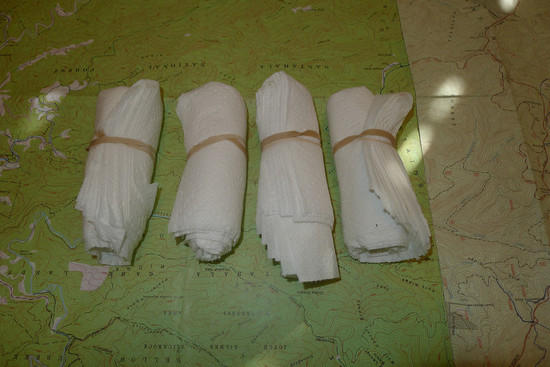
Folding trowel and toilet paper
http://www.amazon.com/gp/product/B0013KTADE
Bury waste well away from the campsite to hide it from scent and sight. Anything which would be attracted by this should do so well away from camp.