


My experience is your Soto does not make use of the Olicamp Pot.
I Double-Dog-Dare you to test a pocket rocket against your Soto.
Topic
Become a member to post in the forums.
 .
.
My experience is your Soto does not make use of the Olicamp Pot.
I Double-Dog-Dare you to test a pocket rocket against your Soto.
Brad, I think you have a protocol issue here. To go straight to the Double-Dog-Dare without first proclaiming the Dare and the Double Dare is a serious breach of accepted practice.

Tell 'em Paul. No need to get aggressive and go straight to a double dog dare like that.
Paul, sometimes drastic issues require drastic measures :)
Which have a beveled angle to the burner jets would seem to position the flame up and outward for a finned HE pot..
It seems to have worked with a few of the Gigapower/Sol hack projects.
Doesnt running a cannister stove on inverted liquid feed mode increase the fuel consumption
No, not necessarily. You just need to adjust the valve such that the flame size is the same as you usually use. If you’ve got about the same flame size, then your fuel consumption should be roughly the same whether you run inverted or upright.
The techs at MSR led me to believe that running on inverted mode automatically increased fuel consumption.
Maybe it varies according to each stove design?
If you don’t adjust the valve, then I suppose that your fuel consumption would indeed increase. It makes sense that more fuel in terms of number molecules would be passed through a given valve setting when in liquid form than in gas form. Liquids are more dense than gasses after all.
But I wouldn’t typically just invert and not touch the stove. Normally, I’d want to adjust the valve setting after inverting. If you adjust after inversion, your fuel consumption shouldn’t significantly change.
And since MSR sells fuel cannisters,
I should not be surprised they did not share any fuel conservation tips…;)
Like Jetboil, they are all about speed.
Burn ,baby,burn…..lol
> The techs at MSR led me to believe that running
> on inverted mode automatically increased fuel consumption.
Oh Dear.
This means the techs at MSR (well, the ones you spoke to) are completely ignorant cretins – how unfortunate. As Jim wrote, fuel consumption is controlled by flame size, and NOTHING else. YOU get to control the flame size.
Poor MSR.
Cheers
"As Jim wrote, fuel consumption is controlled by flame size, and NOTHING else."
… and not also the amount of airflow on the intake?
–B.G.–

Just wanted to add, it looks like the JB Flash Lite is the “new Al Sol”. They more or less just renamed it. 11oz.
Also, way back when I started this thread I bought a Sol Al. It has worked fine. :)
“As Jim wrote, fuel consumption is controlled by flame size, and NOTHING else.”
… and not also the amount of airflow on the intake?
That is basically correct. Airflow does not alter tha amount of fuel coming out of the jet.
cheers
Generally, Roger is correct. Most stoves simply overport so extra air is simply passed through the burning fuel. It can quench the flame a bit at below the HIGH setting (where the manufacturors usually set the port size to.) So, if you burn on medium or low, then there is actually too much air and the extra air will quench the flame temps. Also, on very low fuel settings, it can lead to not drawing enough air and yellow or orange flames with soot…and very low temperature.
Quenching is normally a simple proportion of the amount of cool, unburned air in the flame, and, the temperature of the air and flame. It can also increase the volume of air going through the jets, causing flapping and lifting of the flame, and, also cooling the exhaust gasses by simply overwhelming the gasses with cooler outside air as it rises away from the heat (and drawing more cooler air from outside the flame into the process.) So, too much air can be bad in a few ways. A simple fix is to simply add a small aluminum foil notched “ring” around the jets to allow proper adjustment.
But, to adjust the air input to match the fuel input will only save about 10% of the heat generated by the fuel. And, it is a tricky operation. Shutting down too much on the “normal” burners makes CO production go up, and, wasting fuel with a cooler less efficient flame. So, generally I don’t recommend doing it, especially if you cook near your tent or under a tarp. Just remember your 5th grade science lesson on adjusting a Bunsen Burner, it isn’t a difficult thing to master.
Some of the older “roarer” burners rely on the outside air to burn cleanly. The FMT-300, MSR Dragonfly and XGK, SVEA, Primus Multi Fuel, etc all have fixed external air intakes usually governed by the amount of fuel as it burns. There is normally quite a bit of flame lift off the jets. These tend to be more efficient at medium and low settings but can start burning raggedly at high settings and not working at all on very low settings…a bit different than the premixed burners commonly used by most packers.
Become a member to post in the forums.
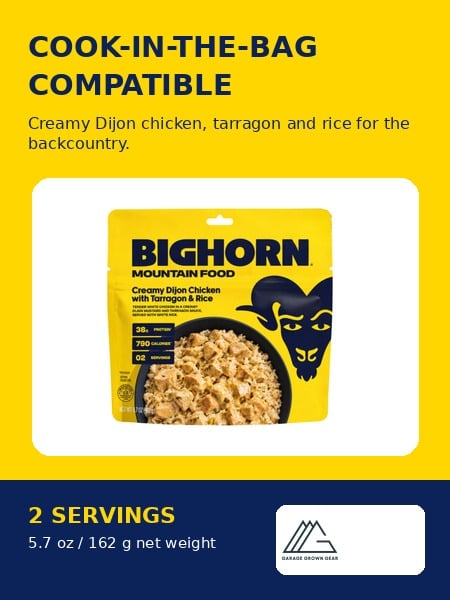 Creamy Dijon ChickenCook-in-the-bag chicken, tarragon, and rice backcountry meal with 2 servings. Net weight 5.7oz | 162g
 © Beartooth Media Group Inc.
 Loading...