


Has anyone here tried a beeswax candle as a stove? Beeswax has about the same kcals/gm as propane and I've seen these candles marketed for survival kits. Just curious.
-Mark
Topic
Become a member to post in the forums.
Has anyone here tried a beeswax candle as a stove? Beeswax has about the same kcals/gm as propane and I've seen these candles marketed for survival kits. Just curious.
-Mark
I tested such a candle in the CO series on solid fuels. Small flames compared to our typical stoves. Very low power, even with a couple of wicks. Figures.
Roger,
I wonder if one made a "Buddy Burner" with beeswax so that the whole surface of the candle was wick, if that might not work. Your mention of "a couple of wicks" reminded me that we made such a "stove" back when I was in Boy Scouts ( a very long time ago.)
You cut a strip of cardboard, coil it into a tuna can, and fill the can with wax. The cardboard is your wick.
Here is a picture from: http://zenstoves.net/Wax.htm
-Mark

Hi Mark
> I wonder if one made a "Buddy Burner" with beeswax so that the whole surface of the candle was wick,
Hum – maybe someone could try it out and let us know. I would be a bit concerned about how long the cardboard would last, but then, does it HAVE to last? This would be a one-shot candle after all.
What I did find was that the flame with a just couple of wicks was very smoky. With a coiled wick as you show I would expect a huge amount of soot as the flame would have a very poor air supply at the perimeter. This would imply a fairly inefficient use of the fuel.
The manufacturer of the 'candle' I have claims that it is useful as a source of illumination and heat in a tent in the snow. Hum … nothing magic though.
That is one of the things I intend to try with my Tri-Ti… actually with just one round of cardboard… that or a round of fiberglass candle wick.
Hi Mark & Roger,
Tried using one this past winter on a trek in VT, found it gave off a great deal of heat by using candle wax which lasted for about 2 1/2 hours before cardboard started to catch fire filling Hex with smoke & soot. Can was a 5oz cat food can with cardboard coiled and filled with melted wax. Would say there was enough of a flame to cook on but the catch would be the amount of time using before cardboard catches fire.
I'm guessing that the cardboard burned when the wax level got low enough that cardboard "dried out".
I'd be worth a try to bring a supply of small wax chunks that could be added as wax is consumed.
That's exactly what happened, placed additional wax into the can only to have area that ran out of wax start to catch fire was a bit of a chore to evenly disperse wax within the cardboard coil. Was using this more for a heat source then for cooking on a -15 degree trip. Seemed like a back up can would have been a better option, although more of a weight penalty.
Well, I'm intrigued with the potential if the wicking in the burner was set up to allow for air flow as Roger notes and the proper wicking material could be found. Maybe fiberglass would work per Joshua's suggestion and avoid Jim B.'s smoke and soot problem.
From zenstoves.com the fuel table at:
http://zenstoves.net/Fuels.htm
shows the following numbers in kcal/gm
Naphtha (stove fuel) =10.1
Gasoline = 10.4
Kerosene = 10.3
Propane = 11.0
Butane =10.8
Acetylene = 11.5
Ethanol = 6.4
Methanol = 4.7
Paraffin = 10.0
Beeswax = 11
Dry Wood = 3.89
Sun = 9×10^13
So beeswax ranks up there with propane, somewhere between gasoline and the sun, in terms of capacity. It's just getting at the capacity that is the problem.
Well time to get out the cardboard, tuna cans, and beeswax and start experimenting. Should be fun.
-Mark
Mark,
Think if using this again the construction of cardboard burning section might be built differently cutting cross sections opposed to coiling method, that way you could control the wax saturation level of cardboard by adding wax in a much more effective manner. Selection of wicking material is something to consider as well.
Let us know how this works out for you, the one I made last year at one point had the pack thermometer reading 45 degree at head level inside a tent on a -15 degree night, was pretty impressive.
Jim,
Thanks for the wick suggestion. I'll post my results, but it probably won't be until the weekend due to other commitments this week.
-Mark
Well here are the result of my experiments with candle stoves.
My purpose was to make a candle stove and then test its ability to boiling 2 cups of 60 degree F water.
I did two sets: one with paraffin and the other with beeswax as the fuel. The stove and wicks were the same design for all tests as were the general conditions. The altitude here is 750 ft. above sea level and the air temperature in my kitchen was 76 F. No wind. Evernew 1.3 liter pot and tap water cooled to exactly 60 F was used for all tests. Boiling was measured at 212 F by thermometer.
The stove was an aluminum juice can cut about 3/4 inch from the bottom to make a shallow cup. The wick design I settled on, after some experimentation, was made of corrugated cardboard cut in the shape of the letter "E" without the middle line and laid on it back (see photo). Two of these were made and crossed at right angles in the can bottom. Melted wax was poured into the stove covering the lower part of the wick and the stove was then weighed. The wicks were lit and the pot with water was place on a wire pot stand and timer started. When the water reached 212 F. the stove was extinguished and weighed.
Results:
Paraffin and beeswax averaged 16 minutes to boil.
The fastest boil time was 13 minutes.
There was no significant time difference between paraffin and beeswax.
Both waxes produced soot, but the paraffin stove was worse.
It took an average of 8 gm of paraffin and 6 gm of beeswax to reach boil.
Observations:
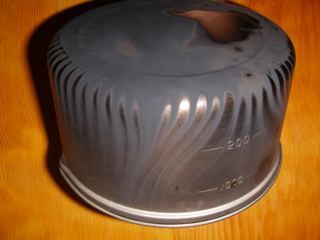
The wicks and placement worked well (thanks Jim B.). I initially used two straight pieces of cardboard in a "+" shape, but the center was very smoky, as Roger predicted, due to low oxygen availability. So I eliminated the middle of the "+" and got a better burn and less soot. Still there was a fair amount of soot on the pot (see photo). Also, the wicks get consumed in the burning process. I believe with this wick setup one could feed chips of wax to the stove to prevent this. I wasn't able to come up with any fiberglass wick so I only tried cardboard.
The soot is not overwhelming, but is a bother. It was easily wiped off with a wet paper towel but it would be easy to forget and end up with soot everywhere. On the other hand, folks burning wood have a similar problem.
I was hoping that the beeswax would be significantly better than paraffin, but it is only incrementally better. Slightly better efficiency and a little less soot. Whoopee!
Conclusion: The candle stove was slow to boil 2 cups of 60 F water, but required only 6 gm of beeswax to do it. (vs about 12+ gm of alcohol) Soot and time were the major drawbacks.
-Mark


Mark
Trying to come up with a "simmering" solution for my alcohol stoves, I found out that I could get a boil for 500ml of water with about 20g of alcohol and than I could keep the water simmering with just one standard 9 hour candle.
Because of the low heat and narrow flame I can put a cozy on top of the pot and have a hot meal after 20 minutes or so.
Franco
Hi Mark
> Well here are the result of my experiments with candle stoves.
Very nicely done too. I liked the pic of the four flames in the dark – they do show much better availability of air input. Well done on that. I also liked the extremely artistic soot lines up the side of the pot in the last pic. :-)
You didn't mention how much the candle weighed when new. It looks as though you should be able to get several meals out of one candle? Hum … no liquids to spill, very little associated danger, just the soot and a slow boil … hum…
Cheers
Something that might help .
During my obsessive tests with my Supercat modifications, I found out that ,when you get a boil going , by moving the pot closer and further away from the flames there is a definite point when the boil is more vigorous. In my case further from top of the stove than I expected.
This is possibly something that everybody is already doing and or may not in fact be correct (?)
Franco
some years ago the Kerosun corp made a big splash in the market bringing kerosene stoves and heaters into the states. they had several models that took a round, that is circular wick. for a time, you could get the wicks at orchard hardware supply. we had a couple of the heaters in the shop and the wicks lasted hella long. just an idea.
cheers
peter v.
Franco,
1: A candle for simmer- sounds like a book title, but I suspect works and is very "light."
2; You're right, I didn't really look for the best candle to pot spacing for this set up. That would be next on the list.
Roger,
The prototype stove weighed in at a whopping 22gms (18 gms of wax and 4 gms for the can bottom and wick) and would be easy to scale up. At 6 gms of beeswax per 500ml of water boiled, I guess you could get 3+ meals on that little stove. Hummmmmm…..
The artful soot lines -Maybe I should sell it as Art on eBay.

Peter,
I'll check out the wicks. I'm not sure cardboard is optimal. Thanks for the lead.
-Mark
Mark
This is worth pursuing.
Could you email me direct at roger@backpackinglight.com please? (You don't have a PM address set up.)
Cheers
Roger
Roger,
"Plumber's candles" of stearene wax are likely the hottest single wick candles. Multi wick "survival" candles in a flat tin would give the most heat. I think Brigade Quartermasters sells them. Dunno if they use stearene wax.
But for real BTUs with about the same weight I'd go with ESBIT or Firelite fuel tablets and a good windscreen. A Vargo Triad Ti stove W/O the alcohol can would be one of the best ESBIT stoves I've used. It can burn 2 fuel tabs if necessary. You can tell by this advice I'm not an alky stove guy, even though I have several. (Who doesn't?)
P.S. Perhaps those bent on further testing beeswax or parifin would like to use a flat woven kerosene lantern wick pre-saturated in wax. (more surface area than a standard candle wick and better wicking function than cardboard wicks)
Eric
Mark,
Very nice tests. FYI, Palm Oil candles and Soy candles are reported to be less sooty than beeswax or paraffin.
Also, I'm planning on testing something similar with my Tri-ti.
Roger,
I can only assume you are interested in acquiring the "Artful Pot" prior to my putting it on eBay. This is serious Art created using organic methods and so demands top dollar, however, since you are a fellow UL enthusiast I would be willing to cut you a deal. ;-)
I'll email you.
-Mark
Eric,
Thanks for the wick idea, I'll have to get some flat wick. Cardboard was just convenient for my first try at this.
>"But for real BTUs with about the same weight I'd go with ESBIT or Firelite fuel tablets and a good windscreen"<
Actually, my sources show that beeswax has about 1187 BTUs/oz vs Esbit at about 831 BTU's/oz. (Stearic acid candles are just below beeswax at 1082 BTUs/oz) Beeswax has about the same energy density as propane, which is why I became interested. Unlocking that energy may be a problem, but hey, it's a hobby so I figured I'd tinker with it a little.
Anyway thanks for the input and I'll look into the flat wicks.
-Mark
Joshua,
This is great!
We can make candles out of Palm Oil, Soy, and Beeswax and we won't have to bring as much food. We can eat our fuel. :-)
I know some of the alcohol stove users have been known to drink theirs. Olive Oil is also supposed to work pretty well.
I did see some soy candles when I was out trying to find beeswax. Since I now have a pound of beeswax I will confine my experimentation to that for the time being. But thanks for the info.
I will watch for your results with the Tri-Ti
-Mark
Hi Mark,
A very interesting thread.
“At 6 gms of beeswax per 500ml of water boiled”
This is a similar result to my Pocket Rocket stove.
“Paraffin and beeswax averaged 16 minutes to boil. The fastest boil time was 13 minutes.”
My stove testing shows that slower boiling times are generally more efficient than fast boiling with canister and alcohol fuels.
Keep up the good work
Tony
“At 6 gms of beeswax per 500ml of water boiled”
This is a similar result to my Pocket Rocket stove.
“Paraffin and beeswax averaged 16 minutes to boil. The fastest boil time was 13 minutes.”
My stove testing shows that slower boiling times are generally more efficient than fast boiling with canister and alcohol fuels.
Since the energy density of propane and wax are similar, I suspect there is presently a tradeoff in effeciencies between the slow burn of the wax and the likely incomplete combustion of the wax resulting in similar efficiencies to the propane with a longer time to boil. Cleaning up the burn of wax (probably by tweaking the wick design to produce burns that are complete) may bump it to slightly more efficient than propane (though with the tradeoff of time).
Become a member to post in the forums.
 How to Plan with Decision GatesKeep going, change your route, or turn back? Watch how decision gates help structure these choices in our YouTube video.
 © Beartooth Media Group Inc.
 Loading...