That's interesting Bob. I did not know that. Thanks for the info.
Topic
Become a member to post in the forums.
That's interesting Bob. I did not know that. Thanks for the info.
So I'll throw in an additional thought here. Even if you don't get hit by the lightning keep in mind that a nearby strike could be potentially explosive and you could be injured by shrapnel-tree or rock bits flying from the strike.
Last week I was coming down a ridge with roughly a thousand feet of mountain above me and eight hundred feet to the valley floor and I found this tree which had been struck semi recently. It was on the side of the mountain but clearly took a direct hit. The bark/wood strip that shot out of the tree was about twenty feet long and three to four inches thick and was about twenty feet from the trunk of the tree. That'd leave a mark if it hit you.


Yes, tree explosions can happen from a direct lightning strike. It is all very inconsistent, because different tree types have different amounts of water underneath the bark. When thousands of kilo-amperes of current are surging down a tree, that water is in the way, and there is a violent steam explosion. Sometimes it just blows a width of bark off and the core is left intact.
I saw one of these occur before my very eyes. I was driving along a highway, and the lightning strike exploded a tree off the shoulder. Geez, there was tree crap flying all around.
–B.G.–
I was hiking the JMT a few years back. I camped in the morning right at the base of Mather Pass. I woke up fairly early to ascend the pass. It was sort of an overcast morning like the Sierras can often be, but I thought nothing of it since there did not seem to be any angry clouds. As I approached the pass itself, I turned back around and saw dark clouds approaching from the north, maybe a few mountains away. There was no thunder or lightening. I wasn’t particularly worried, since it was around 8:30 am and I thought it was unlikely to have a thunderstorm that early, and even if did, I could make it down off the pass easily.
I was very wrong. The storm was much closer than I gauged, and it approached very rapidly. I was only 1/3 of the way off the pass before it started light raining. About halfway down when it became to rain more heavily and the thunder started. Within a few minutes, the hail started and shortly thereafter, the lightening. I later ran into some other people who said the lightening was striking the side of the mountains just a few hundred feet away, but by that time, I was pretty much running as fast as I could down the pass and oblivious to my surroundings. I eventually made it to flat ground with absolutely no tree cover. I was likely the tallest object there, so I pretty much ran several miles towards the nearest tree. I’m not sure if that was the smartest idea. Perhaps I should’ve just crouched down into a ball.
The lesson I learned is that if I see a storm, I need to get to lower ground ASAP. I need to identify the safest place to be as I descend because it’s likely that I can’t outrun the storm even if I try. Thunderstorms can travel up to 60 miles per hour.
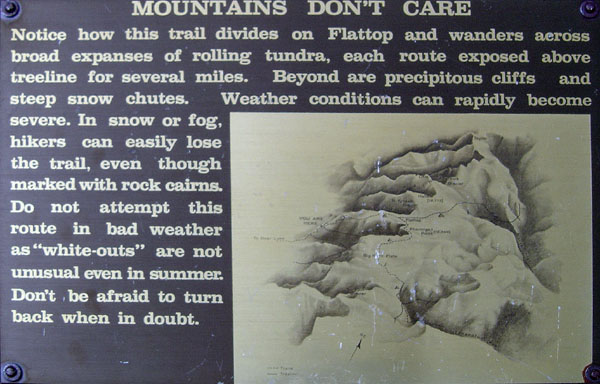
This sign in Rocky Mountain National Park reminds me that you can’t really win against Nature. Mountains don’t care.
Become a member to post in the forums.
 How to Plan with Decision GatesKeep going, change your route, or turn back? Watch how decision gates help structure these choices in our YouTube video.
 © Beartooth Media Group Inc.
 Loading...