Topic

Thunder: How close is too close?

  • This topic is empty.
Viewing 25 posts - 1 through 25 (of 29 total)
Brian Mix BPL Member
PostedAug 8, 2014 at 3:11 pm

Being a California native I've been exposed to thunder and lightning for most of my life. I really really enjoy it, I love seeing it and listening to it. Feeling it when it's close enough is great too! I feel like I need to ask the BPL opinion it because I have no fear of it.

A few weeks ago I got caught in a pretty severe storm on Forester Pass wherein two fellow hikers I met at the uppermost lake confided in me afterwards that they were truly scared for their lives. Just before the switchbacks (southbound)we had to hide among the large boulders to avoid severe weather. They were able to deploy tarps as cover, I used my poncho. I sat and watched the storm for an hour and relayed info to them under their tarps- too scared to look! We took a few lightning strikes within a (couple) hundred feet. We smelled the plasma and boulders were buzzing. I enjoyed the storm although I know we were too close for that one. (There was no was I was going to descend the ridgeline to get to lower ground.) That storm erupted within minutes so we just hunkered down, had it been apparent we would not have attempted the climb.

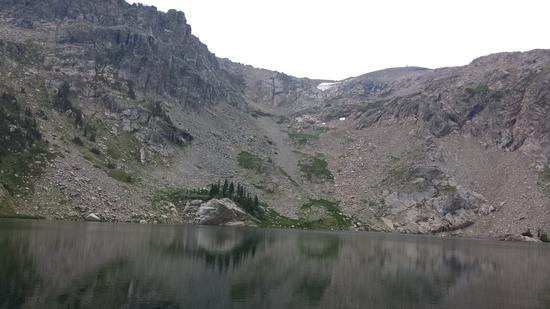
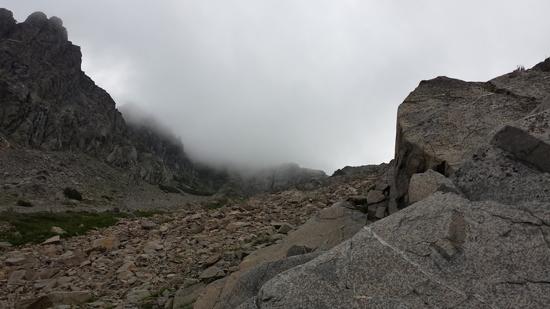
Now, on to a hike I did yesterday. In the afternoon it clouded over like is pretty common in the Sierra. By 2pm there was more thunder than quiet but the storm seemed a mountain or two away. The skies were completely overcast and no lightning was ever visible that I saw. It was sprinkling periodically. My route would have me crossing the lowest saddle I could find, heading to the next valley over.saddle1My plan was to go thru the boulder outcropping slightly right of the center of the picture then strait up the green drainage area then cut right towards the top as the terrain allowed. By the time I got thru the boulder outcropping the saddle was lost in the clouds. saddle 2As I ascended it did rain fairly heavily for 15 or 20 minutes. All this time the clouds were coming and going and the thunder still sounded a mountain or two away. I climbed the saddle without incident, about an hour later a substantial storm came thru and rained and hailed enough to cause sporadic flash flooding. With the given information, in your opinion was I taking too great of a risk to continue on my route? When you can't see the lightning to estimate it's distance how do you make educated decisions? At what distance from thunder and lightning do you take shelter from it? At what distance do you get off the mountain, whatever it takes?
TL;DR
I've been caught in storms while hiking. What are your safety parameters for staying safe with lightning and thunder? Distance from storm, not lightning pose.

PostedAug 8, 2014 at 5:18 pm

If you want stupid-simple and overly conservative, BSA is now requiring us to abide by the "30-30" rule: seek shelter as soon as the difference between flash and bang is less than 30 seconds, remain in shelter until 30 minutes after the storm has passed.

I must confess I've never actually seen a troop follow this rule.

EndoftheTrail BPL Member
PostedAug 8, 2014 at 8:53 pm

Not that I know…

But I suspect a healthy degree of CYA in BSA rules? 30/30?

Very roughly, sound travel 1 mile every 5 seconds. Three miles away good enough? Let's add another for buffer. So, maybe no less than 20/20 — ever? Easy to remember, as in 20/20 vision (foresight)? YMMV, of course. Again, not that I know – at all.

Bob Gross BPL Member
PostedAug 8, 2014 at 9:04 pm

Another factoid.

Of course it is lightning that we are trying to avoid, and thunder is just the audible indicator of it. Lightning normally strikes the tallest object in an area, although there is a lot of slop in that. Sometimes it strikes mountain ridges that are quite a way from the summit. In lightning theory, a tall object will receive the lightning bolt, and that provides a 60-degree cone of protection around it. The theory does not hold up so well unless the various ridges and trees have similar conductivity. If we were to designate a 10,000-foot mountain summit as the likely place for the lightning to hit, and if you drew a circle 5,000 feet out from the mountain center at sea level, then theoretically the lightning hit on the summit would protect everything within the circle. Similarly, if you were 8,000 feet out from the mountain center, you would be outside of the cone of protection, so you might get hit by a second strike. That's all theory straight out of the book, though, and it is very difficult to prove by the experimental method.

–B.G.–

Stephen Barber BPL Member
PostedAug 8, 2014 at 9:31 pm

Last month, a friend and I were leading 12 jr and sr high boys on a hike in Carson-Iceberg. While climbing up a long switch-backed cliff, a lightning storm hit us. As it got more intense, and the strikes got closer, and teh rain got heavier, my partner, a retired Marine gunnery sergeant who still does mountain combat training for the armed forces, yelled, "Marine doctrine says lightning strikes within 3 1/2 miles call for retreat to a secure area – that last strike was less than a mile. Okay with you if we go back and camp in the canyon down there?" We did, and the rain continued for another four hours – we got tarps up, and a fire to warm our hypothermic kids up, but it was the lightning which drove us down. What I might risk for myself, I would not risk for the kids we were leading.

David Thomas BPL Member
PostedAug 8, 2014 at 10:17 pm

>"Lightning normally strikes the tallest object in an area, although there is a lot of slop in that. "

Thankfully, xkcd did a little research to quantify that "highest object around" vagueness.

https://what-if.xkcd.com/16/

the punchline of which is:

"roll an imaginary 60-meter (200-foot radius) sphere across the landscape (for safety reasons, do not use a real sphere). This sphere climbs up over trees and buildings without passing through anything. Places the surface makes contact—treetops, fenceposts, and golfers in fields—are potential lightning targets."

But read the whole thing, because he also discusses ground current and hazards of standing TOO close to a tree.

And, if you're looking for other ways to die in the mountains, here's another outdoorsy article of his:

https://what-if.xkcd.com/51/

Bob Gross BPL Member
PostedAug 8, 2014 at 11:25 pm

Once you have dealt with the problem of dodging the lightning bolt out of the sky, you have the problem of the electrical energy of the bolt _after_ it hits something. Let's just say that it is a tall tree, and you are standing near the trunk. The current of the lightning bolt might be 20 thousand amperes, or possibly even 60 thousand amperes. If you were on a perfectly conductive surface like a thick sheet of copper or aluminum, then the current would enter the metal and be absorbed instantaneously. However, you are probably standing on the Earth surface, and its conductivity is a bit unpredictable. There might be rocks, dirt, and everything else. All of those imperfect conductors represent electrical resistance. As the lightning current gets through the tree trunk and enters this zone of electrical resistance, ground potential rise occurs. That means that a big voltage might appear at the base of the tree, but a hundred feet away the voltage has already dissipated. If you study that more closely, at the base of the tree there might be 5000 volts, and ten feet away there is only 2000 volts. If you happen to be standing in that ten feet, there could be a voltage differential of 3000 volts. So, depending on how you have your feet oriented, you might get a Zap of hundreds of volts very easily (between one foot and the other foot). That's why some suggestions are to squat down into a ball. If you can hold that position for the instant of the lightning shot, then you are unlikely to get Zapped by any lethal voltage. If you had a death wish, then you might want to spread yourself out from the tree trunk along the ground surface so that you feel the worst of the voltage difference.

Again, there is lots and lots of theory on this, and it gets tested the hard way. I prefer not to be a test subject, so I like to move away from the tallest trees during an electrical storm.

–B.G.–

PostedAug 11, 2014 at 11:57 am

I heard somewhere that lightning can strike something in the neighborhood of 10-15 miles outside of the cloud cover. IMO, if you can hear it, you're too close.

Brian Mix BPL Member
PostedAug 12, 2014 at 10:30 am

So, I've read all the reports (NOLS, NOAA, BSA, ETC) and ordered the referenced book on Amazon. I guess my real question to the few who responded is with all the scientific data aside, Do you actually abide by the 30/30 rule? Do you regularly setup camp waiting a storm out? Turn around and go home if the clouds start building up and turn grey or black? Abandon your hike because you hear thunder? What in practice do you actually do? Looking for opinions on a solo hiker- I would err on the side of zero risk if I had other people with me. I know you're not my guide/lawyer/etc…

Bob Gross BPL Member
PostedAug 12, 2014 at 12:23 pm

An old anecdote: Two of us were skiing up Lassen Peak. We saw some clouds in the west, but we were skiing up the southeastern ridge, so we couldn't pay close attention. The clouds got worse, but we were getting close to the summit, so we were reluctant to bail out. We paused for an instant. Right then, I looked at my buddy, and his blonde hair was standing up on end, and he had a very puzzled look on his face. I had my parka hood up, and a static discharge went off inside the hood. That sounded like bees buzzing around my head. Within a few seconds, we realized that the electrical cloud was directly over us, and there could be a lightning bolt any second. So, we layed down flat against the snow slope so as not to make bigger targets than we already were. The cloud passed over us, and then the next cloud had snow falling. We decided to bail out, but before we could start moving down the slope, ball lightning struck the mountain 500 feet or so below us. We made it back to camp an hour later, still trembling from the experience.

–B.G.–

Ralph Burgess BPL Member
PostedAug 12, 2014 at 7:10 pm

This is an excellent paper from the Wilderness Medical Socieity:

http://www.wildmedcenter.com/uploads/5/9/8/2/5982510/wms_lightning.pdf

Some key points:
Only 5% of injuries are caused by direct strikes.
Over 80% of injuries are caused by either "side splash" or ground current – from lightning striking an object nearby.

[ My comment: Humans are only ~6ft tall, so unless you're standing right on top of a pinnacle, it's pretty unlikely that you're the tallest object in the vicinity, so direct strikes are unlikely. A direct strike to a tent is even less likely, unless (for example) it's pitched on the top of an outcrop next to a lake. Most injuries occur when a person (or tent) is NEAR an object that is struck. Get well away from any tall & relatively prominent objects (trees, outcrops, ridges) in the vicinity. ]

Note the evidence grades for the recommendations, from
1A – strong recommendation, high quality evidence
through
2C – weak recommendation, low quality evidence

Note that the strongest recommendations (1C) are mostly about avoiding dangerous places, finding the safest places in the local terrain. There IS plenty of data on the places that lightning is likely to strike, so the biggest priority is to learn that and avoid dangerous locations.

As for other recommendations, even the much-vaunted "lightning crouch" gets just a 2C grade – in other words it's basically a guess, there's no data because nobody is doing experiments! And stuff that I've seen people obsess about like metal tent poles does not even get a mention at the lowest "2C" grade of recommendation.

The bottom line — spend 95% of your energy worrying about getting you & your shelter into a safe location in the local terrain, so that the probability of a strike within ~100ft is as low as possible. This is BY FAR the biggest controllable risk factor.

Justin Baker BPL Member
PostedAug 12, 2014 at 7:13 pm

If you are walking on flat ground, not heading up to the top of a ridge or anything like that, is there any point in setting up shelter and waiting out thunder storms? Would sitting in your shelter out on a flat grassy field be any safer than walking through the flat grassy field?

I got hit with my first bad sierra thunderstorm last month and it kind of scared the crap out of me at one point.

Bob Gross BPL Member
PostedAug 12, 2014 at 7:24 pm

"Would sitting in your shelter out on a flat grassy field be any safer than walking through the flat grassy field?"

It's probably worse.

I would recommend to get out of the exposed location and not just act like a sitting duck.

–B.G.–

Justin Baker BPL Member
PostedAug 12, 2014 at 7:32 pm

So lets say I was walking through tundra and the next 10 miles in front of me was flat tundra. And I was experiencing a nasty lightning storm.

Any reason to stop moving and set up a shelter? Would that make me any safer?

Also, am I safer in a forest or out in a grassy field?

Bob Gross BPL Member
PostedAug 12, 2014 at 7:51 pm

"am I safer in a forest or out in a grassy field?"

Probably in a forest, slightly away from the very tallest trees.

In a lightning situation, I have camped in the middle of a dense cluster of short trees within sight of the tall trees.

When you are looking around the woods, notice the tree that has the big lightning blaze down the length of its trunk, and camp elsewhere.

–B.G.–

Jerry Adams BPL Member
PostedAug 12, 2014 at 8:04 pm

WMS didn't mention staying away from metal fences or similar

I like the rating system – for example the crouching position isn't very effective

WMS said timing between lightning and thunder is unreliable – easy to not sync them properly – better to get to safety when you hear thunder and wait 30 minutes from last thunder

jscott Blocked
PostedAug 12, 2014 at 8:20 pm

Justin: yeah, that's a good question. In similar situations, when continuing on didn't bring me into more exposed terrain, or less, I've decided to walk on. If there's no good forest shelter, it seems that your chances of being hit by lightning are about equal whether you're moving or in one place.

Once when I decided to press on in a lightning storm, I met a horse packer coming in the other direction. He was surprised to see me, but it seems that his experience had led him to the same conclusion. The lightning was close enough in this instance to set a single tree on fire about five hundred feet up on one of the nearby ridges. But I couldn't see how staying still would have increased my chances for not being hit. And anyway, I was down about fifteen hundred feet or more from the surrounding peaks and ridges.

d k BPL Member
PostedAug 12, 2014 at 9:01 pm

I was at Lake Virginia (JM wilderness) last Wednesday and got hit with an electrical/hailstorm about 30 minutes after we first heard distant thunder. We made camp just as the rain and thunder started in some small trees a ways up from the lake, a ways down from the bigger trees – it seemed the safest area, to my limited knowledge. The time between lightning flashes and thunderclaps was generally 4-8 seconds once it got going good, but there was one really deafening thunderclap that came IMMEDIATELY after the flash – that really got our attention!!! This was after about 30 minutes of lightning, thunder, and garbanzo bean-sized hail. Luckily, there was only the one really close one, but it brought home the idea that one isn't necessarily safe just because everything you're hearing is further away. (the hail started about 5 minutes after we got in our tents and continued for 40 minutes, then it and the thunder subsided)

Ryan Smith BPL Member
PostedAug 14, 2014 at 9:52 am

"there was one really deafening thunderclap that came IMMEDIATELY after the flash – that really got our attention!!!"

We've had a few of those recently around my house. Truly amazing! It will flash and then immediately a huge bang, not a rumble or anything like one. Sounds like a gunshot, except much more awesome. Always makes the kids run for cover. Maybe daddy too. :)

Ryan

Randy Nelson BPL Member
PostedAug 21, 2014 at 9:42 am

I'm firmly in the "If you can hear it, fear it camp." And even if I can't hear it, I still fear it. I was watching baseball in my detached garage on 4th of July about 8 years ago and there had been no thunder at all and then flash/BAM! The picture on my TV shrunk to a dot in the center, then started to expand back. I thought it might be OK but everything was purple so no such luck. I never figured out what it actually hit but all the electronics in the house and garage that were not behind a UPS were taken out. I guessed that it may have hit the main power line that feeds both structures. It was the infamous bolt from the blue. There was no thunder before or after it.

I was at the top of Huron Peak (one of the 14ers in CO) at 10:30 in the morning. There were clouds in the distance but far enough off that I wasn't concerned. Take a pic, enjoy a quick summit beer, and head down. I had just opened my beer when it started cackling like static from bad AM radio reception. I check the clouds, still not close. The women nearest to me wasn't wearing a hat and her hair was standing straight up. I grabbed my trekking poles, getting a nice shock, and stuffed them in the pockets of my pack and we raced off downhill. Probably 30 people all going as fast as they could. My dog's pack is completely leaning to one side because of the missing beer and a woman offers to fix it and I tell her to just keep going, I'll fix it in a bit. Then clouds seemed to form around us, or maybe come up from below and it started haling. After maybe 1/2 mile I stopped to fix my dog's pack and realized I still had the beer in my hand and hadn't spilled any. Nice! I drain it, quickly balance the pack and start to head down again where there is a big gap between us and everybody else. Except one guy who is coming up! I ask him if he is seriously going to continue up and didn't he notice the pack of panicked people that just rushed past him. He said he was just going to go up a little more and see if it cleared. I said it's a 14er not Everest. You can come back tomorrow. But he insists. I later see him while we're taking a break after reaching the trees. I ask if he made it and he said yes but he was getting shocked the whole way and it was the dumbest thing he's ever did. I didn't see the point in asking why he did it anyway. Oh, and there never was an actual lightning strike that I saw or heard that day. Go figure.

And that's just one instance where I'm rushing down to beat a storm while some people are heading up. Sometimes, just starting up. A lot of it just comes down to luck. If everyone who ignored lightning danger was killed, it would be in the 1000's per year in Colorado. I'll still do everything I can to stay as safe as possible anyway.

Bob Gross BPL Member
PostedAug 21, 2014 at 10:53 am

As we all know, it is most common to have the static cloud in the sky and have the lightning bolt shoot down to earth, and then return. However, if the cloud is very near to the earth, there may not be a bolt. Instead, the static from the cloud is intermittently discharging to any conductive object or person on the ground. You can feel and hear the static crackling around you, and this is somewhat related to St. Elmo's Fire.

–B.G.–

Viewing 25 posts - 1 through 25 (of 29 total)
Loading...