Topic

Argon Silnylon Pyramid Tarp – Hex

  • This topic is empty.
Viewing 25 posts - 1 through 25 (of 29 total)
J-L BPL Member
PostedJul 27, 2014 at 3:20 pm

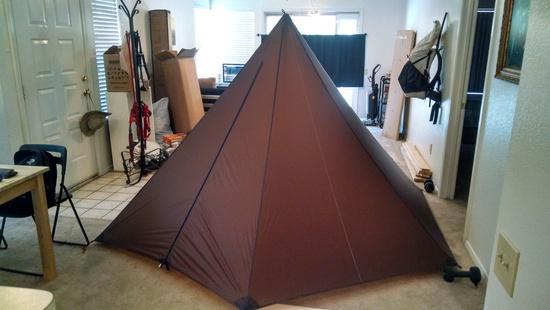
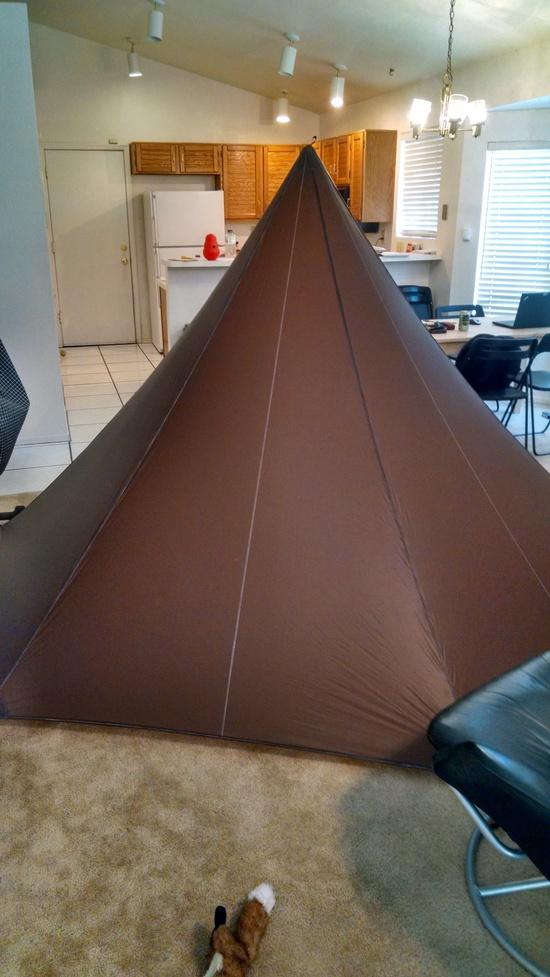
I am just about finished with my 6-sided pyramid tarp. It has the same footprint as the GoLite SL3, but is 2 inches taller (so 64 inches tall when pitched to the ground). It is made up of 6 triangles all the same size. All I need to do now is add something to tie back the doors when unzipped, finish sewing on some mid-distance perimeter tie-outs, and seam seal it. Edit: first two done, now I just need to seam seal it!

Materials: I decided to make it out of Argon Silnylon. The Argon Silnlyon I received weighed approx 1.1 oz per square yard and was 59.5'' wide. All the reinforcements were done with Argon Silnylon (double layered on the 6 main perimeter tie-outs and double-layered at the peak). A #3 zipper was used.

Cat Curve: I used cat curves for the main seams with 1.25'' of deflection. I would say this amount works out quite well for balancing a taut pitch and interior room on a 6-sided pyramid tarp. I would recommend 1'' – 1.5'' of deflection for six-sided pyramid tarps, probably 2'' maximum.

Weight: the current weight of the tarp (as seen in the photos) is 13.9 oz! With everything done and seam sealed, I expect it to weigh around 15-16 oz. I tried to measure everything I added on as I went, so here are the details of what goes into a pyramid tarp:

6 cut triangles of Argon Silnylon (bare fabric weight): 12.0 oz
Main seams and hems done, peak loop added, zipper sewn in: 12.8 oz
6 main tie-out reinforcements (double-layered Argon Sil): 6g
Ribbon for 6 main tie-outs: approx 1-2g
6 linelocs: 8g
Kelty triptease guyline: 6g
Peak reinforcement (double-layered Argon Sil): 3-4g
Buckle and webbing for zipper stress relief: 3-4g
Zipper pulls: 2 g
Ribbon for mid-length perimeter tie-outs: 2 g
Mid-length perimeter tie-out reinforcements (single layer Argon Sil): < 1 g
Toggles to hold back doors when unzipped: 2 g
Total: 14.1 oz (399 g)

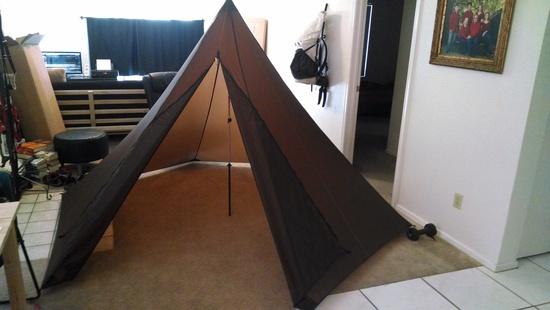
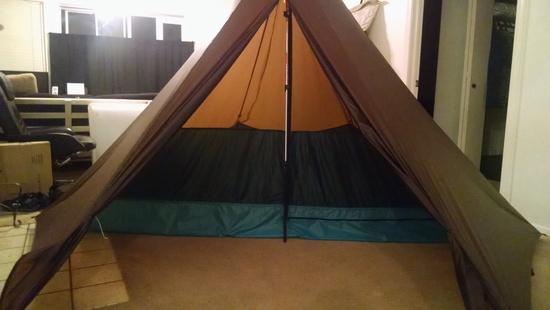
It's so hot outside, I pitched it in my living room. Pardon the mess (I just moved in a couple weeks ago and have been spending all my time sewing!):

"Staked out":
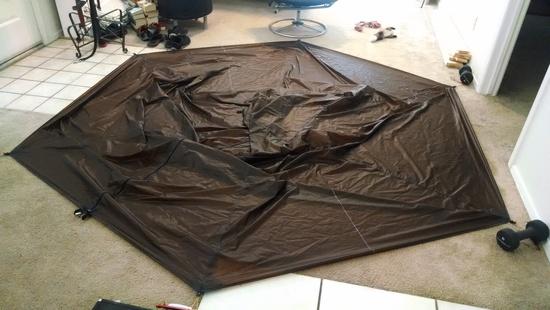
floor_staked

hex1

2pitch

3pitch

4pitch

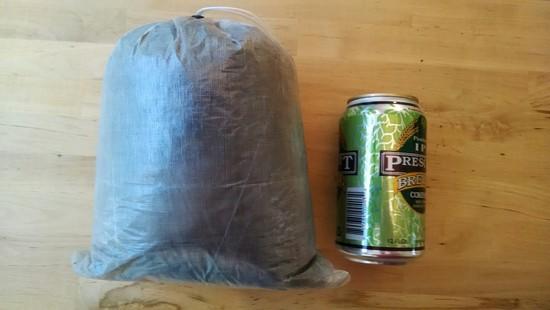
Packed size is stupidly small (could be compressed more):
packedsize

I found working with Argon sil to be a little more difficult than your typical 30D silnlyon. The material is thinner, a little less stiff, and incredibly slippery. It required a lot of pinning. Being dark brown also made things more difficult since I could not see through the fabric. With the white silnlyon I had previously used, lining up fabric pieces back-to-back was very easy.

Argon sil did well in my bathtub test: I soaked a towel in water, put a layer of Argon sil on top, then put a cotton t-shirt on top and stepped on the t-shirt. The t-shirt showed one small damp spot and the rest remained dry. I believe the fabric should do quite well in the pyramid tarp application, where it has very steep walls.

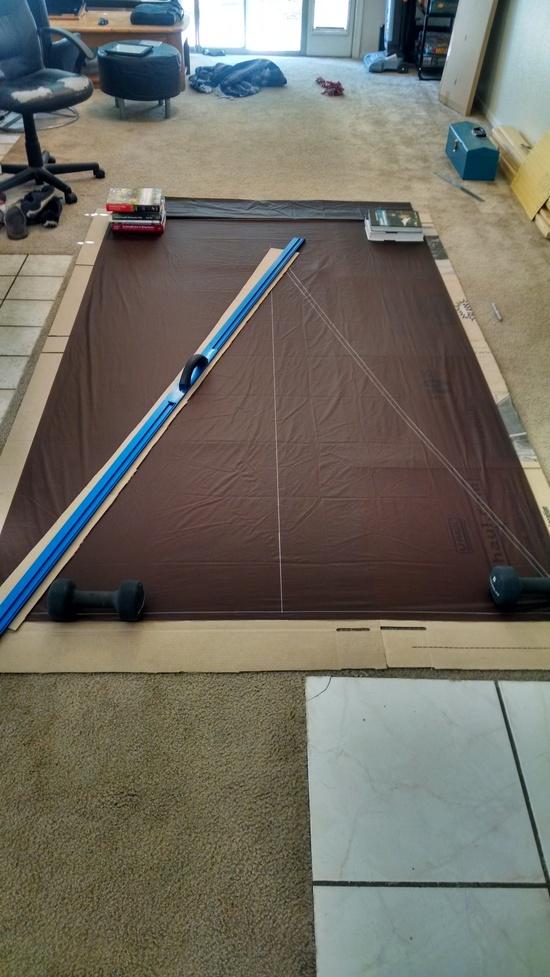
To dimension the fabric, I needed a flat surface. My house is mostly carpet, so I went to U-Haul and bought two of their large mirror moving boxes. Unfolded and taped together, these cardboard boxes provided a very large flat surface for me to work on and enough cardboard to cut my cat curve out of. I used a very long straight edge to help keep things in line. Here is one of the triangles drawn out on the fabric:
dimensioning

For reference, this is my 2nd attempt at a pyramid tarp. My first pyramid tarp can be seem here:

http://www.backpackinglight.com/cgi-bin/backpackinglight/forums/thread_display.html?forum_thread_id=90985

Brandon Guy BPL Member
PostedJul 27, 2014 at 4:54 pm

I'm impressed. What are the dimensions of the individual triangles? How many yards of fabric did you use total?

J-L BPL Member
PostedJul 27, 2014 at 5:28 pm

They're isosceles triangles with dimensions:

Height = 81.36''
Width = 58''

In total, I used 15 yards of fabric. I thought about making 12 right angle triangles to reduce the amount of necessary fabric to maybe 8 yards, but I would have had to shrink the dimensions a little to account for seam allowances and it would have doubled the number of flat-felled seams I'd have to sew and then seam seal.

Jerry Adams BPL Member
PostedJul 27, 2014 at 6:00 pm

That looks really good

Your pinning must have worked because the seams look taut

1.1 oz/yd2 is good. Makes it harder to justify Cuben

J-L BPL Member
PostedJul 27, 2014 at 6:39 pm

"1.1 oz/yd2 is good. Makes it harder to justify Cuben"

Yes, particularly when the Argon Sil is $6 per yard. I think it may pack smaller than cuben too.

I had initially planned to use a #5 zipper. But between Roger Caffin saying he uses #3 zippers and the tents from Tarptent and Six Moon Designs using #3 zippers, I decided to give one a try.

stephan q BPL Member
PostedJul 27, 2014 at 7:36 pm

Great job! A lot of coverage for 1 pound. A number 5 zipper is long term solution for little weight gain. My next project.

Thanks

Jerry Adams BPL Member
PostedJul 27, 2014 at 9:44 pm

"I had initially planned to use a #5 zipper. But between Roger Caffin saying he uses #3 zippers and the tents from Tarptent and Six Moon Designs using #3 zippers, I decided to give one a try."

I used one for more than a year, probably 60 nights, before it failed, and maybe that was a fluke. This was with a pyramid tent.

Definitely baby it – like when you zip it closed, don't let there be a lot of pressure pulling it apart.

#5 zipper doesn't weigh that much more. Probably good in an application where there is a lot of force pulling aprt the zipper.

Adam BPL Member
PostedJul 28, 2014 at 4:57 am

Very, very fine work! Thanks very much for sharing :-)

James Marco BPL Member
PostedJul 28, 2014 at 6:54 am

Yeah, I will second the drool…well, sort'a;-)

There are two basic issues that prevent me from going from a shaped tarp (similar to Yama Mountain Gear's Cirriform DW except a bit larger at 37sqft) to a full pyramid.

1) The doors do not prevent rain from entering when open. This also excludes a good share of other tents. Sorry, but midnight runs, setting up in the rain, etc, can all be bad without some sort of awning over the door. (Mine simply does away with the door.)

2) No floors or half floors at best. This relates to 1) above.

Other than that, you do some fine work!
Thanks for sharing.

Jerry Adams BPL Member
PostedJul 28, 2014 at 7:58 am

Of course different tents for different people/situations, but

I stake one side of the door and open the other so there's only 1/4 of the tent floor exposed to rain

If it's raining, I'll get into tent and stand on the 1/4 exposed area, close the door, take off wet jacket and shake it off on the ground there. Set wet jacket on the ground on the edge of that 1/4 exposed area. Then sit down on my sleeping bag which is on a 1/2 of the area that's totally dry.

No reason to have awning, because water's going to drip off me onto the ground there anyway.

And just as well having no floor anywhere so any water soaks into ground rather than sitting on waterproof floor. With waterproof floored tent, occasionally, water puddles up, although with proper technique that won't happen.

The other 1/4 of tent floor, that's under the staked door, stays dry, and is good to set gear that I want to keep dry.

J-L BPL Member
PostedJul 28, 2014 at 8:00 am

My dog and I will typically be sleeping behind the pole in this tarp (using the front half as a big vestibule), so it doesn't matter if rain gets in when opening the door. This will let me have the door open all the way during rain if I like for good ventilation, or zip it up for wind. With pyramid tarps, I've found that if you leave the buckle at the bottom secured, you just open the zipper a little bit to go out and not much water or snow gets in.

I will be careful with the #3 zipper. The buckle at the bottom does a really good job of keeping stress off it. If it breaks, that will just give me an opportunity to try out my zipper-less door idea, which is just overlapping fabric.

J-L BPL Member
PostedJul 28, 2014 at 9:23 am

I estimate that using Argon silnylon saved approximately 3 – 3.5 oz on this shelter weight over normal 30D silnylon (at 1.35 – 1.4 oz per square yard).

This place has some 20D silnylon (at claimed 1.27 oz per square yard weight), that would add about 1.5 oz, but I've never used or seen the fabric. Not sure how it compares to Argon sil:

http://ripstopbytheroll.com/collections/silnylon

PostedJul 29, 2014 at 11:55 am

Cool. You should sleep in it while pitched there inside. Just for the excitement of it.

J-L BPL Member
PostedSep 10, 2014 at 7:58 pm

A couple updates:

I seam-sealed the Argon Hex. Total weight of the completed tarp is 15.0 oz

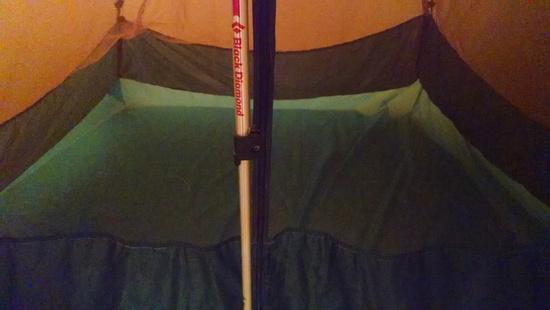
Also, I made an inner tent for it. The specs:

30D silnylon floor (from Lightheart Gear – blue material)
Argon 67 for the lower half (green material, extends to approx 20'' above the ground)
Nylon tulle for the upper half (brown netting, from JoAnnes)
Max dimensions: 90'' long x 48'' wide, 7'' bathtub floor
Weight: 11.8 oz

This gives me a total shelter weight of 26.8 oz + 1 oz pole extender = 27.8 oz

Here are some pictures of the inner:

inner1

inner2

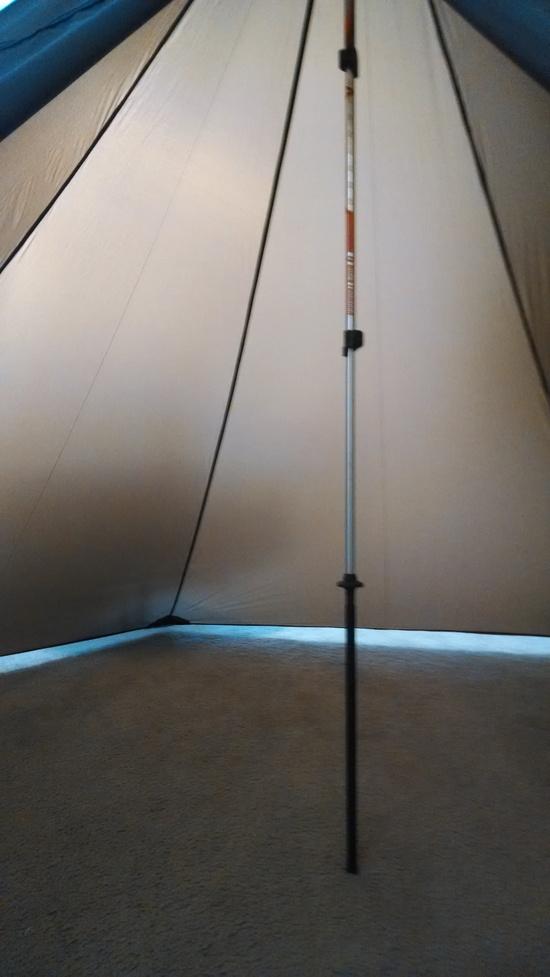
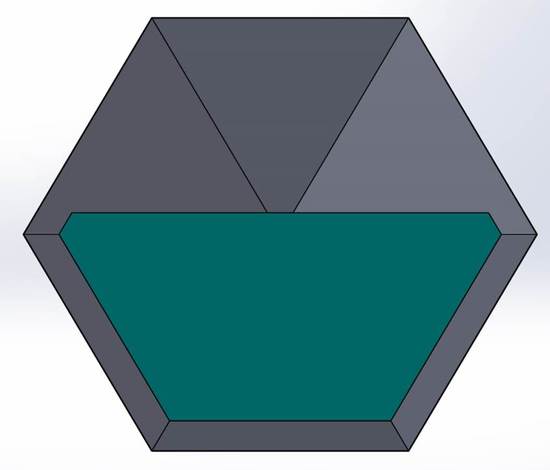
It's impossible to tell from the pictures, but this is what the floor looks like relative to the tarp:

iner3

It should work out well for my dog and I. I offset the pole a little bit so we are both on one side, giving us a very large protected area – one which I can vary the exposure of with the zipper.

The inner does pitch a little loose – it is not as taut as I would like it to be. I think I made two errors in dimensioning my inner tent:

1. I forgot to account for the catenary curve of the tarp's ridgelines, so I lose a little bit of interior room there
2. The elastic cords + loops to attach inner to outer come out to around 2-3 inches vs. the 1 inch I designed for

I think these two add up. The inner being a little loose does not seem like a big issue right now, but if it proves to be a problem (i.e. condensation for some reason, general annoyment, etc), then I figure I can just roll over and sew the main seams of the inner to take up some of the slack. For now, I will leave it as is.

Sewing the inner was substantially more work than the outer. Composing it of three materials, all of which were a little difficult to dimension due to the non-standard geometries, resulted in lots of seams. And sewing tulle is never easy. On top of this, my old sewing machine broke half-way through the inner, so I ended up buying a new one (it would have cost $60 to repair, and it only cost $80 new, so I bought a nice Singer 401A).

I'm taking the tent out this weekend for a couple nights, and then should be using it lots once the fall backpacking season gets under way in the SW.

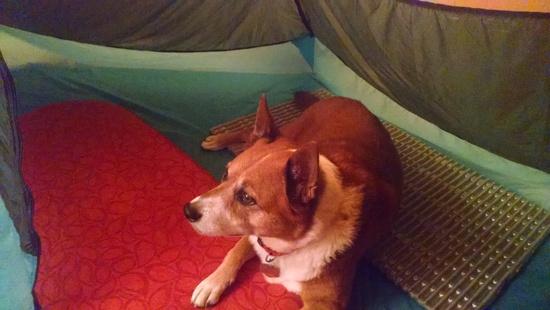
A couple more photos (red pad is Prolite Plus Womens – 20'' x 66'', other is 20'' x 36'' ridgerest). It is dog approved:

ddd

dbd

PostedSep 10, 2014 at 8:34 pm

That is really beautiful! Somehow, you got the seams just right to pitch taut.
Only wish you'd used another low denier silnylon, though it would have been much more expensive. When the time comes, please let us know how it performs in heavy rain. Thanks.

P.S. Purchased some high HH silnylon from LHG over a year ago that weighed out to 1.28 oz/sq/yd. Thought pretty sure it was 30D, but maybe not. Have looked at 15-20D tarps to disassemble. GoLite has a PU coated one that is around 1.12 oz and 1200 mm HH, and Terra Nova has silcoated ones about the same weight that are 3000mm HH, but the end cost to get the material comes to even more than Cuben.

J-L BPL Member
PostedSep 10, 2014 at 8:59 pm

The 30D silnylon I purchased from LHG for the inner tent's floor weighed around 1.5 oz/sqyd. A little heavier than I wanted, but the stuff feels very durable and thick, so it should be quite waterproof.

I think if I was going to purchase a tarp to disassemble and use for fabric, it would be Sea to Summit's "Escapist Tarp". They're rather large (one model is 10'x10') and use 15D Sil/PU fabric (probably similar to GoLite's material). I have another design in mind for a tent I'd like to build sometime over the next year – maybe I'll use that stuff or just go with cuben.

Bill Townsend BPL Member
PostedSep 11, 2014 at 3:25 pm

Quite a nice shelter!

Perfect fabric/design combo as well. Nice steep walls means no huge worries on the Argon Sil, and with all that fabric, the lighter Argon is perfect.

Is the fabric dead though?
I did check the Hammock forum updates and poked around a bit- but guessing that too many complaints if one doesn't accept the limits and build a steep wall shelter like this may have killed it?

Any insight or updates? Anything close?

J-L BPL Member
PostedSep 11, 2014 at 3:49 pm

No idea – I am not Dutch and I don't sell the fabric. I would contact him if you have questions about the fabric's availability. I also don't frequent Hammock Forums, but my searches reveal generally positive experiences with Argon Sil.

I've set it up in my backyard. It withstood a large wind storm that knocked over some trees in my neighborhood. Stretch seems average for silnylon. 40% chance of rain this weekend, but probably nothing heavy.

Viewing 25 posts - 1 through 25 (of 29 total)
Loading...