Topic

Ralph Burgress’ Unsupported SOBO JMT Record

  • This topic is empty.
Viewing 24 posts - 1 through 24 (of 24 total)
PostedJul 25, 2014 at 6:37 am

Following Krissy and Jenn’s (underway) attempt on the JMT, I came across Ralph Burgess’ unsupported SOBO record – 4 days, 8 hours, 43 minutes, completed on July 11th.

RalphBurgess2

“I followed all wilderness regulations to the best of my ability, including taking a bearcan. I adhered to “Leave No Trace” principles, taking only water from the wilderness, and packing out all my uneaten food, trash and toilet paper. I did not abandon common etiquette simply because I was moving quickly, yielding to uphill hikers in the usual fashion.”

Details Here including gear and food. It is a Great trip report.

Pretty damn impressive.

And Very impressive for an “old guy”.

Ken Thompson BPL Member
PostedJul 25, 2014 at 6:40 am

Sweet. Nearing 50 myself this is good news.

Interesting failure of the Sawyer Mini.

Art … BPL Member
PostedJul 25, 2014 at 6:59 am

50 is not really that old …
but still an impressive hike.
certainly a new over 50 age group record.

what is additionally impressive about Ralphs effort is I know of no other record attempts that carried a bear can.

Reinhold Metzger (age 63) over 60 record = 5d 7h 45m (to summit, 2004)

John Vance BPL Member
PostedJul 25, 2014 at 7:26 am

50 is young….. Inspiring and depressing at the same time.

Scott Bentz BPL Member
PostedJul 25, 2014 at 8:29 am

What a nice, concise report. When I heard this "old" man had done it I was thinking a 70 year old. Hey, I'm 53. Now, I'm an old man!

I really like the mental aspect of these fast hikes. I hiked the JMT in 13 days and think a 10 day would be fast for me.

Ralph Burgess BPL Member
PostedJul 25, 2014 at 7:37 pm

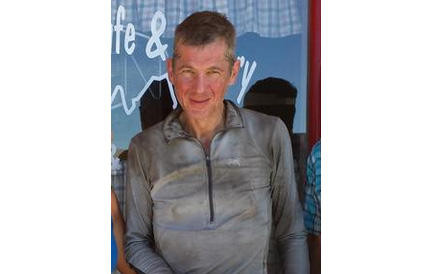
That photo's in front of the fabulous Alabama Hills Cafe in Lone Pine. I can't believe I walked in there for breakfast looking like that, didn't realize I was quite so filthy.

Of course I swore I'd never do anything like this again, but 24 hours later was trying to figure out how to go faster. I can never compete with the elite ultrarunners for speed, of course – I'm not really a runner at all. But it seems like I have good day-to-day recovery ability – can chug down 6000 calories a day and plod along steadily for a long time. Unfortunately, that tortoise-vs-hare approach probably means if I could post a competitive time in something it would be in going longer – something like unsupported JMT yo-yo. Something for next year maybe, I don't think I have two of these in me in a year.

Adam White BPL Member
PostedJul 30, 2014 at 8:58 am

Ralph,

Just wanted to say congratulations, and thanks so much for sharing!

I'm curious–how did you come up with your caloric needs? I don't think I've ever eaten more than 3,500 calories per day, but am almost certainly never eating enough.

However, once you're eating past when you're hungry, I wouldn't know when to stop. 4,000 cal/day? 5,000 cal/day? 6,000 cal/day?

Basically, how do you know when you're eating enough, and how do you know if you're eating too much?

Thanks for any insight, and again, congratulations!

PostedJul 30, 2014 at 2:01 pm

Hopefully Ralph will chime in. Until then –

During an extended difficult effort (near your sustainable maximum) the body can only process about 300 calories per hour. Any more than that just won't empty from your stomach. Given that these efforts are burning about 400-600 calories an hour, you do what you can to get those 300 calories into the hopper. The deficit comes from body fat and muscle.

From Ralph's summary: 5800 calories per 20 hours is ~ 290/hour.

You know you are not eating enough when you legs feel like cement, you hate the color of your shoes, and wonder why the last 5 minutes seemed like an hour.

You know you are eating to much when the glob in you stomach just won't go away.

Ralph Burgess BPL Member
PostedJul 30, 2014 at 2:39 pm

I think Greg pretty much summed it up. You're burning more than you could possibly replace, so you're just eating as much as your body can process to minimize the deficit.

This is something that's very familiar to pro cyclists competing in multi-day stage races. Because cycling is low-impact, biomechanical stress & fatigue generally isn't a limiting factor, so these guys have phenomenal cardiovascular/metabolic capacity. I'd guess that they average over 1000 cal/hr for about 5 hours per day. Typically, a rider in a 3-week Grand Tour will need to eat 7-8,000 calories per day. What's interesting is that many elite riders don't have the ability to recover well enough to be competitive over 3 weeks, and that this recovery ability (including the ability to process so much food every day) seems to be largely genetic (i.e. refractory to training), and not well correlated with other aspects of physical prowess. Some riders are extremely good at very long single day efforts, just emptying the tank completely with a huge single effort, others are much better at day-after-day recovery. A few can do both, but not many.

I used to race bikes when I was a teenager, but I was never any good. I was certainly nowhere near fast enough over 1 day to get anywhere near a multi-day stage race, since those are only organized for elite amateurs and pros. So it may be that although my top speed is hopeless, I happen to have good multi-day recovery.

I've eaten this much on a single day before, but never tried to do it day-after-day until this hike. I think I could probably process slightly more, maybe 350 calories an hour, if I cut fat content right down – something like the "perpetuum-only" diet that I see Mark Davis tried on the JMT once. Gets pretty heavy to carry that many calories of carbs, though.

I think, unfortunately, that if I'm going to set a really competitive time at something (let's face it, a SOBO record is a little soft!), it would be in going longer distance over equaly difficult unrunnable terrain. i.e. 400-500 miles over terrain where it's difficult to average above 2.5mph. JMT yo-yo I guess, although I'm not sure that back-and-forth is aesthetically very pleasing. And suffering for double the time it's not a selling point!

Adam White BPL Member
PostedJul 31, 2014 at 9:52 am

Greg and Ralph,

Thanks for the input, and for sharing your experience.

This is an area that I haven't given too much thought to, and I've always been cavalier–but given the scrutiny that I give to everything else in my pack, I probably ought to think a little harder about diet and daily caloric needs. Food for thought!

From Peter's thread over at the FKT boards, it looks like the FKT for a JMT yo-yo is 12d4h58m, by Catra Corbett in 2004. I assume that was supported.

You know, August/September is a fine time to be on the JMT, Ralph…

Art … BPL Member
PostedJul 31, 2014 at 10:01 am

I believe Catra's YoYo on the JMT was "" selfsupported "" . meaning no one helped her but she may have placed food caches for herself before hand.

Catra is a very well known ultra runner who will be going for her 109th 100 mile or greater finish this weekend at Angeles Crest 100. I think this is the record for the most 100 milers by any person.

PostedAug 1, 2014 at 2:55 am

…just amazing. People, and companies, pay untold sums of money for today's sports heroes. LeBron James, Tom Brady, etc.

Forget them, Ralph Burgess is the man!!

PostedAug 3, 2014 at 3:45 pm

“…a Nanopuff and tights with rain gear and an emergency blanket over the top is plenty of insulation for survival.” Which emergency blanket would you take?

Ralph Burgess BPL Member
PostedAug 3, 2014 at 6:05 pm

I was thinking just of one of the lightest 1.5oz emergency mylar "space blankets". But I can't say that I've really thought it through in any detail. The risk is mitigated by the short duration – for a 4-day trip, the weather forecast will be quite reliable, at least in terms of overnight temperatures. I think it would depend very much on the forecast; and I'd probably be more conservative going SOBO than NOBO, because NOBO you have several easy bailouts in the second half, where problems are far more likely to occur.

But there's certainly something of an ethical dilemma in how much risk you take going unsupported on the JMT. I think there's a fantastic sense of camaraderie on the trail, which is great – but it's unfair to set out without at least basic means of survival and self-rescue. In peak season on the JMT, you could set out with no provisions for emergency at all, and still be pretty safe – simply because you know that somebody will pass by within a few minutes, and probably at least 25% of people now carry a SPOT or InReach or satellite phone. But it's pretty selfish to rely on screwing up somebody else's trip as your means of rescue.

Adam BPL Member
PostedAug 3, 2014 at 8:05 pm

I think the way you think about bail out options is very commendable Ralph.

With the sleeping gear option of nanopuff, tights, raingear, space blanket, I have some questions.

1. How much of those do you wear while actually hiking? (I've no idea about the JMT really, being an Aussie who's never been there) I'm guessing that you definitely wouldn't wear the nano puff, maybe the tights, but could probably also get away with just wearing raingear to increase warmth the little bit required. You are moving fast.

2. What is the weight/total weight of those items? Would it be more efficient to instead take a very light down quilt instead of the nanopuff, tights and space blanket?

3. What shelter are you thinking of with that set-up? I guess if you don't take any shelter then the space blanket will give you some rain protection if needed. As you say, you can predict the weather pretty well 4 days in advance.

Great trip mate :-)

Ralph Burgess BPL Member
PostedAug 3, 2014 at 9:04 pm

My original comments were at the end of my trip report – linked to in the first post above. And of course this isn't something that I'd ever do on any kind of regular hike. It's more contemplating what's feasible for what you might call "ultra-fastpacking". Probably ends up little different from what ultramarathoners would do routinely, but not something that I'm accustomed to.

When the plan is to be moving for ~20 hours per day, if the forecast is for fine weather & warm nights, then I think going without any shelter is a reasonable strategy. Forecasts are accurate for air temperature a few days out – so if there's minimal risk of hypothermia when wet then the ever-present risk of rain showers is ok I think. The plan is just to keep on hiking if it rains, and stop to sleep only when the rain stops.

Without shelter, I think warm clothing makes more sense than a bag or quilt. Enough clothing so that wearing everything, including rain gear, you're warm enough to sleep at the forecast temperature. If it starts raining when you're resting, you just get up and move immediately.

I guess it's basically gambling on fine weather, and relying on your ability to keep moving and hike long distances to bail you out if the weather turns unexpectedly bad. The risk is getting sick or injured so that you can't move (or can't eat). For a couple of ounces, I figure a space blanket gives you an extra little bit of insulation and waterproofing to survive that.

Art … BPL Member
PostedAug 4, 2014 at 6:41 am

I agree with Ralph if you are going very minimalist better to have the weight in clothing than a sleeping bag, gives you more options.

As for the space blanket, I suggest one of those space bivies instead.
much better than just a blanket in windy conditions.

Ralph Burgess BPL Member
PostedAug 4, 2014 at 9:18 am

You're probably right. I have a Sol emergency bivy in my cupboard, often take it on day hikes. I've never had cause to open it to find out how well it works, but it's under 4oz.

PostedAug 4, 2014 at 2:13 pm

When under a surprise lightning storm, some people say to find the safest spot you can, then put down a closed cell foam pad, put your feet on that, then loweer your body into a squat. This gets you low while minimising the area of contact with the ground, and puts a non-conduvctive pad plus your shoe soles between you and the earth. Is your inflatable pad too soft and cozy to exchange for ccf?

Ito Jakuchu BPL Member
PostedAug 4, 2014 at 4:08 pm

I fastpack alone as well and have bought an ultra light bothy by Terra Nova recently for those times when the weather can be more problematic. If I can't continue it gives me a bit more protection than a space blanket or SOL bivy.

Down points are you can't lay down, and it's heavier. Plus points are it can stand more rain, as in continuous tropical rainstorms, and if necessary you can shelter two.

When the weather is mostly good I jus take a SOL bivy.

Amazing feat by Ralph Burgess by the way. Can't imagine my feet to hold up to the abuse (among other things!).

Ito Jakuchu BPL Member
PostedAug 4, 2014 at 4:11 pm

I like to eat, always have. But when going hard, for a sustained period I find I have trouble getting hungry, or when I do eat I often get an upset stomach. I eat a lot of dried fruits, some energy bars, some salty candy in the summer.

Is everybody just on gels?

Adam BPL Member
PostedAug 4, 2014 at 4:24 pm

Hey Ralph (my new hero)

Did you manage to fit all your food into that bear canister? Or did some sit outside?

Not trying to get you into trouble or anything, just wondering for volume purposes.

Cheers!

Ralph Burgess BPL Member
PostedAug 4, 2014 at 4:37 pm

I had a 13-inch Bearikade, so plenty of room for all the food. There's not much additional weight penalty for making a Bearikade taller – most of the weight is in the Aluminum end pieces, the extra carbon fiber doesn't weigh much.

Ralph Burgess BPL Member
PostedAug 4, 2014 at 4:54 pm

With lightning risk, I prefer to focus on factors that have a strong evidence base. Number one on that list – we have a lot of data on where lightning strikes occur. So biggest priority is understanding where to position yourself in the local terrain to be safe. It's almost always possible to find somewhere that has virtually zero risk of a strike.

Everything else is secondary – I'd rather focus on not getting hit in the first place than on strategies to ameliorate the effect of a strike.

Of the secondary strategies – the standard squat with feet together does have decent evidence to support it – because we know that most lightning injuries are caused by ground current. So you don't want to lie down, you want to make sure that everything is scrunched up with parts of your body that are in contact with the ground as close together as possible. I find the squat uncomfortable to maintain, but sitting on with your arms hugging your knees in tight is almost as good and more comfortable.

But then there's a bunch of stuff that people worry about like metal tent poles (and pad material is in this category) that I'm not sure has any sound evidence to back it up, it's just speculative. Nobody really has a clue if tent pole material or pad material is a significant risk factor, because nobody's doing experiments with lightning.

Viewing 24 posts - 1 through 24 (of 24 total)
Loading...