Topic

thread loop issues

  • This topic is empty.
Viewing 25 posts - 26 through 50 (of 50 total)
PostedFeb 3, 2014 at 9:12 pm

If I was working on packs with heavy fabrics like ballistic nylon I would get a used upholstery machine with walking foot like a Consew 206 RB, a Consew 226, Juki 241 or Singer 111. Look around on Craigslist everyday in a 100 mile radius. The first three machines can be had for around $350-$550 while the last machine, which has no reverse, can be bought for as little as $200. Personally I like the Juki 241 and the Consew 206 best because they have larger bobbins and don't run out of thread as quickly as the other two machines. Then for sewing light fabrics a high quality home machine like a Bernina 830 or an industrial garment machine like a Pfaff 138 will do fine. If you want to put a servo motor on the industrial machine I'd recommend a Reliable Sewquiet 4000 which is what I got. By the way, not all servo motors are made to the same quality standards so shop around. Better yet, give the old clutch motor a try after you replace the motor pulley with one that is 2". With practice you can learn to sew fairly slowly. Lastly, see if you can't learn how to service you own machines by reading repair manuals and by practicing on cheap thrift store machines. In the end, you will save money and you will be able to fix any problems that come up immediately.
PostedFeb 3, 2014 at 9:27 pm

I have a sailrite lsz-1 as well but i find that it's harder to do finer detail work like zippers than the kenmore. Am i wrong in assuming that an industrial walking foot will be the same way? Should i just transition all my work to the sailrite? At this point I'm mostly using the sailrite for final sewing assembly (mating of the backpanel and main body) and for edge binding with 3/4" grosgrain.

PostedFeb 3, 2014 at 9:39 pm

also, do you have any online resources for machine repair? all the stuff i can find looks a little scammy.

PostedFeb 4, 2014 at 3:49 am

Michael
Looking at the photo of your machine… Interesting development by your sewing machine mechanic – can't see what it improves (as Tad discusses). I do note that the tension mechanism appears to have been rotated 90 degrees clockwise (red dot @ 3 o'clock – usually vertical). I've encountered collection of thread particles (fluff) between the tension washers as well as deterioration (rust) of the surfaces.
I think that the relatively easy dismantling/cleaning of your upper tension mechanism on a machine that is one of the most suitable for your purposes (as you have already demonstrated), is a much cheaper option than undertaking the cost/learning of acquiring an industrial machine!
Although the link that William posted is not your model it gives you good pointers as to how to disassemble/clean/increase thread take-up spring/reassemble your upper tension mechanism.
Start by undoing the grub-screw that holds the tension assembly into the machine!
Rodger

PostedFeb 4, 2014 at 8:41 am

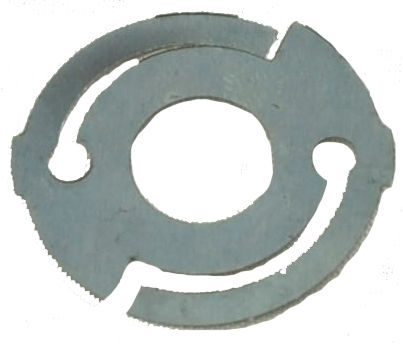
Since you already have a Sailrite LZ-1 you don't need another walking foot machine for your heavy duty work. As for the loops on top, I've found this to be caused by some kind of bottom/bobbin tension problem. I've experienced something similar on both home and industrial machines when springy nylon thread backlashed as I sewed forward too fast. The solution was as simple as adding an inexpensive bobbin backlash washer. It's basically just a thin metal washer you add to the bobbin case that prevents the bobbin from spinning freely. Lastly, most of my repair manuals I got online for free from the manufacturer or from Yahoo sewing machine repair groups. Here is a link to all the old industrial Singer operating and repair manuals. You can learn a lot by reading how these older machines were adjusted and much of that information is applicable to many ss/zz machines since they are similar in many ways. http://parts.singerco.com/IPinstManuals/

PostedFeb 4, 2014 at 11:37 am

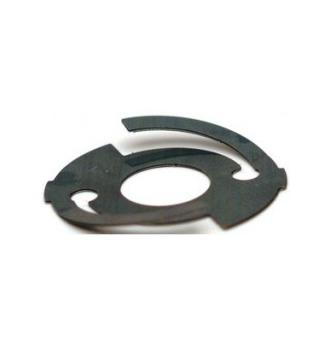
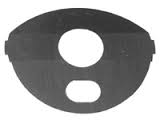
I got my "no backlash spring" off of Ebay, but you could easily make your own out of some thin aluminum or sheet metal just to see if it solves your problem. The whole idea is to prevent the bobbin from freewheeling which can produce a loop. Look at the attached images.no backlash springno backlash springAnother no backlash spring

PostedFeb 4, 2014 at 11:41 am

By the way, the no backlash springs/washers that I got of Ebay fit my industrial machine but not all of my home ones so I just trimmed the thin metal down off the edges with a regular pair of scissors. Adding the washers will create more bobbin friction so you will have to loosen your bottom tension and likely have to increase your top tension a bit.

Roger Caffin BPL Member
PostedFeb 4, 2014 at 11:53 am

I understand the general idea, but I am just a shade puzzled as to how this will stop loops forming on the TOP surface. My machines all have adjustable thread brakes on the lower bobbin assembly anyhow.

Cheers

PostedFeb 4, 2014 at 3:40 pm

I think the reason a loop could form on top from a backlash is because it creates a unique situation in which the bottom thread tension is temporarily reduced resulting in an unbalanced stitch. When a backlash happens, a bunch of loose thread is thrown around the bobbin spindle like when you get a bird's nest in a reel after a bad cast. When the bottom thread is no longer tightly wound, less force is needed to draw it out because the only tension comes from the spring plate and not the added energy of rotating the bobbin. The top tension then becomes relatively higher then before resulting in a loop. However, after a few bad stitches the slack thread is taken up, the bobbin begins to turn once again, and the stitches go back to normal until something else happens. To prevent this scenario from occurring the backlash spring prevents the bobbin from spinning as easily resulting in more even pressure. Of course I'm not positive if this is the case here, but I mentioned it since everyone else brought up the more common reasons for this occuring.

PostedFeb 4, 2014 at 5:09 pm

So I took the tension knob apart and found the the discs were pretty flattened out from 40+ years of use. I successfully reassembled it and did a flat felled seam with vx21 and ballistic that didn't get any loops on top. I went very slow though. I couldn't get the upper thread tension to be tight enough to make for an even stitch even when trying to loosen the bobbin tension. I ordered a new tension knob and I'll pick up one of those bobbin washers as well.

PostedFeb 7, 2014 at 7:47 am

It's sounds like you are getting closer to resolving your loop issues. I've found that sometimes it's a combination of things that cause a stitch to be unbalanced and it takes time to figure things out. By the way, you can oftentimes just buy the tension discs online to replace the old ones; or if they develop deep grooves from years of use, they can be smoothed down with fine wet/dry sand paper.

PostedFeb 9, 2014 at 1:56 pm

I installed the no backlash spring and the new tension knob. The problem still persists with Urtek zipper if i go fast. Luckily it's a relatively short distance to stitch so i just go as slow as possible and the loops don't happen.
I'm taking a look at a used Juki ddl-8500-7 this afternoon that's $230.

Thanks for all the help guys.

Michael

Roger Caffin BPL Member
PostedFeb 9, 2014 at 2:47 pm

I am not convinced that the tension spring is the source of ALL the problem. What is an Urtek zip, what thread are you using, and what size needle?

I ask, because there is a possibility that the the needle is pulling the thread back out of the hole if the needle is too small, is sticky, and/or the zip is plastic coated.

But that's just my 2c.

Cheers

PostedFeb 9, 2014 at 2:51 pm

Yeah, they're plastic coated waterproof zippers. I was using #14 needles at first but switched to #18 to make a larger whole so the thread could move more easily through it.
I'm using gutermann Tera 40 thread.

Roger Caffin BPL Member
PostedFeb 9, 2014 at 3:14 pm

If you sew fast, or the polyester thread has a lot of friction, the needle heats up and you can get a small amount of localised melting around the needle. Melted material then gets on the thread or the needle and causes all sort of problems. This is also a problem if one ever tries to sew through sticky tape: the adhesive gums up the eye of the needle. This will cause the sort of problems you have described. I am not saying that this is what is happening in your case, just that there is a good probability.

If I am right, the 1st 12" are heating the needle up, then there is a problem for a few stitches, but the gunk is then rubbed off, then the cycle starts again but with a shorter 'heating up' distance.

There are several things you can do to handle this IF it is happening. Sewing slowly in the troublesome places is certainly one, to keep the temperature down; using a larger needle is another (you are already doing this); and lubricating the needle or thread is also useful. Commercial machines come with special 'oilers' for this reason.

Not even oilers can really handle sticky tape though – I tried :-)

Cheers

Patti Binder BPL Member
PostedFeb 9, 2014 at 6:02 pm

Michael, I just found this thread And have only skimmed some of the replies so I apologize if I missed something. First I have a question about these thread loops. Is each loop just one stitch length long or as long as 2 or 3? If each loop is longer than a normal stitch, the bobbin hook may not be catching the upper thread every time around.

Patti Binder BPL Member
PostedFeb 10, 2014 at 12:44 pm

So is the space under the thread loop, between the needle holes in the fabric, the same length as a normal stitch, or is it longer?
If it is longer, not the thread but the space on the fabric between needle holes, it could be due to the type of needle. I'm pretty sure that an old Kenmore machine needs an ORGAN brand needle. If you have changed from the needles that came with the machine, to newer SCHMETZ brand needles, this can cause the machine to skip stitches.
If it is not actually skipping stitches, or if changing back to ORGAN brand needles, doesn't totally solve the problem, then I would recommend you have it serviced again.
With an older machine I might not rely on a technician who works mostly on fancy new computerized machines. I would look for someone who has been repairing machines a long time and has lot's of experience with older machines, maybe even someone who repairs industrial type sewing machines. Take some samples of the mistakes, so they understand the problem better, and take samples of the fabric and thread you are using. After the repair, you might even want to sew on your problem fabric with your own thread before you take the machine home.
I hope this has helped. I don't know everything about sewing machines, but have dealt with some of these issues and have done quite a bit of sewing.
Good luck with your gear projects.

Roger Caffin BPL Member
PostedFeb 10, 2014 at 1:53 pm

There's very little difference between Schmetz and Organ Universal-type needles. A lot of the 'difference' is in the eye of the vendor or is just urban myth.

On the other hand, matching the needle to the thread is far more important.

Cheers

Jerry Adams BPL Member
PostedFeb 10, 2014 at 2:23 pm

Sometimes I put in a needle and I get loops and rat's nests, and I put a different type of needle in and it works, but I haven't done scientific experiment – when it starts working good I just focus on sewing.

I have a package of Shmetz Microtex with one needle used, so I think that's one that doesn't work – I used one needle, it didn't work, so I threw it away and left the rest of the package.

I have another unlabeled package with 3 needles used so that one must work. I've used needles successfully three times.

I think this goes in the "Urban Myth" category : )

Roger Caffin BPL Member
PostedFeb 10, 2014 at 2:59 pm

The Schmetz MicroTex needle is very fine, but it is rather specialised (being very thin). It would suit silnylon and M90, but not pack fabric.

I suggest using 'Universal' needles where-ever possible. Schmetz is a good brand.

Cheers

Patti Binder BPL Member
PostedFeb 10, 2014 at 5:47 pm

Couldn't find anything about these needles on Snopes ;)
Maybe it is "urban myth", but I've heard (from people who make a living with sewing machines) that the scarf (scooped out area near eye) on the needles are different. This affects the clearance for the bobbin hook to catch the top thread off the needle. Maybe my imagination, but I have had a some machines(old Kenmore, Juki, and Singer Featherweight) where this seemed to be the case.

Roger Caffin BPL Member
PostedFeb 10, 2014 at 6:53 pm

> but I've heard … that the scarf … on the needles are different.
That is true, but when the needle is 0.8 mm diameter, minor changes in the scarf are going to be very small in size, and not too many sewing machines have such a super-critical alignment of the hook.

I agree, sometimes there IS real gain to be had, but not too often.

Cheers

PostedFeb 10, 2014 at 7:27 pm

Match the needle to the job, and to the thread size being used. As Roger says, there's little difference between needles of the same point style, size, and system, but of different brands, at least for household machines. (There's a much wider quality spread in industrial needles.)

Universal needles try to be universal, and like most universal things, fail to be the right tool for nearly anything. They have a rather rounded point, which makes them not penetrate well, but not enough of ballpoint to work well on knits. They're okay on loosely woven stuff, like many garment weight fabrics. For coated fabrics, I really prefer a sharp point (microtex is schmetz's trade name for their special sharp point) needle. They're available in range of sizes to suit materials of all sorts of weights — (Schmetz make microtex in size 18 (110 metric), which is over kill for the materials we're discussing. A 14/90 is more in the right size range for the stuff the OP is talking about. But materials and machines vary, so do try things and use what works best with your goods and equipment.

Viewing 25 posts - 26 through 50 (of 50 total)
Loading...