I've been sewing with an old Kenmore for over a year now. I've made about 8 backpacks and 4 tote bags mostly out of VX21 and Balistic Cordura and my machine has worked flawlessly until recently. I'm getting these weird loose loops on the top thread when sewing. They seem to occuring at even intervals. I took the machine in to get looked at and returned once more since the issue wasn't addressed it's still happening. The sewing machine repair guy doesn't seem to have any idea what's going on. He gave me bigger needles to use (size 18), silicone thread lubricant (which made it worse), and made another piece to make sure the thread was coming into the tensioner vertically and not from the side. He tried to tell me that the sewing machine isn't suited for this fabric and that my presser foot/fabric combination was the problem.
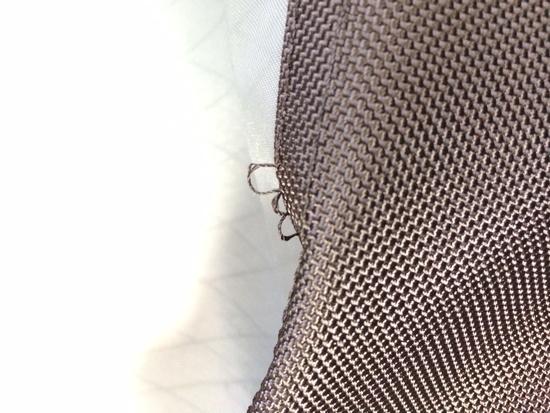
Here's a picture of the problem. If anyone has any experience with this problem please let me know.
Topic
thread loop issues
Become a member to post in the forums.
- This topic is empty.
is the thread going through the correct path?
pull bobbin out of machine, hold onto thread with bobbin dangling, is it held in place? like when maybe you bounce it up and down a little?
maybe the thread sin't going through the tension plates up above?
if the repait person has looked at it, these probably aren't the problem
does it work okay with other fabric?
it's like maybe there's no tension at all
when I screw up threading the thread through sometimes it will act like that.
you've tried a totally different type of needle, maybe try several totally different types
Just to confirm: these loops appear on the TOP surface as you sew?
Could you run the machine by hand please and check the following:
When the needle goes down into the fabric, does the thread get pulled down tight or is there a loop left on top?
If the thread does get pulled down proprly, does the loop appear as the needle rises back out of the fabric?
Also, what weight fabric, what thread, and what needles are you using when the stitching faults?
Cheers
Burr on the bobbin or hook?
yes, the loops only appear on the top surface. I've had this happen with a combination of 210d coated oxford and urtek #5 zippers, 2 layers of vx21, and the vx21/ballistic cordura. the thicker/tougher that fabric combination this is to go through the worse the problem is.
I've tried muiltiple #14 and #18 needles. And I use gutterman tera 40 thread. That's all i've been using for the past 3 months but it's only recently that i've had this problem.
The problem seems to get worse as the stitch progresses. Usually the first 12" are fine then there are 3 loose threads, a couple of inches of tight sewing, then three even looser threads, a couple of inches, 3 more progressively looser threads, etc
I'll try to replicate it by hand, that's a lot of hand cranking though because of the length.
that's what the repairman though but he didn't find one.
WAGs –
When you hand-strip thread from the spool does it come off evenly?
When you hand-strip off the bobbin does it come off evenly?
Bobbin holder and bobbin have no "dings" (from a drop)
Bobbin cradle is lint free?
yes, thread comes off evenly from bobbin and spool. I'm using a thread stand.
bobbin case is clean.
WAG –
How does it do with a "typical" piece of fabric?
I couldn't replicate the problem with 2 or 4 layer thick muslin
I've not posted to the forum before, but have a little knowledge about sewing machines…
My thoughts are that the tension in your thread take-up spring needs to be increased slightly. I am not familiar with your Kenmore model and the upper threading, but somewhere in that process will be a spring that in older models can be rotated to increase the torsion/tension. Newer styles of machine have a take-up spring that is not as easily adjusted, but can be replaced.
Your machine will continue to sew beautifully with thinner materials as the take-up tension is sufficient to pull the thread down. With heavier/thicker combinations it is unable to do that. It gets "tired" after the first 12"!
A thought that might be worth a try….
Is that the same as the upper thread tension control?
On my machine, it is a dial 0-10 that sets tension.
–B.G.–
yeah, i'm starting to think that what happens is that it gets out of the sweet spot in the thread tensioner the provides adequate tension then starts getting loose then gets back into the right part of the tensioner and goes back to normal.
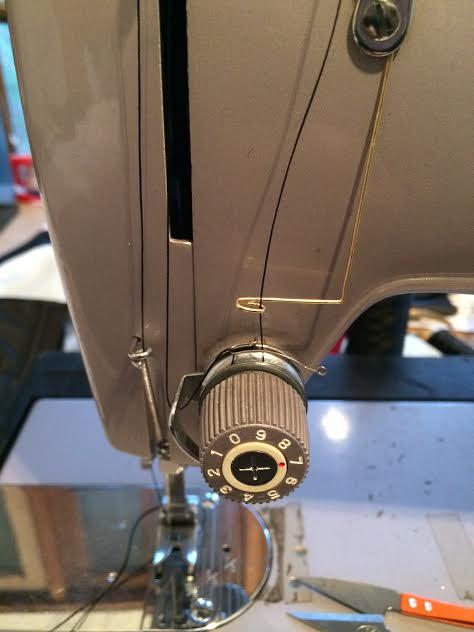
here's a picture of the threading with the additional guide that the repairman made:
Perhaps it's time i upgrade to an industrial machine. I've been selling the bags and backpacks i make for about 6 months fairly regularly and maybe it's time i upgrade to big boy machine.
Michael, I might be way wrong but I don't think you are threading the tension area correctly.
Editing & photos
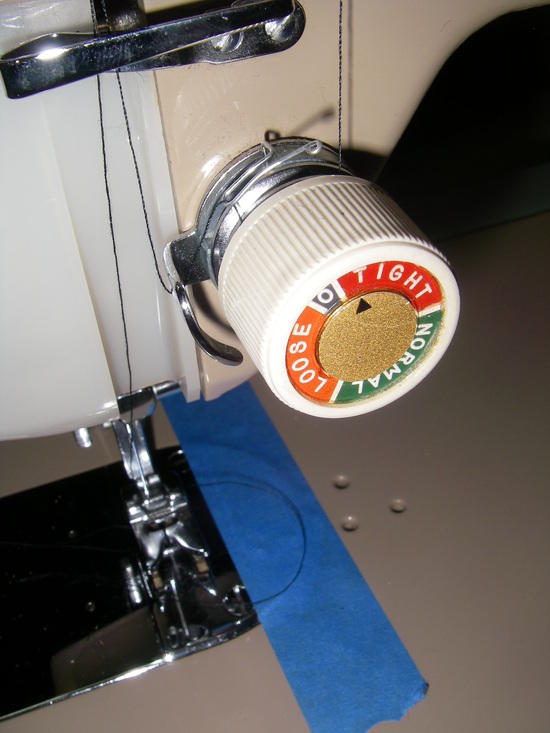
Ok here is what one of my machines looks like

Your pic shows the little wire with the circle too far to the right and the thread doesn't thread thru the loop in the wire (causing bad tension). When you pull the thread under the tension dial (clockwise) continue around until the thread can go on the backside of the wire with the circle on it. Then thread like you have it, you might have it this way already but I can't tell from your picture. Also pull the thread up on the left side of the dial forcing it up inside the tension cams. Try this and see if I'm even close or way off base.
Also, your cams might be a little warn.
A industrial machine is way expensive, a working older machine should be fine.
Tad
It's a kenmore 158.433
the machine appears to be threaded properly. It's possible the take up spring is too far clockwise, but I don't know the machine, nor it's normal behavior. But if the machine worked well for months, and doesn't now, something is broken or out of adjustment. It might not be fixable, or not worth the money if it is, but your service guy ought to be able to tell you what's wrong.
As for industrial machines: A brand new machine, with a servo motor, but no automation (foot lifter, thread trimmer, automatic back tacking…) will run between 600 and 1000, depending on model and source. With all the bells and whistles, somewhere in the neighborhood of $1500 or so, with a bunch of things to choose from. There are, of course, used machines, available at prices ranging from nearly nothing, to two or three times what they'd cost new. If you know what you're looking for, or have some guidance, used machines can be a good way to go. If you don't, paying more and buying from a reputable dealer may make sense.
I don't think we can get much further until we know when the loops form. Does the thread never pull down properly, or does the needle drag the thread back out?
Try using the motor very slowly. 12" by hand seems a bit much :-)
A thought: have you used any adhesive tape on the fabric at any stage, before sewing, to seam seal or bond bits together, or whatever?
Cheers
I'll take a stab at going slowly tomorrow and giving a more accurate description of the problem.
As for industrial machines, I'm looking at a juki ddl-8700 tomorrow with a servo motor that's being sold by an industrial machine repair shop. For $550 it seem like a fair deal compared to the stuff I've seen in the Bay Area. I don't mind paying a bit more just to know that there's someone i can go knocking to if it starts acting up.
If your tension assembly is out of whack, maybe this page could help:
http://mysewingmachineobsession.blogspot.com/2012/08/kenmore-158-tension-assembly_11.html
Disclaimer: I have not done this, and do not know for sure it works. But my tension assembly on my 30 year old Goodwill Kenmore seems to be on the edge of a good range of adjustment, so I saved this link for my own future use. If you end up going this route, please report on your experiences.
William
try sewing some fabric before buying industrial machine
like, the lightest weight fabric you'll ever do, and the heaviest
I have no experience, but maybe industrial machine is designed to do something you don't need, like heavy fabric or high speed
You said you're sewing a lot so maybe industrial machine would be good for you
That is a good price for an industrial if it comes with a reverse and like jerry said, can handle both the silnylon and the cordura.
You will be able to use heavier thread too.
Jerry's right: you want to test the machine. Take samples of the stuff you work with: fabric, thread, straps, and sew them. The 8700 is an okay machine, and should cope with your materials fine. Assuming it's in good shape, and in proper repair, and set up for your materials, $550 is reasonable price to pay a dealer for one.
I sew about 20 hours a week at this point so i think it'll be a wise investment.
Become a member to post in the forums.