Topic

Best baseplate compass

  • This topic is empty.
Viewing 25 posts - 1 through 25 (of 34 total)
PostedJan 1, 2014 at 7:03 am

I am wanting to hone my skills using paper maps and compass for off trail travels. What would be a good baseplate compass to begin with or one that will stay with me as my skills improve?
I can obviously buy them from REI And the like but I would like more expert advice.

Also what type of training is available? Books, online etc. that would be useful resources for a beginner?

John G BPL Member
PostedJan 1, 2014 at 7:43 am

Look for a compass whose needle settles into it's final position fast when you turn 90 degrees and doesn't giggle a lot when you are standing still but breathing hard. I'm partial to Silva for this reason.

I also look for a 2" arrow to make aiming at distant peaks precise. I find this is accurate enough, and much more durable than folding compasses with a sighting system. A 5" total length makes using it with a map easier, but harder to keep in my pocket than 3.5" models.

Some sort of declination adjustment is nice, but not critical. I don't like the tool-less declination adjustments because I worry about it turning itself in my pocket though.

Lots of scale markings aren't a big deal. The map scales tend to wear off, and you only need the scale for the map you are using. I remove the generic scales marks with rubbing alcohol, and mark my long edge with the scale of my map with a sharpy.

Ps: I think selling a global needle to keep the compass needle from binding when not held flat is a marketing gimmick. You can tilt most quality compasses 30 degrees without binding.

Mole J BPL Member
PostedJan 1, 2014 at 7:58 am

I would have a look at Silva compasses. The basic baseplate compasses are fine for general use. (In future, can upgrade if necessary) Their website has some basic info on use.

If very rusty on the fundamentals (e.g. can't name the equivalent bearing of the primary directions!), I would do some basic school maths revision until clear about angles and how to use a protractor before going near a compass – it will really help.

Ken Thompson BPL Member
PostedJan 1, 2014 at 8:11 am

Just remember that Silva compasses sold in the USA are made in China. The ones sold in Europe are made in Finland. I bought a Suunto and would again.

Wealth of information on YouTube.

Orienteering? No clubs near you though.

PostedJan 1, 2014 at 9:13 am

Suunto M3 Global.
While not necessary, adjustable declination makes a huge difference in ease of use of a compass. I don't know why you'd bother with a compass without it, because it's not like it's a feature that weighs anything.

I've read "be Expert With Map and Compass" by Bjorn Hjellstrom but I feel that this book has only a few useful chapters.

The compass chapter in "Mountaineering: The Freedom of the Hills" is about all you need.
Learn about declination, taking bearings in the field and transferring them to a map, map to field, following a bearing, and triangulating. Most of it, in my opinion, comes from practicing a lot; carry maps everywhere and break out the compass and learn to translate what you see on the map to field and vice versa.

The concepts are simple, they just need to be reinforced with constant practice.

Dale Wambaugh BPL Member
PostedJan 1, 2014 at 9:21 am

One of the Suunto M-3 compasses will get you through any course and last. The global needle is not necessary in North America but it is smoother. Either model has adjustable declination, easy to read, big baseplate, etc.

I would check the library for books. REI and hiking organizations offer courses.

Compass navigation is a powerful skill. You get to understand map reading much better as part of the process. It will improve your GPS skills too.

Stuart R BPL Member
PostedJan 1, 2014 at 9:29 am

The best baseplate compasses by far are made by Moscow Compass. Far superior to Silva or Suunto, you have to see one to believe how fast and stable they are. More that a beginer needs but you will not outgrow one of these

http://www.moscompass.ru/mc/cat-en.html

Ian BPL Member
PostedJan 1, 2014 at 11:51 am

Suunto MC-2 is my vote. With some training, the mirror offers some options you cannot get with a mirror-less compass above and beyond signaling airplanes, clearing debris out of your eye, etc. When used in conjunction with your clinometer, the mirror is useful for elevation estimation by aiming at a known point. You can also tell if you're too close to a widow maker among other things. I'll weigh mine later but I believe it's a smart 2.5 oz. ymmv

Brian Johns BPL Member
PostedJan 1, 2014 at 11:57 am

I have used eBay for the last five years or so to score several NIB/NOS made in Finland Sylva brand compasses, usually for about $5. Personally, I prefer the light, simple no frills starter/bases models. See what you can find. Get another for a backup.

Mole J BPL Member
PostedJan 1, 2014 at 12:18 pm

Silva is a Swedish company!
from Wikipedia:
At its production facility in Haninge, Sweden, and in mainland China,[8] Silva of Sweden AB manufactures a wide variety of portable compasses for recreational, hiking, scientific, and marine uses.

(though Silva is owned by Fiskars which is Finnish)

Suunto is Finnish

Recta is another good brand

I had a Suunto MC for years and used it for tree surveys and quick landscape surveying. A bit overkill for backpacking though. (I can estimate a <45* angle easily enough with my hands to avoid a widowmaker!)

I mostly use a Silva Expedition 4 – which is a popular model over here. For trips along trails where nav is mostly obvious I only take a Silva starter which is very small and compact.

I'd enjoy the quick response/settling of a Moscow compass, but even with teaching Scouts nav and doing night exercises couldn't really justify buying it until I lose/break one of my Silvas.

We are lucky here at present- there is no need for declination adjustments at present – where I live the difference between OSgrid North and mag is 30' and gets less each year. (When I was a boy it was 7+ degrees). In a few years, for the first time we will have to subtract instead of adding (and viceversa for the opposite operation)

Ian BPL Member
PostedJan 1, 2014 at 12:28 pm

Interesting. Thought there were only three trees left in the UK.

Scott Hayden BPL Member
PostedJan 1, 2014 at 12:57 pm

My vote would be for the Suunto M3 Global. If you want to save and not get the global needle, get the regular M3. I find they track well. I had a silva. Bubbled once the temp got below 40F. I returned it. Got to love REI.

PostedJan 1, 2014 at 1:44 pm

I have a Suunto M2 Global. Very high quality. The M3 is the baseplate version. Same compass.

You can either get the North American version or the Global version if it's worth 10 bucks for a needle that will move freely with the compass held at more of an angle and be useable if you ever travel to the southern hemisphere. Either version would be good.

I went with the M2 because it usually sits in my pack as a backup for GPS navigation. The folding mirror makes it a little more compact and protected in the pack (and doubles as signaling mirror on the odd chance that I ever need it). I don't think the mirror sighting provides any great advantage for hiking.

I think the declination adjustment is a huge benefit for occasional compass users. I just set it and forget it, not having to worry about corrections. I just have to remember to reset it if I go hiking in a different region.

There are some really good YouTube instruction videos on the basic concepts. If you don't have to correct for declination, it's pretty straightforward.

David Thomas BPL Member
PostedJan 1, 2014 at 1:59 pm

>"I don't think the mirror sighting provides any great advantage for hiking."

Agreed. But the ability to see your face or backside can be helpful for solo first aid.

Dale Wambaugh BPL Member
PostedJan 1, 2014 at 3:06 pm

I use a sighting compass (MC-2G). I could get by just fine with a baseplate, but I got the deal on the mirrored model. It's nice to have the feature and part of the fun of navigating. As it is, the mirror doubles for grooming and is included as part of my signalling gear.

The mirror is really there so you can see who is lost ;)

jim logan BPL Member
PostedJan 1, 2014 at 3:14 pm

I looked at the recommended site for Moscow Compasses and it was old and had VERY poor information. I was so impressed I have already deleted that option.

I don't bushwhack as much as I would like, but I am good for half a dozen or more a year. I have been using a Brunton Model 8096 Adventure Racing Compass for several years on my bushwhacks and I am satisfied with it. I have used it enough that the scales on the baseplate are now barely legible. It settles quickly and is easy to read.

I note Brunton has not made this list and elsewhere I have seen comments saying to avoid the brand but never seen why. Any information, preferably backed by experience, would be greatly appreciated.

PostedJan 1, 2014 at 4:09 pm

As I understand it from researching a compass purchase, Bruton at one time made excellent compasses, but the brand changed hands, production moved to China and the product is no longer the same quality. Old Brutons, good. New Brutons, buy a Suunto.

Suunto MC3 and MC2 were the overwhelming recommendations that I saw among the currently available options — or the very heavy duty military sighting compasses that are kind of a in a different category.

PostedJan 1, 2014 at 5:59 pm

The Field Navigation course at our technical college (a requirement for Forestry, Fishery, Wildlife, Environmental and Natural Resources technicians) has always recommended either the Suunto MC-2 or the Silva Ranger.

But when the campus bookstore's supply of Silva Rangers came in this year, many of them had bubbles. Of the rest, several developed the bubble quickly, or soon had broken declination adjustments. There have been similar problems the last couple of years with Silvas. Meanwhile, the older Silva Rangers (European made) have proven reliable over decades of use by college staff. If you buy a Silva, buy an old one. The Suunto MC-2 is still a solid, reliable compass with great features, and I've not heard of anybody having trouble with one.

The sighting mirror on a compass (aside from its multipurpose use in first aid and emergency signalling) allows great precision in field navigation and mapwork. (Whether you need this depends on your intended use and terrain, of course.) Using your dominant eye (important!), hold the sight to the landmark at eye level, and look at the compass dial in the mirror. This lets you see both landmark and azimuth at once, in perfect alignment. Should you find yourself navigating in conditions of reduced visibility or short sightlines, the ability to locate a point to walk towards (a treetop, for example) so precisely can, in the long run, save a lot of course correction. And if you are trying to put something on a map, the more precision the better.

Roger Caffin BPL Member
PostedJan 1, 2014 at 7:25 pm

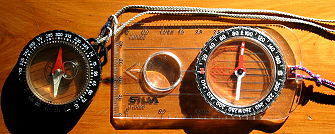
I don't think there is ever a 'best' compass. But few good navigators need anything more than the most basic of models, as shown here.
Compasses
I have used both of these to navigate across Australia and Europe.

Cheers

PostedJan 1, 2014 at 7:45 pm

If US-sold Silvas are made in China then get a Suunto with settable declination and a sighting mirror. You need a compass that is graduated in 2 degree increments to permit accurate readings.
If you travel the world get a "world" capable compass, not just one for the northern hemisphere.
Also a built-in inclinometer is necesary for travelling in avalanche taritory in winter.

My old Silva Ranger is my backup compass.

P.S. GOOGLE "orienteering compasses" for best results.

PostedJan 1, 2014 at 7:49 pm

"I don't think there is ever a 'best' compass. But few good navigators need anything more than the most basic of models, as shown here."

+1 to the Silva on the right. Been my go to for years.

Roger Caffin BPL Member
PostedJan 1, 2014 at 9:27 pm

Hi Dale

> What, Roger, no songlines? :)
Um – reference? Blue Gum Songline?

Cheers

Viewing 25 posts - 1 through 25 (of 34 total)
Loading...