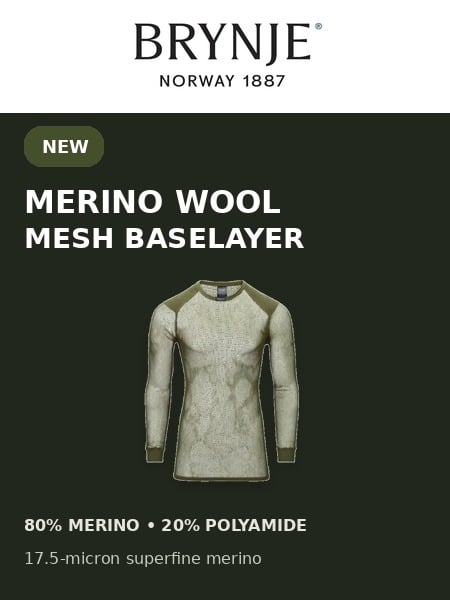
Alpaca fiber and Merino wool have many similarities, but some important differences. Similarities: Both have great odor control, both quite insulating (if the fiber size is similar Alpaca will be more so), and both are heat retaining when wet.
Some important differences, Alpaca is innately less itchy because the scales on same are of a lower height, less of them, and generally the fiber is smoother. Merino is not itchy if the fibers are small enough, and anyways what happens with a lot of sport merino garments is the scales are taken off or filled in to make laundering easier and more fool proof.
Laundering Alpaca is innately easier, because it has less tendency than untreated Merino to felt and thus doesn't shrink as much.
Importantly, Alpaca has a much higher tensile strength than Merino, is less moisture absorptive, and usually has at least semi hollow fibers (either pockets of hollowness, or in the more guard type hairs fully hollow cored) which means it dries faster/wicks better and is warmer per similar sized fibers (however, a garment made with much finer, solid fibers can be more warm and air trapping than a garment made with more coarse/large but hollow fibers).
Someone once argued with me on another forum that Merino is ultimately tougher and stronger than Alpaca because even though Alpaca has a much higher tensile strength, Merino fibers lock together which greatly increases the overall strength and durability. This is actually true up to a point.. however relativity. This debate got brought up in the context of backpacking, baselayers, and sport/outdoor's brands.
If you took say a non sports brand Merino wool sweater, that is untreated, and you deliberately felt it (entangle the fibers together), you can create a fairly strong and durable fabric–stronger and more durable than Alpaca. However, this just does not apply at all to most popular, sports wear merino out there–especially baselayers made by the well known and popular brands that cost an arm and leg usually.
The reason why it doesn't apply is because most of these companies either take off the scales of the fibers (which is what potentially entangles the fibers together and also really shrinks the garment) or they fill them in. Either way the point is, is that it doesn't apply in these baselayer cases and Alpaca's strength and durability is far superior. Alpaca has one of the highest tensile strengths of any natural fibers, 2nd only to silk and some bast fibers (like hemp, linen, etc).
I've actually noticed that in the last couple of years, that i've begun to see more Alpaca based baselayers being marketed, and honestly, it's about time because Alpaca is in many ways superior to Merino. Just think of it in evolutionary terms. The Alpaca is an animal that has been bred to a more extreme climate than Merino Sheep. While Merino have in recent modern times been exported/imported to more extreme climates (partially to force them to adapt by making finer fibers that trap more air, etc), it will take time for them to catch up to the Alpaca origins which evolved over a long period of time. In the high Andes where Alpacas originated, they can experience temps anywhere on average from -30 degree F, to above 100 degrees with super intense U.V., and in the paramo levels lots of rain/snow and moisture at times, but in other places desert like. The Alpaca's "wool" developed to be able to handle all these and keep the animal alive and in relative comfort.
I've yet to get any Alpaca based baselayers because of the high prices. I do have and use Alpaca sweaters (and hats) which i really like, but not so much for backpacking because they are heavier and warmer than what i need for hiking in most conditions, and for rest/camp, down just makes more sense because it's so light and packable. And while they handle moisture extremely well for a natural fiber, they still aren't as quick drying as thinner poly based fleeces, polypro or the like. But i would love to eventually try some thinner/lighter Alpaca based baselayers.
Interestingly, the former CEO for Malden Mills which makes Polartec, started a company based on making unique, natural fiber based baselayers primarily out of Alpaca, but with some added Tencel (to further increase strength, durability and softness and maybe to lower cost some). Alpaca btw, is also more innately "eco" friendly to the environment than Merino sheep are.
Here's a link to the company:
http://www.komafram.com/
And here's a very interesting article from the media about the company and their somewhat unique products:
http://alpacaculture.com/index.php?option=com_content&view=article&id=643:performance-meets-luxury-in-komaframs-alpaca-blends&catid=35:north-america
It's funny, but when i brought this up at another forum a couple of years ago or so, people there derided, made fun of and basically told me i was stupid for advocating the use of Alpaca over that of Merino. However, it seems that people and companies (aka the "mainstream") are starting to finally catch on to the very nice combo of properties of Alpaca fiber based garments.
Anyone here who has and uses Alpaca based baselayers? If so, what do you think?