Topic

What’s it like to bushwhack after a large forest fire?

  • This topic is empty.
Viewing 12 posts - 1 through 12 (of 12 total)
Kevin Burton BPL Member
PostedSep 3, 2013 at 11:06 am

So let's say your national park has a fairly significant forest fire.

Granted it's sad… but it happens. It's also part of nature (assuming the vast devastation isn't because the forest service was preventing natural fires or not lighting control fires).

I was thinking that it could open up new bushwhacking opportunities. You could go places and get to things that normally wouldn't have been possible due to the forest being in the way.

Take a cross country hike to that lake you've always wanted to fish. Find features in the mountains that normally couldn't be seen (caves, waterfalls, etc).

Thoughts?

Kattt BPL Member
PostedSep 3, 2013 at 11:12 am

Bush whacking would be easier but you would get dirty !!
Also, poison oak loves to grow right after a fire. In our area we now have Poison Oak, thistles, blackberries, bind weed. All the lovely stuff.

PostedSep 3, 2013 at 11:57 am

it's Great !

if it's really beuno burn, you'll find old mining ditches, camps, digs, and all manner of neat stuff normally lost to humanity.
a year or two later you'll get mono-cultures of flowers, thusly it can happen massive orgasmic assaults of color. it's all good.
if the fire is wussy and insufficient, the deadfall may not be properly obliterated, and then you get filthy crawling thru it.

for a variety of reasons, surface water can be hard to find in roasted areas.

v.

Gary Dunckel BPL Member
PostedSep 3, 2013 at 12:12 pm

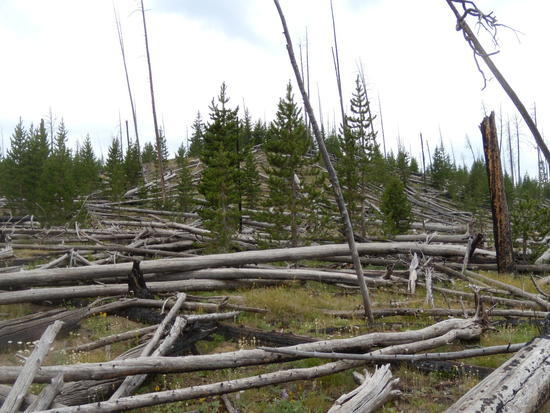
In 2006, in Yellowstone, I had to go off-trail to get around a huge bison that was standing on the trail staring at me. It was the hardest hiking I've ever done. The fallen dead trees from the 1988 fire were piled up maybe 4' off the ground for as far as I could see, and I had no choice but to climb up and carefully walk on top of them, stepping from one to another. I went maybe just 50 yards in 45 minutes, and I was worried about blowing an ACL the whole time. The funny thing was that when I figured I'd made it safely past the bison, and I went back to the main trail, there he was! He followed me, probably out of curiosity, but who knows? So I had to go back in, climb up onto my logs, and struggle for another 50 yards again. This time, he lost interest, and I could scoot on down the main trail. I've never had to work so hard while hiking.

Here's a photo of the general area where my bison incident occured. I took the shot this summer, but you can imagine how tough it would be to go off-trail here.

Grebe deadfall

Ryan Bressler BPL Member
PostedSep 3, 2013 at 12:19 pm

As a mushroom hunter and a backcountry skier i've done this a ton in different seasons and in burns of different ages.

It does open things up.

It also creates new hazards like hidden holes where the roots of tree burned out, standing dead snags and hordes of morel hunters.

I find myself coughing at the end of a day in a recent burn and wouldn't enjoy spending multiple days within one though using it to access higher less burned ground above the previous tree line could be okay.

A few years down the line can be quite nice though downed trees can become an issue as standing dead snags fall in windstorms…avoid ridge lines that get the worst of this.

In winter, the opener terrain is a big plus for skiing until enough of the snags fall over at which point it can require very deep snow to be easily passable. There is a local tour here in an area that burned in 2000 that was apparently really good about 5 years ago but is now not really doable.

David Thomas BPL Member
PostedSep 3, 2013 at 12:52 pm

A few, varied experiences:

After the Oakland Hills 1991 fire, yes, things completely opened up because it was an unusually hot and long fire. Houses were reduced to just white ash on the (badly spalled) concrete foundations, with a chunk of metal where the water heater had been. A friend had a huge set of Calphalon pots in his kitchen and there was a pool of aluminum 20 feet below on the ground afterwards. A fire like that will make passage easier, but it is rare for a forest fire to burn that hot for that long – in addition to substantial natural and landscaped plants there were decades old, the houses themselves burned so completely as to be a major source of fuel.

I hiked in Yellowstone shortly before and a year after the big 1988 fires – the trees were standing dead and there were tons of wild flowers. It was especially striking when viewed from a distance. Up close, looking at the ground, you saw small spots of color in a blackened landscape. Kind of like Death Valley in Spring – the wild flowers are more striking when viewed from a distance and at a low angle.

As Gary mentions above, after many years the dead trees get blown down – we get that in Alaska due to both fire and beetle kill. Then the going gets really, really slow. Slow and blackening with burnt trees. Even slower and more of a thrash with beetle kill because all the branches are still on the trees. In northern and high elevation areas, it can take many decades for the roots to rot enough for the tree to blow down. There are still lots of standing, dead spruce from salt-water intrusion after the 1964 Alaska earthquake.

I catered a wedding on top of Half Dome in 2003 and there were fires going on at the time – helicopters were performing water drops nearby. The couple went up Snake Dike (I did the cables because I smoked salmon, champagne and wedding cake for 30 people in my pack) and the bride melted her approach shoes on the hot ground.

The 1995 Mount Vision fire at Point Reyes was extensive and hot. It was very open for about two years, but the bishop pines came back so thick and dense – spaced just inches apart – that hiking off-trail soon became impossible in many areas.

Expect a mosaic of conditions – untouched stands that were better hydrated, heavily burned swaths and areas where the undergrowth was burned out and the trees killed but not burned. Don't expect a lot of easy straight-line paths from A to B.

Ike Jutkowitz BPL Member
PostedSep 3, 2013 at 12:57 pm

4033
It certainly clears out the undergrowth and is great for mushroom hunting or berry picking. If fishing is your goal though, fires often kill off a significant portion of the fish population due to deposition of sediment and ash in the water.

PostedSep 3, 2013 at 1:00 pm

Timmmmmberrrrr!! Heads up. When hiking Yosemite sometime in the early 90's I could hear tree falls every few hours due to previous fire. Wild flowers are normally prolific in ensuing seasons.

Nico . BPL Member
PostedSep 3, 2013 at 2:47 pm

It's a mixed bag…

A lot of my local national forest and wilderness areas burned in a series of fires over the last 5 or 6 years.

I recall one particularly good example of hiking in an area after a fire…
A couple of months after the Zaca Fire burned through most of the San Rafael Wilderness, I did a ~40 mile mostly on-trail loop with a friend to suss out the damage and take advantage of the incinerated brush to explore off-trail areas along the way and search for previously unknown native american rock art sites, etc.

The thinner brush was great for getting off trail and being able to reach previously unknown or inaccessible outcroppings and caves. We found some sites with evidence of Native American occupation/use that were new to us. In that respect, the fire provided a unique opportunity to explore some new areas in a much more efficient manner.

On the other hand, the landscape was sparse and looked like the moon. Ash clouds would get kicked up with each step as we walked. Camps and landmark trees were obliterated and basically vanished other than a few metal signs and ice box stoves. The trails were completely gone in areas where heavy rains in the months following the fire washed away all the top soil. Swimming holes were gone; filled in with soot/debris. Creeks and streams were also significantly reduced in capacity. Wildlife sightings were down to nothing.

We bushwhacked along, fighting the charred skeletons of brush for mile after mile. Weaving through the charred remains of chaparral and stepping over endless tree falls is really slow going. By the end of the trip, we were quite the sight… Scratched arms and legs, torn clothing and packs, covered in soot, and to top it off, I got a bloody nose after a particularly stubborn branch snapped back and hit me square across the face, so I also had blood splattered all down the front of me. We looked, and felt, like we had just battled our way through one hell of a challenging hike.

And yet, I'm sure after the next fire(s), I'll be back out there again capitalizing on the opportunity to explore areas previously hidden by decades of brush.

Oh, and I don't know if this would grow where you hike, but watch out for Poodle Dog Bush. It's a particularly nasty CA native plant that grows in burn areas; it's typically found from the southern Sierra south to Baja. It gives a rash similar to poison oak. No bueno.

Roger Caffin BPL Member
PostedSep 3, 2013 at 2:49 pm

In a word – FILTHY!

Been there, done that. You get covered in ash and charcoal. It billows in clouds around your feet.

Cheers

M B BPL Member
PostedSep 3, 2013 at 6:51 pm

I agree, its filthy.
You get filthy. Your gear gets filthy, clothing gets filthy.
Theres no shade.

Then you find shade and sit in it, and the burnt up needles and twigs under your butt leaves sap on your pants.

Viewing 12 posts - 1 through 12 (of 12 total)
Loading...