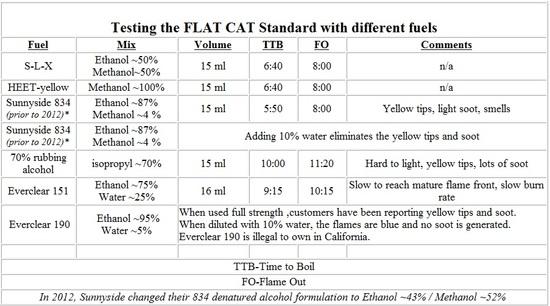
A while ago I realized my chemistry was just too rusty, and that the information about the efficiency of the various alcohols too mixed up re units and other non consistent parameters, so, wanting to take a break from other projects, I sat down and tried to figure it all out. I just created this alcohol stove fuel efficiency for methanol / ethanol page to collect all the information I could find, and to force me to refresh my ancient chemistry education, which is far more than rusty at this point.
That page has everything I can find in terms of the energy contents off the fuels, how to calculate them, sources, the result being: methanol (15.8kjoules per ml) and ethanol (21.1 kjoules per ml), and gives me a baseline to try to figure out the actual energy content of the commercially available denatured alcohols. For those who can’t wait to read, the bottom line is at 100% efficiency, 6.7 ml ethanol brings 2 cups of 70 F water to a boil, and 9 ml methanol does the same. I also include a short table with 70F, 50F, and 35F starting points. Ethanol contains about 33% more energy per ml than methanol, and methanol has about 75% the energy of ethanol. Translation: if someone says x ml boils 2 cups without telling you what fuel they are using, the information is not particularly useful.
I tried to include everything relevant to the use of alcohol in this, along with some early stove efficiency results based on my own tests, but the main point is to just force myself to actually learn the chemistry.
I realized this morning that I will be able to actually calibrate the efficiency of stoves using either 100% methanol (HEET), or 98% ethanol that I just ordered (e98 racing fuel), which is actually as cheap including shipping as klean strip green. If the racing ethanol is what it claims, it will be a great fuel. I include sources and links (where needed) for all the fuels in an appendix in the article.
Once I have those two ranges, I’ll be able to calculate the actual energy content of things like SLX, which I believe is somewhere around 60% methanol based on my early tests and calculations. Likewise via this method I should be able to get reasonably close to learning the actual energy content of more readily available mainly ethanol fuels like klean strip green, which I am suspecting is around 85% ethanol, though that number probably varies batch to batch depending on the price of methanol/ethanol. My guess is due to the current low price of natural gas in the US, they are putting more methanol in these denatured alcohols than previously (most methanol is made from natural gas, not wood on industrial levels if I understand it right), thus dropping their per ml efficiencies.
I still need to refresh my memory on how to calculate more readily combinations of different energy densities.
Since it’s virtually certain I’ve made chemistry or logic errors, feel free to offer corrections etc, I’ll update the information, and also check it with a real chemist to see if I messed up really obviously somewhere.