"Another side benefit, filling the jetboil with clean snow was as simple as shaking it off the tree branches into the cookpot. This could be done, little by little for better efficiency without stopping the stove. Plus you can watch the flame and make sure it doesn't got out.
Of course, this could be a big no-no. "
Deniel, I don't see any issue with melting snow shaken off of trees slowly other than it might not be as efficient as doing a one full pot with the stove on high.
It is interesting to note that of all of the first hand reports of canister failures none reported the the canister exploding. The two second had reports (I heard from soneone …) included canister explosions. The two second hand report don't appear to be more myth than reality to me.
BPL did acually run a story about canister safety and one canister was actually heated until it failed. It failed at 98C and it took 16 minutes to heat it up to that point.
http://www.backpackinglight.com/cgi-bin/backpackinglight/exploding_gas_canisters_the_hazard_of_overheating#.UWTvyaLQpCw
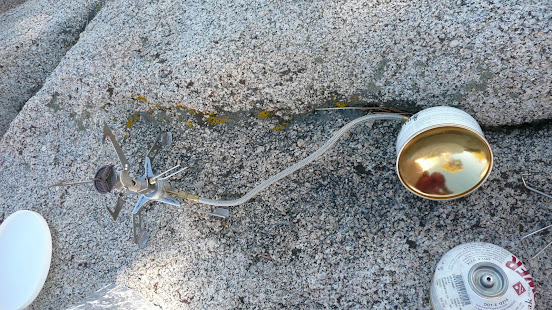
Note a canister is made of 3 parts, the valve, the main can, and the bottom of the can. All are tightly crimped together. When a canister fails it will fail in its weakest spot which is likely where two parts are joined together. So the most likely failures are:
1 A seam ruptures and the all the gas is released and the can stays in one piece.
2. A seam ruputes and the two parts of the fly of in oposite directions.
A failure of two seams at the same time is note likely to happen because one seam will always fail first and when it does the pressue in the can goes to zero before the second seam will fail. The only way you can get more than three seperate pieces of metal would require high explosives.
If a canister is going to explode in front of you you will get burned by the fire and one piece of the can might hit you and cause an injury (likely a cut) while the other will be moving in the oposite direction. You won't loose multiple limbs due to flying metal.
A spark hitting a leaking canister will not cause it to suddenly explode. There is no air in the canister so there is no way for a fire to occur in the canister. However outside the canister will be fuel will burn. That burning fuel could heat the canister and it might heat it enough to cause it to explode. However as fuel burns the The amount of fuel left in the canister drops and the loss of fuel will also cause a cooling effect In short there is race going on when a leaking canister burns. Will it get hot enough to explode before it runs out of fuel? My guess is that in most cases it will run out of fuel before it can explode. Also in most cases it will take several minutes for the can to get hot enough to explode. More than enough time to get up and walk to a safe distance.
In short if your can leaks and catches fire, try putting it out with dirt or water and if possible throw it into snow or a lake. If you can't do that within 20 seconds the best you can do is to move to a safe distance and wait for it to be over. Most of the first hand reports on this forum of leaks and fires are consistent with trying to put it out and if that failes walk away.
From my own limited experience with white gas stoves, white gas is more dangerous.
Before I got into boy scouts my dad had burned off the paint on two stoves due to problems priming them. In scouts I had to use them but the adults kept a very close eye on us to insure we used them safely. Fortunately we had few fire balls while using those stoves. Then in one day in a multi troup camporee I heard a scream and commotion. Later I learned a scout had remove the fuel cap from a white gas stove and poured the fuel in the cap and then put the fuel in the fire (it was a very wet day). He didn't notice a small flame on the cap and when he put it back on the stove. He suffered serious burns on his face. There were apparently other incidents and a year later the local scout councel decided to ban the use of white gas stoves in scouts.
So before the age of 16 I had seen several fire balls and one serious accident with white gas. From then on in scouts we had to use propane stoves. The green canisters were haavy but they were easy to use and we had no safety problems with them.
Once I got back into hiking I purchased a butane stove. Never had anything serious happen with them. I have recently had one case were the stove wouldn't work. I remove the canister inspected it and put the can back on. Then it worked normally. Don' know what happened but it wasn't dangerous. No one I know has had a problem with butane.