


Because we all love the lightest (especially when it is 7.5 times lighter than air and almost as light as helium)…
http://www.cnet.com.au/graphene-aerogel-is-the-new-worlds-lightest-substance-339343765.htm
Topic
Become a member to post in the forums.
Because we all love the lightest (especially when it is 7.5 times lighter than air and almost as light as helium)…
http://www.cnet.com.au/graphene-aerogel-is-the-new-worlds-lightest-substance-339343765.htm
Where can I get myself a coffee mug made from this stuff
Sorry old news here. Put in Aeorgel in the search box.
"Now, a new graphene aerogel created by scientists led by professor Gao Chao at the Zhejiang University has swept past, weighing in at just 0.16 milligrams per cubic centimetre.
"For reference, the density of air is 1.2 milligrams per cubic centimetre — so the new material is 7.5 times lighter than air. It's twice as heavy as hydrogen — the lightest element there is — but beats out helium, which has a density of 0.1786 milligrams per cubic centimetre."
The concept is old, but the graphene/nanotube substrate is new. And amazingly light.
So I have to wonder, since it is 7.5 times lighter than air, why doesn't it just float off the rice?
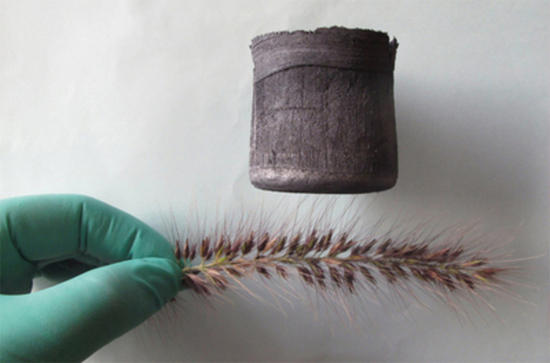
Edit: see below
It has to do with density. Think about liquid oxygen- it doesn't float away.
"It has to do with density. Think about liquid oxygen- it doesn't float away."
Liquid Oxygen is far more dense that gaseous oxygen. What's your point?
I found this on gizmag.com –
"Regarding those questioning why the aerogel is not floating away, here's my understanding of it:
The term "density" could be slightly misleading in this context. The figure of 0.16 mg/cm3 actually refers to the weight of Graphite used in producing 1 cm3 of the aerogel. This does not take in to account the weight of air that occupies the empty areas between the Graphite structure.
Carbon has a density of 2g/cm3 and is approximately 2000 times heavier than the surrounding air (depending on what form of carbon you take in to consideration). Essentially the aerogel uses 0.00016 g (equivalent to 0.00008 cm3 of Graphite) to fill a cm3 of space. This leaves 99.992% of the material empty to be filled by the surrounding air.
No matter how little material is used in making the structure, an open form structure filled with air would always be slightly heavier than the surrounding air due to the presence any trace of denser than air Carbon within it. The only way to make it lighter than air would be to produce a closed structure filled with a lighter than air substance or a vacuum.
Correct me if I'm wrong someone, it is Monday morning after all!
secondclassmale
25th March, 2013 @ 03:25 am PDT "
Greg, my understanding is the same as yours. The graphene aerogel would have less mass in a vacuum than the same volume of helium or air has at atmospheric pressure.
A chunk of the graphene aerogel might float in air if the interstices were filled with hydrogen.
Yes, I believe the answer is that the volume of the aerogel is in fact mostly air. It doesn't float because the density of the non-air part at the microscopic level, what little there is of it, is of course not lighter than air it displaces. Aquagels are near cousins – they are almost entirely water, but many feel dry to the touch.
I'm guessing no mugs any time soon – while the good news is that it can be lifted with a delicate object, the bad news is that it probably would be get crushed (perhaps "squashed" is a better word) by anything much more substantial. Since it is hydrophobic it would hold water if it were strong enough.
Full disclosure, I'm a physicist, but my PhD is in theoretical physics, and we are mostly full of shit. You definitely don't want me working on your car.

It doesn't compress tho, right ? Sounds like it is a rigid structure capable of supporting thousand of times it's weight.
>"my PhD is in theoretical physics. . . . You definitely don't want me working on your car."
I hiked with a theoretical physicist at Berkeley and each time he went to CERN it failed and shut down. He didn't (and probably for good reason) own a car.
My brother in law is a experimentalist in Molecular Optics, entangling photons and finding exceptions to the Heisenberg UP. Back when he had a car, I had to show him how to work on it.
Tom and Ray Magliozzi (the Cartalk guys) sometimes fancy themselves physicists, but Ray graduated in Humanities (albeit from MIT) and Tom in Chemical Engineering also from MIT.
>"Sounds like it is a rigid structure capable of supporting thousand of times it's weight."
Yes. But thousands of times its weight is a few grams. When I've seen it proposed for use (if prices drop), it would be protected by outer layers of material.
Hey, I'm an experimentalist, and I work on cars all the time! Currently I'm keeping a number of cars going into their third decade, even longer in some cases.
However I do concur on theoretical physicists. ;-)
"I hiked with a theoretical physicist at Berkeley and each time he went to CERN it failed and shut down."
Yes, this is a possible example of the Pauli effect. The "Pauli Effect" (not to be confused with the Pauli Principle) is the apparent spontaneous self-destruction of mechanical/experimental apparatus when a theoretical physicist is nearby. The effect goes inversely as the square of the distance, but is believed to be proportional to the genius of the theoretical physicist.
Its namesake, Wolfgang Pauli, was such a powerful theorist that his mere presence in the same town could cause experimental apparatus to blow up. There was even one documented case where an experiment at the local university in Germany failed at precisely the moment a train carrying Pauli passed through the town.
From wikipeadia: "An incident occurred in the physics laboratory at the University of Göttingen. An expensive measuring device, for no apparent reason, suddenly stopped working, although Pauli was in fact absent. James Franck, the director of the institute reported the incident to his colleague Pauli in Zürich with the humorous remark that at least this time Pauli was innocent. However, it turned out that Pauli on a railway journey to Copenhagen switched trains in Göttingen rail station about the time of failure. The incident is reported in George Gamow's book, Thirty Years That Shook Physics,where it is also claimed the more talented the theoretical physicist, the stronger the effect."
My own Pauli effect has been verified many times, but its strength is far, far less than Pauli's. I have to be in the same room, but if I am close enough to touch anything, watch out!
The Pauli effect is much weaker with earth scientists, but they have their own reputations:
Sign in the ET shop: "I KNOW you have a PhD, don't touch anything anyway!"
One scientist was infamous for twiddling with the knobs of sensitive equipment, and really messing things up. So the ETs built a fake board with lots of knobs and switches, so he could fiddle to his heart's content. He totally fell for it, twiddling knobs, looking at the output, and stepping away satisfied. I don't think he ever found out!
I was told by our Techs to "keep your hands in your pockets, unless you can fix it with a sledgehammer. And if you can't fix it with a sledge, please ask one of us for help."
I don't recall ever screwing up anything, but I think that comes with the territory.
Similar tale from when I was a graduate student, maybe apocryphal:
I was doing research in 1977 at a large national lab that got visitors from all over the world. The apparatus I worked with used film cameras to record particle collisions (it was the Fermilab 15-foot bubble chamber, for techies). Contrast and picture quality varied for no good reason. But experimenters were always asking the lab crew to make adjustments. I was told the crew installed an adjustment box in the experimenters area so they could make the adjustments themselves.
This made the experimenters very happy, and they stopped bothering the crew.
One day an enterprising graduate student opened the box to see how it worked. There was nothing inside.
Become a member to post in the forums.
 Brynje Mesh BaselayersBrynje baselayers use open mesh construction to move moisture away from the skin, create insulating air pockets, and help regulate body temperature across changing conditions and activity levels.
 © Beartooth Media Group Inc.
 Loading...