Topic

BD Epic tents in the Sierras?

  • This topic is empty.
Viewing 21 posts - 26 through 46 (of 46 total)
PostedApr 1, 2007 at 4:21 pm

They are still the only light poles around? That seems crazy. Anyone tried adding reinforcment after the fact? They could be wrapped like fishing poles without adding much weight. Does fibraplex guarantee them?

Beyond that. I really don't mind the weight of the 'al you mineum'

D L BPL Member
PostedApr 1, 2007 at 10:29 pm

I have a BD lighthouse and I am always nervous about it's performance in extended rain (I am in WA state where it can rain for weeks on end). So far I've been out in some pretty wet conditions and I had been taking along a lightweight bivy just in case I ended up needing shelter inside my shelter. What I did find is that when the tent finally did wet out, water would start dripping in from particular spots, and start to spread from there. I also found that the wetting-through would always start where the tent poles came in contact with the epic fabric. I found that I could greatly increase the water resistance by taking a brush and "sealing" a strip along the entire areas that the poles touch the tent. You have to use the silnet sealant for epic, but now that I have done it, I haven't had a wet-out yet. I am still nervous about it, though. If I were in California, I would consider it adequate (I used to live in CA), but for WA I am still looking for the perfect lightweight, waterproof, breathable, freestanding, 2-person tent solution (if such a thing exists).

EndoftheTrail BPL Member
PostedApr 1, 2007 at 11:15 pm

Den:

What you wrote above is consistent with my experience with the tent as well. Rain hitting the sides of the tent will just flow downward and onto the ground. It's rain hitting the top of the tent that would have more direct force and also more likely to "pool" a bit — at least around the apex.

Now adding to the above, you have the force of the poles pushing UPWARD against the fabric — and stretching the fabric out so to speak. It would make perfect sense that wetting out — when and if it occurs — would start at and around the top — where the poles are tensioned against fabric — and where rain comes down with the most direct force. The wet out then continues along the lengths of the poles where the fabric is tensioned.

Not sure if you live in a house or apartment, but is there a way you can leave your tent set up in the rain for a day — and checking on it every now and then to find out the extent of its resistance against wetting out? Just knowing will give you more comfort and confidence with your tent. I have tested my tent both empty and occupied. I've found that the accumulation of condensation — when the tent is occupied — can cause havoc (internal dripping) before actual wet-out occurs.

Thus far, we know that the tent can wet out anywhere between 5 and 12 hours — depending on 'circumstances'. Given this wide range, the more user feedback we get, the better. Thanks.

D L BPL Member
PostedApr 1, 2007 at 11:23 pm

I live in a house and I have left it setup in my backyard a couple of times during rainstorms. The problem is trying to figure out at what point it wet out in my backyard while I was asleep or at work, etc. Since I applied the strip (about 1" along where the poles push the fabric out) I have had the tent setup for over 24 hours without wetting through; but I'm not sure if it kept raining all night or not. I slept in it overnight and it still did not wet out but I still wasn't sure that I had a continual rain all night. I left it out during a heavy storm where I was sure it was going to rain (very hard and constant) for days straight, but the ground got too soft and the wind got too strong and I found the tent plastered upside down up against my fence. I'm lucky it didn't fly away or do any damage. Since the vent was open, it was soaked inside so once again my research is somewhat inconclusive! I think I'm just going to have to go out and do more overnighters in rain season. Usually if I know it's going to be raining, I opt to bring my Hubba Hubba since it's nice to have vestibules.

EndoftheTrail BPL Member
PostedApr 1, 2007 at 11:27 pm

You know, researchers have sacrificed themselves in the name of science by inserting their bare arms into a container filled with 'thousands' of mosquitos! And mankind has benefitted from their work.

I think you should 'suck it up' and camp overnight a couple of times when hard/continuous rains are forecasted. Didn't it rain for days and days just a few weeks ago in your corner of the woods?

Oh, and whatever you do, keep awake! :)

EndoftheTrail BPL Member
PostedApr 1, 2007 at 11:30 pm

Oh, and the old saying: even a freestanding tent needs to be staked down!

Kidding aside, I think brushing an inch wide of seam sealant along the fabric where the poles push up against is a great idea! Test when you can, and have fun with your tent!

PostedApr 2, 2007 at 12:19 am

Den, Ben,
My BD Hilite arrived today, and I am eager to test its waterproofness before and after sealing it.
Ben, I know you strongly suggest sealing it, and I will once I determined where the real weak points are; seams, etc..
Den, forgive my ignorant question, but did you silnet seal the outside, or the inside, along the poles?
Kevin, I am encouraged by your personal experience with epic tents, and echoing the research I did about this tent being used in alpine environemnts. It is not waterPROOF; but probably water resistant enough for what I would encounter here in Japan.

In the absence of rain I will use a fish pump to circulate water over the material in a closed loop for my test. Of course I will edit this if I have worthwile results.

PostedApr 2, 2007 at 3:12 am

This debate about waterproofness of Epic is not new and will not go away.
As it happens I have a Lighthouse and have used it for a while before I got the Rainbow. On several outings the Lighthouse performed very well indeed even under prolonged rainfall, however during some backyard testing (chances are that if we have a thunderstorm, there will be a tent pitched in my backyard) after several hours, around 5 or 6, the tent started leaking, first from the fabric under pressure above the poles, then just wetting out on the sides. For this reason I would not trust this fabric in Tasmania, New Zealand and areas where rain can last for hours.
Richard (food) came up with a solution in the form of a question, “how difficult it would be to use a poncho over the tent” . That was my solution using the Sea To Summit Poncho Tarp, as I have done with the Rainbow. If I still used the Lighthouse this is what I would do.
Kevin is spot on about keeping the fabric clean and on the plus side I never had problems with condensation apart from a few drops forming on the poles, easy to wipe down.( habit from a previous Bibler tent)
However I have to agree with Ben about his warnings, including his “Tarptent are not for everyone” type proclamations.
Franco
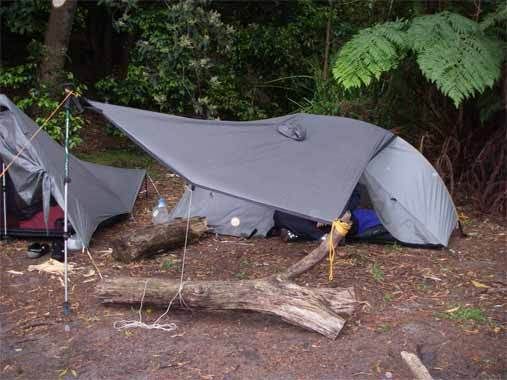
Not exactly like this , but you should get the idea
Photo Sharing and Video Hosting at Photobucket

PostedApr 2, 2007 at 7:32 am

I have no experience whatsoever with BD or Epic tents or materials, so I'm not even going to try to stand up to any of you concerning its waterproofness. However, Brett (and I don't want to rain on your parade…erm…that IS a bad pun, right?), my experience in the Japan Alps, at least once almost every year for the past 30 years has been a entire night of some of the strongest torrential rains I've experienced anywhere in the world. Not just a quick cloudburst where you can just hoist your umbrella and wait out the mood, but all-night downpours so strong that you can't sleep for the thunder of the rain on your roof, and campsites literally ankle deep in racing water and mud. And no where to escape to, because Japanese campsites so often are choked with other campers who've all dug trenches around their tents so that all the run off flows toward your tent. Every year. And nothing at all like the months-long drizzle of the Northwest in the States. Last year the downpouring happened only once, but I had to drape my rainsuit over my sleeping bag inside my Rainbow tent to keep it from getting soaked from heavy mist and droplets from the ceiling. Two years ago it poured every single weekend from May until October, with one five day trip when it never once stopped. I dearly want to get one of the new BD tents, but these experiences really leave me with a lot of doubts. If for nothing else, Brett, I would strongly urge that you take along a small tarp or poncho to throw over your new tent just in case one of those downpours hits you. It's really cold up there sometimes in the summer and you wouldn't want to get soaked without backup.

Just a bit concerned.

PostedApr 2, 2007 at 8:14 am

Miguel. Wow, that is amazing. Im going to be wall to wall with the other campers in Kamikochi in May, in my HiLight. I will bring the sil-nylon vestibule to tie over the tent if I need to protect the epic fabric.
I also know that moisture condenses on the interior cool walls of the tent, so maybe the breathability of epic will reduce inside-out moisture..
Only one way to find out for sure.

PostedApr 2, 2007 at 6:25 pm

Hi, I live in Perth, Western Australia. I have successfully used a BD Firstlight on our Cape to Cape track (www.capetocapetrack.com.au) which is next to the sea. I used it in a week of the worst storms for 15 years. Several nights it rained all night long. Except for a fine misting when the wind blew really hard sometimes, my Firtslight did not leak. Everyone at the adventure store where I purchased the tent advised against buying it. I bought it for the light weight and have not had any condensation problems. I also have a Bibler Bipod bivvy which has condensation problems.
I would not hesitate to recommend the BD Epic tents. Pieter

PostedApr 2, 2007 at 7:30 pm

..for relating that story. It is very encouraging. I have to trust that a company as experienced as Black Diamond would not make a critical error in fabric choice for their entire line of ultralight tents. Not truly waterproof like eVENT, but good enough when weight is a concern.

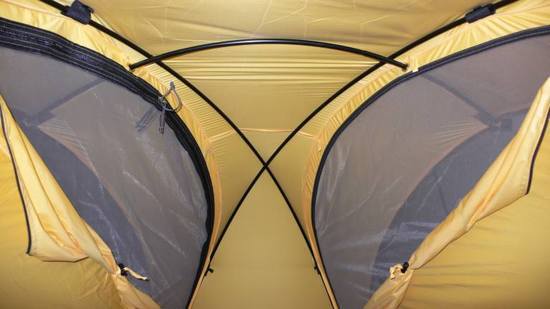
I set up my HiLight for the first time yesterday, 1180 grams for a 2(small) person tent and poles.. amazing. The pole configuration is quite clever. A third pole stretches an 'eyebrow' over two large mesh windows. In the first picture you can see the three poles, two windows, and behind the windows, the two eyebrows. Picture is taken laying in the tent, looking up and towards occupant's feet.
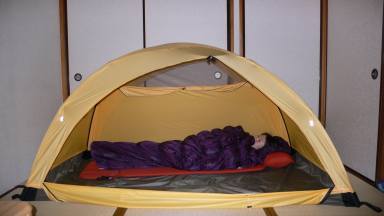
Second picture shows the full width door. Occupant is 5'4", in a Monbtell#7 on a MB pad. The tent is barely long enough for me at 178cm. My regular MB bag will touch both ends when stretched out.
hilight internal frame
hilight full width door

PostedApr 3, 2007 at 5:45 am

Had to chuckle at the photo a little, Brett. Not only must your toes have just touched the ends, but the tent must have taken up almost your entire apartment!

Looks really good. I'm really curious about the performance here in Japan. It would be just what I want if it works here.

By the way, I spoke with the BD representative about adding the vestibule to the OneSHot, He told me it wouldn't work. I had suggested in my earlier letter to him that if I bought the OneShot or HiLight that I was thinking of designing and making a vestibule that is supported by a hking pole. He said that BD would be more than happy to look at my design and consider it. So there's proof that BD listens to its customers.

PostedApr 3, 2007 at 6:20 am

Miguel, yes; only people who have visited Japan would appreciate the cozy accomodations we have in the big cities, although homes in the countryside can be huge, like American suburban homes.
The vestibule seems really awkward and floppy, but I will stake it out instead of holding it taut before I make a final decision of course. But if I'm going to carry 2 kilos of tent, it would be a Quarterdome(roomy double vestibules), not a HiLight+vestibule.
As I was fiddling with the vestibule, I had the same thought most of who read about tarp-tents would consider; pitching a vestibule with the hiking pole I'm already carrying. The design problem comes from transitioning from the arched shape of the doorway, to a linear (triangular or square) guy out configuration. Going from a radial coordinate system to rectangular just seems to introduce sagging fabric. Maybe there is a precedent to be found in other tubular tents? What we need is someone with architectural experience to help us.. ;)
I hope your design addressed this problem, and you get due credit$$$.

PostedApr 3, 2007 at 6:33 am

What we need is someone with architectural experience to help us.. ;)

Well, if it's any consolation… I used to be an architect!

PostedApr 4, 2007 at 8:17 pm

Miguel, I knew that from your website ;)

Ben, that looks like a simple solution, and I wish BD had just done that for my HiLight. Would have been lighter (smaller and no pole), more stable (no cylinder cross section), and I predict, more resistant to gusting winds. While still being large enough to cook in.
Maybe I can make that with WalMart silnylon…

EndoftheTrail BPL Member
PostedApr 4, 2007 at 8:23 pm

Brett:

Silnylon should work. Now, if 'someone' can do the same with the BD OneShot…

PostedApr 5, 2007 at 1:48 am

Silnylon should work. Now, if 'someone' can do the same with the BD OneShot…

"Someone". "Someone"? Did "someone" say "Someone"? Or "someone"?

First someone is going to have to buy "someone" someone's OneShot, some time.

PostedApr 5, 2007 at 5:19 am

Is someone trying to sell a oneshot? Or get someone else to buy one? That last post shows why English grammar is difficult for non-native speakers!

EndoftheTrail BPL Member
PostedApr 5, 2007 at 7:51 am

Meaning if someone can make a similar vestibule for the BD OneShot, then I might be tempted to ask that person to make me one also — and buy the tent from BD. As of now, I'm not much interested in a tent without vestibule — and I find the vestibule designs of all the other BD tents heavy and awkward — as Brett has recently discovered for himself.

Viewing 21 posts - 26 through 46 (of 46 total)
Loading...