


Companion forum thread to:
Topic
Become a member to post in the forums.
.
Companion forum thread to:
I had thought from the beginning; due to the giving expectation of the title, that the article, itself was going to show a more tautness and toughness point of view about strenght and forces distribution on a Tarp in the process of an inclement site condition.
"I had thought from the beginning; due to the giving expectation of the title, that the article, itself was going to show a more tautness and toughness point of view about strenght and forces distribution on a Tarp in the process of an inclement site condition."
Yeah – no, it was just a re-hash of a 9 year old article. Fun to watch people get excited about it, however.
Please feel free to write a similar article yourself, if you think you can do it better.
I'm sure almost all of us would appreciate your perspective on the subject.
I've been exclsuively a tarp camper for years, and there are some good ideas here. I will definitely be adding stakes to my pack, and I love the corner-loop idea – simple but a great idea. I also appreciate the scientific aspect you offer.
Thank you for an awesome article. I am a hammock guy, so my tarp setups are a little different, but Definately enjoy the added sights and sounds of the adventures from under a tarp. This was a great read and brought back a lot of great memories of my scout days under the blue tarp in eastern Washington. Thanks
I read the first version of this article as part of the book "Lightweight Hiking and Camp" and the lessons from it served me well for the past 4 years camping under a poncho tarp and then a variety of (mostly small) tarps. I like the square tarp idea and might give it a try sometime.
One thing I like about Ryan Jordan's articles is he seems to wear out a lot of gear. Its nice getting his insights on how things fail over time so I can make better choices about gear that will hopefully be a good long term investment.
What would be a good cuben fiber (material) weight for a 8×8 tarp?
I have seen a variety of weights out there and would be curious to hear what a solid material weight would be.
.50 / .75?
Locus gear do some sil tarps with lots of tie outs.
Somehow this is eerily similar to what Ray Jardin was saying all along… Even the techniques are similar.
I'm getting confused about what exactly the "best" type of shelter is… first tarps, then pyramids, now tarps again. I guess, like with all the UL techniques, it all depends.
Locus Gear makes almost jewel-like, superbly crafted shelters, with beautiful, very well thought-out and implemented practical detailing. Jotaro Yoshida is a perfectionist.
Earlier this year someone showed me a great way of pegging guylines. It's so simple that it can be done with one hand even with gloves (with some practice) and it has the added benefit of cleaning off your stakes and keeping hands clean when you break camp, especially when the stakes are the round type instead of V's or Y's.
No loops in the line or extra hardware needed–just a straight line coming off of the tarp. You can use linelocs if you like, though, but it's not necessary. Just tie a marlin spike hitch and use the stake as the "marlin spike". Super simple–go to
http://en.wikipedia.org/wiki/Marlinespike_hitch
or the video below. This knot is commonly used to hang hammocks from tree straps using toggles (Shug Emery has a fantastic, funny video here:
http://www.youtube.com/watch?v=d7NZVqpBUV0
Go to 3:57 if you are impatient. Shug was a Barnum and Bailey clown and his videos are fantastic. Just substitute a stake for the toggle he uses in the video and ignore the stuff about attaching a hammock. When you pull the stake out, it comes untied.
I've never had one of these slip even in pretty serious winds and using thin dyneema line.
Great article, I've been moving towards using a tarp more frequently but have had some real concerns with it above timberline. The article definitely helped with understanding some of the dynamics involved in making a secure pitch in an exposed area. I also went back and read the article from 9 years ago and it was also excellent but the new one expanded on it and covered a lot of new territory.
Thanks….Ron
"Please feel free to write a similar article yourself, if you think you can do it better.
I'm sure almost all of us would appreciate your perspective on the subject."
I don't have to…I can read the 9 year old article.
We spend a lot of nights in the rain and under the tarp. Cold rain, often accompanied with a stiff breeze. The flying wedge is a bomb proof pitch. Shown here at the entrance to Chatham Strait off of Peril Strait in Southeast Alaska this past June. It rained for days.
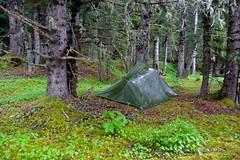
and from the front
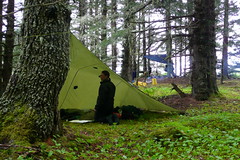
Can someone reply with a decent list of recommended retailers for quality tarps? I'm not sure I'm ready to spend the money on a Cuben Fiber tarp, but would like to see options out there for silnylon, etc. An internet search comes back with a smattering of REI and Campmor results; I'm sure there are better options out there.
Thanks in advance to anyone who can provide some links!
Cheers,
Bill
First, thank you for this article.
But I have to say, again, I think BackPacking Light should be more careful to encourage Leave No Trace principles in it's publications. Two of the three campsites pictured in this article violate widely accepted LNT principles, and many state and national park and forest regulations too, by being WAY too close to water.
Backpacking Light should promote responsible enjoyment of our remaining wild places.

I completely agree with Tim.
I guess I don't have a problem with it. Take a look at the topography around the lake in those two pictures. I would bet that there were few spots that were good for a site. Now one could say, "Then don't camp there." But sometimes the topo maps show that there "should" be good campsites and then when you get there–nope. Maybe there are extenuating circumstances that made this best of available choices.
Rules for the Anaconda-Pintler Wilderness: http://www.fs.usda.gov/Internet/FSE_DOCUMENTS/fsm9_003202.pdf
"CAMPSITE RESTRICTION – MANDATORY SETBACK FROM WATER
Campfires are prohibited at the following lakes within 1/4 mile of their shorelines: …"
So the campsites were technically legal as long as there were no campfires, even though they violated LNT principles.
However, I do feel that BPL could set a far better example by not violating LNT practices in photographs in their publications!
http://lnt.org/learn/principle-2
"CAMPING IN UNDISTURBED REMOTE AREAS
…camping 200 feet (70 adult steps) from water is a good rule of thumb….It should never be necessary to camp on…islands of vegetation…"
Yes, I've had to violate LNT practices and even USFS rules, especially in areas where all the trees are dead from bark beetle so the only safe alternative is to camp in a meadow and/or too close to the trail (if I have to break the rules, I'll camp too close to the trail rather than too close to water). I don't take pictures of such camps for publication, though!
William:
Here are some options for silnylon tarps:
http://shop.bivysack.com/category.sc?categoryId=6
http://www.bearpawwd.com/tents_tarps/tarps.html
http://www.mountainlaureldesigns.com/shop/index.php?cPath=21
I have a tarp from Oware (first link) that has served me well for over 10 years.
Dan
I really liked this article (even if the LNT police are around), these are the kind I signed up for BPL in the first place.
Ray doesn't mention it, but another advantage of using a square flat tarp is that you can set it up as a tetrahedron to shed wind from any direction if the weather requires it. Just stake out three corners, fold the fourth corner back to the mid-point. Crawl under and raise up the center with your pole and you get the following shelter.

This is a 9'x9' Lawson cuben tarp
I don't have a problem with the pics in this article. The first one in particular with Ryan looking at the lake is impossible to determine how far away he is from the water – in fact he could be well away. I know the second water pic looks close and the third one could again be far enough away. If these were shot with a telephoto lens then the distance is distorted. Sorry but the LNT police and zealots on here will just have to fume.
Thanks for the links, Dan.
I think I'm going to go with the FlatTarp3 9.5'x9.5'. Seems like a winner!
Cheers,
Bill
Become a member to post in the forums.
 New Gear with Aluula FabricsLighter, stronger, more abrasion-resistant, and highly water-resistant - explore ultralight backpacking gear made with ALUULA Graflyte fabrics. Engineered for exceptional strength, durability, and lightweight performance, ALUULA Graflyte helps reduce pack weight without sacrificing reliability, making it ideal for demanding backcountry adventures.
 © Beartooth Media Group Inc.
 Loading...