Topic

Why no bivy love?

  • This topic is empty.
Viewing 9 posts - 26 through 34 (of 34 total)
PostedSep 16, 2012 at 4:23 pm

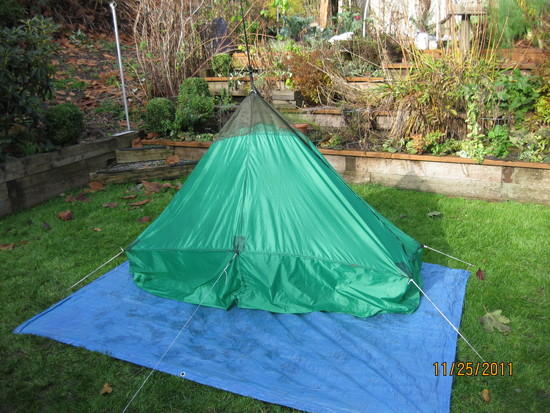
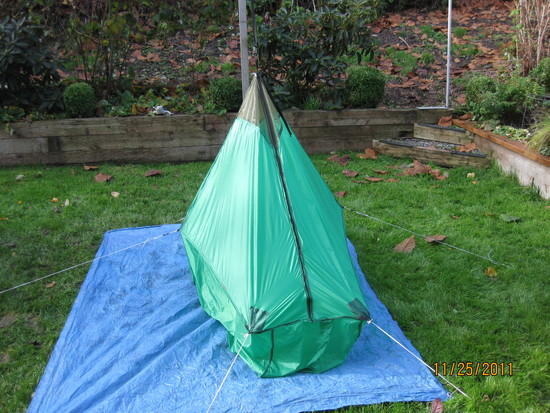
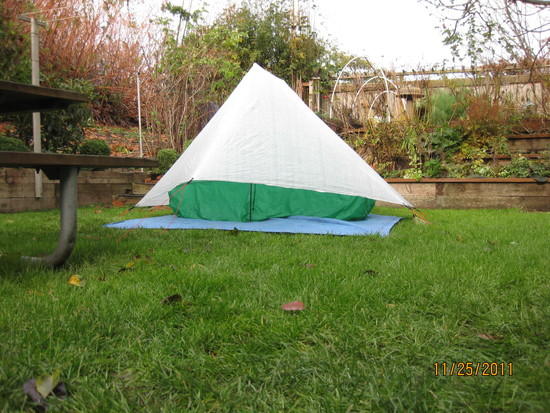
Here's an option, for your consideration. I call it a bivy/tent because it has a little of each in it. I use it under the tarp you see in my avatar. It would also fit under a Gatewood Cape.

here

here

here

It weighs weighs 7 ounces and was poorly made by me. It is 45 inches tall, 6' long, 18'wide at the ends and 30" wide at the center. I can sit up and even get onto my knees to change clothes. When combined with my avatar fly and home made poles (including cross bar) the tent, fly and poles weigh 19 ounces. Takes 4 stakes to put up and two more to stake out the vestibules. It is a very warm tent which is what I want.

jscott Blocked
PostedSep 16, 2012 at 8:16 pm

Hi Dena: I recently bought a Marmot Alpinist bivy strictly for use as an emergency winter shelter on day hikes in winter around Lake Tahoe. My idea is that I would carry a 30 degree down bag (1 lb 6 oz) plus some kind of pad, plus the usual winter clothing arsenal for a day hike. I'm unfamiliar with bivys. Looks like sub-freezing weather is a good thing as far as condensation build up on a down bag. I'm imagining finding shelter as a last resort in a tree well or under a solid log, perhaps with boughs laid down beneath and above for shelter from snow. In other words, a last ditch effort, not a planned retreat. I'd appreciate any advice on this kind of situation, in particular the kind of pad I might use; i.e. if I'm exhausted and it's cold and dark my old exped downmat might be too finicky with it's nozzle adjustment and all.

Anyway, given that you're our snowy owl, I thought that I'd ask.

Dena Kelley BPL Member
PostedSep 16, 2012 at 9:21 pm

Jeffrey-

I'm glad to share what experience I have, I have done multiple overnights in winter in Alaska in everything from snow shelters of various types to a tarp shelter to a tent. The worst one was the tent, and it was a double wall 4-season tent. It still condensated badly. The best shelters were the snow shelters- they're quiet, maintain 32 degrees regardless of outside temps, and are relatively comfortable as you can customize your sleeping platform however you like. Our system was to lay down a heavy duty space blanket (the rip-stop tarp style space blanket) as a ground cloth with the reflective side facing up, and use double CCF foam pads (we used Z-Rests) with our bivy on top of that and 0 degree synthetic bag inside of the bivy. Note that gear has come a LONG way since my last winter trip and I might choose different gear now, but then again I might not. That system worked well, and weight and bulk in winter isn't as much of an issue for me because I pull my gear in a sled rather than carry it on my back. A small toboggan is a fantastic replacement for a backpack in winter and makes snowshoeing or skiing easier than doing so with a loaded pack. I took pieces of 1/2 PVC and used them as stiffeners between my waist belt and the pulk (sled) so that on the downhills and such the pulk wasn't trying to run me over. The cords ran through the PVC from my belt to the pulk.

The Tahoe area can get a lot of snow, if you have the option of making a snow shelter that would probably be the warmest, quietest and most comfortable option. A trick to reduce drips inside a snow shelter is to round the roof and then take a candle and melt the roof a bit and then let it re-freeze- it will then run any drips off to the side of the shelter. You can both light and heat a snow shelter with a candle- I always dug out a little alcove in my snow shelters for the candle, and the heat would eventually burrow a chimney up through the snow.

You can also make hybrid shelters such as a snow trench with a tarp roof – this can be a good option if the snow isn't consolidated or moist enough to dig into safely or to create roof blocks for a ranger trench. It won't be as quiet or as warm, but will be warmer than a tent. Just make sure whatever snow shelter you make that you have a cold-sink for colder air to sink into. In snow caves you create the sink just by situating your entrance lower than your sleeping platform. In a trench you can dig your sleeping platform and then a deeper section of trench you can rest your feet into when sitting, and then it acts as a cold sink when you are sleeping.

Snow camping can be a lot of fun if the snow is good and workable. One of the best trips we had was in a group (about 10 of us) and each of us made different snow shelters and a communal kitchen which was a large circular hole in the ground with carved out benches and a table. It was low enough that we sat completely under the snow level and out of the wind. Our snow shelter was a snow cave/trench hybrid. Teh entrance and the area from the hips down was done snow cave style. The area above our heads and bodies was a ranger trench style with blocks of snow leaned up against one another like a peaked roof. That was a very comfortable camp. Keeping gear dry was simply a matter of diligently brushing off snow in the entrance area and taking off outer gear away from the sleeping bags. The ground sheet and the bivy did the rest.

Not sure on using a log, obviously a log would make a great wind break. In my area in winter logs are covered up. Tree wells can make a decent shelter, just make sure you don't get trapped in one. Sometimes they are so deep, and the snow around them is so loose, that you can't climb back out.

David Thomas BPL Member
PostedSep 17, 2012 at 2:23 am

Dena: Good info on bivies, there. I noted something you said about pulks:

>"I took pieces of 1/2 PVC and used them as stiffeners between my waist belt and the pulk (sled) so that on the downhills and such the pulk wasn't trying to run me over. The cords ran through the PVC from my belt to the pulk."

And that's all good info, too. Except for the use of PVC. It works, pretty well, and is readily available and cheap. BUT, even in warm weather (10-40F), it is not the best strength to weight, and as it gets colder, it can get more brittle. Additionally, the amount of UV the pipe has seen effects its brittleness, some of which you can't know about – how long it was stored at the manufacturer and then at Home Depot outside before being sold. Here are several alternatives:

1/2" aluminum electrical conduit. Costs a bit more, but is stronger, customizeable with bending, and can be rebent in the field. http://www.brownselectric.com/ stocks it in Kenai and they have two stores in Anchorage. I keep some around for various projects.

1/2" EMT (Electro Magnetic, Thinwall) steel conduit is cheaper and available anywhere in 10 foot lengths. Pound the ends flat and drill for your attachment points.

Used ski poles from Goodwill / Salvation army. Aluminum, fiberglass, bamboo are all better than PVC for strength, weight and cold temperature tolerance. Some I have rigged with minimal modification such that they could be disassembled and used as ski poles again, just as back-up / redundancy.

A little on the floppy side, but great at low temps (HDPE, I believe) are those internally corrugated driveways wands. Not the solid 1/4" diameter ones, but the 1" O.D., bright orange, mostly hollow plastic ones. 5 and 6 feet long, cut to length. Sold in all the hardware stores in winter.

DIY option: Strips of 1/8" plywood glued around a foam core (or a single ply wrapped around a round foam center) make the lighest, stiffest option of whatever length/diameter/strength you wish. The last few inches have a wood core into which you drill your attachment points.

Let me know if you have any interest, I could drop some off next time I'm in Anchorage.

PostedSep 17, 2012 at 3:37 am

You guys have got to read Ronald Turnbull's "The Book of the Bivvy". Not only does it throughly explore bivvy use, it also is outdoor writing at it's very best. A British classic.

Dena Kelley BPL Member
PostedSep 17, 2012 at 9:37 am

David-

Thanks for the suggestions on the pulk design, you are right that PVC has drawbacks. I happen to have an extra set of old ski poles- they used to be my hiking poles until I upgraded to lighter weight ones- I may use your idea and modify them for use instead.

Thanks again!

Dena

jscott Blocked
PostedSep 17, 2012 at 7:47 pm

Thanks Dena, that was great info.

As you well know, there's a big difference between planned winter camping and emergency riding-out of an unplanned night in winter. I typically day-shoe in winter and expect to be back in my cozy cabin by nightfall. But the winter hours are short. I've never come close to being lost or incapacitated in winter and don't ever expect to be; but then nobody does and still it happens. That's why I'm looking to establish a lightweight emergency set-up. In my mind I'm picturing white out/nightfall/lost/broken ankle situations where I finally give up despite my headlamp…such a small chance of a problem that when starting out I choose to carry the least weight possible for what is almost certainly to be a safe and happy hike. Obviously I'd never go out in a 30 degree bag in winter; nor would I look for protection in a tree well or under a log if I had time or strength to do otherwise. I bought a decent and stripped down bivy bag for just this emergency scenario and now I find that if I want to follow through I should carry more stuff and weight than I've ever done before (i.e. a bag and then some sort of pad, just for a day hike!) Last winter I went minimalist on my day-shoes. This summer my wary imagination caught up with me. How best to prepare for an unplanned night out in the snow? I guess that's my question; especially how much of a pad do I need? but you did answer that; thanks!

PostedSep 19, 2012 at 12:19 am

Jeffrey,

I'm glad you are going through the mental exercise of what could happen. From search and rescue, it is amazing how little extra gear it takes in a bad situation, to modify your condition from dead to very uncomfortable. The two most likely scenarios will be:
1) Lost (or white out)
2) Injured

I have spent many nights in snow shelters of different types and love them. They can be warm, quiet, and secure. However, they do take a lot of effort to build. If you are just lost or unable to proceed, the building process can keep you warm and out of the wind. Just take care to avoid too much sweat. If you are injured, this might not be much of an option.

Have a storm worthy bivy sack, CCF pad and some extra clothes. A few pieces of extra clothes lets us continue to function in nasty conditions since we can't shelter until we reach the victim. They also serve us well inside of a good bivy sack when we do take shelter.

jscott Blocked
PostedSep 19, 2012 at 9:11 am

Thanks Dave and again, Dena. Looks like I need to better my snow-shelter building skills. I'm usually solo on these trips.
For the moment these are my thoughts:
seam-taped waterproof Marmot Alpinist bivy: 15 0z
30% down sleeping pad: 25ish oz.
thermarest sleeping pad that I forgot I have: 8 oz.

That's only about three pounds of extra weight over and above anything that I would wear/carry on a typical day-shoe. That's doable. In this scenario I'm also carrying a 13 oz. down sweater or my nano-puff.

Last year I went out just with a sea-to-summit 4 oz. pack to carry a shell, water, etc. The above safer kit is going to require a larger pack; bummer.

In the real world I'm going to want to ditch the sleeping bag and just take my EB First Ascent down jacket. I guess that with a shelter and pad that would probably get me through the night. But with the bag I'm practically in heaven.

p.s. SAR rocks!
p.p.s. excellent timing on the bivy article by BackpackingLight. I'm learning a lot.

Viewing 9 posts - 26 through 34 (of 34 total)
Loading...