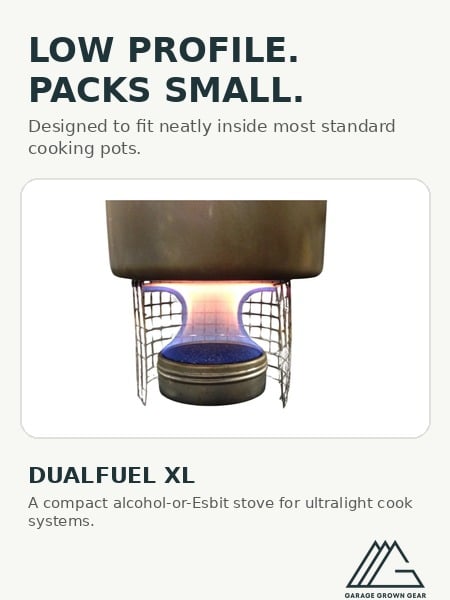
I'm getting into high altitude trips and I was wondering if anyone had a solid answer on alcohol stoves up higher. The vapor pressure of alcohol is lower the higher you go, so I assume it'll 1) burn easier but 2) burn cooler and thus take longer to boil water, at least that's what I experienced compared to sea level. Anyone have any more experience with this?
Topic
Alcohol stoves at high altitude
Become a member to post in the forums.
- This topic is empty.
Vapor pressure of a liquid is a function of its temperature, not of atmospheric pressure.
Generally high elevations have lower temps. That in turn makes for a lower vapor pressure. You could assess if that was the issue by comparing high elevation performance to useage on a cold day at sea level. If the stove being cold is the problem, you could play with pot / windscreen configurations that reflect more heat back to the stove. (But not too much.)
High elevation air also has less oxygen per liter of air. So your car produces less power; older pre-computerized cars needed to be tuned leaner to be efficient; and any volume of air flowing through your stove has less oxygen in it. That can be a limiting factor in heat output, depending the stove design.
>"The vapor pressure of alcohol is lower the higher you go, so I assume it'll 1) burn easier"
You may have concluded this after reading about butane canisters near freezing. The vapor pressure is only a function of its temperature, but whether that pressure is enough to flow out of the canister depends on atmospheric pressure. In that way, being higher helps in this marginal situation. But if your canister has plenty of pressure or if you have unpressurized fuel (alcohol, candle), then less oxygen definitely can hurt and lower ambient temps can decrease heat output while also increasing heat losses off your pot.
David,
Actually vapour pressure is a product of both temperature and pressure. Reducing air pressure will increase vapour preasure to the point of boiling. Example: boiling water. It boils at less temperature at 20,000' than it does at sea level. Because it is a product, I treat the two as a single component, though not technically correct. I was surprised about this comming from you.
Given that atmospheric presure is fairly constant in any hiking situation, the rest of the explanation is correct.
Using alcohol at elevation DOES mean fighting for heat. More heat means greater vapour pressure. As you explain, stoves need to be tuned to burn well by reducing fuel/air mixtures.
The reduced air pressure also means less avalable heat transfer. The extremely low pressure of space gives rise to an interesting paradox. It is very hot generally speaking, when we look at the speed of movement of any molecules in it. But, it is generally very cold when taken as a whole, since there are not enough of the molecules to transfer that heat. It is easier to use direct radiation than molecular movement. So, the general model for "heat" (the movement of molecules) fails. It is also the quantity of the molecules available.
I have noticed that cooking takes longer with my pop can stove at altitude than when lower, but it still works adequately. I think you will use more fuel though.
I've had same boil times at my home (4,000') as at elevation (10,000'+-) on bp trips.
Duane
James
"Actually vapour pressure is a product of both temperature and pressure. Reducing air pressure will increase vapour preasure to the point of boiling. Example: boiling water. It boils at less temperature at 20,000' than it does at sea level."
Actually you are wrong and David is right. Reducing air pressure does not increase the vapour pressure of the liquid. The liquid boils because its vapour pressure exceeds the air pressure. At altitude, water boils at a reduced temperature (less than 100C) because it needs less vapour pressure (a function of temperature) to overcome the reduced air pressure.
I've used my alchie stove at ~13k feet in October here in Colorado as one relevant example.
My meal was cooked and I was eating in a timely manner. The old-school white gas stoves were actually slower overall due to the futz factor as much as anything I imagine.
You can get into math and scientific terminology, but the simple fact is that for any real world, 3 season use in the Lower 48, you'll be fine.
My experience has been that in general the time to boil and the fuel efficiency is about the same. That being said, the burn rate changes due to the lower oxygen content and boiling point drops: they tend to offset each other (my experience anyway). Sometimes fuel efficiency can go up!
The more import aspect is what type of alcohol stove you using as not all alcohol stoves perform the same. Some work great at sea level and not work at high elevation (TD has written about this as well). All of this and your windscreen can also impact the performance. If you are concerned about it, you might bring a couple of Esbit tablet with you.
As usual…sorry David.
You could use ESBIT and a Caldera cone/Gram Cracker/matching pot combo for max efficiency and less fuel weight.
James: thanks. I make mistakes too, (but rarely about Chemistry).
Good point about lower air pressure reducing heat transfer between hot gases and the pot.
Science facts and established theories are true. But which dominate in a particulate setting is tricky. A good practical test always helps. And the wisdom of someone with years of practical experience trumps all the theories.
this is the second time i've done the science and this is what i've come up with. i had graphs and all, but it was all too much.
1) with lower atmospheric pressure, water boils at a lesser temperature because of the lower vapor pressure. the same can be said of ethanol.
2) there is less oxygen, so the alcohol will burn cooler
3) ethanol will burn faster because the fire itself will boil the ethanol fast because of the lower vapor pressure, see 1).
so in conclusion water will take roughly the same time to boil (lower atmospheric pressure both lowers the boiling point of water and flame temperture) with more fuel required and your water won't be a true sterile boil which is exactly what i experienced. best solution: more fuel/use lid to build pressure.
or i could be wrong, but it makes sense scientifically and rationally (things are more difficult to do the higher up you are, it probably takes longer too).
someone needs to do some controlled tests. maybe someone with the exact same jetboil in san francisco and colorado can compare.
Getting too technical now. I go bping for the outdoors and hopefully great fishing. A little info is good, experience counts more.
Duane
Not sure if 10,000ft is considered high but this last week I had the same boil times on my alcohol stove at 10,000ft up in the GTW as I achieve in my Poway, CA garage (elev ~540ft). Same volume of water and same volume of alcohol.
richard, that's what i predicted in my long reply. might be a tad slower due to wind/water temp, but in line with what i said.
David
I thought I made a mistake once
but I was wrong…
"Not sure if 10,000ft is considered high but this last week I had the same boil times on my alcohol stove at 10,000ft up in the GTW as I achieve in my Poway, CA garage (elev ~540ft)."
The boil was at a lower temperature though, so if actually cooking something the time would be a bit longer as would fuel consumption.
Become a member to post in the forums.