Topic

hypoxia meter

  • This topic is empty.
Viewing 25 posts - 51 through 75 (of 76 total)
PostedJul 22, 2012 at 6:24 pm

"What I dig about this forum is that people love to learn. :-)"

I, for one, read the entire post with great interest. Thanks for taking the time to put it out there. Not that I'm about to go out and buy a pulse oximeter, mind you, but it was a very interesting read nonetheless. ;0)

PostedJul 22, 2012 at 6:31 pm

Hey you doctors out there, is there a risk of becoming dependent on oxygen if it is used too often? My Mom is worried about becoming dependent. But with exertion she drops into the low 90s and sometimes into the 80s.

Dean F. BPL Member
PostedJul 23, 2012 at 7:15 am

Everyone is "dependent" on oxygen, brother. Try going without it for a while…

But seriously- one can acclimate to low oxygen tension, that's how people manage to climb Everest without oxygen, but no matter what there IS a limit and they are NOT enjoying it. If you want to interpret not doing so as weakness, the more power to you.

But for your mom, no, she won't get dependent. If she is desating to the 80s with mild exertion she already is dependent, and just doesn't know it. If I'm interpreting your question correctly: No, if she starts using oxygen she WON'T start to do even worse if she is off the oxygen for a while. She very well may notice it more, though, because she'll feel better on the oxygen and thus will comparatively feel worse when off it and she might interpret that incorrectly and try to say "I told you so!"

But I'm not even sure that she really needs supplemental O2. You need to ask someone who is more hip to PFTs than I am. I just cut people…

PostedJul 23, 2012 at 8:46 am

You interpeted my question correctly. Typeing from my phone so it is a little harder to type long explainations. She does feel better after using the oxygen. Her script is for 24/7 at 3 liters. Seems like a lot to me and GP wrote it, not the plumnologist (sp). And since she has stage 4 lung cancer (yes, she smoked for many years) they tend to give her whatever she wants, but she doesn't want to be dependant. She didn't relate that to them however.

Thanks for the response. I knew you would have an answer. I will worry less about her becoming "dependant".

PostedJul 23, 2012 at 6:18 pm

The body will automatically adjust your breathing and heart rate to get the optimal oxygen level in the blood. Here breathing and heart rate will depend on the concentration of the oxyden in the lungs and how damaged here lungs and heart are.

How much she will need the bottle will depend mostly on the amount of damage the cancer does to the lungs. lungs unlike the skin cannot heal once they are damage. if the doctors can cure here without removing any lung tissue she could probably wouldn't need oxygen anymore. However if permanent damage is done it will depend a lot on how much is damaged and how much is still functional.

PostedJul 23, 2012 at 6:44 pm

She already had the upper and middle lobes of the right lung removed. Anc0d unfortunately stage 4 is terminal. She also has copd. All things considered she is doing well.

PostedJul 24, 2012 at 4:19 am

"I, for one, read the entire post with great interest. Thanks for taking the time to put it out there. Not that I'm about to go out and buy a pulse oximeter, mind you, but it was a very interesting read nonetheless. ;0)"

No probs Tom. My pleasure. :-)

PostedJul 24, 2012 at 8:26 am

Read "Altitude Illness: Prevention & Treatment (Mountaineers Outdoor Expert) [Kindle Edition]" over the weekend. Quick read and full of practical information for all levels.

http://www.amazon.com/Altitude-Illness-Prevention-Mountaineers-ebook/dp/B003P9VZ9I/ref=tmm_kin_title_0?ie=UTF8&qid=1343143129&sr=8-5

I will expound on my comments now that I am sitting at a computer. This book is a very easy read and has information that will teach both those just beginning their study of AMS up to and including professionals working in the field. I think even physicians who are mountaineers would do well to read this book. He warns in several places that that physician mountaineers die at a higher rate than normal. If you have a sport that takes you into thin air you should read this book. It may save someone's life!

Bob Gross BPL Member
PostedJul 24, 2012 at 10:45 pm

"After spending a night at the hospital, they are still waiting on test results. It seems like it was not a full-blown heart attack, and more like an episode of tachycardia. Still, that isn't good."

Update. This hiker, who shall remain nameless, had to spend two nights in the hospital and then was released. He was still psyched up to do the big peak, leaving soon. I sent him a medical release form for him to get signed by a physician. He had the appointment today, and now he is back in the hospital. The preliminary diagnosis is unclear, but it is something like tachycardia. Gee, who ever would have thought of that? So, he will not be with us on the mountain. Good luck to him anyway.

Now the oximeter gizmo will go along as more of a toy than a tool. Now I am trying to think up some protocol for manually recording data from it. Maybe every hour I record my elevation, pulse, and saturation. That might make a pretty graph.

–B.G.–

PostedJul 25, 2012 at 1:50 pm

"If you keep your fingers outstretched, the gizmo's display is facing away from you, so it looks"

Maybe rotate the gizmo 180 degrees so the display is facing inward? Then all you have to do is give yourself the finger and read the display. Unless you are administering the mental impairment test, that is. ;)

PostedJul 25, 2012 at 2:05 pm

"The preliminary diagnosis is unclear, but it is something like tachycardia."

If it's of the AV nodal reentrant variety, or atrial flutter(right atrium), he can consider himself lucky. I had an occurrence of that 6 years ago that was treated by catheter ablation. I walked out the door the same day and 3 weeks later went up over Shepherd Pass in one day. Let us hope it is not something more complicated.

Bob Gross BPL Member
PostedJul 25, 2012 at 2:42 pm

Yes, but this guy isn't legendary like you are, Tom.

–B.G.–

PostedJul 25, 2012 at 2:49 pm

"Yes, but this guy isn't legendary like you are, Tom."

Nor would he want to be if he has half a brain. ;0)

Bob Gross BPL Member
PostedAug 1, 2012 at 1:16 pm

I used the new gizmo and wanted to report on it.

On July 27th, I went up White Mountain Peak, about 14,246'. The gizmo told me numbers on my blood oxygen saturation, but it was about like what I could have guessed on my own, just based on how dizzy I felt. The pulse meter part was actually very handy.

Then on July 31st, I went up Mount Whitney. The newest elevation is 14,508'. The gizmo was handy. I'll have to compile my numbers to see if they fit to any predictable curve. The weather up there was very mild, so I didn't feel any risks. I had gone up very early (leaving at 2:30 a.m.) in order to beat the heat.

On a related subject, I just picked up a copy of the fifth edition of Going Higher, Oxygen, Man, and Mountains, by Houston. I've only started into it, but it is a promising read. I have two of the earlier editions.

–B.G.–

Steve C BPL Member
PostedAug 1, 2012 at 2:57 pm

Since you left at 2:30, was there any sign of the mountain lion? People encountered it several weeks ago.

Bob, if you could post your gizmo report on WhitneyZone, I am sure hikers there would appreciate it.

Also, how many WAG bags did you see along the trail?

Bob Gross BPL Member
PostedAug 1, 2012 at 3:20 pm

What mountain lion?

Most of the self-respecting mountain lions stay just a bit farther north, like around Mount Baxter where the bighorn sheep are found. I suppose that one might wander as far as Whitney if his GPS receiver were lost.

I am not involved with WhitneyZone.

WAG bags?
[first, a word of explanation]
The wilderness area east of Mount Whitney was becoming overused, especially by hundreds and hundreds of backpackers digging their little catholes all over the place every day. Starting several years ago, the Forest Service issued a human waste packout bag for each person on the trail permit. It contains some plastic for collection, some chemical like kitty litter, and some toilet paper. It is to be used and then carried out by the user for deposit in a special container at the trailhead. The kit is about 7×5 inches.

A few fools use theirs and then leave the finished product out along the trail. Maybe they should be shot on sight. I saw one or two yesterday.

–B.G.–

Bob Gross BPL Member
PostedAug 1, 2012 at 5:32 pm

I collected some data, but I don't know if it proves anything.

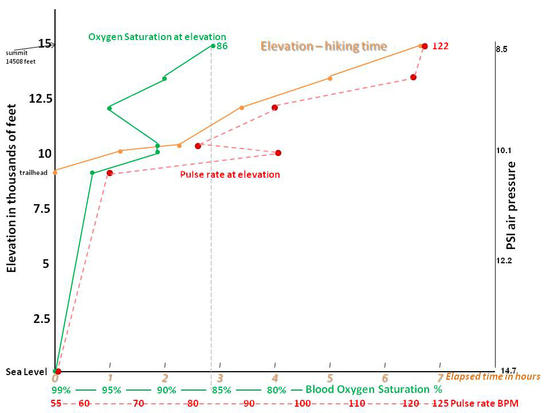
Mount Whitney time, air pressure, oximetry, pulse, etc.

The graph will not make any sense if you assume that the Mount Whitney Trail is perfectly smooth and consistent. Of course there are flat places and steeper places.

The other thing that I have to report is on the performance of the oximeter gizmo itself. Once I was halfway up the mountain, I would clip this thing on my finger and push the ON button. The blood ox sat display would go:
95..94..93..92..91..90..89..90..91..92..93..94..94..94..94..94..

In other words, it started a count, then that dipped, then returned to the original count, more or less. Once it stabilized, then I recorded that as a valid number. That takes 20-30 seconds to wait for it all. Now, maybe my blood ox sat is really varying that much, but I don't think so. I think it is some measurement sampling anomaly. It seemed like it was varying with my finger skin temperature which got colder as I went up. Oh, and if you wiggle your finger too much while the thing is trying to sample, the display will blank and start a new run.

It was good to watch the pulse rate display. I mean, at my age I don't want to blow a gasket or something.

–B.G.–

David Thomas BPL Member
PostedAug 1, 2012 at 11:40 pm

55 at sea level and 122 summiting Whitney?!? You're a dang healthy old fart, Bob.

Bob Gross BPL Member
PostedAug 2, 2012 at 12:38 am

"55 at sea level and 122 summiting Whitney?! "

Modern living through chemistry. That's what a beta blocker twice daily does.

–B.G.–

Bob Gross BPL Member
PostedJun 23, 2014 at 7:34 pm

More on the meter. This is best described as a pulse-oximeter. It measures your pulse rate and the blood oxygen saturation.

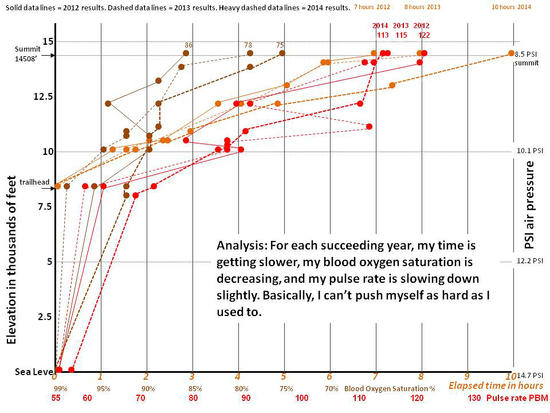
A couple of weeks ago I went up Mount Whitney again (Year 39), and I used my little pulse-oximeter to measure results as I went along. I've produced another chart that shows the data for 2012-2013-2014, so I used the data from the original chart along with new data. I'm afraid that there is a lot of data crammed into a small place.

solid line=2012, thin dashed line=2013, thick dashed line=2014

The obvious conclusion is that I am getting older and slower.

–B.G.–

chris smead BPL Member
PostedJun 24, 2014 at 12:18 am

I brought a pulse ox on my last trip to young lakes and mt conness, and was surprised to see my saturation at 92/93 consistently vs 98/99 at sea level.
Most of the time I was at 10k ft….so not that high. I didn't think I'd see results like that. I was on diamox…so not sure how that factors in…

Bob Gross BPL Member
PostedJun 24, 2014 at 12:47 am

Diamox fools around with your water balance, but I an unaware of effect on pulse rate.

Interestingly, on June 12 I was at a backpacker staging area around 10,000 feet, and I was chatting with two 21-year-old guys who were starting out on the next morning. One guy held out a prescription bottle of Diamox pills for the other guy to share. That seemed interesting. Apparently they teamed up with two other guys and all four started out on the morning of the 13th. On the morning of the 14th, I was toiling up the trail for a few miles and ran into the third and fourth guys who were coming downhill earlier than expected. They explained that they got up to some lake around 11,000 feet on the 13th, and one of the first two guys was getting sick (heart racing, etc.). That guy had to come down in a hurry, so he did very late on the 13th. I don't know if he was getting sick despite the Diamox, or because of it, or whether the symptoms were unrelated to altitude.

–B.G.–

jscott Blocked
PostedJun 24, 2014 at 10:00 am

Mio makes a wrist watch/heart rate monitor that's pretty cool. Works in the pool too. Anyway, I just finished a hike out of Tuolumne Meadows. I drove up from the Bay area (sea level) and found that my heart rate was quite high as I started out on a flat trail to Glen Aulin–around 120 bpm, higher on a little hill. Then after a few hours I seemed to re-set, and my heart rate came down. Starting the next day my heart rate was much lower–even on the climb to Youngs Lakes–and I was feeling the effects of altitude less.

It takes a week or more to become fully acclimated, but I've consistently found that even one night in Tuolumne, for example (8700 feet) helps a lot in terms of bringing my heart rate down while hiking or even at rest.

I have one of those finger pulse oximeter devices too–they're excellent, very easy to use.

The Mio gives a continuous read and so lets you adjust your hiking rate to match your heart rate. But I can get too obsessed with this and have to turn it off!

Ian BPL Member
PostedJun 24, 2014 at 10:29 am

Just wanted to throw it out there that a Pulse-Ox only reads blood saturation with the assumption being that the RBCs are saturated with Oxygen. In reality, "Hemoglobin binds with carbon monoxide 200–250 times more readily than with oxygen."

http://en.wikipedia.org/wiki/Oxygen%E2%80%93haemoglobin_dissociation_curve

I bring this up as the usage of a pulse-ox in this thread is being used to help diagnose hikers with HAPE/HACE. This is also an environment where people tend to cook in their shelters where CO poisoning may happen as well. CO saturation will cause a Pulse OX to read levels of saturation which will be misinterpreted as O2 saturation well into the 90s.

More on this here:

http://www.ncbi.nlm.nih.gov/pubmed/8037391

As always, treat your patient, not the machine.

Ian BPL Member
PostedJun 24, 2014 at 10:49 am

"is there a risk of becoming dependent on oxygen if it is used too often?"

I realize this question is a couple years old, and I'm certainly not a Dr., but the consensus on bottled O2 use and its impact on the human hypoxic drive flip flopped a few times when I worked EMS. The most recent update we received, which was 10+ years ago and geared towards first aid provided for those with COPD et al, was to not withhold O2 as the fear of chingering with someone's hypoxic drive was trumped by the need to deliver the O2. This treatment philosophy was developed for a sub 1 hr ambulance drive to a hospital, not for a weeks/months long expedition in the mountains.

This is an ongoing topic of discussion and study so there's no telling what the consensus is these days. When in doubt, consult with a physician who's knowledgeable on the topic. Emphasis on "knowledgeable on the topic" as not all Drs are created equal.

Viewing 25 posts - 51 through 75 (of 76 total)
Loading...