So it was a bit of fun, and hopefully a fun video?
I think these problems require a rare set of circumstances and so tend to happen for a small fraction of camped nights. Typically folks will not go camping in the weather forecast of heavy rain and rain for a sustained period. However, if it did happen, the consequences will be unpleasant, so it would be useful to have a solution.
In all seriousness this was too-bad a test, real-world would not produce that angle of rain at that velocity able to go at speed in volume right at the vent and be hitting the underside of the roof. So it was an unfair test.
However…. it does in a few seconds show a type of problem which will happen eventually, which is the following. In windy rain, the rain hits the fly and splashes in all directions, the slope of the fly against the wind, produces an up+over airflow, so some of the splashes get a bit of wind help pushing up fighting gravity, producing a spitting of small splashes through the vent. The vent itself is funneling air through, increasing the upward flow. In the right conditions over time this will be quite a bit of water entering the shelter. As the Notch's vent opening is only slightly above the vent, I can forsee a bit of spitting from splashes getting in, but not with the velocity a hosepipe can produce!
I certainly found it much easier to get splashes in the Scarp's vents.
The Notch has a unique opportunity and a unique problem I need to figure out. The Notch has a "low fly mode" (shown here) which TT calls "storm mode" (I think)
https://www.youtube.com/watch?v=ElC04q78c3Y
You'd only have it like that in strong wind situations, because in lower air velocity condensation is the problem. Strong wind is what will produce "uphill rain". Notch in "storm mode", the fly is tilted more vertical, making rain tend to bounce downwards more and less goes uphill than in "high fly mode". Steeper sides, the wind is tending to go around more than up+over due to the more vertical fly, the vent is correspondingly tilted down following the fly, so the part of the fly which is being hit by rain is lower down, increasing the distance that rain has to flow up a steeper hill. So I think this artificial hosepipe test will give a better outcome if the Notch was pitched in "storm mode". That bit is the opportunity, the Notch in storm mode will tend to reduce the vent as a vulnerability.
The problem with "storm mode" is the angle of the peg's attachment, I invite you to see the angles of the fly, in that mode is practically vertical, when combined with heavy rain, the ground in this type of heavy rain will be becoming sodden immediately where is that poor peg, all pegs which are right next to the fly suffer that problem, as all the rain hitting that side of the tent runs to ground at the fly, and I have complete confidence that peg will become loose in sodden earth eventually and be lifted out of the ground eventually resulting in tent collapse. The answer obviously is the guy attachments which are further from the fly, they don't get as concentrated a soaking, ground has more chance to drain the rain than the peg next to the fly and they have a shallower angle from the guy and so stronger ground and less force to pull it vertically. All tents I've used have guys away from the fly, they relief the force the peg at the fly has to withstand and both extends the duration that peg will last, hopefully past the end of the rain (windy rain blows away quicker), and if that peg did come partially out, the guys will keep the tent in its shape.
That then presents the problem of getting the guys out through that vent, so you can't really close it to lock-down the vent to seal against uphill rain.
I have a few problems to resolve with my "Notch bombproof" mind's eye problem:
– if I close the vent then the guy I feed through to the right will struggle, it will tend to open the vent and by definition in that kind of wind in that direction to the tent, you need the extra guys to keep the tent on the ground anyway
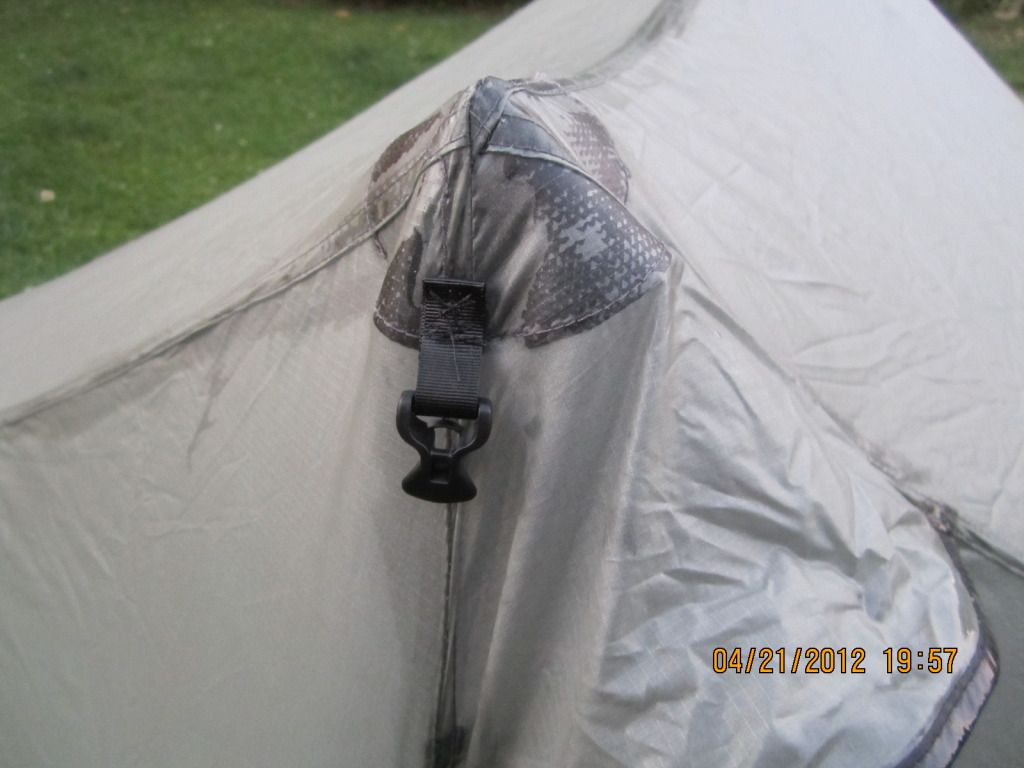
– I don't think the guy attachment stitched external will last, its simply not attached to enough of the fly, but the angle of the vent precludes coming too parallel to the vestibule peg through the vent from the pole.
– I think I'm seeing a problem with anything which is holding the pole too rigid, which is what will happen with Dyneema, the wind will hit say the head-end of the tent and the Silnylon will stretch under the force and without guys on the pole, the pole will sway with tent, which will be annoyingly noisy. But if the pole will not budge with strong guys, it is held rigid so I see the pole being pulled out of the grommet and tearing a hole in the roof, so there are limits of using pole-attached guys.
I have a mind's eye modification. More to come. I'm sure the next step won't be the last one.
So far from garden tests I've learned to not rely on the Easton poles that's saved me from a potential big problem. All my other garden tests are somewhat artificial and of less value.