in the interest of avoiding a boring work project, I mean, of testing empirically claims made re stove efficiency, I've been testing various claims about simple stove efficiency as they come up here.
Today's test: the tealight simple stove. Pot is an 11cm stainless steel pot I have.
Very warm day today, water starting temp about 71F, so the stove got a real handicap starting the test, this is the warmest day, with the warmest tap water, I've seen here for a while.
500 ml, about 2 cups, water tested.
16ml fuel measured accurately, brings on a warm day, no wind outside today so couldn't test that claim, water to 204F at roughly sea level.
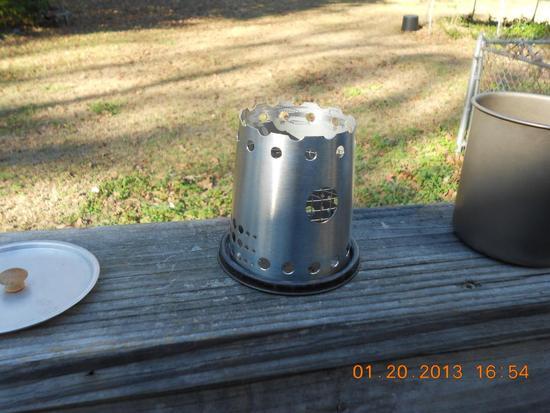
Everything is optimized for efficient boils, I put the tealight on a can top as base because they get so hot they will burn wood (which I have discovered in the past testing them) on a base of wood. Heat shield has a roughly 0.4 inch gap between pot and screen. Also the base raised it high enough to have the proper distance from pot with my pot stand. Screen is 4" high.
This same amount of fuel would give a full boil on a colder, much colder, day, with colder water, with an optimized penny stove, in-pointing jets, and the boil would last a bit more, not a lot, but a bit.
So the stoves are not the same re efficiency, but the basic point is true, the tealight is very simple, though too fragile for my taste, and unknown how it performs in wind. It also should be used with an insulating base because it gets very hot, very, hot enough to char wood under it.
Best efficiency for any stove I've seen reading but not personally is 12 ml to boil 500 ml water, someone else said they could not reproduce that, and could only get 13ml.
So you do get an efficiency boost, not sure about swirling winds however on top of wind screen, I tested the penny stove outside on a stream valley with the winds blowing down the valley floor, as they do, and it had no visible impact on the performance of the stove, the flames are strong and didn't even slightly flicker or waver.
The claim above re tealight efficiency was 20ml (2/3 oz) boils, but that's a lot more fuel than an efficient alcohol stove needs to boil a narrow pot, so that it's not even worth testing that amount in my opinion, basically anything will boil 2 cups using 2/3 to 1 oz (20ml/30ml) of alcohol. You start seeing actual efficiency and wind performance in more complex stoves. 18, 19 ml brought 2 cups plus to a boil outside, in wind, and kept it boiling / cooking food, for almost 5 minutes with the penny stove for example. In other words, bring water to boil, toss in food, bring water to boil again, then boil for almost 5 minutes more. That's a fairly major difference in efficiency. I'd used a bit extra fuel because I wasn't sure how it would handle in actual steady wind, turned out it seems to make no difference, which makes sense because the flames are jets, not just flickering loose flame.
But, as with the fancy feast stoves of jim wood, tealight stoves are easy to make, that's true. And if a roughly 25% to 30% difference in efficiency doesn't matter, which really it does not over a shorter hike of a few days, then the ease of use is a good plus. personally I think I'd go for a slightly wider, and stronger, can like an energy drink can cut down to hold 1oz or so. I suspect efficiency of the tealight might be improved with some screen/insulation added, not sure, that's sort of what some other very efficient stoves do, like the starlight.
One thing I did note, as I burned my hands trying to move the pot mid boil, is that the tealight, like any uncontrolled flame, gets very hot and made the sides of the pot very hot and made the air above the pot VERY hot, that's why it's less efficient, the penny focuses the heat tightly and you can actually grab the pot by the top edge without really burning your hands. So there was a lot of heat rising up the sides of the pot, much more than with a tightly controlled jet like a penny.
And that's where the actual efficiency difference comes in I believe. All the efficient stoves somehow control and regulate the fluid boil/flames and keep them from shooting up too much heat that isn't used for actual pot heating. The uncontrolled stoves just hit a max, vaporize and burn less efficiently, then peter out. Easy to make, yes, a huge plus, efficient enough, yes, I'd say so, particularly if modified with insulation or something. I'd try an energy drink can, it's stronger and not too much bigger. Might work, don't know.
But really, 2/3oz, close to 1/2 oz – ie, a 30% difference in fuel consumption a day, 1 oz plus a bit vs 1 1/3 oz, but on a short trip, speaking realistically, not a huge difference per day. Per week, significant. I do wonder how a tealight stove works in real wind though, my guess is not very well. The tealight, obviously, is also a major fire hazard from stove tip overs, being full unenclosed, and because if you don't use a true insulating base like the top of a pop/beer can, you can literally burn whatever is under it, something I suspect would not make the park services etc very happy. Insulating base solves that, but makes the stove more complex.
Mission accomplished, now off to work…