


Has anyone tested the monatauk gnat and snowpeak litemax side by side to see which one is the most efficient?
Topic
Become a member to post in the forums.
Has anyone tested the monatauk gnat and snowpeak litemax side by side to see which one is the most efficient?
Answering my own question in case others are interested.
I found this: http://hardcoreoutdoor.com/2010/06/14/competition-makes-cannister-stoves-better.aspx
It seems the Gnat is a bit more efficient and slightly lighter.
You rock!
How did you reach the conclusion that the Gnat was a bit more efficient? The article never measured efficiency by fuel weight. They measured time-to-boil, and often that is the inverse of efficiency.
–B.G.–
You want CO numbers for efficiency. The Snow peak burns very cleanly.

You need to measure amount of fuel used to boil water – weight of canister before and after, make sure you wipe off any condensed water, controlled amount of water and temperature increase,…
Compare Gnat, Jetboil,…
Comparing time to boil is not very uesful, although it is roughly proportional to amount of fuel used
Doh!
I just assumed that they put out the same amount of fuel in that given amount of time. My bad. I just ordered the gnat too! I knew I should have waited for advice from you guys.
I might have to do some testing myself.
I think you'll be happy with the Gnat
I think all canister stoves have similar efficiency – except Jetboil and Reactor are better…
the Gnats design doesnt lend itself to making a light Al windscreen that can enclose the burner head and pot bottom, there isnt anything to mount it on with the pot supports on top of the burner.
A slight breeze blows the heat away from most of them, destroying efficiency anyway.
"the Gnats design doesnt lend itself to making a light Al windscreen that can enclose the burner head and pot bottom, there isnt anything to mount it on with the pot supports on top of the burner."
Yes, but… you don't exactly need such a windscreen.
I made a flame concentrator out of a thin strip of titanium foil, and it hangs on the three pot support arms. That helps for the case of a narrow cook pot. Then a simple one square foot of ordinary aluminum foil works for ordinary wind.
–B.G.–
I think Roger C did a review of the LiteMax and wasn't favorable to it compared to the GigaPower. I bet there is probably a BPL Gnat review somewhere too.
It's because the Litemax pot support legs are across the burner unlike the Giga.
While enclosing the burner of a gnat is harder to do than with stoves that have pot supports originating below the burner it is possible.
You can rig the windscreen off of the pot. I use a couple of spacer ribs that squeeze onto the pot. To those ribs I wrap around an Al foil windscreen to mostly enclose the pot and stove.
Chris, I think each stove will be very similar w.r.t. fuel economy. Pot and windscreen selection will probably play a much bigger role in determining effiecency.
Hi Nick
> I think Roger C did a review of the LiteMax and wasn't favorable to it compared to the GigaPower.
On the other hand, it is still a lot better than *some* other stoves …
cheers
The basics of fuel economy are generally:
1. Use a lid. Escaping steam = wasted heat = wasted fuel.
2. Turn it down. High flame = heat up the sides = wasted fuel.
3. Use a windscreen (carefully!). Wind robs you of heat. Lost heat = wasted fuel.
Pot selection can affect efficiency. Dark colored pots absorb heat better. But unless you’re going with a heat exchanger pot, pot selection is pretty secondary to the three basics.
The stove does matter, but one could take a relatively inefficient stove and use it well and get better fuel economy than on a more efficient stove used poorly.
If you want real efficiency, the integrated canister stoves on the market are really efficient.
I wonder if you turned it down too low, then it would take longer to heat up so there's more time for it to lose heat, so it's actually less efficient
Probably that would be for way low, not an issue
I like all your stove info by the way, Jim
Now, I want to see the results of a pot boiling over onto the canister down below – will this be catastophic? Probably not a reasonably likely possibility since no one has ever reported this
Jerry Adams wrote: > I wonder if you turned it down too low, then it would take longer to heat up so there’s more time for it to lose heat, so it’s actually less efficient. Probably that would be for way low, not an issue
Jerry, that actually can be an issue, particularly in cold, windy weather. As with all things there is a balance to be struck. Your surmise is correct, though, that generally the point where your flame is so low that it becomes inefficient is so very low that it’s typically not an issue. With some alcohol stoves, particularly in cold weather, it really can be an issue.
Jerry Adams wrote: > I like all your stove info by the way, Jim
Well, I keep trying anyway. :)
Jerry Adams wrote: > Now, I want to see the results of a pot boiling over onto the canister down below – will this be catastophic? Probably not a reasonably likely possibility since no one has ever reported this
I’ve actually considered doing this with a cheap canister stove and filming it (from a safe distance). I suspect you’d get a flare that would damage the stove but probably not cause a canister explosion, unless you were in conditions where for whatever reason the canister were already hot. A boil over under some circumstances certainly could be catastrophic.
Some day someone will say, "that's weird, I haven't read any posts from hikin jim, I wonder what's happened to him?"…
Jim, Thanks for the basics:)…I mostly agree with them, they are more about technique than hardware though.
Re. Pot selection: I recomend you find a few pots of varying widths and run some tests. I bet you will find pot width is more important that pot color and on par with the other items you present.
Re. wasting heat up the sides and a proper windscreen: I am playing with a windscrreen set up that holds the stove exhaust close to the pot all the way up the side of the pot (to minimize how wasted heat). I am getting similiar result in efficiency and speed to the HTX pots. Also I am finding, with this set up, there is little variance in efficiency when throttled btw med-fast.
Hi, James,
The nice thing about the “basics” that I’ve described (low to moderate flame, use a lid, use a windscreen) is that they can be applied to pretty much everyone’s set up. In other words, you don’t have to buy any new gear to implement these (well, maybe a windscreen).
I completely agree with you that there are additional factors. A pot that is wider than tall generally is more efficient (unless you’re talking about something like a JetBoil or Reactor pot with a heat exchanger).
Even more efficiency is obtained when one creates a set up where exhaust gasses are entrained such that heat transfer is maximized. Controlling the flow of the exhaust gasses is the “secret” to the efficiency of stoves like the Caldera Cone, Trangia, and Reactor. I’ve seen test results indicating that efficiency suffers less on high flame with such a set up, which would tend to corroborate your results.
I ran some tests with the 4 pots I own:
455g of water was raised by 125F (~55-180F)
Stove output adjusted to maintain temperature increase at ~20F/min (so ~6:00 run time)
Lid used for each pot, No windscreen, testing performed inside
3 runs per pot averaged
The above would requires a minimum of ~2.9g of canister fuel.
POT 1: Generic Ti Cup, OD 3.63” 5g fuel burned n=58%
POT 2: Imusa Al mug, OD 4.5” 4.5g fuel burned n=64%
POT 3: Stanco Al pot, OD 5.25” 4.2g fuel burned n=69%
POT 4: Backcountry Ti Pot OD 5.5” 4.1g fuel burned n=71%
POT 4 has 2.3X more surface area (on the bottom) than POT 1 and required ~20% less fuel — non-trivial. While hardly exhaustive I think this shows, generally, pot selection is non-trivial.
Updated info based on error described below….thanks Stuart!
Excellent data James, well constructed experiment
what is n?
So, wider the pot the more efficient, that makes sense
Did you wipe off any condensed water off the canister after each run
Jerry, I did wipe the cansiters before each weighing (per your recommendation elsewhere)…but really didn't notice any condensation (I guess it was warm and dry enough in my house).
Sorry I forgot to define "n"…it is effieciency as defined by:
n = (minumum theoretical fuel required)/(actual fuel required)
How do you calculate minimum fuel required?
Become a member to post in the forums.
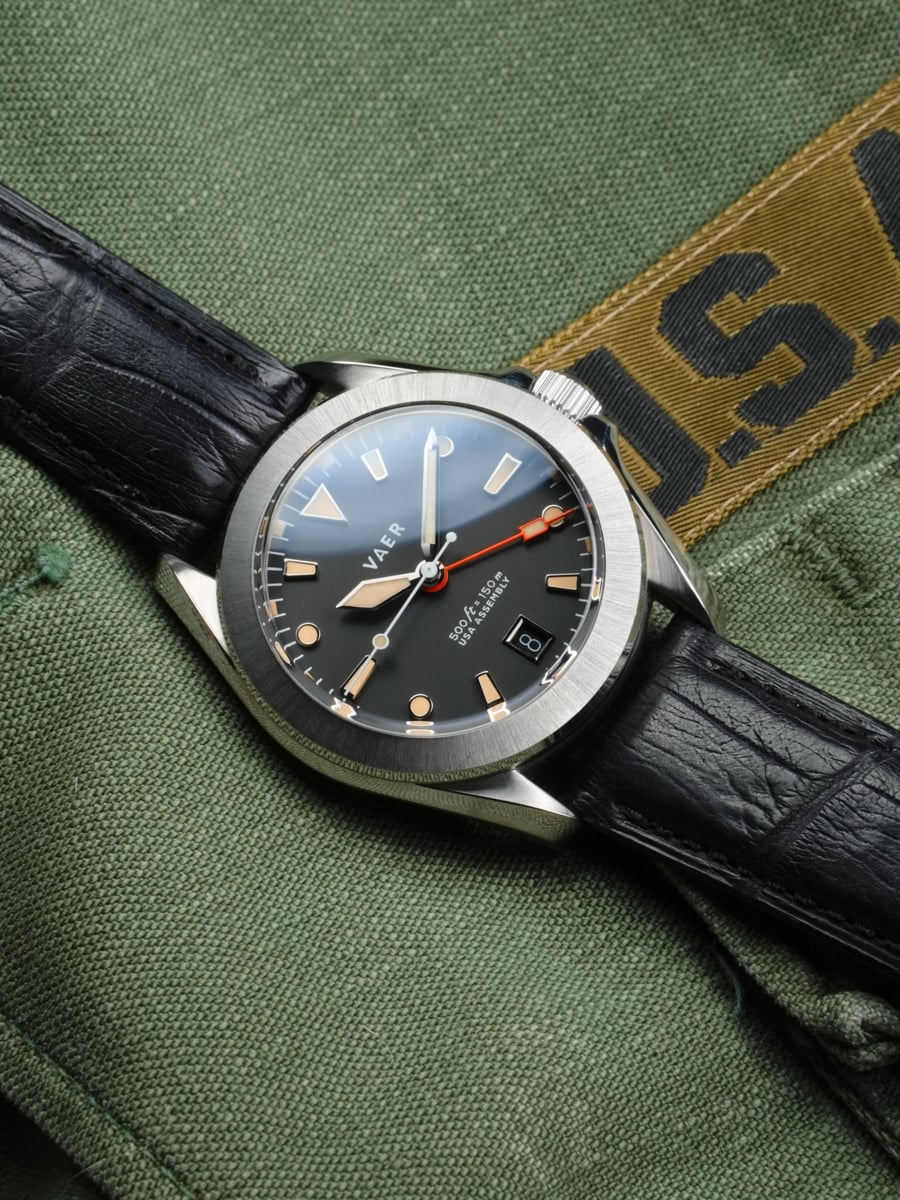 A Cult-Classic GMT Reimagined for Everyday WearInspired by the famously bezel-stripped Rolex GMT-Master worn by Marlon Brando in Apocalypse Now, the G2 Apocalypse turns a piece of 1970s film and watch history into a practical everyday GMT. Its restrained 39mm design pairs a Swiss Ronda quartz GMT movement with sapphire crystal, 150 meters of water resistance, strong BGW9 lume, and USA assembly. The result is an accurate, low-maintenance travel watch with a story collectors will immediately recognize.
 © Beartooth Media Group Inc.
 Loading...