


My first "shelter/tarp". Is a congratulations in order or an "ohhh noooo"?
Topic
Become a member to post in the forums.
My first "shelter/tarp". Is a congratulations in order or an "ohhh noooo"?
I've been eyeing one for a long time. If I had the money I would have gotten one long ago. Everyone loves the spaciousness inside and it's a tried and true design. Congrats indeed!
Love mine!
Congratulations on a good shelter choice. Good weight, good protection and easy setup.
It's great, especially when the bugs are out.
I own a Virga 2 (now known as the Squall 2) and a Rainbow. Both are great tents, very high quality work. Both tents came in right on the advertised weight, in the bag and ready to hike. I have recommended Tarptents to all of my backpacking friends.
Through all of the positive comments, I'm having second thoughts.

Love my TarpTent. It's a Rainbow, but for me and my wife. Got to say, if I had the cash to go for a solo tent, I'd be looking at the Notch, not that the Contrail is a bad tent. I've given it a serious look a lot lately. I just love the modularity and crossover into mild 4 seasons of the Notch. Henry Shires is an excellent craftsman, whatever you choose.
Where do you plan on using it? Do you normally hike with poles?
I'll be honest with everyone. Please, give thoughts on this. I seem to be afraid to give up an "real" tent for lack of better terms. I am tossing around the idea of buying a TNF Mica 1.
From what I have read, (yes, we all know everything on the internet is true, haha), the condensation issues and constant adjusting have kind of steered me away from a Tarptent. Yes, most of my backpacking is above 6000 ft (I live in Colorado), so that kind of helps with the condensation, but I do deal with a bunch of wind. And not a steady wind that comes from one direction for hours at a time.
If anyone has suggestions to cure me of my tent dependency, please help. Yes, the Mica 1 is almost a pound more than a Contrail and/or Notch, and would definitely take up more room in my pack, but I've been backpacking with TNF tents for years now and have come to trust them. I've never had one fail.
To add to it: I've never hiked with poles before, but have been thinking about it. As for usage, the shelter/tent I choose, will be the shelter/tent I use for my Colorado Trail thru-hike this coming summer and PCT next year.
With dealing with wind I want a shelter that can be pitched tight to the ground all the way around. So I have a place to actually get out of it.
The height of the Contrail is adjustable. You can get it pretty low. I don't remember if you can get it all the way to the ground, but I think you can. You can also put shockcord on the guylines to help them take up the slack as the silnylon stretches overnight.
If you don't use poles why not a Rainbow then? Little more wind worthy IMO.
If you like the idea of a two wall tent and don't mind the price, then look at the Notch.
It is really the same weight and stored size of the Contrail, has more headroom and dipper/larger vestibule (x2) than the TNF and it is an integral pitch.
That is inner and rain-fly go up together but you can set up either by themselves.
BTW, as for sagging ,you can just adjust the pole height from the inside. Easy to do particularly with the flick-lock type poles.
Franco
franco@tarptent
I will definitely look at the Notch.
Is the Notch big enough for my long sleeping bag or quilt? Whichever I choose?
I shot a video comparing the SS1,the Notch and the Contrail.
You will see on the floor an Exped 72" mat and a Mont Bell pillow. Combined they take up 80"
http://www.youtube.com/watch?v=SIt1Oezq2GQ&list=UU0PuLUKvG7Fxxex5BMVK4vw&index=2&feature=plcp
Franco
Awesome. I really appreciate the help. I will check out the video!!!!
Nice video Franco. Every tent review should have a cat in it. :)
How does the Notch handle sidewinds? Unless they're end on it looks about as aerodynamic as a brick to me.
No real world use but the vestibule tie out point already works in a similar way to a guyline and if in high wind areas you can add guylines to the pole tips via the vents.
Yes sort of a sleek brick…
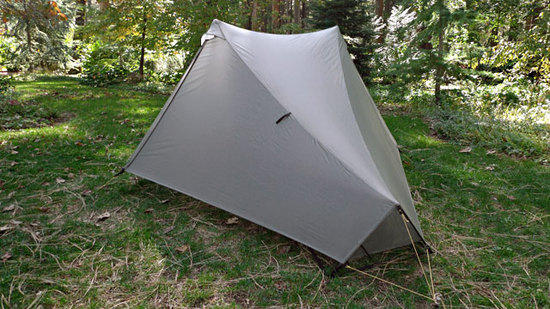
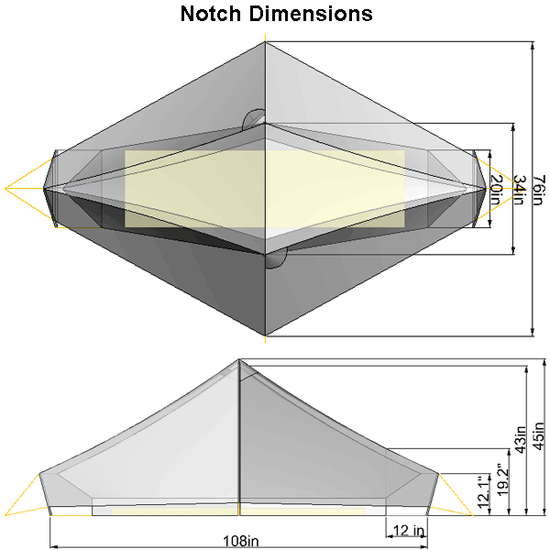
Franco
Don't worry about carrying poles. If you decide you don't want to carry poles, then buy a pole (or two) from TarpTent. Those poles are light and strong. The design of a tent like this puts a lot less stress on poles. As a result, the pole is a lot less likely to fail (which means that while the tent may, depending on design, take a lot of wind, your pole is unlikely to fail). If you do decide to use a trekking pole, than you can be confident that your pole is much stronger than just about any pole designed to hold up a tent. After all, when is the last time you put all of your weight on your tent's poles?
As I see it, a tent can fail in three ways: fabric, poles and pegs. The fabric is tough and time tested, so I don't see that failing in the Contrail. As I mentioned, if you happen to use trekking poles, then they are unlikely to fail (even carbon fiber poles are unlikely to fail, although I could see them failing in extreme conditions). The most likely failure is a failure of a peg (stake). If you don't get the stake in deep enough, then the stresses could pull one of them out, and the tent could fall over. Of course, even a free standing tent depends on stakes, but the only difference is that a lose peg or two won't hurt things.
Every tent design has its pluses and minuses. The Contrail design is a solid, time tested design. Furthermore, it has undergone numerous tweaks that make it better than ever. I personally like the fact that it is high on one end (where your head will be) since that makes it feel much more roomy than many tents. It also cuts down on condensation. To a certain extent, that is a personal preference. Some people like the apex in the middle (so they can sit up without scooting). Other tents have side entry, which tends to be a bit easier to get into. Unless you are looking at Cuben tents, I don't think you can get much lighter for that much room. Overall, I think the Contrail is an excellent value.
Do you mind if I add my question to your thread, Paul? If so I will create my own. Just say so.
First time poster, been lurking for awhile. I, and a couple friends, have been talking about backpacking for the past year or so and we will be giving it a go this March. It will be mainly in the WV, PA, OH region. Although we have talks of going out west I don't want to get too ahead of myself as I am not even sure if this is all for me.
I have no experience backpacking, only car camping. I've never been an outdoorsman. I have poured over these forums and other sites for a few months now and I kind of have a general list of things I want to purchase, but one area I am unsure of is shelter. I am conflicted between getting in over my head by going too light when I have zero experience. Basically, trying to find the right balance. As somebody with no experience backpacking, really no outdoorsy experience at all, should I just stick with a standard tent like the Seedhouse UL1? Or are tarptents fairly simple? This may be a stupid question, but figured it would be better to ask then make a stupid purchase.
Chris, as a fellow newbie who's picked up a couple of TarpTents (first the Moment, and now a Double Rainbow), I can reassure you that TarpTents are pretty much just tents. They aren't any harder to pitch or manage than a regular tent. They're just made of lighter weight materials than the "regular" tents you see in the big retail shops. They're just fine for beginners.
(You might want to watch the videos on the TarpTent website which show how to pitch the various models. Some do go up more quickly and easily than others.)
Oh, and Paul – if wind is a big concern for you, consider the TarpTent Moment as well. It's got a profile which is very aerodynamic, so it should hold up well to wind. And it's ridiculously fast to pitch.
Chris, while I have a fair amount of 3-season outdoor experience, I only recently started the transition to UL. When we ditched our 5 lb. traditional tent, I picked up a TarpTent Rainbow for my wife and I (saving 3 lbs. of pack weight), mostly because she is like you–new to serious outdoor pursuits. She couldn't wrap her mind around a tarp or floorless shelter.
And honestly, we love the Rainbow. It sets up like a traditional tent and it can handle mild to moderate snow-loading (typical of what you'd experience under most conditions where you are). The only transition is learning to handle the differences of a single-wall shelter (honestly, just be aware of condensation and wipe it off). And the Rainbow line vents really well.
If I did it over again, I'd likely get the Double Rainbow since I'm working on making a solo shelter for me (going to tarps when my wife isn't around). The DR is only about 6 ounces heavier for two, and it has better entry/exit and ventilation.
If you're wanting a solo shelter, seriously consider the Rainbow as a great first shelter. If you'll share most if the time, then think about the Double Rainbow. For starting out, it's hard to get better than those two. Treat them with care, and they'll last for a long time, and you won't kick yourself six months down the road for going with something heavier.
I think any tent by TarpTent is a good tent for a beginning backpacker. Most of his tents are simply single walled tents (a few are double walled). They are an excellent value, and are easy to setup. With single walled tents, you have to be a bit careful about condensation, but it really isn't that hard. This article here: http://www.backpackinglight.com/cgi-bin/backpackinglight/single_wall_shelters_condensation_factors_tips.html gives great advice. But in general, don't worry about it. The worse thing that is likely to happen is that you will get some moisture buildup on the inside walls, and a few drips will fall. Just carry a bandana/mini towel and wipe the inside. I've used a single walled tent for a long time before reading (or knowing what was covered) in that article and never had much of a problem.
I think there is a lot of good, basic equipment that is used by ultralight folks that makes sense for beginners. A NeoAir or similar mattress saves a lot of weight over a regular Thermarest. A Caldera cone combined with a light cooking pot and "pour boiling water into a bag" food is a very simple, easy combination. This is much easier than "real cooking". Get yourself a small bowl and some instant oatmeal (along with a spoon) and you are set.
Everyone tests out their gear. It is always a good idea to take a little trip and see what you like or don't like about your current system. This could be a trip only a mile or so away from the car (so if you forget something it isn't that big of a deal). The basics of ultralight (in my opinion) are:
1) Weigh everything
2) List each item and think about it
3) Share your list with others
4) Based on what people say, tweak your gear, try it, then repeat the assessment
This website is a fantastic place to share your list, or ask any questions about general backpacking or ultralight backpacking.
Become a member to post in the forums.
 New Ultralight GearSee the latest releases in ultralight cottage-brand gear from small makers.
 © Beartooth Media Group Inc.
 Loading...