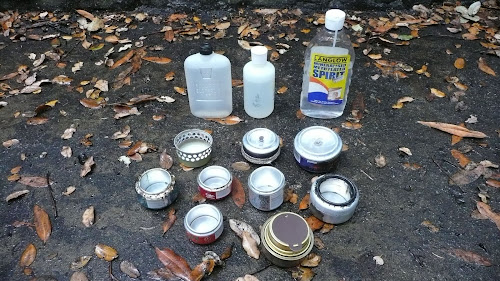
I actually started out with a wider variety of stoves. The stoves in the above photo were just stoves that made the first cut.
My starting line up:

I’m basically looking for efficiency and reliability. I want to consistently be able to boil 2 cups of water in a variety of conditions (calm, windy, cold, etc.) on a minimum amount of fuel.
To weed out inefficient stoves, I conducted burn duration tests. Any stove that burns through a given quantity of fuel quickly is not an efficient stove.
“Closed” jet type stoves (back row in the above photo, the two to the right) quickly fell by the way side. Closed jet type stoves require priming which requires that some of the fuel be used for the priming which winds up shooting any overall efficiency to heck. A closed jet type stove undergoing duration testing:
Priming pan in use with a closed jet stove. Note blue flames coming out of priming pan.
“Fast” stoves (ones that boil water quickly) were eliminated next. Fast typically equals inefficient. This stove is inefficient!
I then benchmarked the remaining burners against Trangia burners. If a test burner cannot outlast a Trangia burner in a duration test, then there is little chance that the burner is efficient.
I noticed the tendency of hotter stoves to burn with yellow flames when using “green” denatured alcohol. Notice in the photo above that the only test stove NOT burning with a yellow flame is the tall stove in the middle of the back row. The tall stove was also the only stove that came close to the Trangia in duration testing.
After conducting duration tests, I did boil tests.
Side burners typically were eliminated during boil tests. Side burners generally have the problem of flame spillage where flames spill up around the pot and heat is wasted. Wasted heat = inefficient.
All of the above “weed out” procedures left me with a few open top jet stoves.
The tall stove shown above did exceptionally well in both duration and boil tests. Inside a windscreen, a notably different environment than out in the open as in my duration tests, the tall stove brought water to a boil slower than my Trangia burners (generally a sign of efficiency) and held the boil for multiple minutes. Inside a windscreen, I was getting nearly 15 minute burn durations on 3/4 fl. oz. of denatured alcohol with boils occurring around 11 minutes and lasting until nearly 15 minutes. That’s pretty good.
Now, I need to “deconstruct” the tall stove that did so well. I wish I could claim the Tall Boy Top Jet (the name of the stove) as my own design, but this one comes from a stove designer here in the Los Angeles area who gave me a copy of his latest creation for testing. It did better than anything else I have including the commercially produced Trangia burners.
HJ
Adventures in Stoving