Topic

Large pyramid tent in wind

  • This topic is empty.
Viewing 18 posts - 1 through 18 (of 18 total)
Elliott Wolin BPL Member
PostedAug 22, 2011 at 6:45 pm

Does anyone have experience with large pyramid tents in the wind? I only used my large pyramid tent in Alaska in protected camping areas (I used a 3-person RayWay tarp in the windy Denali backcountry).

How do large pyramids handle in wind? If you use extra guy lines, how do you rig them? What else do you do to stabilize the tent in high winds?

PostedAug 22, 2011 at 7:02 pm

My ancient Choiunard Pyramid tent survived many high wind storms.
The trick with a pyramid is the way the surface area decreases with the height of the shelter. There are no surfaces left perpendicular to the wind.
However, like any other non-freestanding shelter it is only as strong as your stake out points.
For big storms with high wind I would take time to strengthen my Pyramid by laying branches along the edges or burying them with snow.
Aim the zippered door away from the wind if possible.
If a big gust of wind gets under the edge be ready for carnage in the form of flying stakes, thus the extra precautions stated above during big storms.
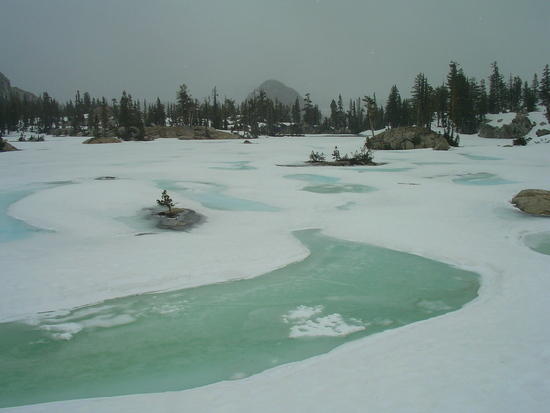
My most memorable storm survival story occured in the Sierra Nevada one year in May. I was offtrail at Otter lake and the barometer dropped below 990 mb as the winds went way above gale force. I spent that night and the entire next day hunkered down in a blizzard next to a frozen Otter lake.
That Pyramid saved my fragile little life. A point driven home every time i went outside to take a leak and had the heat ripped out of every seam and gap in my clothing by that ridiculous wind.
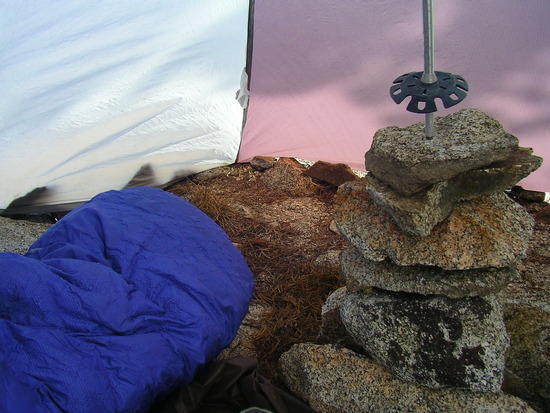
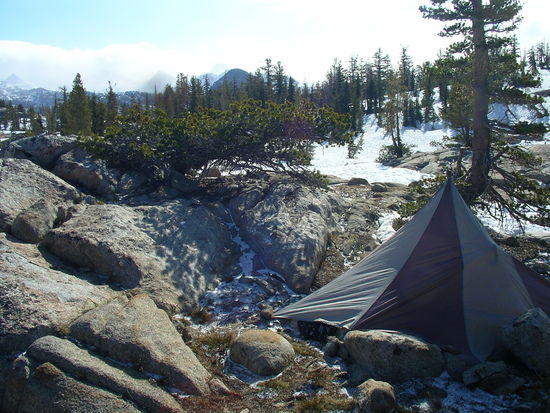
You can see in the last photo that i had a ski pole to hold the pyramid up and another stuck into the windward side at an angle to provide a bit extra support.
I also used rocks to pin the edges down and used existing boulders on the windward side to choose this site to set up the Pyramid on.
At something like 3.5 lbs my Choiunard Pyramid was not exactly UL.
It was magic.
.Life in a Pyramid.Otter lake Blizzard of May 2008
.The aftermath.

PostedAug 22, 2011 at 8:06 pm

From my experience with small mids my main concern, after making sure if is pegged down as securely as possible, would be the centre pole as they can really flex in strong winds. Ryan jordam recently described physically bracing the pole in a mid on a stormy night. So anything you could do to stiffen the centre pole would help eg take a heavier pole than normal or use your trekking poles lashed to the main pole.

PostedAug 22, 2011 at 9:08 pm

Like Matt above, I have a venerable Chouinard Megamid. I have suffered two wind-related failures. One was due to poor stake-holding properties in the ground I was camped on. Moral: in a strong wind, the stakes on a pyramid take a LOT of force, so solid placements in good ground are important.
The other was simpler – a huge gust simply crushed the thing, folded the pole in half. Nothing I could have done would have prevented that.

PostedAug 22, 2011 at 10:34 pm

We use our Oware 9×9 pyramid in the fall and winter in Southeast Alaska. The wind blows and it rains a lot during that time. I’ve found that setting it at ground level and making sure of a taut pitch handles the strongest wind. The pyramid design was used in polar exploration and is considered to be a great shelter in the wind.

This pitch withstood 35 knot winds at the top of a mountain. I wasn’t expecting the wind to pick up that evening, nor was the weather service, so it wasn’t set at ground level. Still it held strong.

Tarp Camp

Dean F. BPL Member
PostedAug 23, 2011 at 3:35 am

When I'm using my MLD SuperMid it's usually becasue I'm out with partner(s), so I rationalize the extra weight of carrying my LuxuryLite Big Survival Stik:

http://www.backpackinglight.com/cgi-bin/backpackinglight/2008_luxurylite_big_survival_stik_staff_review.html

I'm almost embarrassed to admit that I own one but it makes one HELL of a center pole, and is way stronger than trek poles. It takes an extra section to be long enough for a SuperMid, but the basic Stik would probably work for a DuoMid or TrailStar. And, as a BIG plus, my 4-year-old daughter likes to use the bottom two sections as her "hiking stick," so that's enough justification for me. (And after prompting from others I've discovered that the "knife" thingy makes a decent potty-trowel.)

Jerry Adams BPL Member
PostedAug 23, 2011 at 9:01 am

My 9 x 9 pyramid with 5 foot center pole .65 inch Easton – just 4 corner stakes – 30 MPH winds measured with ADC Wind – the corner stakes pulled out because they were in sandy soil – put rocks on them and then they held.

PostedAug 23, 2011 at 9:30 am

A friend and I decided to hike without checking the weather forecast and didn't realize that the remnants of a hurricane would arrive later after we hit the trail.

We ended up having to pitch our small pyramids in a high exposed rocky area because the lower elevations had lots of dead trees that were coming down in the strong winds.

It was so strong that we could barely walk when we started to setup camp.

We ended up using huge rocks instead of stakes. It must have taken two hours to setup camp.

We slept fine after adjusting to the constant roar and flapping from the wind. We both use relatively sturdy trekking poles. So we weren't worried about them breaking.

We woke to the same wind.
Hiking out was hard.
We ran into a group of young men who had all their tent poles broken on their freestanding dome shelters from the wind and ended up fighting conditions all night. I suspect they were using cheap tents with fiberglass poles.

They were camped below us at lower elevation in a more protected area.

I've been stuck in similar gale conditions near exposed beaches and have seen heavy duty aluminum tent poles bend in on freestanding dome tents, but never had any break on me when I use extra guy lines.

I've found that a well attached small pyramid seems to handle the winds better than the equivalent sized dome, but I don't know about large pyramids, say 9×9 or bigger.

PostedAug 23, 2011 at 1:36 pm

As mentioned, the corner stake outs are key. Use rocks as big as you can move, or
deadmen in snow.

Poles are the next important item. For heavy wind, the poles on the 11x11x8 ft ones that Outward Bound uses as their cooking shelters in Alaska are 1.5" diameter at the bottom and 7/8" at the top and made of aluminum.

For very heavy snow (Oregon Rain Forest snow) outdoor schools use closet dowels
they carry in their sleds.

A tipi won't give any advantage in wind as the whole shelter has to be larger to give
the same usable space, (unless, of course, you are ball shaped).

I have found that tie outs about 2 feet up the side and centered in the flat sides will
help maintain head room in heavy snows and high winds.

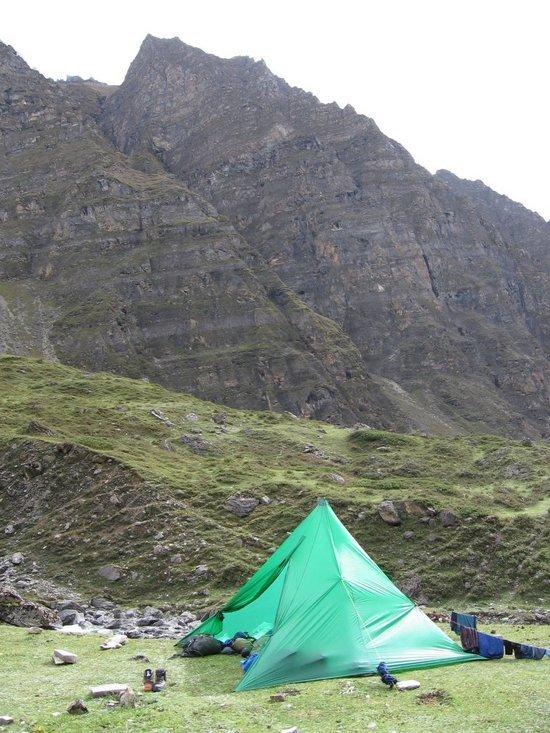
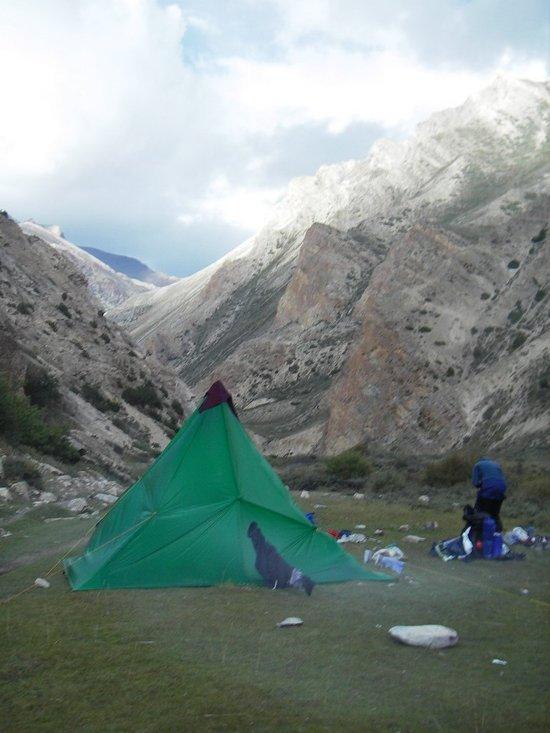
Stuart Bilby photos of large mid in Nepal.
He brought some grip clips to place on the windward sides as needed to get more headroom.

LargeMidNepalTrek-16.jpg

LargeMidNepalTrek-12.jpg

PostedAug 23, 2011 at 2:06 pm

I've experienced strong winds several times, most recently was a storm that blew in over night while we were above treeline. I really regretted not bringing a CF pole and trying to use a trekking pole, as I had to hold the trekking pole for an hour or so, while I know with the cf pole I'd been sleeping or attempting to.

These are probably the biggest things:
1. Strong tie outs , and staking , no ti skewers, at least ground hogs or longer CF stake ok, as long as put in well.
2. pitch tight to the ground, after all condensation won't be an issue in a big wind
3. Strong pole
4. Tight pitch
5. guyouts 2 – 4 ft up depending on height of tent

I believe round has an advantage here, but everyone has their own opinion. FWIW, I've had tents 9 ft tall that did not have an issue in strong winds when 1 -3 were met, 4 and 5 help, and make it more enjoyable.

PostedAug 31, 2011 at 7:11 pm

This tipi is 9 ft tall, winds were gusty, local weather reports were near 40 MPH. I'll call it 30 MPH or so. I've seen higher but , have not had a video camera handy. No guyouts were used, although they can add additional stability.

Youtube video

PostedSep 2, 2011 at 3:13 am

There is some particular way of tying the knots on the ropes which makes it sturdy and steady. But of course the rod is a must to go ahead for any storm happening on trekking.

Rog Tallbloke BPL Member
PostedSep 2, 2011 at 3:28 am

Big rocks and extra cordage for tie out points. Plus a fat branch cut to length if you can find one makes a reliable pole. For my hex 3 I use 3 sections of CF golf club shaft (total weight 7oz) and it has held up in 30mph wind.

PostedOct 3, 2011 at 8:41 pm

I was at a tent show once. Hundreds of tents set-up including many expedition tents. Most were not guyed out with extra lines.
4 go-lite Hex tents (6 sided pyramids) all survived the stormy night without issue, most other tents had at least some stakes out or poles bent.

this was in a graasy field, so the stakes held great.

I am a big fan of the Hex's(Now updated and renamed Shangrila) since then for windy weather.

Roger Caffin BPL Member
PostedOct 4, 2011 at 12:14 am

Priorities for high winds:
Stakes
Stakes
Stakes
Poles

We got hit by 150+ kph gusts in Slovenia recentlty. My UL blue summer tent held, but only because the guys held. Guys – the external ones, plus the two guys inside …

I had better admit we hastily abandonded the site as soon as we could safely get the tent down!

Cheers

PostedOct 5, 2011 at 11:31 am

I have had very good experiences using Golite and MLD mids in high wind, but not as much with the Black Diamond Mids. They don't come with tensioners, so getting a taught pitch is tough. Of course, you could add your own and solve that problem, its just more work.

Viewing 18 posts - 1 through 18 (of 18 total)
Loading...