


Is anyone selling M 50? I am looking to make a summer quilt but I couldnt find the fabric on Thru-hiker.com. Can you get this stuff right now and how much is it? Thanks for any info.
Topic
Become a member to post in the forums.
Is anyone selling M 50? I am looking to make a summer quilt but I couldnt find the fabric on Thru-hiker.com. Can you get this stuff right now and how much is it? Thanks for any info.
Thru-hiker is the only place to expect to find it as far as I know. The original lot looks to be sold out. I think it was around ~30/yd. I'm hoping to see it for sale again in the next 30-60 days (just a a guess). You might find someone selling but it would be hard to find enough for a quilt.
Jamie
Hey Josh,
I had similar plans and contacted Paul at Thru-Hiker regarding the M50 a few days ago.
Here's what he had to say:
"I don't know when/if more will come in. 10d is difficult to mill."
I'm crossing my fingers that more will appear but it seems until then M90 will have to suffice for now.
moved
Sounds like what we need is a 10D, or lighter fabric, that has a cire finish to make it down proof. Cire finishing is the age old method used to down proof fabric, if it does not have a cire finish, it is not "down proof" . The cire side is the "shiny" side on M90/Intrepid. A cire finish would also work with the a DWR to improve water resistance, and wind resistance.
Thanks to everyone for the info. I am contemplating a 2.5 oz Climashield Apex quilt (hopefully a 45 degree rating if my research was right). Since I do not need it to be down proof is there any fabric available that is lighter than M 90 that would work with this insulaion?
Josh
2.5 oz Climashield Apex quilt … is there any fabric available that is lighter than M 90 that would work with this insulation?
There are a number of silk fans on BPL. A recent post (which I can't find at the moment) gave weights for some of the lighter silk fabrics and IIRC 4.5mm silk weighed in similar to M50.
I haven't worked with silk so I can't say much more about it.
Correct. A 4.5mm silk should equal ~.59 oz without a DWR treatment.
Ryan
I haven't heard much about using silk for a quilt. What are there any drawbacks to this material for a sythetic quilt application? What is the cost compared to M 50 or M 90? Does anyone know where I can find a good place to purchase this?
Thanks again,
Josh
Silk is cheap. A good compromise that I'm considering is to make the outside of the quilt m90 (better wind resistance and has a DWR) and the inside 4.5mm or 5mm habotai silk (lighter, cheaper).
http://www.thaisilks.com/index.php?cPath=1_2
http://www.dharmatrading.com/fabric/silk/habotai.html
If you are using down, really light-weight silk is going to leak like a sieve. Sad.
If you are using synthetic insulation, silk will work but it will have a rather short life. It is not as strong as nylon.
http://www.thaisilks.com is a well-known source. I have used them myself for sleeping bag liners etc. Note: there is an 's' at the end of the name.
Cheers

One of the drawbacks to silk, from my perspective, is that it is closer to cotten than nylon when it comes to water absorption and drying time.
Sooo…..IF, I had a .65oz sq/yd, nylon, ripstop, DWR treated, downproof, cire finished fabric. What price per yard would the market bear?
Sooo…..IF, I had a .65oz sq/yd, nylon, ripstop, DWR treated, downproof, cire finished fabric. What price per yard would the market bear?
I'm not sure what it'd bear, but if it was truly 0.65 oz/yd out the door, and did a good job of holding back down, it'd sell like hotcakes at $10/yd.
Yes it would ;-), even I'd pay $10 a yard, but I'm pretty sure something of that caliber would cost more than that. It may well cost more than $10 a yard to produce, so is $25 a yard too much?.
cuben runs about $25yd retail and people buy it, so i'm sure whatever you charge people will pay it, but the better the price the faster you'll move it. wish i could help with a group buy, but i doubt i could. I'm sure i'd buy from you if you wholesaled it at 20yds like OWFINC does though.
-Tim
My interest would probably begin to wane at $20 — you wouldn't lose me at 25/yd, even at that number I would probably buy enough to play around with (and maybe more depending on how much I liked it).
I was under the impression that M50 had a similiar down proofing treatment maybe not (couldn't quickly find any supporting info on that assumption). If you know anything on that treatment could you discuss pros/cons between this and the finish you are proposing?
I've used an M50 quilt and down jacket for a few months now and it's definitely not as downproof as m90 and the dwr isn't nearly as good. I still like it but the weight definitely has some tradeoffs.
In all fairness, very few fabrics on the market at any weight are as downproof as M90 and Intrepid.
I've personally never found any that I felt were superior in that regard.
What was M50 selling for before it vanished? You could either put the price a little higher on the .65/oz since it's lighter, or put it at the same price or less and gobble up all the market share M50 would have.
Ryan
M50 was at $24 plus shipping.

What have we really gained from these UL fabric fads?
First we learn from Richard that the .08 gauge PET in Cuben leaks worse than most silnylon.
Now we have reports suggesting a definite trade-off in DWR for the similarly expensive M50.
For that matter, wonder if the 1.1 oz "uncoated" nylon that has been available for years in many colors at much lower cost with a good DWR coating is really that much inferior to the M90 that is not much lighter, and may not be as rugged.
Admit I'll be using some 3/4 oz .08 green shaded Cuben for some tent end covers because I don't want to waste it; but think we could all benefit greatly from being more careful about springing for untested pricey stuff just to shave negligible amounts of weight.
Samuel,
Having used more than my fair share of M90/Intrepid, I can say unequivocally that it's more durable than the vast majority of 1.1oz I've used. So in that regard, I'd say be careful of making broad assumptions based on weight, in either direction.
Extremely high quality fabric of whatever weight will usually trump average quality fabric of any other weight, although even the military overrun type 6,6 1.1oz nylon I've used didn't hold up as well as the aforementioned 0.9oz fabrics.
Final weight of the finished fabrics only matter so much. Weave, yarn, and most importantly, the mill's skill toward making fabric seem to be much more important.
I definitely agree with being cautious about adopting new technologies overly fast just because of being lighter weight, but if we don't use the "untested" stuff, how will it ever become tested? I think we've seen from our history that we can't sit around and wait for the big companies to innovate for us, they'll simply spend all the money on marketing and packaging, and keep telling us it's new and better without ever doing anything other than making it more "bomber".
Anyway, just my 2c.

"First we learn from Richard that the .08 gauge PET in Cuben leaks worse than most silnylon."
Did we really learn this? Last I read, most variants of cuben under Richards testing have been far more waterproof than silnylon and only a couple anomalous samples tested lower.
Dan,
Did you see the water pouring through that cuben in Richard's video? Better quality silnylons, like Skylite for example, may allow a few drops at those pressures, but not that much. But I would agree that silnylons made these days can be very disappointing also. I am pining for Roger's test results, if and when they arrive, and hope they include the silnylon sent to him by T-H and currently offered on its website.
Javan,
My comment about M50 was expressly based on observations posted earlier on this thread. I have not personally exposed either M50 or M90 and the uncoated 1.1 oz DWR treated nylon to similar heavy use. Just looking at and handling them, the nylon (from Quest ca. 2004) appears much ruggeder to me than M90 from T-H (ca. 2009); but I would agree, that is not enough to base an opinion on. Before doing my next MYOG sleeping bag, I will have to find out more about the comparative durability and DWR quality of these fabrics, and would appreciate whatever further information you can provide about your conclusion about the M90's durability.
If the prices on some of these newer products were not so much higher, I would agree with you about innovation; but, given the very large price differences, I still don't think there is enough potential weight reduction to warrant the much higher expense along with the risk that the product will not perform that much better, or even as well. And when I see the expensive ultra light materials selling out like hotcakes, I have to wonder if what is really involved is innovation, or less noble human motivations.
Kind of expected to take some heat for the earlier post, but felt it was a minority opinion worth expressing.
Become a member to post in the forums.
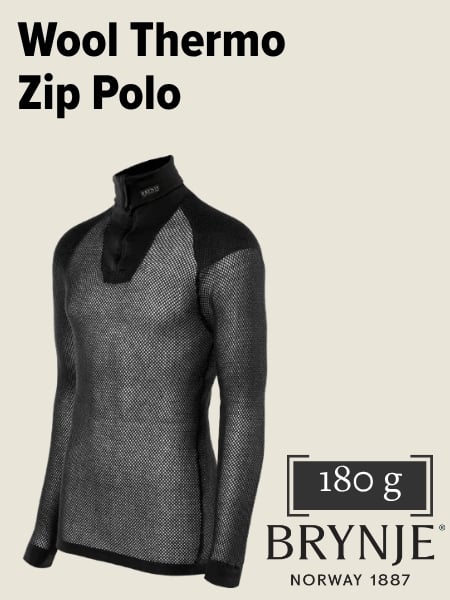 Wool Thermo Zip PoloMerino wool-blend mesh base layer with a 3/4 zip neck for venting and reinforced shoulders for pack-carrying comfort. Weighs 6.3oz | 180g
 © Beartooth Media Group Inc.
 Loading...