


<del></del>
Topic
Become a member to post in the forums.
<del></del>
no pdf zoom can and will be a detriment to reading maps in some cases
I chose the sony prrs350 ereader when I lost my previous ereader.
just weighed it at 5.4oz. With the case with integrated light + rechargeable 2aaa it weighs 10oz total , battery life on the light last easily over ten thousand pages for me (= not an issue).
Compared to the other ereaders, it only has a 5in screen but it is the lightest and most pocketable ereader.
It has the latest pearl display so the refresh is as fast as anything available out there.
Battery life should be measured in page turns (refresh) and with all the wireless stuff turned off you all can read several novels before recharging.
The sony accepts pdf, epub, and you can easily convert purchases from amazon (kindle format).
The touch screen on the sony isnt as nice
Compared to tablets ( I had the ipad, currently have the ipad2 and an asus transformer – get tablets with IPS screens), well you can't. They have different purposes for the most part.Another thing not mentioned is the difference in weight.
ipod touch
I just got my wife the Kindle 3 and its great to read on. Much easier to read on then any tablet I have picked up.
As far as tablets go…they cost more or just as much as a laptop. I dont see myself ever getting a tablet when I can get a laptop for less. Plus I carry an android phone if i ever need some quick browsing etc…
i got a sony prs 350 on ebay for just over $100 delivered. nice!
it's fantasticly light and small. will easily fit in the side pocket of my pack where i typically keep my maps (hopefully i won't lose it).
i took a screenshot from mytopo from kyle's wenthiking.com printed it to pdf and pushed it to the sony reader. it zooms and pans great!
i was afraid i'd have to put the various pieces of maps on different pages. i'm sure i'll do that for large maps, but for just one hike i'm sure i'll just create a giant pdf "page" and zoom/pan around.
only issue i see is lack of color (hard to distinguish water), but we knew that already.
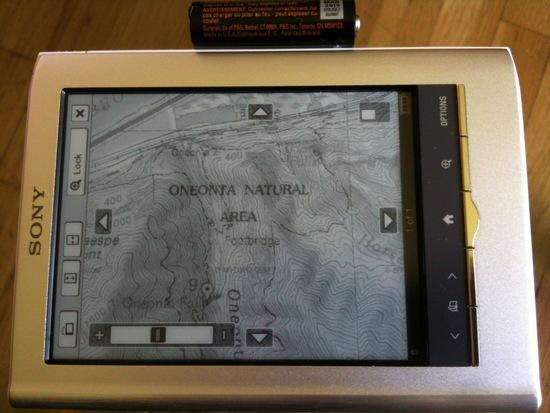
AA battery for scale.
i'm psyched.
I just recently purchased the kindle (no ads) wifi edition and weighed it at 7.7 ounces. I loaded a few e-books in mobi format that really look great in direct sunlight, etc.. I also loaded the thru-hikers guide pdf and two maps I have in pdf format and they both look clear and you can zoom in on them if needed.
I have a cellphone that I pay a stupidly high fee on for the internet, games, blah….. the e-reader give me simplicity and actually weighs less then the paperback I am currently reading. I think I will bring it on my next 2-3 day trip and see how durable it is in a ziplock bag in my pack.
Hey sorry to bump this thread, but I'm picking up the new Nook Simple Touch and was excited to take it out backpacking next spring. I was wondering what you guys thought would be the best kind of lightweight case for these e-readers? Just a neoprene sleeve/nothing/a lightweight hard case? I kinda don't know the direction to go on a lightweight case for the e-reader cuz I would just throw the e-reader in my backpack and I'm a little afraid of doing that as it might get broken that way. I know you guys always have the best solutions, so I wanted to tap that creative side. Thanks!
I protect my Nook with a bubble wrap envelope. They last several month and just add the right amount of protection without adding to much bulk, are free and weigh next to nothing.
When you take your Nook on trips with cooler temperatures (aprox <10°C), you have to warm it before switching it on – else you get a "Can't switch on because battery is empty" message or it doesn't switch on at all. At least this is the case with my Simple Touch reader. Apparently they use a very thin Lipo battery inside that is very sensitive to temperature.
Once switched on it keeps running, even when cooling down – but I didn't use it in very cold conditions yet.
You can download almost every USGS topo map for free from their website as a pdf. I do this and cut out smaller sections to print for dayhikes. It would be really useful to be able to carry the entire map on a reader. The only downside would be if you were truly lost and needed to look at larger areas to rule out where you weren't, but nobody on this site would ever get that lost, would they? ;-)
good idea andy!
i tend to take screenshots from mappingsupport.com (i prefer mytopo in most cases to usgs), and then print small-ish pdf pages from those (otherwise they are slow to load in my sony e-reader).
i have yet to fully figure out how to create multiple pages of my intended hike in one pdf doc, but that's what i'll try to do next time…
The new basic kindle is now down to 5.98 oz.
Adding touchscreens, keyboards, 3g, etc. adds a little weight.
Eric, it may be easiest to make multiple copies of the original pdf file, crop each for each day and then recombine those into one pdf file using free software.
Okay, someone has to bring up smartphones as an alternative in this thread, so it might as well be me … :-)
Seriously, I certainly agree that dedicated eReader hardware has its place in normal life, but backpacking? Give me the best multi-function device. Since I already also want to carry a cell phone and a camera and maybe a GPS, why not combine these functions along with book reader, internet access, MP3 player … you've likely seen this list of funtionality before, but perhaps worth repeating.
A modern smartphone is a pocket computer that happens to also function as a phone. The suite of apps available on it is likely to beat out what any dedicated reader hardware can do, indeed until these are supplanted by more general purpose tablets. And then a smartphone with a decent screen is going to be a better choice for backpacking due to the overall size, weight, and perhaps durability on trail issues.
My Droid X worked great on the CDT for all of these things, to include as a book reader in the last month or so when nights got pretty long (limited daylight hours). It has a 4.3" screen, so really not a bad book reading experience IMO. But I'm also content to read on the 3.2" screen on my new phone, one I just got because Verizon charges me too much to use my Droid X at home (!).
So when you're thinking about a book reading device, do think "multi-function device" and consider going the smart phone (or even the smaller-variant tablet) route.
i believe we covered some of this previously in the thread.
two words: battery life
otherwise i'd totally agree with you,and it's a good point.
on trips of two days or less i just bring my cell phone
you can buy very cheap smartphone powerpacks at deal extreme …
whether its worth the weight is a different question
i usually carry an extra power pack when my cell phone is my sole means of calling in help … it weights < 1.5 oz .. and cost < 10$
ah. i guess i should have qualified battery life.
my e-reader weighs ~5.5oz and the battery lasts 3 weeks
Regarding the Kindle's claimed month-long battery life…
"No battery anxiety – read for up to one month on a single charge with wireless off and a half hour of reading per day."
Do some basic math from their statement and you end up with 15 hours, give or take. That's only 5 hours more than an iPad.
I totally agree that the smartphone is a more useful device overall.
However, when I'm in the backcountry I like to detach from my LCD-dominated life. E-readers are simple and uncluttered and give a book-like experience at a lower weight.
As e-readers approach magazine weight they will be very tempting for solo trips.
(re-battery life: as an owner of both a Kindle and iPad, there is no comparison in the battery life department. Kindle wins by a long shot)

"As e-readers approach magazine weight they will be very tempting for solo trips."
I thought e-readers already approached magazine weight – or are as light or lighter than magazines. I don't have one and haven't researched them, so I don't know. Are they not there yet?
ah. i guess i should have qualified battery life.
my e-reader weighs ~5.5oz and the battery lasts 3 weeks
What does that mean? There's a big difference between leaving it on the entire time while flipping pages every minute or two or the other 'test' of flipping five pages real quick and then leaving it turned off for the rest of the three weeks. The latter is what I see quoted all too often when the former is really what matters.
Yeah, I suppose they have approached magazine weight but not reached it.
e-readers are in the 6-9 oz range.
magazines are closer to 4 oz.
As soon as you have several magazines on the reader for any (single) multiday backpacking trip, you're going to be way lighter with the e-reader, evewn if you don't find time to read all the magazines.
Eric said:
"two words: battery life
otherwise i'd totally agree with you,and it's a good point.
on trips of two days or less i just bring my cell phone"
I used my Droid X on a 5 month trip this year, and battery life was not an issue. I just carried two spare batteries, made sure all three were charged each time I'd leave a trail town, sit next to a wall plug when eating in a diner, etc — no problem. No solar charger this trip.
I acknowledge that it depends on a person's backcountry 'style' — less hiking and more camping would mean more time to sit and use the device and potentially run down the battery(s). But at just over an ounce per battery, not a really big hit there, and again — I would likely be carrying a cell phone anyway, so … !
I'm not trying to knock eReaders like the Nook or Kindle; it's just that for me personally a device that's primarily designed to read books isn't the optimal thing to carry on a backpacking trip — not when I can get a "pretty good" reading experience with a more generally useful device.
I should also acknowledge that I rarely read when backpacking — do my camp chores and then sleep. So perhaps my comments are out of place for this particular thread … though I do read a fair bit on my phone in other contexts (in trail towns sometimes, and even at or around home).
In any event, I definitely don't mean to lead the discussion off track or disparage folks who see things differently!
i use mine for trail maps, as well as books.
last winter i was out in the gorge and lost in the snow. the reader saved me (time) as my phone battery had died overnight when i thought i turned it off, but it decided better for me.
Become a member to post in the forums.
 New Gear with Aluula FabricsLighter, stronger, more abrasion-resistant, and highly water-resistant - explore ultralight backpacking gear made with ALUULA Graflyte fabrics. Engineered for exceptional strength, durability, and lightweight performance, ALUULA Graflyte helps reduce pack weight without sacrificing reliability, making it ideal for demanding backcountry adventures.
 © Beartooth Media Group Inc.
 Loading...