


I have been using the Caldera Cone and love it, but I thought the Bushcooker LT1 would be a more versatile option. It's smaller and takes up less space. Has anyone had any experience with this stove. Pros and cons?
Topic
Become a member to post in the forums.
I have been using the Caldera Cone and love it, but I thought the Bushcooker LT1 would be a more versatile option. It's smaller and takes up less space. Has anyone had any experience with this stove. Pros and cons?
Tom,
I just bought the CC Sidewinder and a 3 cup aluminum anodized pot. The Sidewinder and the optional Inferno woodburner fits inside the pot. Everything is light and compact – more so than a BB LT1 IMHO.
True the Bushbuddy stoves may be a bit more efficient in burning wood because of their inherently tighter design. But the CC Inferno stoves, using the same air circulation pre-heating principle as the BB, are far more efficient at using the heat they produce.
OOPS! yer keerect, I did mix up the two stoves. Sorry. But still, the Bushbuddy and Bushsooker have the same inefficient use of that heat they both so efficiently created. The Sidewinder W/Inferno solves that problem elegantly.
^ I think your mixing up the"bushbuddy" and the "bushcooker", the later made by fourdogstoves :)
I have the LT1 it's a good choice for solo hikers and smaller quantities of water- I brought it along on trip w/ my wife and had to boil ~ 1.0 liter of water for suppers, it got the job done, but was slow
I've used it solo w/ my SP600 (it's a perfect fit inside!) and was much happier w/ it- there is no doubt that the bigger stoves are going to outburn this one (more fuel/more air), but for solo use I've found it to be pretty good, also works well w/ esbit
here's a guy who used the entire length of the PCT
http://tjamrog.wordpress.com/2010/12/03/bushcooker-lt1-long-term-use-report/
These sure are some Freakishly fast boil times posted on the BPL site for a FULL LITER of water.
from BPL/cooking/woodstoves page:
Boil Times (one liter)
* Alcohol: 4 minutes
* Esbit Tab: 6 minutes
* Dry Twigs (3 oz): 6 minutes
* Charcoal (4 pieces): 12 minutes (with 90 minutes cooking to follow)
* Other Biomass: your mileage may vary
based on my use- those seem a wee bit optimistic for 1 liter
I would be open to more realistic information for the BPL product page as I have not personally tested and achieved those figures.
I havent tested one myself. I however have made over a thousand fires in woodstoves over the last few years. In my experience with woodstoves of all types (double and single wall) and sizes (imcluding the Bushbuddy) I would guess that the boil times listed might be possible with half of that volume of water. I have read a few reviews that seem to corroborate my estimate.
from tjamrog's review:
"To Burn Wood:
Gather dry grass, leaves, shredded birch bark, toothpick sized twigs, and small pieces of wood no thicker than a pencil. Place a small amount on the bottom of the inside, light a shred of birch bark, throw it in, and then brush the little pile in there against the burning bark and it should catch. Once the flame start to get higher, and it does very quickly with dry material, you can add more. I usually do it at two minute intervals to start…..
Lt 1 Boil Times with 16 oz. of water in SnowPeak 700 Trek Ti ( with lid). No wind conditions at time of testing. You should be aware that metals vary in their ability to conduct heat in terms of boil times. For the same amount of water, aluminum pots boil the fastest, followed by anodized steel, then titanium, with stainless steel the slowest to transfer heat. Wider bases cook faster than narrow ones:
I was able to get the quickest boil time with alcohol, employing less than 1 oz. of alcohol in 4 minutes and 20 seconds. It should be also noted that the LT 1 working in alcohol mode is more efficient than at least one standard cat-can type alcohol stove. The same 2 cups of water took 5 minutes 40 seconds to boil in my Etowah alcohol stove, a full 30 percent reduction in burn time. Clearly, the design of the Bushcooker allows a much more effective use of alcohol, with the stove burning the remainder of the 1 oz. of alcohol for a full minute and 15 seconds after it reached boiling, suggesting that less alcohol would be needed to achieve a boil.
Using dry wood, I was able to boil the same 2 cups of water in 7 minutes and 20 seconds, from the time I first ignited the birch bark tinder and started adding wood fuel. Field conditions may add additional time, due to collecting the wood, and even prepare it for burning, if wet conditions are encountered."
^ those are MUCH closer to my experiences w/ the LT1 w/ ~ 1/2 liter, one liter took quite a bit longer
if I have time this weekend, I'll try and post some more accurate times (obviously lots of variations in wood, ambient conditions, etc- but some at least something to go by)
I would add testimonials to our product pages with customer-tested results. In terms of the "official" stats posted on a page I will continue to use the mfg specs or possibly a 3rd party if said party was testing in a controlled environment.
I look forward to seeing either a front page review, and/or testimonials with real world numbers.
I think someone was using one during the recent gathering on the west coast, not sure how it fared in the "competition" though
I have done some testing of the stove using wood only.
Fourdog reccomends not filling the stove above the inside holes. That recommendation was made in a thread over at hammockforums. To fill above those holes restricts air movement and causes an oxygen deficient fire box. The results are lots of charcoal left when the flames go out. My testing of the stove shows that to be true. The grate design is such that when twigs are put into the stove they cover a great deal of the angled louvers and restrict air flow. I found that it is necessary to constantly feed twigs to maintain a hot fire. Oxygen is obtained mostly from outside the stove.
These photos will give you an idea of the size of the stove and it’s fire box. Keep in mind that fourdog recommends not to have fuel above the inner holes that would block incoming air.
It would be nice if fourdog would do an uninterupted video of this stove boiling the 1 liter with the 3 ounces of wood. In the interest of stove science.
<center>

</center>
The construction looks nice but it seems that to prepare fuel to fit in that small of a vertical space would be difficult and time consuming.
It is hard on the hands(IMO) to break up wood, even small wood, in lengths that small.
I am assuming that most people would use a stout knife to score the wood first.
Maybe wood pellets would work well too.
I keep sayin' we need a woodburner stove "cookoff".
1. same fuel (same # of pellets or 3" lengths of 1/8" and 1/4" hardwood dowel rods)Dowel rods would be more representative of actual use.
2. same exact pot
3. same exact amount of water
4. same exact water & pot starting temp.
5. same ambient air temp.
6. same fire building and starting method. i.e. criss-cross dowel pattern and one or two commercial "fire starter balls" in bottom center. 1/8" dowels on bottom layer(s). Butane torch lighter
7. digital thermometer measured temp. goal (say 212 F.) Stopwatch begins when torch is lit.
8. repeat each stove test 3 times and average the boil temp. times
This would eliminate virtually all variables except stove efficiency.
It seems as though we've been down this road before.
2. Each Trail Designs Ti-Tri Caldera is made for only one size of pot, so you can't just plop a different pot on.
7. Digital thermometer is good. Affixed how? A boiling pot deserves a hard lid. Are you going to stick the digital thermometer through the lid? Sometimes 212 F is a hard temperature to hit. Depending on elevation, you might want to shoot for something like 211 F, i.e. about one degree below the calculated boiling point for that elevation.
–B.G.–
While I would love to have my stoves tested in such a controlled environment, I do believe that there are other comparisons that people make or should make that are just as important. If just boil time were the standard we would all be using gas stoves and we would barely be able to carry on a conversation over the noise.(humor)
That being said I would put any one of my stoves against any non kettle stove for boil time…
a list of what is more important to ME in a stove. (not the same for everyone Im sure)
also not necessarily in order of importance:
EASY FUEL PREPARATION (effort and time..2 mins tops with a FM)
packability
weight
multiple lighting options ex. TOP or MIDDLE (dependent upon fuel quality and weather conditions)
concentrated flame on the bottom of the pot
ability to achieve boil with ONE LOAD OF WOOD (batch load)
resistance to wind
has to look cool
multi-use if possible (alcohol, solid fuel, hold coffee and keep it warm)
I'll do the "COOKOFF" under controlled conditions.
I have the "Bushbuddy" and the folding "Woodgaz" and will soon have the Bushcooker Lt II. I have a "Want To Buy" listing at Hammockforums and should be able to get one soon. Once I have one, the testing will begin.
If someone here has the LtII for sale or lease let me know. I'll need it only for test purposes and returned or resold.
The LT1 is too small to do a comparison.
There was suppose to be a woodstove cookoff conducted over at Hammockforums between the three stoves mentioned above. Anyone heard if that has taken place?
Videos of my 3 tests will be made available on youtube.
I hope others will be able to participate in this long awaited cookoff.
To clarify the times posted on my website just about two years ago. The standard I used was when bubbles started coming up from the bottom of the pot.
I used the stove DX II that I started to produce in 2003 with a 1,8liter Open Country Boiler. I have since replaced the DXII with the BKltIII model.
Not being knowledgably to what standard was used at that point, thats what I used.
I'm sorry for any confusing that may have caused.
Being more knowledgably now and using a modifed method as used for cooking stoves in the developing world. I have changed my testing methods to the standard as follows;
-Water at room temerature 65F, in a room at 65F
-A covered pot sized to the stove model. The cover has a hole to allow a digital meat thermometer probe to placed in the center of the pot in the water.
-The thermometer has a alarm set at 211F . At that point the water is at a true
rolling boil.
For wood;
-5/16 poplar wood dowels cut to size for the model to be tested.
-The wood to be used is weighed.
-Wood is stacked a random fashion in the fire pot ti height just bellow the top holes in the fire pot.
-3 cc of alcohol is sprinkled on the wood in the fire pot.
(alcohol is used as a starter for uniformity and to balance out if one has good or poor fire skills)
-Time is started when the alcohol is lit.
-Pot is placed on stove.
-Two to three pcs of fuel is added in two minute intervals.
-First time is when the alarm sounds (211F)fuel is no longer added.
-Second time is when it ends (210F) end of rolling boil.
At that time any wood not used is weighed. That weight is substracted from original amount.
That balance is fuel consumed.
For alcohol;
-HEET is used
-Time is started when alcohol is lit.
-First time is when alarm sounds (211F)
-Second time when it ends (210F)
For Esbit (hexamine);
-14 gram Esbit tablets are used placed long side up.
-Time is started when tab is lit and placed in stove.
-First time is when alarms sounds (211F)
-Second time when it ends (210F)
Here are the results using the standards listed above;
Bushcooker LT I using a SP600 mug with lid, 16oz of water;
212%F END OF BOIL
1,2oz wood dowels 5,20 sec 13:40 sec
1,2oz twigs air dried
(22% moisture) 7:10 sec 16:15 sec
14 grams Esbit 4:40 sec 7:20 sec
,75 oz alcohol (HEET) 5:30 sec 7:55 sec
My stoves are sized for one person BKltI= 16 oz water,two person BKltII= 32 oz,
three person BKltIII 1,5 qt- 2 qt.
Boil times are about the same as listed above except for pot size, water content and fuel consumation doubles for 32oz and triples for 48oz.
A person always needs the right tool for the job.
The BushcookerLTI with SP600 mug with lid and titanium windscreen weighs 8,4oz.
It allows the user to burn wood, alcohol and esbit by it self or in combination of fuels at the same time.
A person would be hard pressed to find a more durable, lighter, efficient or versatile solo cook system then that.
To learn more "how to use" the "Bushcookerlt" stoves or any wood burning stove
your welcome to view my how to videos on youtube.
http://www.youtube.com/user/fourdogstoveco
Dan of Zelph Stove Works as I have offerd to you before you can call me and I would be happy to explain and instrucat you on how to use my stoves.
If you would like your welcome to attended one of my stove making classes I offer time to time to give you some one on one instrucation on stove design and making.
fourdog
Thanks for all the great input. I did end up buying the stove and have tested it, to a lesser degree than Donald, in my garage and came up with about the same times using denatured alcohol and later one esbit tab. I haven't tried the wood yet. The pot is a Ti 700 with lid; but I was a little concerned about the loss of heat from around the sides of the pot. Maybe a larger in diameter pot.
Tom if you use a windscreen sized for your pot to you have 3/8 of a gap around your
pot it will greatly aid in efficient operation.
When using fuels of low btu value (wood, alcohol & esbit) I always recommend a
windscreen.
Gas stoves make up for btu loss with power.
fourdog
Don- thanks for posting :)
things are definitely looking much more congruent now, look at tjamrog's time w/ dry twigs and 16 oz of water- 7 minutes 20 secs, Don's time w/ twigs- 7 minutes 10 secs- again those are pretty close to the times I was seeing w/ 16 oz water and my SP600
Mike
Great. Thanks for posting Don. I am sure that they will now correct all of the selling points of the stove on the cooking/woodstoves page so as to not unintentionally mis-represent the LT1's capabilities.
Mike, Did you have to add wood to the stove every two minutes to maintain the heat level?
I have never found alcohol to be a very good fire starter. Maybe with perfectly dry wood…
but it just doesnt usually seem to burn long enough to light real wood in the field.
A long burning tinder is much more reliable and yields fewer singed knuckles.
Brent;
I have found that with the method I use for the testing also works very well in my style stove for starting wood found in the field. If the wood is very damp or cold 10-15 cc in the burn cup under the wood works well. I like the alcohol because it is also used as my back up fuel. I developed that technique to help the learner to have good results quickly as they develop good fire skills.
fourdog
Holy moly Thomas Clem, that was ultra fast shipping you got there. You made your first post on 03/21/2011 20:59:22 MDT and you received your stove and did 2 tests by 03/24/2011 09:35:15 MDT when you made your last comment. That's what I call eager beaver and super fast shipping. Did you purchase from BPL or Fourdog?
Thanks fourdog for the invite.
My wife and I are headed up to Jay Cooke State Park up near Carlton, MN. We'll swing on by your place on our way up there. We'll be staying overnight in White Bear, MN. We'll be going up Rt. 35 towards Deluth. Your place is just a mules throw away from White Bear. Let me know when you have a scheduled stove making class so I can plan my camping adventure up there. I want to see you do your stuff with the LT1. I'll be sure to bring my video recorder and camera. I know you've been too busy to do videos while your big stove production is at it's peak during the winter months.
I know how to make little wood stoves and makes fires in them, now I want to see how you make the big ones.
Thomas, Clem…….did the alcohol burn slow in the beginning and then once heated start to burn aggresively up and over the top edge of your pot? what is the approx. diameter of the Ti700?
Brent- I do add twigs as needed, I think the intervals vary quite a bit on how much wood (and what kind) I use to start
Dan- SP 700 is 4 1/8" in diameter, my 600 is 3 3/4"- it might behoove me to use the 700 for efficiency sake????????
Become a member to post in the forums.
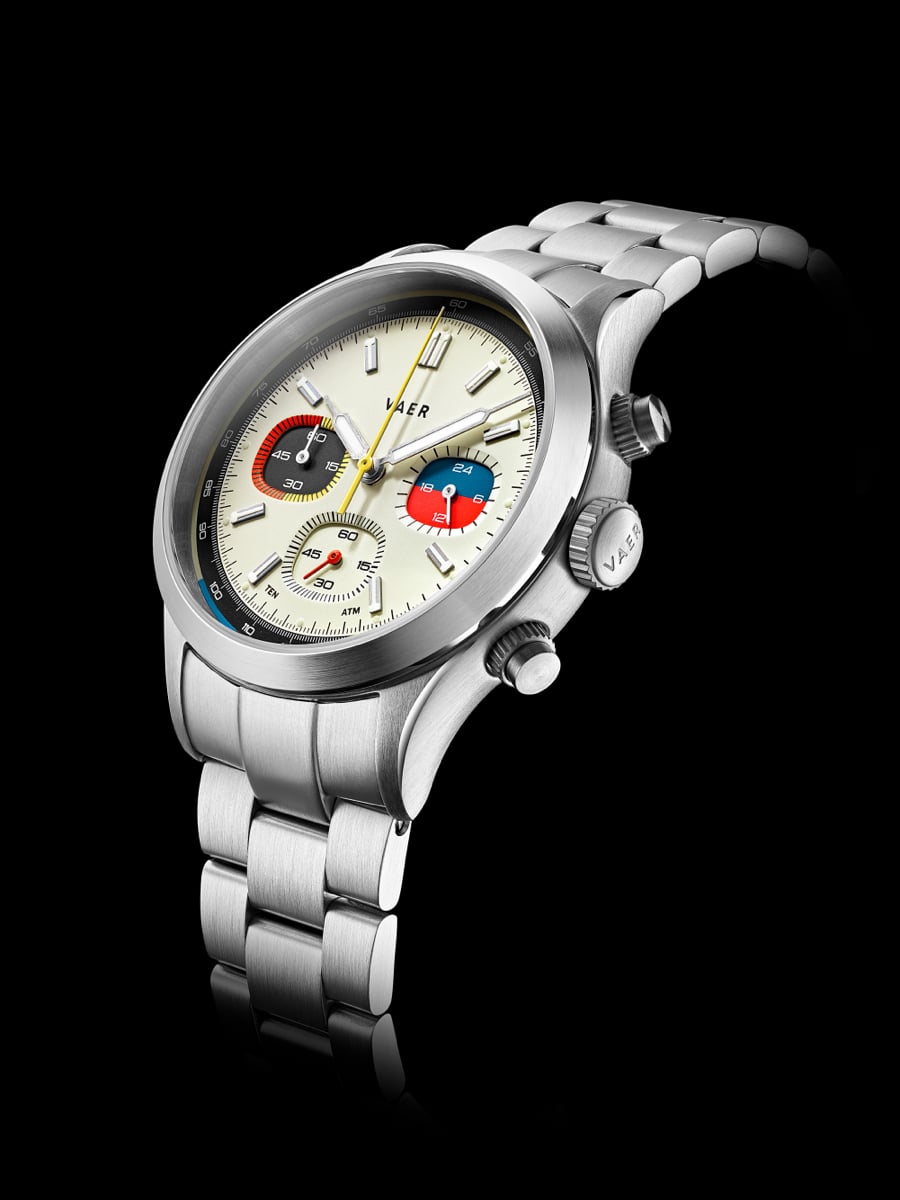 Retro Racing Character, Built for Everyday WearDrawing on the colorful racing chronographs of the 1960s and '70s, the RS1 Rally pairs vintage motorsport style with the durability expected from a Vaer. Its 40mm case houses a Japanese VK63 meca-quartz chronograph movement, complete with stopwatch functionality and an integrated tachymeter scale, while contrasting subdials give the watch its distinctive retro character. Sapphire crystal, 100 meters of water resistance, a screwdown crown, and strong BGW9 lume make it far more than a style piece. At under $300, it's an easy pick for the car enthusiast or chronograph fan.
 © Beartooth Media Group Inc.
 Loading...