Topic

Shelter Pictures – Stormy conditions

  • This topic is empty.
Viewing 22 posts - 26 through 47 (of 47 total)
Jerry Adams BPL Member
PostedFeb 27, 2011 at 5:23 pm

That's a really cool shot – 50 MPH – wow!

My MYOG pyramid looks like that too, although I probably haven't been in quite as high wind. It looks like it'll collapse, but it doesn't.

I wonder if you're really better off with a guyline midway up? It's a very complicated thing to calculate. Intuitively, you'de be better off with a mid guyline, but intuition isn't always correct. I don't think the silnylon fabric is going to rip.

You'de be better off sheltered at lower elevation in the trees. "Hike high and camp low". But sometimes that just doesn't work out. I can sure think of some times I've camped high and had some meorable scenery.

Roger Caffin BPL Member
PostedFeb 27, 2011 at 6:32 pm

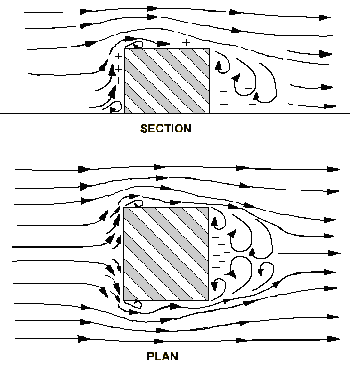
> Using a boulder as a protective barrier may backfire if the boulder isn't large enough.

And How!
We spent one night (behind such a boulder) trying to guess which of the four points of the compass the next blast would come from.
Make that 5 points: we also got thumped from above.

We much prefer being just a little down-wind from a good clump of snow-gums.

Cheers

PostedFeb 27, 2011 at 6:45 pm

Franco,

A perfect cube in laminar flow is not necessarily a very fair analog to a boulder in alpine winds (read: largely turbulent flow). Lots of variables exist that would affect the region of boundary layer separation over the boulder, and the location of the resulting vortices, not to mention that the velocity of those resulting vortices would be, by and large, considerably lower than the prevailing winds. It's been a couple of years since my last fluid mechanics class, but if it were me, I'd take my chances with the best windbreak in the area before setting up in the center of what appears to be tantamount to a wind tunnel.

Wow, I'm such a nerd…

PostedFeb 27, 2011 at 6:47 pm

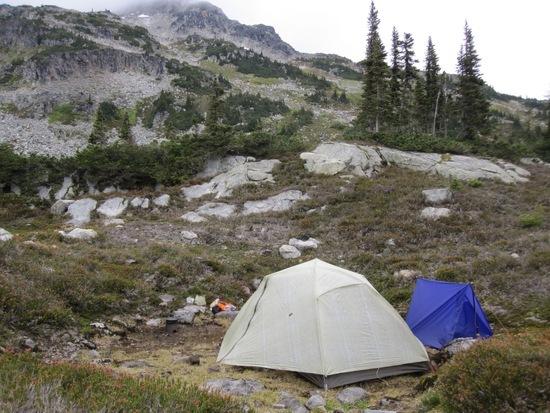
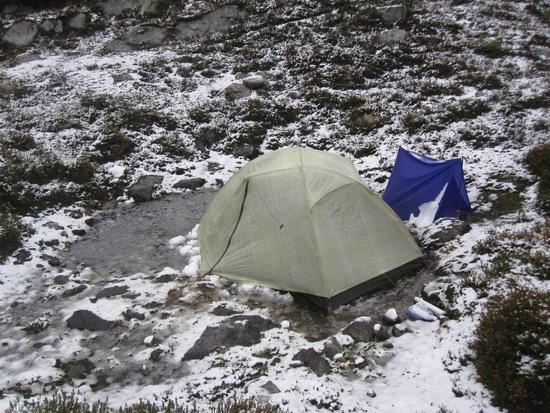
Here's a picture from this fall.

This low spot was chosen because when we set up camp, the weather looked dry but with high winds, and we didn't want to be exposed to more high winds after the tent got rocked all night the previous night.

During the night we got a few inches of heavy snow, and then it turned to rain which melted a lot of the snow and flooded our low spot. Thankfully the tent floor kept all the water out. On my NeoAir, I actually felt like I was floating on water when I woke up. The water was several inches deep.

Before:
Tent Flood A

After:
Tent Flood

Dondo . BPL Member
PostedFeb 27, 2011 at 6:57 pm

Golite Shangri-La 2 after an October snowstormShangri-La after storm

PostedFeb 27, 2011 at 6:59 pm

Side guyouts certain help mid / tipi style tents in high wind. Another help is "faux structure" with a light poly or dyneema line.

Eugene Smith BPL Member
PostedFeb 27, 2011 at 7:17 pm

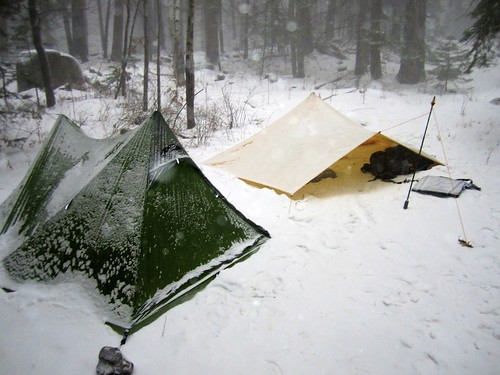
IMG_1954

IMG_1958 - Version 2

Nothing I would consider a “big storm” but 25-35mph gusts and windblown snow for a few hours into the early evening. MLD Trailstar pitched alongside a Golite SL-2.

PostedFeb 28, 2011 at 8:00 am

Black Diamond Mid in the Wind River Range, October

Went from traces of snow to about a foot in less than 8 hours. We were protected from the wind, so that wasn't an issue at all. The BD handled the snow like a champ, just lost a lot of interior space from the snow weighing the walls down. Oveall I was very impressed.

Tyson Marshall BPL Member
PostedFeb 28, 2011 at 3:05 pm

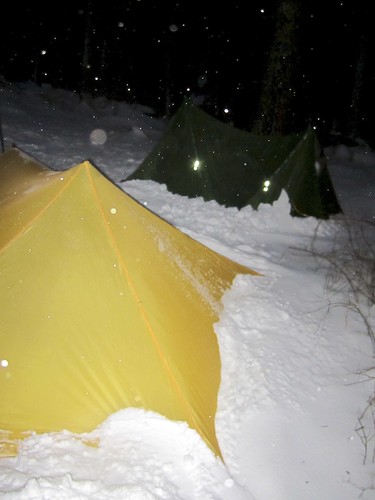
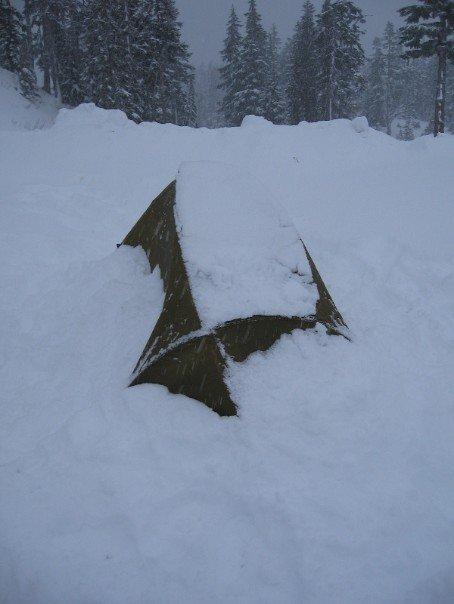
Hard to see, but there is a quinzhee down there...Mountain Hardwear Approach after one night...Or just pick a spot away from the inclement weather...

Image 1: Quinzhee – hard to see, but it's down there…

Image 2: Mountain Hardwear Approach after one night…

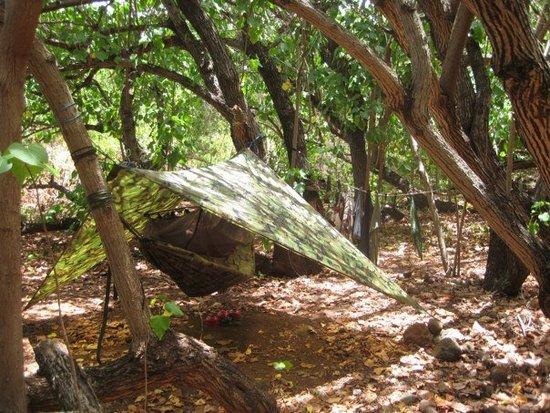
Image 3: Hammock: stayed away from the mean weather…

PostedFeb 28, 2011 at 4:17 pm

In fairness to Stephenson, they pitched the MYOG shelter end to the wind and the 2R broadside to the wind — hardly a fair comparison.

Hi Michael, just to state up front, I really have no particular interest in either shelter. I was just showing some pictures of two tents in stormy conditions.

But I do have to ask you to look at the page again. The Stephenson is actually set up both ways. end and broadside to wind. The end to wind seems to be working fine.

As to the comment about the guylines on the side, true. But there is also the collapse of the poles to consider in those pictures, plus the picture of the Rainbow earlier. Trekking poles and shorter tent poles are far less likely to collapse.

I should add, that guylines on the tent poles themselves would make a huge difference in their stability.

PostedFeb 28, 2011 at 5:12 pm

All of you folks with bent pole tents. Myself included(modified cloudburst 2 for winter conditions(3lbs). If you want to make your tent poles 2-4 times stronger. Tie prussics around the poles to make an 'x' between the arch ends, or just between the… Midway on said pole. Takes said pole from a single arch into 3 arch segments or 4. Tighten in middle with another prussic if 3 segments. OF course now there are lines inside your tent, but your tent poles won't buckle and collapse leaving the tent walls on top of your sleeping bag wetting it out. That is assuming of course you don't have a vapor barrier lining on your sleeping bag. Do this and you don't really need to worry about if your tent/tarp/bivy is on top of your sleeping bag as long as your vapor from your breath can escape.

Note said prussics have to have a LOT of turns as said aluminum poles are slippery. Don't expect a 4 turn prussic to hold. Especially with wind gusts. I am talking 6+ turns. Also all of your guylines should have prussics on them as well for storm conditions. That way when you set your stakes you can actually tighten your tarp/tent to said stake instead of trying to make your tension adjustment via the stake placement. Not to mention that on snow the snow will give until it turns to ice from said pressure, creating slack. Also on snow make sure to bury your titanium/aluminum stakes as sun will hit said stake warming them up melting the snow around them.

Also mid point side wall guy line attachment points do far more for your tent/tarp than any point on the bottom which for all practical purposes are useless for relieveing stress from the wind. IE your tent will flap in the breeze making you get no sleep at all.

Cheers.

Joe Clement BPL Member
PostedFeb 28, 2011 at 5:29 pm

No pics, but I had my Double Rainbow in 20-30 mph winds with the trekking poles set up in the inside grommets, and it didn't move.

PostedFeb 28, 2011 at 6:59 pm

In fairness to the Warmlite tents, the earlier thread referring to Olivier's tests may be worth reading: http://www.backpackinglight.com/cgi-bin/backpackinglight/forums/thread_display.html?forum_thread_id=34339

The Warmlite tents are also available with a third, middle pole for use in high winds, and even "multiple" mid poles, not to mention internal wind stabilizers.
Don't know about side guy-out points – you'd have to ask.

I have no connection with Warmlite and have never owned or used their tents; however, and even so, they have been very helpful in selling me materials that I could not find anywhere else.

Roger Caffin BPL Member
PostedFeb 28, 2011 at 7:31 pm

Hi Dan

You camped in a dry tarn! Oh deary me!
Other times of the year that would be full of water.
Now you know to never do that again… :-)

Cheers

Theron Rohr BPL Member
PostedFeb 28, 2011 at 9:54 pm

Hey Brian do you have a picture of what you're talking about – I don't quite follow. I have a Cloudburst also and would love to know how you can make it snow worthy!

PostedMar 1, 2011 at 12:57 am

Brian, I really like your prussic attachment advice. I'm curious how you manage to get the prussics onto the poles if the poles are in sleeves.

As I tried to envision what you mean (somewhat confusing to follow) I wondered if wrapping grosgrain loops, attached prussic-style to the poles, might be an easier alternative.

PostedMar 1, 2011 at 9:10 pm

Thanks everybody for the excellent pictures. I have enjoyed all of your posts.

Jeff

Viewing 22 posts - 26 through 47 (of 47 total)
Loading...