Topic

Boots boots boots? help!

  • This topic is empty.
Viewing 25 posts - 1 through 25 (of 32 total)
PostedFeb 21, 2011 at 8:27 pm

Need some ideas for boots, and where to be fitted for them. Obviously it all comes down to fit, and my current boots, Montrail Torre GTX, are giving me heel blisters. I may try a lift, but I'm also looking at new and better boots for the long term. Danners look great, but a tad pricey considering boots only last as long as the outsole (at which point I would have to spend $60-80 on reosoling). So maybe its worth looking at cheaper boots like Hi-Tec, granted that they fit properly, and just replace the whole boot when the outsole runs out?

Also, where to get boots? I go to Campmor in NJ for my gear, and the staff is pretty good but not like some of the outfitters I've read about in AT thru hiker's accounts. Anyone know any real good boot fitters, even if traveling is required?

Thanks!

Robert Cowman BPL Member
PostedFeb 21, 2011 at 8:36 pm

fit, fit, fit and fit are the most important things.

most people on here use trail runners tho.

PostedFeb 21, 2011 at 11:51 pm

Take a look at Merrill Moab GTX boots. Very comfortable (for me). Also I use a heat formed insole from REI. Keeps me from getting blisters or hot spots on the balls of my feet in the 1st few days of a backpack.

PostedFeb 22, 2011 at 3:43 am

Trail walking. Trail runners are great. Off trail work, you really will want boots with a fairly stiff sole for side hilling. Though I note that you are in the east coast where there isn't lots of side hilling on heather and snow…

as the other poster wrote, fit fit fit fit fit. Who cares about weight if they give you blisters.

PostedFeb 22, 2011 at 4:20 am

The new Montrail Mountain Masocist Mid is sweet. Its even more comfy than the regular Masocist IMO.

James Marco BPL Member
PostedFeb 22, 2011 at 4:24 am

Boots are a bit of a problem. Fit is all important to comfort. Plastic will never conform to your feet. Leather will. Fabric will, but can change every time you lace them. Getting by the fit problem can be an issue. If they are not totally comfortable when you try them on, DON'T buy them. Try another set. Many times manufacturing variances and tolerances can make one set work and the next set poor fitting. Your feet never stop growing. Buying more than two sets at a time is probably a waste of money. Width, front toes, plantar fascia, heel and ankles will change as you do different things, besides overall, length. Count on it. All will effect the fit.

Inserts help a lot. These can help when a boot is a little too wide. These help if you have arch problems. These help with cushioning. Many times two pair of socks will help with cushioning, too. All will add weight.

Weight on your feet is not a big problem. If you wear your boots a lot, as you should before any hike, I suggest you insert a couple sheets of magnetized insoles. Mystical crap? No. It is about the heaviest weight for the thinnest most flexible sheet I have found. Two sheets might cost about $10. These will let you build mussels in your legs to enable you to hike comfortably. Regardless of the boot or trail runner, this is a good idea. Remove the weights just before a hike. This is an old basketball trick that serves well.

Leather will conform, streatch, to your feet. The problem with newer shoes is that the soles are glued to it. Soo, after a couple or three months, thay may need some superglue around the welts to reattach loose spots. DO NOT treat the leather untill this is done. Plain old motor oil works best for treating the leather. Anything that will lubricate the internal fibers of the leather. Leather breathes pretty well. Try not to wax over this. Sealing a shoe is not the best. Better is a good liner…gortex, or equivalent.

Trail runners are good on easy trails. For more rugged trails you really want a higher boot to protect your ankles from rocks, sticks, etc. Slogging through mud puddles is a typical trail chore. Trail runners don't cut it for this. Like sandals, and other open footwear, they are not the best for moderate to hard trails.

Pick out the lightest, mid-height boot. I live in NY and hike through the ADK's every spring, summer and fall. While I use sandals for canoe trips, and trail runners on a few trails, mostly I use Chukura style boots. Lately, the last 7 years, I have been using Timberland's. But, it really doesn't matter. Use the footwear that is appropriate to your anticipated trail.

The glued on soles means your boots are heat sensitive. Do not try to dry these by a fire. It also means they are likly not worth repairing.

PostedFeb 22, 2011 at 8:03 am

Thanks james! While most of hiking is East Coast and on trails, plans change and I may find myself in the WInd River this summer, or any of the ranges of the Rockies. So I like to have a boot that is "all purpose" so to speak, being for trails or bushwhacking. Trail runners are definitely out for me, as solo in the wilderness is no place for a broken ankle.

So any ideas on where to go to get fitted properly by an extremely knowledgable sales staff?

James Marco BPL Member
PostedFeb 22, 2011 at 9:22 am

Wish I could say thet EMS was the best, but they are only mid grade as far as qualifications go. Same for Dicks or any chain stores. For the last couple years, they will agree with anything the customer says to make a sale. That said, they sometimes provide a minimal amount of training in footwear. Most are colledge kids, though. Smaller specialized shoe stores will usually provide a higher quality of assitance, but, you will pay for that.

Overall, your best will be to simply start trying on shoes. When you find one that is just very comfortable, that is the one. Most inserts are just helps for ill fitting mass production shoes. That said, try BOTH feet. And walk, and run around the store. Relace them and do it again. It may take an 8 hour day or two to pick out a set. Don't be afraid of inserts, these are recommended for long distance hikes or hard miles. But, don't rely on them. For winter boots, synthetics are good. But this is only 3 months out of a year. Double socks in regular boots are usually enough.

Pick out the lightest you can find, check them out thuroughly. Ankle supports should have a scree sheild or padded ridge around the upper to keep stuff out. Generally, they will NOT protect your ankles against sprains and breaks. A full boot, might. Mostly, the low cut boots will protect against bruising, scrapes, and punctures. Only about a half to two pounds of actual support is added, though. This will depend on how you lace them and how tight. They should weigh ~1#8 each. Give or take a few ounces…

Leather will streatch over the course of a day. So, even though your feet swell with walking, they should remain comfortable. Do not overtighten the laces in the morning, anyway. A tight shoe will really fatigue your lower legs.

Canoeing is different, as you know. Wet feet happen a lot. Good trails are not the norm in NY. But, the sections of the AT (Georgia, NJ, Pen, NY, CT, ME,) I have hiked are good. This is where multiple shoes are likely wanted. If I don't know about a trail, I take my mid boots. They are never out of place, though they might be heavier than I need. If I know the trail is good, I take my trail shoes. Both sandals and trail shoes are more specialized. Anytime, I take a pack with more than 20lb's though, I wear my boots. For a weekend, often my trail shoes.

PostedFeb 22, 2011 at 1:10 pm

Obviously they're your feet, but not sure how you'll get a broken ankle easier in trail runners than you will in boots. In fact the opposite can be true as you klunk about in boots.

I use trail runners – Inov-8s actually, all over the mid atlantic, year round, rain or shine. Used them on a 6-day backpacking trip along the Teton Crest in Wyoming – off trail most of the time. That meant side hilling, talus and scree, a bit of bushwhacking, boulder hopping, etc.

I find trail runners to be all-purpose hiking footwear. And I don't ever get blisters. But, of course, YMMV.

PostedFeb 22, 2011 at 3:41 pm

ONly real reason for boots is for crampons and steep snow where getting continual cold snow down your tennis shoes is a giant hassle. Or higher altitude where its colder. This obviously can be cured by VBL socks with an insulating sock followed by a waterproof sock followed by shorty gaitors….

Roger Caffin BPL Member
PostedFeb 22, 2011 at 4:46 pm

> ONly real reason for boots is for crampons and steep snow where getting continual cold snow
> down your tennis shoes is a giant hassle.
+1.

Cheers

PostedFeb 22, 2011 at 5:06 pm

"Trail runners are good on easy trails. For more rugged trails you really want a higher boot to protect your ankles from rocks, sticks, etc. Slogging through mud puddles is a typical trail chore. Trail runners don't cut it for this. Like sandals, and other open footwear, they are not the best for moderate to hard trails."

Use boots if you want, but this is simply not true.

PostedFeb 22, 2011 at 5:51 pm

If you are having trouble with the Montrails, the more commonly used last shapes may not be for you.
Try the Keen mids, in the store anyway. They are the only thing that has worked well for me, after trying everything, including 3 custom boot makers, except the Inovs – no place to try them on around here. Good luck.

Tad Englund BPL Member
PostedFeb 22, 2011 at 6:10 pm

>Weight on your feet is not a big problem.< Where do you get that…

Each pound of weight on your feet is like carrying an extra +/- 8 lbs! Your analogy using "magnetized insoles" is like someone training with a 100 lb pack so they can carry a 50 lb pack on a trip.

+1 on Chris Benson's post

There are a bunch of threads and articles on this issue.

I had ankle problems and feet issues until I stopped wearing boots and now- no issues and far more time/miles on my feet.

Of course this is my opinion YMMV.

Roger Caffin BPL Member
PostedFeb 22, 2011 at 10:03 pm

Hi James

> For more rugged trails you really want a higher boot to protect your ankles from rocks, sticks,
> etc. Slogging through mud puddles is a typical trail chore. Trail runners don't cut it
> for this. Like sandals, and other open footwear, they are not the best for moderate to
> hard trails.

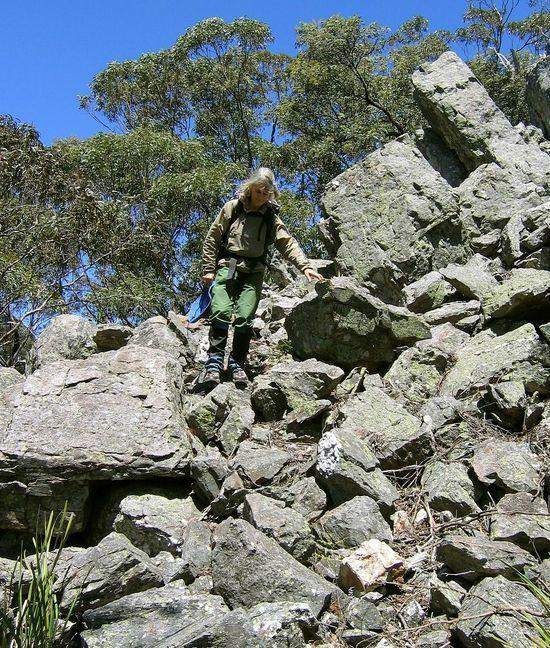
Forgive me if I disagree with you totally. In fact, the rougher the country, the LESS willing I would be to consider anything but the lightest of footwear. Big clumsy klunky boots are an accident waiting to happen on rough terrain in my experience.

1065 GuouogangRockyDescent
Descent from Mt Guouogang, in nice grippy light joggers.

Cheers

PostedFeb 22, 2011 at 11:57 pm

If the terrain is wet and slippery, off train terrain in the N. Cascades or BC coast range, boots edging power shines. If it is dry, then tennis shoes/rock climbing shoes will always outshine boots unless we are talking very steep forest covered in pine needles where once again you need the edging power. Such sections are generally short though and tennis shoes will still be more comfortable in the long run. Only caveat here is in giant amounts of scree. If its large stuff, tennis shoes are preferable, but lots of small/medium scree will decimate any pair of tennis shoes and you won't be able to hop from rock tip to rock tip quickly as doing so HURTS like the devil himself is puncturing the balls of your feet as tennis shoes or even things like the "hiker shoes" don't have a stiff enough sole to spread out the point load over a larger area.

Yukon HO! Tally Ho!

I have used tennis shoes, hiking shoes, medium boots, heavy boots, climbing shoes.

Nick Gatel BPL Member
PostedFeb 23, 2011 at 12:43 am

I am going with the trail runner crowd here. I hiked in top of the line leather boots for 40 years. I will never go back. You actually are more agile and sure footed in tricky terrain with light shoes.

As far as fitting goes, you need to check with people close by who can recommend a shop. If you go to a store catering to runners, you have a good chance of getting a proper fit. Boots are another story. Some large retailers like REI have fitting experts in some of their stores, and complete morons in others.

James Marco BPL Member
PostedFeb 23, 2011 at 4:03 am

Chris, which part?
Several times hiking though the ADK's carrying a canoe I have banged up my ankles pretty bad. This was on a canoe trip, of course. I was in pain for two days, once, thought I broke it a couple days in. Not good when portages are typically 3-7 miles each.

I have twice jammed twigs into my feet with sandals. Several other times with no damage. Even though I am fairly careful about that. Near shore is the worst, though and I have often been swimming because of a catch.

In spring and fall, often I have to slog through 3 inches of muck covered with an inch of water. I don't care for mud in my shoes. Sometimes, even the half-boots are not enough and the bottoms of my pants and tops of my socks are coated with the stuff. The scree collar helps a lot, it never gets down into my feet. Same for fall snows and late spring snow in the High Peaks.

Off the tourist trails in the ADK's, I find a lot of stuff on them that is not the best for trail runners. Above is just a few examples.

The High Peaks are different. Mostly rocks and boulders. Generally easier going, except for the tight passes between the larger ones. Or, the climbing on some of the peaks…not real technical though. But, my ankles take a beating wedging between rocks and on the climbs. Skipping between boulders over a potentially fatal drop is not the time to be playing with footwear nor worrying about the fit. I tend to be a bit conservative when I do this, soo, the extra ounces don't really matter.

Don't get me wrong, I have UL Montrails, Keens and Merrils in the low cuts. They do not work as well as mid cut hiking shoes for the majority of the area. For comparison, the AT I consider an easy to moderate trail. Even Katadyn is not that difficult. Trail runners would be fine along the vast majority of that route.

Like everything else, it depends on where you are hiking.

James Marco BPL Member
PostedFeb 23, 2011 at 4:17 am

Roger, sure, we can agree to disagree. The trail in the picture would be a moderate trail in the High Peaks. Lots of good gripping points on the rocks and they are spaced close together.
An annoying climb, but not too bad. What happens if she stps between the rocks?

PostedFeb 23, 2011 at 4:35 am

Brian wrote: "If the terrain is wet and slippery, off train terrain in the N. Cascades or BC coast range, boots edging power shines. If it is dry, then tennis shoes/rock climbing shoes will always outshine boots unless we are talking very steep forest covered in pine needles where once again you need the edging power."

I've found wet, slippery slopes easier to navigate in trail runners vs my boots. Fell running also comes to mind.

"Only caveat here is in giant amounts of scree. If its large stuff, tennis shoes are preferable, but lots of small/medium scree will decimate any pair of tennis shoes and you won't be able to hop from rock tip to rock tip quickly as doing so HURTS like the devil himself is puncturing the balls of your feet as tennis shoes or even things like the "hiker shoes" don't have a stiff enough sole to spread out the point load over a larger area."

I have found this to be true. Shorts stints of sharp scree are do-able in trail runners. Long stretches of it and my feet end up pretty sore.

PostedFeb 23, 2011 at 6:52 am

My comment was regarding wet and slippery mud algae coated slopes/logs. Boots are far preferable in such situations as you need to kick an edge step into the hillside to go upward. As far as I am concerned there is no such thing as a "wet and "slippery"" trail, which is what I think many would have taken my above comment to mean. You are right trail runners are still preferable on a wet trail. I was talking specifically regarding off trail work. Yea, I have worn trail runners off trail and am continuously going for a slip and slide because one cannot edge on steep muddy slopes that boots have no problems with. I don't believe such places really exist on the East Coast or for the most part in California or the Rockies. I have only been on such slopes in the North Cascades and BC Coast mountains. I have been in the Smokies a little bit. The Rockies, both CO, and MT versions along with their northern cousins up in Jasper. I have not been in the Sierras though, so I could be wrong about such slopes existing there. I highly doubt it though as its generally way too dry.

Upthread posters annoyance with dirty socks. Well ya, that is why you wear gaitors if you are going to be slogging through lots of muddy trail and brush. To not bring gaiters is simply, erm the term stupid comes to mind even when wearing boots, but hey maybe he likes washing socks and having rocks/needles in his boots to build up callouses on his feet and wear through socks and insoles faster. Now if the trail is a continuous river…

James Marco BPL Member
PostedFeb 23, 2011 at 7:25 am

Tad, for many years, I wore sneakers and mocasins out hiking, taking my model from the Native Americans. I switched to heavier full height 'Nam boots after a series of scrapes & pokes… culminating in a bad ankle for a two day hike out. After wearing those out, I switched to mid cuts. For the past 20 years or so, that has been my standard, cept for canoeing and known good trails. Not the lightest at ~1#3, but certanly not the heaviest.

I cannot say that the 2.25oz difference between low cuts and mid cuts has disabled my hiking distance. I don't put on more than 20mi per day, usually. I guess I never really noticed.

These are the mid-height boots I use:
http://shop.timberland.com/product/index.jsp?productId=10961109
They weigh 1#2.5 by my scale.
These are the set of Keen low-cuts I often use:
http://www.keenfootwear.com/product/ss11/shoes/men/trailhead/voyageur/black%20olive%20!%20bossa%20nova
They weigh 1#0.25 by my scale.

2.25oz is not something I worry that much about in footwear. Fit is more important.

The mag weights are only about 4oz each. I routinly use 15lb ankle weights when I walk when training, I never really thought of them being like 100#. That is more than I ever train with, let alone just exercise with. Though, counting the canoe and food for a week for two, I have carried 55# over some trails, usually not far, though…7mi max. My average pack weight is almost always less than 25#, even for a week.

Anyway, like I say, it depends greatly on where you hike, trail conditions in particular. I don't pretend to be an expert, I simply know what works for me in the ADK's.

PostedFeb 23, 2011 at 7:45 am

My comment was regarding wet and slippery mud algae coated slopes/logs. Boots are far preferable in such situations as you need to kick an edge step into the hillside to go upward. As far as I am concerned there is no such thing as a "wet and "slippery"" trail, which is what I think many would have taken my above comment to mean. You are right trail runners are still preferable on a wet trail. I was talking specifically regarding off trail work

Thankfully, I've never encountered (or at least have been able to avoid) off-trail terrain where the studded sticky rubber soles of my trail shoes have not sufficed. If kick steps are required, I'd surely want a stiffer sole and better toe protection than trail runners provide.

PostedFeb 23, 2011 at 10:32 am

I know there is more collective hiking experience in this thread than years I've been alive, but I just do not see how low tops can provide as much ankle support as a boot that comes above the ankle, its just not possible. I used lower cut shoes when I first started hiking, but have switched to a mid ever since I started hiking the ADKs. Between the rocks and the mud, I would not be enjoying myself in low tops. A good boot is never clunky or "an accident waiting to happen" maybe you just need to develop more muscle in your legs?

Native Americans wore moccasins, true, but they also didn't try climbing 14,000 ft peaks.

Roger Caffin BPL Member
PostedFeb 23, 2011 at 1:09 pm

Hi James

> What happens if she steps between the rocks?
I guess the best answer is that she never does. Doesn't slip either. A light pack, and she dances down.

We lost a very well-known girl here in Australia once, when she jammed her boot between two rocks while crossing a river. She drowned. Very unfortunate.

Cheers

Viewing 25 posts - 1 through 25 (of 32 total)
Loading...