Topic

Simmerlite Weight vs. WindPro Weight

  • This topic is empty.
Viewing 25 posts - 1 through 25 (of 56 total)
Hikin’ Jim BPL Member
PostedFeb 18, 2011 at 9:22 pm

I'm going to make an attempt here to compare the weight of an MSR Simmerlite with the weight of an MSR WindPro. I would appreciate any feedback that you might have, particularly if you see holes in my line of reasoning.

OK, now to the question of the Simmerlite vs. the WindPro. First, fair warning: Weight comparisons between stoves that use different types of fuel are somewhat problematic as we shall soon see. That being said, here I go plunging in.

The Simmerlite weighs 6.25 ounces. The WindPro weighs 6.8 oz (both on my scale at home). However, you have to carry a pump with the Simmerlite, another 1.9 oz, for a total of 8.15 oz. So the pumpless Windpro has a slight edge by 1.35 ounces.

Now for the tricky part: fuel. An empty 230g Snow Peak gas canister (steel) weighs 5.2 oz. An empty 20 oz Sigg fuel bottle (aluminum) weighs 2.9 oz without the cap (I never carry the cap in the field; I just leave the pump in the bottle). I'm using the 20 oz Sigg bottle because it's the closest in capacity to the fluid capacity of a 230g Snow Peak tank (approx. 16 fluid ounces when I measured it). I'm carrying a little bit of extra capacity in the Sigg bottle, but for comparative purposes, this was as close as I could get.

So now were at:
WindPro 12 oz. (approx.)
Simmerlite 11 oz. (approx.)

Assuming that you're carrying equal weights of fuel, the Simmerlite comes in at about 1 oz less.

Of course you have to prime a Simmerlite with some fuel and some fuel is wasted when you detach the fuel bottle. With a Windpro you must also "prime" (allow the stove to fully heat) before you go into inverted canister mode and some gas gets wasted when you disconnect the canister. However, as a practical matter, more fuel is used in priming and disconnecting with liquid fuel than with gas, but the Simmerlite is one ounce lighter to begin with, so really the difference in weight between the two stoves is almost a wash if you bring equal amounts of fuel. I'm assuming you don't do things like leave your liquid fueled stove running between heating things simply because it's hard to relight. I don't. The real weight advantage or disadvantage between the Simmerlite and the Windpro arises out of the amount of fuel that you need for a given trip.

Let me explain what I mean by that last sentence. With a liquid fueled stove, if you don't need a full bottle you can bring less whereas with gas you're kind of stuck with whatever amounts come with a given size of gas canister (usually 4oz/113g, 8oz/227g, and sometimes 16oz/450g). If you have to bring a second gas canister, that's usually fairly weight inefficient.

Three scenarios:
1. If you have a trip that will use almost exactly one 8oz canister of gas, then the two types of stoves will have rough parity in terms of weight with a slight edge going to the WindPro since more fuel is wasted with liquid fuel when priming and disconnecting, this even though the Simmerlite is one ounce lighter to begin with.

2. If you have a trip that will use less than one 8oz canister of gas, then you're carrying some dead weight in terms of gas that you didn't really need to bring whereas with a liquid fuel stove you can bring only what you need. This difference would generally be relatively small and is partially offset by the fact that it's better to bring a little bit extra fuel. Again, you have rough parity but this time with the Simmerlite having a slight edge.

3. If you have at trip that will use more than one 8oz canister of gas, then you'll have to carry a second gas canister which will generally be weight inefficient. The Simmerlite will probably be lighter in this scenario.

In the last scenario, if you can find a 16oz gas canister, this inefficiency might be somewhat ameliorated depending on just how much more than 8oz of gas you needed, but I think you can see my line of reasoning here. Because of the inability (without specialized equipment) to custom fill to a specified amount, gas can be heavier either because you're carrying more gas than you need, a second canister, or both. Liquid fuel can have an advantage simply because one can take the exact amount that one needs, even if, as in my example, one has to carry a bit of excess fuel bottle capacity.

I would appreciate feedback on my analysis. Obviously method of use and in particular inefficiency thereof would alter the equation.

Thanks,

HJ

Bob Gross BPL Member
PostedFeb 18, 2011 at 9:41 pm

Your analysis avoids some factors, perhaps rightfully so. One is cost. Liquid fuel tends to cost much less. Another factor is the BTU value of different fuels. You seem to blur together the mass weight of one versus the liquid volume of another.

Some would argue that a user-refillable liquid fuel bottle is "greener" than a single-use butane canister.

–B.G.–

Hikin’ Jim BPL Member
PostedFeb 18, 2011 at 9:53 pm

Hi, Bob,

Thank you; good feedback. Yes, I am aware that a typical butane/propane mix will have a higher caloric content per gram than white gasoline. I'm making an assumption here that the difference isn't so great as to substantively alter the three scenarios that I've laid out. Someone with a better understanding of the underlying science may have to chip in here if they feel that it's a salient point.

You are also correct that I didn't consider cost or "greenness." My interest for these purposes was solely weight.

You seem to blur together the mass weight of one versus the liquid volume of another.

Ah. I see that I wasn't clear. I'm assuming that one will take equal amounts of fuel by weight. I mention the respective volumes of the two containers (16 fluid ounces for an 8oz size canister of gas vs. 20 fluid ounces for a Sigg fuel bottle) only to establish that equal amounts of fuel (by weight) can be held.

HJ

Roger Caffin BPL Member
PostedFeb 18, 2011 at 10:57 pm

> Assuming that you're carrying equal weights of fuel, the Simmerlite comes in at about 1 oz less.

I question the assumption. I found I was using at least 50% more white gas than butane/propane by weight, sometimes even more.

> With a liquid fueled stove, if you don't need a full bottle

True … but I have yet to see someone who does not slosh a bit extra white gas in the tank 'just to be safe'.

Cheers

Hikin’ Jim BPL Member
PostedFeb 19, 2011 at 8:08 am

Hi, Roger,

Thank you. Yes, the assumption that one will carry equal amounts of fuel is a bit of a stretch. Are the rest of my arguments within reason?

My purpose with the "equal weights of fuel" approach was to establish a reasonable comparison between the two stoves, including the weight of fuel containers. The "equal weights of fuel" approach was in part to establish what two containers could reasonably be called comparable.

The "equal weights of fuel" approach can be used as a baseline. If one knows one's own habits concerning a given fuel, one can adjust accordingly.

HJ

Mike M BPL Member
PostedFeb 19, 2011 at 9:12 am

I think w/ what Roger brings up the wash may no longer be a wash

there are a few other considerations- ease of use, where the stove can be used (ie in a shelter), CO emissions, chance of fire, does the simmerlite have advantages over the windpro w/ simmering?, does the simmerlite allows alternative fuels?

I'm guessing that in very (very) cold temps the simmerlite might be advantageous (maybe not)????

personally ease of use, relatively good performance in the cold and the ability to use the stove in or close to the shelter, makes me lean towards the windpro

R Y BPL Member
PostedFeb 19, 2011 at 10:38 am

I mostly only use these stoves in the winter / spring for snowcamping & mountaineering. As you've noted, the weights come out pretty close, especially compared to the weight of an ice axe, shovel, helmet, crampons, etc. Here is how I choose to bring one or the other –

1. Good weather forecast – simmerlite. No issues with partially-used canisters, easy to top off fuel bottle.

2. May need to cook inside tent (high wind, bad weather) – windpro. No priming fireball.

That said, I occasionally used the simmerlite inside my old golite hex 3 because the roof is so much higher. But mostly I bring a BD firstlight these days instead.

Another issue is if you are going to bring the stove on a plane somewhere, like Rainier. With canisters you can just buy them when you get into town, and give the partially empty ones to a campground host or something like that. It's a little more of a pain to deal with white gas.

Roger Caffin BPL Member
PostedFeb 19, 2011 at 1:40 pm

Hi Jim

> Are the rest of my arguments within reason?
No problem.
I don't really like white gas stoves because I'm scared of the stuff. I've seen too many accidents. And I always cook inside my tent vestibule. I use to use the safer kero, but it stinks.

Cheers

Roger Caffin BPL Member
PostedFeb 19, 2011 at 1:42 pm

> Another issue is if you are going to bring the stove on a plane somewhere, like Rainier.
> With canisters you can just buy them when you get into town
Yeah, and how!
I remember meeting a couple in the Pyrenees one year, clutching their Whisperlite. They couldn't find white gas anywhere, and were getting cold and hungry. But every town had gas canisters.

Cheers

Stuart R BPL Member
PostedFeb 19, 2011 at 1:52 pm

2. If you have a trip that will use less than one 8oz canister of gas

then you have another option with a windpro, these canisters:
Bernzomatic gas canister
contain 175g propane/butane yet weigh 85g when empty (less then an empty 100g canister)

Bob Gross BPL Member
PostedFeb 19, 2011 at 1:54 pm

"I don't really like white gas stoves because I'm scared of the stuff."

You must have been raised on the other side of the pond.

I never saw a butane canister until I was over 25 years old. I was raised using Coleman fuel in the scouts. You learn to appreciate that big red fireball. It's kind of like the smell of Napalm in the morning.

–B.G.–

Hikin’ Jim BPL Member
PostedFeb 19, 2011 at 2:21 pm

Mike Moore wrote: > there are a few other considerations- ease of use, where the stove can be used (ie in a shelter), CO emissions, chance of fire,

I'm not sure about CO emisssions (interestingly, the Xtreme does very well here), but I'd much rather have a Windpro in a shelter.

Mike Moore wrote: > does the simmerlite have advantages over the windpro w/ simmering?, does the simmerlite allows alternative fuels?

The Simmerlite, despite it's name, isn't much for simmering, and it's a white gasoline ("Shellite," I believe, for those down under) only stove.

Mike Moore wrote: > I'm guessing that in very (very) cold temps the simmerlite might be advantageous (maybe not)????

In really cold temps, you would probably do better with a liquid fuel. I've not heard of polar expeditions using gas, but I do know that liquid fuel is common. We're talking about really cold temps here though, below at least -10F/-23C, probably lower before you'd really have to cut over to liquid fuel. Roger might be able to comment as to what is the lowest practical temperature in which one could expect to operate a stove in inverted canister mode.

HJ

Hikin’ Jim BPL Member
PostedFeb 19, 2011 at 2:25 pm

RY wrote: > Here is how I choose to bring one or the other –
1. Good weather forecast – simmerlite. No issues with partially-used canisters, easy to top off fuel bottle.
2. May need to cook inside tent (high wind, bad weather) – windpro. No priming fireball.

Thanks for that (and the rest of your reply). Really good, pragmatic stuff.

HJ

Bob Gross BPL Member
PostedFeb 19, 2011 at 2:28 pm

"In really cold temps, you would probably do better with a liquid fuel. I've not heard of polar expeditions using gas, but I do know that liquid fuel is common. We're talking about really cold temps here though, below at least -10F/-23C, probably lower before you'd really have to cut over to liquid fuel."

I agree. While on one high expedition, almost everybody on the mountain was using white gas stoves, especially in the high camp (19,500') when the air temperature got down around -5 F. And, this was relatively good weather.

–B.G.–

Hikin’ Jim BPL Member
PostedFeb 19, 2011 at 2:46 pm

Roger Caffin wrote: > Hi Jim
> Are the rest of my arguments within reason?
No problem.

Thanks for having a look. By the way, I really appreciate your BPL articles, on your bushwalking pages, and your input here on the forum. Definitely worth the price of a subscription, and then some.

Roger Caffin wrote: >
I remember meeting a couple in the Pyrenees one year, clutching their Whisperlite. They couldn't find white gas anywhere, and were getting cold and hungry. But every town had gas canisters.

It's a bit different here in the US where white gasoline is very common thanks to the influence Mr. W.C. Coleman, founder of the company by the same name. The hassle is more with air travel. Liquid fuel stoves "just won't fly" if you will pardon the pun, where as some airlines will allow gas stoves. Emphasis on some. Some airlines will only allow unused stoves still in the original packaging. It's gotten a bit silly. As though a gas stove without a canister posed a hazard.

Roger Caffin wrote: > I don't really like white gas stoves because I'm scared of the stuff. I've seen too many accidents.

Interestingly, I've been using white gasoline since the 60's, first with my family, and now on my own. I've never seen a serious accident despite many trips with family, friends, the Sierra Club, etc. I don't know of anyone who has ever been injured. The potential does exist though, I will grant you that.

Roger Caffin wrote: > I always cook inside my tent vestibule.

Can't argue with you much there. Gas pretty much wins hands down. Priming with alcohol (i.e. metho) helps, but nothing is as easy or as safe as gas in a tent. That safety factor is probably the best argument for gas and against white gasoline.

HJ

Hikin’ Jim BPL Member
PostedFeb 19, 2011 at 2:52 pm

Stuart Robb wrote: > you have another option with a windpro, these canisters:

Bernzomatic gas canister contain 175g propane/butane yet weigh 85g when empty (less then an empty 100g canister)

Nice! I take it they have a standard threaded connector?

A little harder to put into inverted mode I suppose, but not undoable. I haven't seen them locally. I'll have to see if I can track some down.

What do they cost in your area? Are they about the same per gram as the standard canisters?

HJ

PostedFeb 19, 2011 at 3:32 pm

HJ:

You could compare them by scenario. For example, two nights out.
Coffee in the morning and two dinners with 2 cups of water boiled.
The canister weight graph would have steps and the white gas would be linear, up to the point where a larger fuel bottle would be required.
It would also take into account the startup waste.

It would answer the question of how much does it weigh per N meals, which is all that matters.

Other than that, nice comparison.

PostedFeb 19, 2011 at 4:28 pm

I have done a similar, although perhaps more detailed (in the sense of trying to insert the question of relative fuel usages), comparison of these two stoves myself, in trying to decide whether to switch from white gas to canister for my snow camping needs. And my conclusion is that the elephant in the room is cooking style. And by that I mean whether you normally light the stove once in the morning and once in the evening (as I do), or you normally light and relight a number of times for each meal. In the first case, if using a white gas stove, you amortize the priming fuel over a longer burn, minimizing the percentage of fuel you use to prime. In the second case, you may have to reprime several times, increasing the percentage of fuel used to prime. If you also like to brew up in the middle of the day, then you use even more. In other words, how many times per day you light the stove makes a difference in how much white gas you use, even if the actual burning time is the same. But with a canister stove this is not the case. So for the light-it-once group, white gas will be closer to canister in terms of fuel usage, while for the relighters, white gas will be further behind. Given the fact that propane/butane mixes have more BTU's per weight, the canister has an inherent advantage, but that can be offset by the fact that the fuel container may be heavier.
Case in point – my smaller Sigg fuel bottle weighs only 5 oz with the MSR pump in it. full, it weighs 17 oz. that is 12 oz fuel by weight in a container weighing about 3 oz. I can carry additional gas in a plastic bottle weighing less than 1/2 oz. at this rate the fuel container weight for 24 oz of white gas is only 3.5 oz or so, while for 24 oz of canister gas it would be around 15 oz. So the white gas stove can afford to be less fuel efficient, up to a point.

My general conclusion has been that for me, given my cooking style, there would be very little difference in carried weight with either stove for a weeklong snow camping trip. And I also ran similar numbers for a coleman extreme stove, coming to essentially the same conclusion. But for others whose cooking style is different, the conclusion would be different – although the difference will still be pretty small, and so I would suggest that the other factors – ease of use, safety, extreme cold weather performance, personal preference, which stove you already have – should be the deciding factors

James Marco BPL Member
PostedFeb 19, 2011 at 4:28 pm

I would say that offhand, barring personal preferances, that that is about right. Note that the Simmerlite is one of the worst performing white gas stoves I have ever used for fuel consumption, only slightly better than most Coleman products. And, it will simply not take a low flame without a lot of fiddling: Low pumping pressure, half filled and large fuel bottle, etc…

The fuel BTU for white gas is almost as high as propane. ~19000BTU/lb as opposed to 20500/lb. Soo, theory says you will get close to the same burn times at 9000BTU outputs. For one meal, say breakfast: 2 – 10oz cups of coffee and 2 – 6oz packets of oatmeal, the difference can usually be ignored. Only about 1 gram or so due to fuel differences. Priming will usually make up another few grams of fuel weight for a white gas stove, though. This is why they usually get left on between cooking segments…boil water for coffee, walk back and get water to make oatmeal for example. It isn't worth turning it off for less than the three-five minutes it takes to do this. Carrying an empty, "dirty" water bottle is often an easier and more fuel efficient solution.

Bob Gross BPL Member
PostedFeb 19, 2011 at 4:52 pm

I own a Simmerlite stove, but I have to admit little field experience with it. Since the pump is the same as on an MSR XGK (most of my experience), I keep thinking that they will operate similarly. On the XGK, I prime it and run it for ten minutes, then shut it off for ten minutes, then run it again without any re-priming. I'm not sure whether it is from retained liquid fuel temperature or retained pressure.

If all of the main factors make comparison a wash, then maybe my suggestion about fuel cost would creep back into the discussion. If you are cooking for just one person, there isn't that much fuel cost at all unless you get into a trip of many days. However, if you have one stove cooking for a group of hungry backpackers, the liquid fuel starts to shine a little better. Also, when it is a snow trip and you need to melt lots of snow to make drinking water, your fuel usage can increase by two or three times, easily. Money adds up after a while.

On my auto, there is a fuel computer that carefully gauges the unleaded gasoline heading toward the fuel injection system. It compares that to the odometer and the fuel tank gauge, and it will display the result in terms of instantaneous miles per gallon, average miles per gallon since the last reset, fuel used since the last reset, and estimated miles of range left on the tank. Wouldn't that be neat to have our backpacker stove fuel managed that way? It would need to be in a package of only one ounce or so. It's display could be calibrated in how many minutes of full flame are left on the tank. Then it could be programmed with the cost per quantity for the fuel, and you could see cost per minute of full flame.

–B.G.–

PostedFeb 19, 2011 at 7:23 pm

I did an overnighter earlier this week and took my much used Markill upright canister stove and .85 liter MSR kettle. If the weather is really cold and/or windy I move the expensive flammable gear aside and cook in my tent. The temperatures were fairly moderate at 20-30F. Normally, the canister stove works just fine in these conditions. The problem in this case was the need to melt snow for all water. This took up a huge amount of time even with a full windscreen, pre-warmed canister and the stove at full throttle. I found myself wishing I'd brought the Simmerlite and a 2 liter pot. I guess the point being that sometimes you just need to put the BTUs in faster than they are getting away.

Roger Caffin BPL Member
PostedFeb 20, 2011 at 1:25 am

Before heading back to the Simmerlite, just check the power ratings of each one. I can't remember the exact figures for these two stoves, but typically they are as follows:

Canister stove: 3 kW
White gas stove: 2.5 kW

Which one has more power?

Cheers

Stuart R BPL Member
PostedFeb 20, 2011 at 1:29 am

Hi Jim
These are a standard canister used for small blow torches, you get then in a hardware store. There are many different brands, even Camping Gaz (their only threaded canister). The Bernzomatic ones are 35% propane.
Here, they are cheaper than camping canisters: 175g costs less than a 100g canister and less per gram than a 220g canister.
I find them easy to use inverted, just lay them on their side and raise the bottom with stones, snow, shoe, whatever.
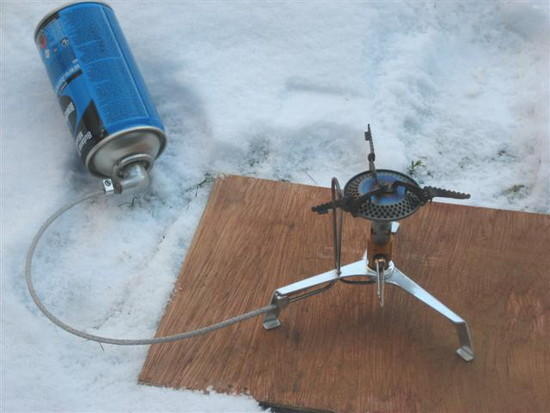
Gnat on stand in snow

James Marco BPL Member
PostedFeb 20, 2011 at 2:22 am

"I own a Simmerlite stove, but I have to admit little field experience with it. Since the pump is the same as on an MSR XGK (most of my experience), I keep thinking that they will operate similarly. On the XGK, I prime it and run it for ten minutes, then shut it off for ten minutes, then run it again without any re-priming. I'm not sure whether it is from retained liquid fuel temperature or retained pressure."

Raw pressure has a little to do with it. The combination of vapourizing temperature and feed pressure are what counts. See this link for a very basic explanation: http://www.chemguide.co.uk/physical/phaseeqia/phasediags.html

Mostly, I think the big difference is the burner. It is a bit more massive that the thin steel of the Simmerlite. The "roarer" style burners are much more forgiving of small flames. The Simmerlite will not take this, though. I believe that the preheat tube cools too quickly. It will again need priming at 70F after about a minute of being turned off. Turning it on with pressure will do the priming cycle again.

Bob Gross BPL Member
PostedFeb 20, 2011 at 3:12 pm

Here is an idea.

Can anything be done with MAPP gas as a substitute for butane blend? I mean, it is hotter. I watched some plumbers working with copper water pipes, and I was impressed about how hot their torches were.

–B.G.–

Viewing 25 posts - 1 through 25 (of 56 total)
Loading...