Topic

American Silnylon not Acceptable?

  • This topic is empty.
Viewing 25 posts - 51 through 75 (of 112 total)
Mary D BPL Member
PostedFeb 9, 2011 at 9:40 pm

The general perception of a "cottage manufacturer" is someone who (perhaps in conjunction with family members) is doing the work pretty much alone, often in their garage. Kooka Bay and Goose Feet as new, one-person firms come to mind here.

Once these firms expand to the stage of contracting out work (such as sewing) or hiring more than one or two employees, IMHO they are not really "cottage" any more. That doesn't mean that their standards have fallen but just that they are a slightly less small business! I'm thinking of Tarptent, Six Moon Designs, ULA and Gossamer Gear as examples.

While I'm of course unhappy to see some of Ron Moak's manufacturing go abroad, I recognize what he's up against trying to stay domestic and congratulate him on his expanded business! I suspect we'll find within the next few years that other small firms who currently contract their work in the US will end up going the same way, like it or not.

Once a business has grown so that the multinationals or at least the big domestic corporations buy it out, then we have to start worrying that the business will end up like the North Face–as appears to be happening with GoLite, getting progressively less "lite." We pray that doesn't happen to any of our beloved small specialized lightweight gear firms! The buyout makes a nice retirement package for the original owners, but in the hands of the big corporations the merchandise goes south!
PostedFeb 9, 2011 at 10:08 pm

I agree Mary, the progression often goes that route. I suppose I was put-off by Lawson's implication that because Ron was forced to outsource some portion of his manufacturing, that he was going by the wayside and that his product was then somehow inferior.

As in the cases of golite and others, let the gear speak for itself. If, in a year, quality has taken a hit, or the designs do not carry the same UL principles, then draw your comparisons.

It also amuses me how many people on BPL hammer companies that manufacture outside the US, but I venture a guess that the vast majority of these people are also driving themselves to work everyday in a non-domestic automobile.

Again, weren't we talking about silnylon waterproofness?

Roger Caffin BPL Member
PostedFeb 10, 2011 at 1:15 am

Hi Dave

> Did you ever test the red sil/pu coated fabric I sent? It was 1.9 oz base
> with a .5 oz coating one side with a blended coating. It was domestic (US) goods.
I did, and I thought I had emailed you the results.
But blowed if I can find the results now.
scruffle scruffle scruffle …
I measured the weight as 87 gsm, which is just a little over the 2.4 oz quoted. I will have to measure the pressure rating again.

Cheers

Stuart R BPL Member
PostedFeb 10, 2011 at 2:18 am

Richard

Thanks for the link to your table of rain drop size versus pressure. I'd be very interested in the calculations behind your figures. I have to admit the figures are somewhat higher than I would have expected.

>>> Wind also influences the water pressure of rainfall. When subjected to wind velocity of 20m/sec (44.7mph-comparable to a typhoon), the static pressure of rainfall is estimated to reach 20,400 mm <<<

The effect of wind is very relevant. Here, atlantic lows bring rain in the 2-4mm range often driven by strong wind. The 45mph you mention would not be unusual at all – we have had wind speeds of over 170mph recorded at both high and low altitudes!

Edited to add:
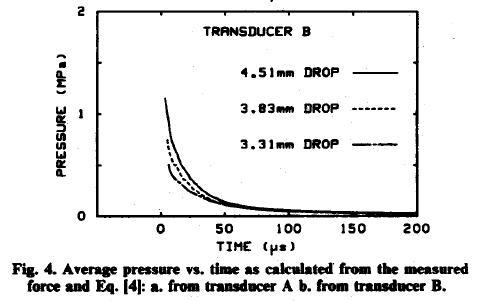
I did some research on measured rain drop pressures and came up with this:

rain drop pressure

The limitations of the transducer used meant that the first 3us could not be calculated. The text in the paper added "the peak pressure should be dependant only on drop velocity (8-9 m/s in this experiment) and not drop size. However the pressure after peak will reduce faster the smaller the drop size. By 50us the pressure for all drop sizes had reduced to approximately 100kPa."

Pretty big figures. However, a fabric is not a rigid surface and should presumeably result in lower figures. How much lower? I have no idea.

PostedFeb 10, 2011 at 7:03 am

Wow, I'm learning a lot on this thread. What a pleasure. Roger, you rock!

Here are 3 ways to deal with less than totally waterproof tent fabric:

(1) I use uncoated floors in the tents I make for myself. I rely on an added ground cloth and/or my closed cell foam for protection from ground water. I don't have to worry about light coatings allowing my knees to get wet. The uncoated walls also eliminate condensation on bathtub walls(biggest source of wetness on my sleeping bag).

(2) Solid fabric inner tent ceilings do much better with drips and misting from the fly than do mosquito net ceilings. Drips tend to run down fabric but go through mosquito netting.

(3) Steep fly walls (45 degrees or steeper) really help with keeping rain moving toward the ground rather than working its way through the fly.

Cottage Industries? Well nothing stays the same. My first backpack was a second that Jan Sport was selling out of a 1 car garage.

Richard Nisley BPL Member
PostedFeb 10, 2011 at 9:41 am

The question of what defines “waterproof” applies to garments as well as shelters. Note that although Polartec wanted the maximum possible breathability, they engineered their new WPB membrane so that the pores provided 10,000mm of hydrostatic head; typical rain drops worst case. Also note that the US Armed Services specifies a garment waterproof level of 17,586mm hydrostatic head; typical thunderstorms worst case. Most of the time it is the hood and shoulders that first wet through on garments because they don’t have the force dispersion angles or give that the rest of a garment does.

Shelter flies and roofs are a special case in which most of the industry isn’t providing waterproof fabrics except for some floors; they are providing a “functionally equivalent waterproof” shelter. Conventional double wall tents commonly use outer fabrics with hydrostatic head rating from 1,200 mm up to 5,000 mm. Kelty was the first tent manufacturer to use light tent flies. They found that the force dispersion angles and the separate inner tent allowed the occupant to be satisfied using a lighter coating even though water passed through the fly. What happens in a heavy rainfall is that water does go through the taut fly layer and runs down to the ground along the inside surface. A little will drip onto the inner wall but since it was not under pressure it will barely dampen it. Because the inner tent is breathable, the moisture from humid air and from the exhalations of the humans inside would not condense on the inner tent walls but would pass out to the outer fly and leave the inner wall dry. They found that they didn't get double wall customer complaints with as low as a 1,500 mm fly rating.

Single wall silnylon shelter's flies and roofs are not technically waterproof but they can be engineered to be “functionally equivalent waterproof” shelters. Any given shelter’s design and hydrostatic head that provides a tolerable amount of customer complaints is what defines a “functionally equivalent waterproof” shelter.

Shelter floors are subject to different forces. The pressure applied by the knee of the average 165 lb. male is 11,255 mm. This is the typical definition of a waterproof floor's hydrostatic head.

Lawson Kline BPL Member
PostedFeb 10, 2011 at 10:07 am

Hey Mat,

If my American pride upsets you, I am sorry.. I just find it ironic that moving your manufacturing to Asia is now considered an Accolade.. Maybe someone should tell Thermarest, Nalgene, McNett, etc…

Richard Nisley BPL Member
PostedFeb 10, 2011 at 11:16 am

Stuart,

The general calculations behind the figures you requested are as follows:

The density of water is 1g/cm^3 (1,000 kg/m^3).

Terminal velocity of the smallest 0.002 m diameter raindrop (2.0 mm), neglecting turbulence and updrafts, is 6.4008 m/s, or about 14.3 mph.

The volume of a 0.002 m diameter raindrop is given by (4 * pi * r^3) / 3 = 4.189E-9 cu m.

So with a density of 1,000 kg / m^3, the mass is 4.189E-6 kg (4.189 mg).

The force behind the minimum raindrop is Mass * Acceleration (gravity) = 4.109E-1 N.

Pressure on your fly by this single raindrop is Force / Area; o Area = 3.142E-6 sq m.

This gives that individual raindrop's force as 13.08 Pa or in more common US terms 1.897E-3 psi

For grins on your next UL backpacking trip carry the foil wrapper from a piece of gum. If you feel misting in your single wall shelter, briefly place the wrapper in the rain. The drops will make dents in the foil that are on average 50% larger than the size of the drop. When you get home you can measure across each the largest dent to get an approximate idea of the droplet diameter. Then you can calculate what the force was using the general procedure outlined above.

Stuart R BPL Member
PostedFeb 10, 2011 at 12:03 pm

>>> The force behind the minimum raindrop is Mass * Acceleration (gravity) = 4.109E-1 N. <<<

Really?
The force of gravity is balanced by air resistance when the drop is falling. The force on the fabric is the decceleration of the drop as it hits. This is a very different, and dynamic, figure as the image above shows. The force, and the area over which it is exerted is not at all easy to calculate.
A very simple approximation can be found by using delta momentum = impulse
m.v^2 = F.d
where d = diameter of drop

PostedFeb 10, 2011 at 1:44 pm

I am amazed by the figures quoted here.
7500mm minimum water head ?
Really ? how come for years and well before TT and others came about, we have had tents that were and are still rated at 800mm or thereabout ?
I remember Ben pointing out that a very popular line from Eureka (Timberline series) has the fly AND floor rated at 800mm; beside what is the rating of the floor in all those shelters that don't have one….?
( that is how come people in their mids often with just a mat on top of a groundsheet, do just fine ?)
This reminds me of a comment at WB along the line that "the higher the bathtub floor , the more llikely you will get flooded " the point there was about location, made from a guy that uses an open tarp
Winds of 190 mph (later amended to 170) .. really ?
(BTW we had winds like that here, from a cyclone, however nobody was camping, just trying to stay alive above water in a few emergency buildings)
Do you expect any tent to stand up to that ?
And , in my experience, unlike some other fabrics that wet out and somehow lose some of the water head , silnylon remains the same. So yes you can get some mist within minutes but it will hold prolonged rain for days. I have done several test leaving my shelters up for days on end .
BTW, at least before they wet out, as far as I understand 800/1000/1200mm waterhead is the same regardless of the fabric/laminate in use.
A point that has been glossed over is that , as Richard pointed out, the misting in many shelters is somewhat masked by the inner , particularly the ones made of fabric or with a fabric top, however you may end up packing up a wet ,from the inside, shelter that in some cases will develop mildew and or delamination in the long term and at least result in a heavy shelter right away.
(again, weigh your shelter dry, leave it out in the rain for a few hours , then pack it up . weigh again. You will be surprised at the weight gain…)
Anyway, when you guys find a fabric/laminate that it is lighter/stronger/has abrasion resistance , a higher water head than silnylon,has better UV resistance, does not delaminate, can be seam taped, comes in your favourite hue, cannot form mildew /become sticky and is less than $20 per yard, …please let me know.
Franco

PostedFeb 10, 2011 at 4:04 pm

I personally have a harder time letting go of hundreds of dollars than sleeping in a wet tent a few storms per year. Bring on the "inferior" stuff that has worked just fine since I replaced my PU and canvas tents decades ago. I'll manage w/out the contest between manufacturers to see who has the longest swinging tent pole in camp.

If you guys are in areas that get a lot of mist and condensation, try a double wall tent. Or atleast some kind of double walled hybrid. Nobody said tarps can't be double walled either FYI.

I also exclusively buy my products from domestic sources and cottage type industries. I can't imagine sending my $$$ else where, even if I get more bang for the buck based on some #'s that the very people pushing on me can not even remotely relate to the real world. Its about design, not arbitrary numbers. Until I read this thread I never realized the disparity between different nylons. I've slept in a lot of tents and not once can I think of a time I said "oh man this inferior hydrostatic head is driving me off the mountain!!". I just don't touch the side of the tent and make sure to get a nice taut pitch. These factors are 1000x more important in my experience than any arbitrary figures.

Further more, the market we're talking is insignificant on the consumption scale. We're going to be paying for something that isn't even necessary, simply because we can't "afford" to buy enough of it. Heading down that path is a lot scarier to me than worrying about water droplets. I am for practical pricing pf domestic products, not soulless fancy marketing hype backed by countless tests! That is where this train is headed ultimately.

PostedFeb 10, 2011 at 6:54 pm

David
Facts to me is what I encounter in the real world.
I have been using that silnylon for almost six years , had often been in heavy rain under it and as far as I am concerned it is OK for me.
Carry on…
I am waiting now for another "my boots get wet" thread before I jump out of the window
(it's OK, only a few feet off the ground…)
Franco
And for some more cross forum entartainment here is a comment just posted in a local forum about this thread:
"Interesting link tony, Ive noticed misting with the old golite hex (it doesnt yet Seem a problem with the shangri'la). Some manufacturers get a mention in those posts but I suspect it happens to some degree with most silnylon, just that its not noticed in double wall tents. It even happens with our Kerlon 1800 tarps when the rain is heavy enough ."

John Nausieda BPL Member
PostedFeb 10, 2011 at 7:00 pm

Another exciting session of Everything You Know Is Wrong. There is a new fabric out called Ignorantbliss available only in Shangri la so far.

Roger Caffin BPL Member
PostedFeb 10, 2011 at 9:31 pm

> There is a new fabric out called Ignorantbliss available only in Shangri la so far.
Goes well with adamantium tent poles.

Cheers

EndoftheTrail BPL Member
PostedFeb 10, 2011 at 9:43 pm

"If my American pride upsets you, I am sorry…"

I wish people could just comment on specific manufacturers / materials — good or bad — rather than bashing entire continents — be they N. America or Asia. Would have made for a more useful thread.

Stuart R BPL Member
PostedFeb 11, 2011 at 1:18 am

A very simple eqn for the *average* pressure exerted by a drop hitting a rigid surface is:

P = 2/3 density.velocity^2

This ignores the peak pressure at the beginning of the impact due to the effects of surface tension, viscosity and compressibility, and of course a fabric is not a rigid surface. Some figures from this eqn:

Speed (mph) ___ Pressure (kPa)
8.7 ___________ 10
12.3 __________ 20
17.4 __________ 40

Bigger drops exert much the same pressure as smaller drops, but the pressure is exerted over a larger area and for longer. The impact duration is much shorter than you might guess – 500us or less. This means that these figures cannot be directly compared with those for fabric hydrostatic head, which is measured over many seconds. I would not be surprised if a fabric rated at 10kPa (1000mm) would withstand a rain drop producing 40kPa for 500us without penetrating the fabric.

PostedFeb 11, 2011 at 7:03 am

The Ssian mills can have higher water resistance ratings and can use 66. However, in my experience, at below 1500mm the problem is usually condensation coming from the inside, so essentially you can spec 5000 if you like, you will still get wet in a deluge from condensation. That is why we have the optional DWR liner. The liner is required in winter to keep dry, no single wall will not be a dribbler with the frost. The liner in our large shelter weighs 1.5 lbs. Not a lot for 6 person capacity IMO. Most of the time, you don't need it, but if condensation, dribbling and misting are concerns then take it.

You can increase the coating yourself if you like to make it more waterproof, eventually you will need to do some sort of re-coat anyway.

For floors, yes that rating is a problem, but for us the reason we use another fabric is the slipperyness more so than the water proofing. We will make ground sheets out of sil, since you don't need to walk on it and can always take plastic to increase water if need be.

seekoutside.com

Kevin

PostedFeb 11, 2011 at 7:33 am

@ Franco – yes, I suspect based on the facts presented one could easily see a 3000mm HH overwhelmed. Of course, that is still 2-3 times more waterproof than the US based silnylon. As stated above, the floors are more of an issue because of the localized pressure as Roger points out. As I said before, there are very few flat silnylon shelters out there and fabric angles will positively affect the situation.

On a side note, Hilleberg has never made tarps out of the Kerlon 1800 (40d). Only the Kerlon 1200 (30d) and the SP (70d) polyester. Perhaps that poster got a 'special' one.

PostedFeb 11, 2011 at 8:24 pm

David,
It may be implicit in your last post that MYOGers will have to buy Hilleberg "Kerlon" tarps or the like to get the water resistance we want for our shelters. Expensive for MYOG, but then again, so is Cuben. Such high prices, so little money.

OK, so I actually have checked the WE site to see if they have put their sil/PE coated polyester fabric in their tarps. Help.
Guess the only reason to pay so much for fabric would be if you wanted to build an original design of your own that you couldn't buy somewhere in a shelter already manufactured. Ah, the price of inspiration.

Amidst all the 'sci-talk,' I'm waiting for BPL to save the day be telling us where we can get the good stuff. Waiting … getting sleepier … and sleepier ….

Oh well, Roger's tents are pretty darn tough despite the Westmark fabric.
As somebody mentioned, maybe two walls are unavoidable for real stormworthiness;
an outer wall to catch the worst, an inner DWR wall to deflect the rest, and less condensation on the inner to boot. And cheaper than cannibalizing expensive tarps.
Maybe a little heavier, yes. Or could the future of Cuben be in double walls?

PostedFeb 12, 2011 at 3:35 pm

"It may be implicit in your last post that MYOGers will have to buy Hilleberg "Kerlon" tarps or the like to get the water resistance we want for our shelters."

Oh, not at all. I was just responding to Franco's comment regarding Hilleberg Kerlon 1800 fabric. 1500mm for a HH will be enough for most folks. Maybe not the ground, however.

PostedFeb 13, 2011 at 1:48 am

Thanks, David. Don't know why I couldn't figure that out.

Found the following on the WE website that I found useful in comparing HH numbers:

"In the meantime, note the following (approximate)equivalence in the many ways/units used to express pressure: 2,000mm HH = 2.8 psi (pounds per square inch)= 19.6 kPa = 0.19 bar or atmospheres (very roughly)."

Viewing 25 posts - 51 through 75 (of 112 total)
Loading...