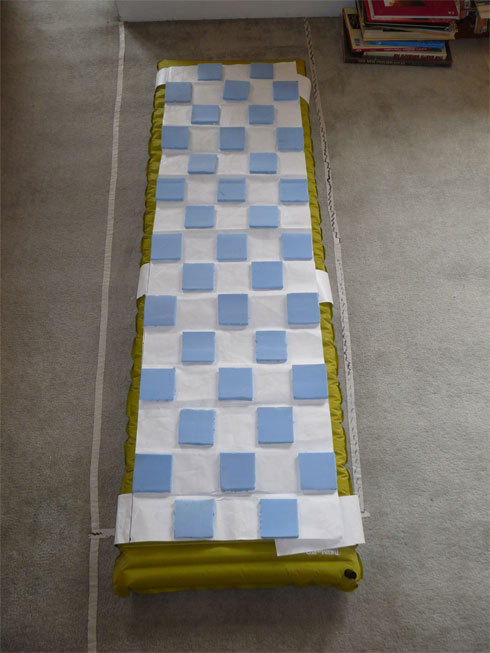
I am exploring ways to reduce the volume, and increase the packability of a closed cell sleeping pad. As a first try, I was going to trim parts of the pad that I never use to reduce weight. As I thought about the packability of the remaining pad, it appeared that it might be harder to roll into a tight bundle. Since the pad (a Ridgerest) is already something of a pain to place on the pack, I am considering cutting the remaining pad into strips, and using either tyvek or silnylon strips glued to the strips to hold the pad together. I suspect that superglue would hold the strips in place, and the strips themselves would contribute essentially no additional weight. In this way, I could make a folding pad (like a z-rest) that would fit better for packing, as well as minimizing the weight. Has anyone tried this approach? If so, what are some of the benefits/pitfalls? I plan on getting a cheap blue pad to try this with first. Thanks,
Jim
Topic
Flattening and trimming a rolled pad
Become a member to post in the forums.
- This topic is empty.
Have you tried packing your pack with the pad put in first like a cylinder? You could cut the pad int sections and poke holes near the ends and tie together with string to make pseudo hinges.
Jim,
The biggest pitfall I see is that it is still going to NOT pack small. Still bulky.
An idea I saw (can't remember from whom) that made sense to me was to cut the pad in two (not necessarily in half though) and roll part as described above inside your pack, then tightly roll the rest and strap to the outside of your pack. Not too much in or outside your pack.
Todd
Smaller is better (and lighter), but there's no free lunch. As others said, used inside your pack as an aid to the pack structure with your gear stowed inside the cylinder, or tightly rolled and carried on the outside. It does rob interior volume, but efficiently so. Something like a full length Ridgerest takes up a fair amount of room.
Outside options: horizontally under a lid or flap, horizontally strapped across the bottom, or vertically on the side or in the middle. Getting an arrangement that doesn't hang up on brush or come loose on the trail is #1. Having it on the outside is great for breaks, as a closed cell pad will survive on any surface– really nice on rocky stream banks.
I went with a small Prolite self-inflating pad to end the battle. With a frameless pack, I fold it in thirds and stow in against my back. With a framed pack I just go for small and out of the way.
Use elastic cord to carry it vertically on the outside, eveready battery style. I'll take the weight of the cord over needing to carry a larger pack, unless it is needed on the inside for stiffening the loaded pack.
You've essentially described my main 3-season pad. It consists of 4 sections cut to about 10"x24", though I went with duct tape (the cheap option) to attach them so that they fold accordion-style. I stick it in the back of my frameless pack to provide structure, and I like it a lot better than using a rolled-up pad (I hate the curvature pushing into my back, and it's more rigid). Works great for me. Blue Foamies are cheap, so there's no good reason not to try it and see if it works just as well for you.
Note: it certainly does still take up a decent amount of space in the pack. But hey, that's what the pack is there for, right? To get packed.
Back in the day when I did carry my Ridgerest in the summer I put it in a Thermarest stuffsack made for the Ridgerest and strapped it to the bottom of my pack's exterior. Worked fine there and didn't take up room in the pack.
BTW, do you have side pockets for your pack? I have 'em on my summer pack and they give me much more room in my main compartment. If you absolutely must put your foam mattress inside your pack the side pockets can make up for the lost main pack space.
Finally, for a litle more weight than a Ridgerestand a LOT more comfort I carry a regular length Thermarest "Lite", the original of the present ProLite. Folded in half lengthwise and in its Thermarest stuffsack it is as large as a small loaf of bread and goes inside the bottom of my pack, beside my WM Megalite down bag. It's my one "extra weight" luxury.
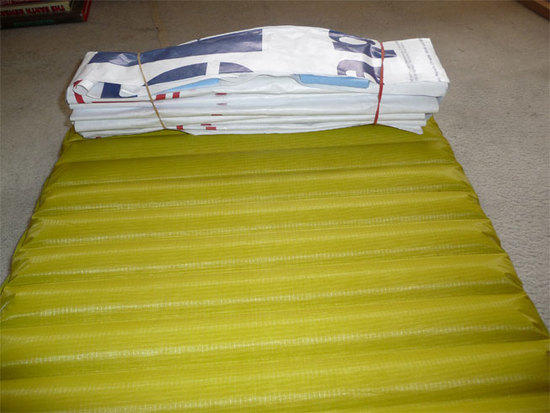
I made a Neo Air "booster" that you may adapt to your Ridgerest.
It was a blue mat and it is glued on Tyvek.

Franco
Double post
Thanks for all the interesting and helpful comments. I do have a spot on the bottom of my pack where I've been putting the pad. My biggest motivation for looking at alternatives was that I am using an inflatable thermarest which does pack down small, and fits either inside, or on the outside side of my pack, for cold winter camping. I wanted something non-inflatable and light in addition to both improve the R value of the ground insulation, and something that would give me at least a little insulation if the thermarest should fail and not be repairable on the trail. I did not want to be days away from warmth without a ground insulation of some type. Franco's neoair booster is exactly the kind of thing I was envisioning. I'll give it a go.
Jim
I did not care for the "tube" liner methode, either. It has it's proponents and works to some degree, but I have found with a fully loaded pack it presses against
my back a bit uncomfortably.
With the Gossamer Gear packs, and nightlite pads, I found that nesting the bumps and cutting it down made it thinner. So, I could get 5, 10" sections of pad into the pockets. Duct taped together, this made a good pack frame, packed easily, was accessable at rest stops and was still fairly compact. But, it moves the weight away from your back about an inch more and, loaded, can turn a 30# pack into a 20# pack.
This works real well for shorter trips of 3-4 nights or less.
For longer trips, I drop the foam pads and bring a NeoAir. But these have problems.
I really hate stuff hanging out of my pack. Soo, the best I have found was to cut a the pad to fit the thickness of your pack, fan-fold 5 sections across the back, then cut a section to fit the other side. For my Miniposa, this was:
5.75",10.5",10.5",10.5",10.5",10.5",3.375"
The slighlty less than 62" length was OK.
I "prepack" everything. Stuff my sleeping bag into a compression sac, load and seal both dry bags, etc. Load the inner pouch with "flat" items…stakes, spoon, foil, etc. Slip the modified pad in and flip out the one edge. Then I load up the pack.
This makes for a fairly rigid pack frame with good load transfer to my hips. The short wings help by supplying stiffness where I want it…along the outside of the pack. The padding is internal and takes up space, but it is all used for something.
The fabric of the pack supplies the tension to keep things from spreading out too much. By trimming the pad, it makes good padding for my back and good structire for the pack…better than a rolled "tube". The bags, inside, hold the "wings" of the pad in position. They press against the fabric, supplying tension, too. Overall a fairly rigid rectangular pack, that flexes easily with the twisting of walking. Heavy stuff (rolled tarp, stove, pot, fuel and water) is pot in the pouches, lower in the pack and closer to my back, since the pad does not push the pouches away from my back. Food is in the center. I can stand the pack up on the bottom. It creats a well balanced pack.
Anyway, pads can do a lot more than simply riding in the pack or becoming tube liners. You can create full structered packs with them. I have many packs (10 or so.) I also have as many or more pads. This is only how I use one pad in one pack to help carry everything else. Again, this is part of a pack system that borrows from the sleeping system(pad)for basic structure, consumable system, clothing system and pack system for reinforcemnts to the structure of the backpack itself, while being carried by the backpack. An example of modifying a pad to do sleep system duty and pack structure/balance enhancement without compromising either function while hiking and camping.
BTW: An electric carving knife works great for cutting pads. Duct tape for putting them back together.
Adhesive backed insignia cloth works wonderfully for taping closed cell foam (and many other things) together. I've used it on shoulder pads and knee pads and it has held up for years, even after going through the washer.
If you put it on both sides of the pad you can then sew through the whole sandwich for a very secure connection…..much stronger than the foam itself.
Adhesive backed insignia cloth comes in several colors, large sheets and rolls. Here's a link to a roll of 2" wide black:
Adhesive backed ripstop repair tape may work as well but I don't have enough first-hand experience with it to say for sure.
Would you consider using one of those egg crate-shaped closed cell foam pads that fold up like an accordian.
I just fold my ridgerest in thirds and pack it against my back…. eventually it stays folded that way pretty good…but I bought the longest ridgerest and cut it in half to just fit my torso…..that way I get two pads for the price of one!! When I get a new pad I leave it folded in thirds under a heavy object for a few days.
sandy boyd
Become a member to post in the forums.