Topic

Protecting DSLR’s

  • This topic is empty.
Viewing 25 posts - 1 through 25 (of 31 total)
Ryan Miller BPL Member
PostedOct 27, 2010 at 10:58 pm

I've used a small roll top pouch clipped to my shouder strap to carry my handheld HDR video camera in the past but just made the jump to a Canon 60D. I am looking for options besides wrapping it in a sock and a ziplock. I would like to have something that holds the camera and one lens and would add some level of protection while riding in a top pouch. Anything out there that I need to know about???

Thanks

Dustin Short BPL Member
PostedOct 28, 2010 at 12:04 am

I don't know of anything in particular myself. I would say with a bit of ingenuity and patience you could make a duct-tape and bubble wrap case. Or for more durability find a lightweight packing foam that comes in flexible sheets, or plastazote/evazote like those used for sleeping pads to replace the bubble wrap.

You'll just need a cylinder for your lens attached to a rectangle for the DSLR body. Have a flap opposite the cylinder (the back of the body) for easy access in and out. You could get all fancy and I'm sure it'll be far cheaper/lighter than anything you could buy.

Hmmm, I may need to do something similar seeing as I nearly waterlogged my EOS XTi on my last trip…

Jeff M. BPL Member
PostedOct 28, 2010 at 12:18 am

I use a lowepro pouch. It is only big enough to carry my 5D w/lens, but I believe they make larger models if you want to carry an extra lens. I use two caribiners to attach it to the front of my pack – easy access.

Although you'll want something lightweight, make sure its strong enough to protect your nice new expensive toy. :)

PostedOct 28, 2010 at 5:24 am

I just put my D700 in my pack, opposite a bear can. I will have an extra plastic bag for heavy rain protection.

Joshua Gray BPL Member
PostedOct 28, 2010 at 6:26 am

+1

I do the same thing with my Nikon d90. And I have an extra ziplock to protect if there are a lot of stream crossings on my expected hike. I have the one that is big enough to carry my d90, 35mm prime and 11-16mm zoom. I think it weighs right around 10 oz and I just clip it on the front of my Golite jam as a front pack.

Easy access to the camera. If I didn't have it so readily accessable I would probably have missed numerous shots on hikes.

Eric Lundquist BPL Member
PostedOct 28, 2010 at 7:06 am

I've got a slightly smaller camera with interchangeable lenses and am working on getting my own setup finalized. I think a large hipbelt pocket would be big enough for me. Ditto the ziplock bag for night/rainy conditions. I purchased accidental protection on the camera and lenses when I got the camera new with squaretrade. Their rates seemed pretty good for the extra protection knowing that accidents happen more often with tech in the backcountry.

Dale Wambaugh BPL Member
PostedOct 28, 2010 at 8:07 am

What level of protection do you want? Plastic food containers work well for bumps/dust/water, with the caveat that they are not trusted 100% for water— you have to assess the cost/risk factors there. I am comfortable using them for rain protection, but not complete dunking. The plastic is easy on the camera and gives some crush protection as well as dust and water. A good dry bag will seal out the elements, but isn't as good for hard knocks.

You could add a silica gel pack for really humid environments. YOu can buy throw-aways, or they sell ones that can be regenerated in a kitchen oven: http://www.adorama.com/ZZSGC.html

The type of food container that I like has a silicone seal and locking tabs. Lock & Lock is a popular brand, but finding a good selection of single units is difficult– they are usually marketed in big sets and no guarantee they will fit your equipment. You will join Goldilocks in getting just the right ratio of height, width and length. Many storage specialty stores carry some variation on the theme: http://www.storables.com/Shop/Kitchen/Kitchen-Food-Storage/Airtight-Food-Storage-Containers/?launch_pg=itemPage&launch_sel=1008488&launch_pg_sp=true&title=101+OZ+Rectangular+Container.

Pelican cases are the ultimate travel/storage cases, but they are leaden boxes in our UL world.

If you just want bump protection, the Zing cases are great. Adorama is a good source. Add a truly waterproof dry bag for good protection for a high budget camera.

On a similar vein, I have used plastic tool boxes for my camera gear for decades. The top tray is perfect for small accessories, with the bottom for camera and lens storage.

Sunny Waller BPL Member
PostedOct 28, 2010 at 9:44 am

I carry my camera in a 0.3oz Zpacks Shoulder Pouch. For rain protection I have a small rolltop dry sack also 0.3oz from Mountain Fitters. Joe and Lawson are great to do business with.

PostedOct 28, 2010 at 10:05 am

+1 on Thinktank. I have a DH-20 which I can hang from my pack straps in front of me, with straps from the bottom of the holster running to the waist belt in back to keep it from swinging. It's a lot smaller and lighter than a Lowepro holster, but still heavy by UL standards. Last major trip I just hung a small DSLR with zoom lens from the straps but I had to put it away whenever the weather looked dodgy, and I got sick of it banging/rubbing on my chest.

I'm off to AZ (including 4 days below the rim in the Grand Canyon) in a couple weeks so I'd love to find a lighter option that doesn't sacrifice too much on readiness or protection.

Ross Bleakney BPL Member
PostedOct 28, 2010 at 10:43 am

I would go with Dustin's first suggestion, just build something. I would use closed cell foam. It's cheap and easy to work with. I built a custom case for my little point and shoot. Use red or orange duct tape, which will make it more visible (so you are less likely to leave it sitting on a rock somewhere). My camera is waterproof, but if it wasn't, I would try and get a goodzip lock to put over the case.

Ryan Miller BPL Member
PostedOct 28, 2010 at 11:03 am

I think you're right, for multi day trips building something is probably going to be the way.

Thanks for the ideas.

Dale Wambaugh BPL Member
PostedOct 28, 2010 at 12:01 pm

Here's my setup:

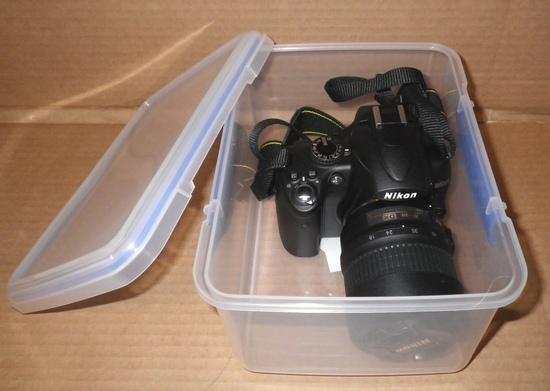
The box is from Storables, made by Sistema and is 3 liters. It weighs 9.2oz. I prefer the Lock& Lock which has retainers on all four sides, but I haven't found the right size yet.

Nikon D5000 in Sistema 3 liter box

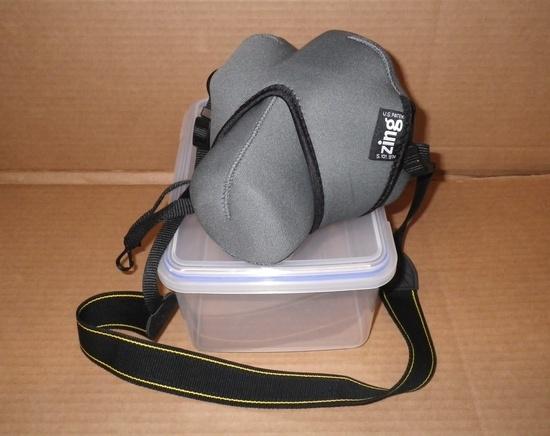
The Zing camera cover I mentioned. It is a simple neoprene cover. There is a small removable strap for tethering the case to your neck strap. 4.2oz.

Nikon D5000 in Zing camera cover

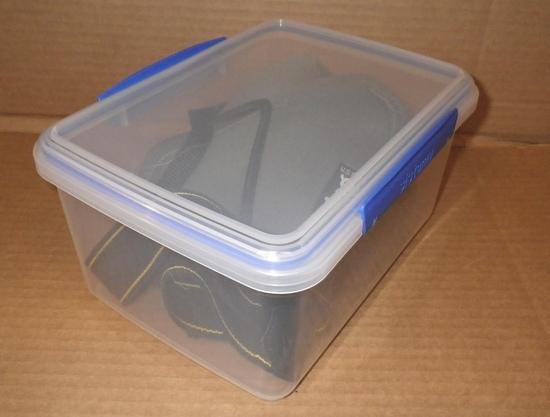
And the camera in the box with the Zing. There is plenty of room for other items that need some protection, camera accessories, etc. IMHO, this is good for bumps, dust and rain, but not full dunking.

Nikon D5000 in Sistema 3 liter box

PostedOct 28, 2010 at 8:38 pm

I agree with Sunny, Joe and Lawson are great to do business with. I think Joe's shoulder pouches are top notch (will be using one on my thru hike) and Lawson's bags are the bomb-diggity.

I use a Tamrac holster holder for my SLR, much like the silver Zingo shown. I think the one shown is better, as it form fits better to the camera. If you're anal, you could place the SLR into a cuben dry bag made to fit, place in the holster, then double gallon freezer bag it.

I more than likely won't be taking my SLR on the PCT (still considering), but I have carried it in the same Tamrac holster and ran it roughshod all over Europe 5 times, and it held up awesome. Less dust, river crossings and rain though ;)

Dug
http://thf2.wordpress.com

Bob Gross BPL Member
PostedOct 29, 2010 at 12:19 am

Folks, I have carried several different DSLR cameras in the backcountry in summer and winter with a variety of lenses. I've shot scenics a little, but I tend to go after wildlife.

I think you want to consider something like a Lowepro Camera Case, Toploader Zoom AW 45. Now, you may need to move one size longer or one size shorter, and that depends purely on your mounted lens. With some of these, you can mount the long lens on the body, because that is what you will need when surprise wildlife shots arise. Then you can carry the shorter lens in an accessory pocket on the case.

Some things make this practical. First, you can flip the carry strap over your neck, or over neck and shoulder, or off the pack top. Secondly, it is All Weather, and I've had mine out in some pretty icky weather.

I added some velcro strap to mine for fast access, so I generally leave the top zipper undone and then just stick the strap for closure. I zip it up completely when passing through an airport. When in wildlife country, I need to have the camera out and clicking within a few seconds of eyeing the target.

I've been using one or another case like this for ten years now, and I have never had a camera damaged while within the case.

–B.G.–

Dale Wambaugh BPL Member
PostedOct 29, 2010 at 7:38 am

I have a similar Tamrac case, without a rain shield. I have a harness for it, but I don't care much for the design and the hardware is heavy metal snaps. I'm considering some snap links from the d-rings on the case to my pack straps, so the load is off my neck.

I carry a Pentax W90 for snapshots so I don't have a big camera bouncing around or having to stop and haul something out of my pack. If you're out to make photographs vs. walking the emphasis shifts on how much gear you're willing to haul and how you access it on route. I'm more willing to take the big stuff and fiddle more on a day hike.

Dondo . BPL Member
PostedOct 29, 2010 at 8:28 am

I'm considering some snap links from the d-rings on the case to my pack straps, so the load is off my neck.

That's the approach I use with my Lowepro Topload Zoom Mini. It works great. There's no neck strain and your DSLR is instantly available.

Dale Wambaugh BPL Member
PostedOct 31, 2010 at 10:33 am

Last night, I played around with making a link to hook the case d-rings to my pack straps. I was imagining a complex link with a quick-release buckle, 3/4" webbing and snap hooks on both ends. The emphasis being that you want to release the case so you can get the pack off.

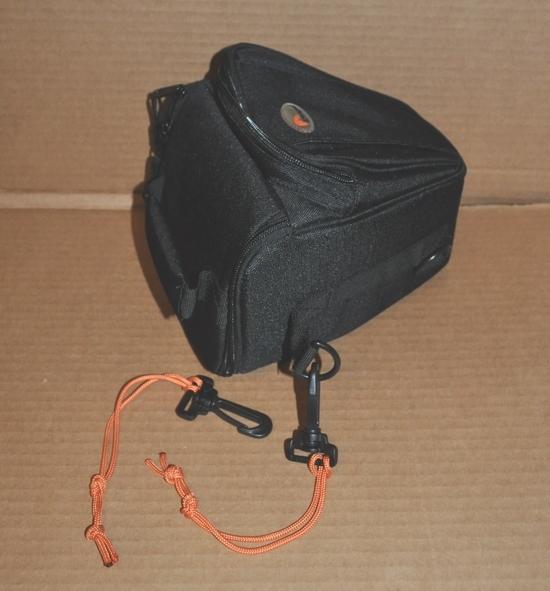
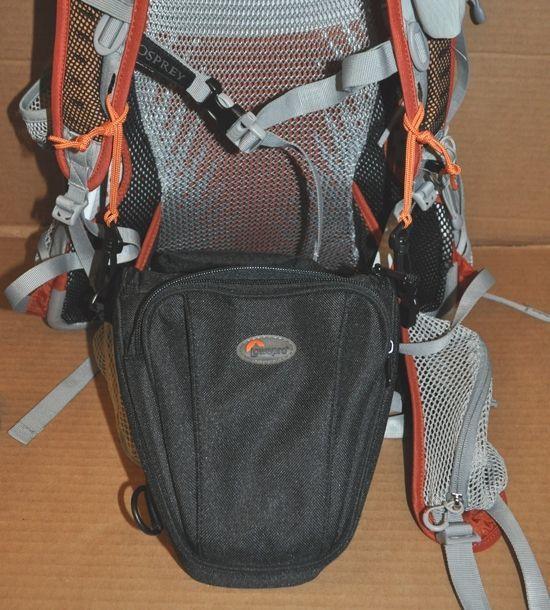
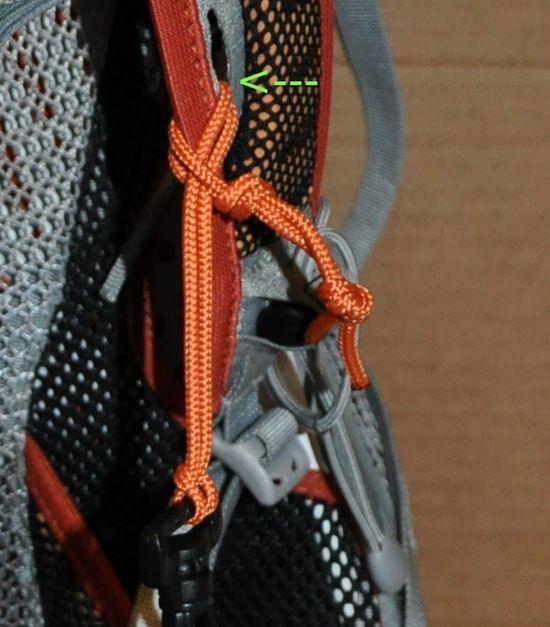
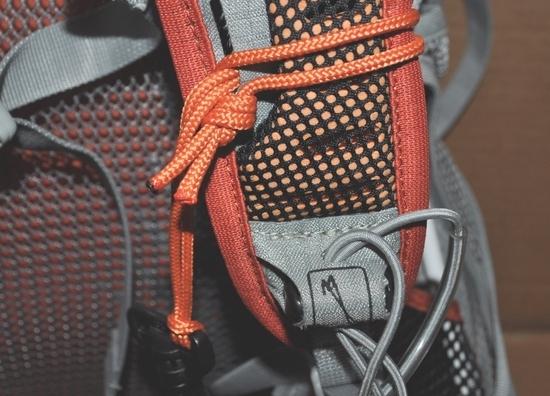
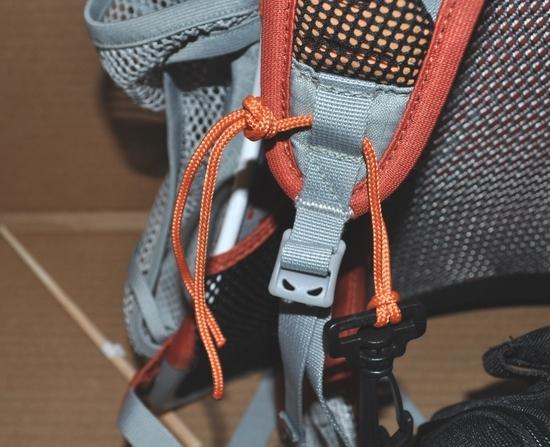
After looking through my collection of hardware and sizing up the camera case and backpack, I found that shorter link could be used. I ended up with a pair of swivel snap hooks and a short length of braided nylon line for each. In this case I was using a Osprey Exos pack that has a series of slots for the sternum strap and the lower slots were just right for using a lark's head on both ends of a loop of line— one around the swivel snap and the other through the sternum strap slot. To get the pack off, I only need to unhook one side, letting the camera case swing free. The links are about 3" long installed, so there isn't much in the way and they can be left in place when the case isn't mounted. Using lark's head knots makes for quick install/removal.

Links with typical case. Weight for the pair is 0.5oz/15g
MYOG camera case links

Case linked to shoulder straps
MYOG camera case links

I'm wonder if the pack straps will tear at the green arrow
MYOG camera case links

Another mounting option that may prevent tearing
MYOG camera case links

Many packs have some other sort of mount point like this one. FYI, chopsticks are great for pushing line though a small loop like this
MYOG camera case links

Bob Gross BPL Member
PostedOct 31, 2010 at 10:42 am

Everybody's solution here is a little different, and it varies with the exact camera equipment you carry. I've tried several kinds of chest packs for a camera, and they do not work for me because then I can't see my feet, so I tend to trip over things. When I put the holster strap over my neck and one arm, the holster is swung to one side more. But, I tend to have about nine pounds supported that way.

If your camera is small enough, then get a fanny pack, stuff it with some bubble-pak and your camera, and wear it in front.

Just be glad that we don't have to carry film anymore.

–B.G.–

PostedOct 31, 2010 at 10:50 am

when its in the pack, I keep mine in a large plastic bag, that is tied at the top. not sure i trust zip-loc type closures that much. Then I wrap it in a warm layer or two for cushioning. I'd have the layer at the top of my pack anyway.

A set up that I like for having it out while on the move. If you are wearing a top layer with a full zipper and have a hipbelt on this works. The hipbelt seals the bottom of your layer, and you put the camera in the resulting pouch. I made the neck-strap long enough that no weight is on my neck, but it is still secure. If you also use a sternum strap that goes over the camera strap and the camera is pretty snug. And of course always keeping the bag handy if it might rain.

Chris S BPL Member
PostedJan 6, 2011 at 10:38 am

Does anyone have experience with these? http://www.amazon.com/CaseCrown-Drawstring-Easy-Clip-Neoprene-Telephoto/dp/B003YVLTUW/ref=pd_sim_sbs_p_1

I've got a lowepro toploader, which will hold my camera with one lens mounted, but I'm looking for a case for my second lens. I'm assuming the listed shipping weight of 0.8 oz. is a typo, but still looks like it would be lighter than a lowepro lens case, just not sure if it would provide adequate protection.

Rick Dreher BPL Member
PostedJan 6, 2011 at 11:04 am

Not that brand but Zing neoprene pouches, mentioned upthread, are nicely protective. Probably not the best protection against cuts and abrasion (Cordura is tougher) but good impact and moisture protection.

cheers,

Rick

Dale Wambaugh BPL Member
PostedJan 6, 2011 at 11:28 am

Zings are good on bumps, but won't do anything for moisture. You need a hard case with seals or a truly waterproof bag of some sort. There's really no free lunch with *reliable* moisture protection. Doubled zip-lock style bags are the lightest thing I can think of, but I shudder to think about using it for a $1000+ camera system. It all comes down to the risk you are willing to accept vs. the weight. Water is thin and it is Murphy's wicked stepchild.

The nice thing about good water protection is that you also protect from dust and grit at the same time. Feeling sand in a focusing helical is just like fingernails on a blackboard to me!

Rick Dreher BPL Member
PostedJan 6, 2011 at 12:51 pm

To clarify I was thinking of in-pack storage, not strapped outside to the pack or waistbelt. While they're not protective against immersion due to the opening, the material and seams are indeed waterproof. For anything short of over-water travel or monsoon conditions I'd trust a lens in a Zing pouch stowed in a sealed bag without hesitation, and I've lugged a lot of exotic optics over the years.

Cheers,

Rick

"Zing Neoprene Pouches and Accessories

"THE BENEFITS OF NEOPRENE

"STRETCH: Neoprene is elastic and form-fitting; it conforms to equipment of varying sizes and shapes.

"CUSHIONING: Neoprene has just the right thickness and density to absorb the shock of everyday handling and “bumping around.” A high level of protection, both inside the camera bag and out.

"LOW FRICTION: Zing neoprene is laminated between layers of smooth nylon knit. Unlike plain foam or rubber, it has extremely low surface friction. This makes it easy to slide and stretch over equipment, quick to remove, and scratch-resistant.

"WEATHER-RESISTANCE: Neoprene sheds water like a duck, making it an ideal outdoor material. Zing cases provide great protection against rain, snow, sand and dust."

Viewing 25 posts - 1 through 25 (of 31 total)
Loading...