Topic

What do I want in hiking boots?

  • This topic is empty.
Viewing 25 posts - 1 through 25 (of 34 total)
PostedApr 19, 2010 at 12:56 pm

So I've been hiking, backpacking, camping and I've only been using ordinary shoes. Sneakers, everyday shoes, and even basketball shoes.

Theyve all been fine. Provided enough traction even on slippery hill sides.

I hear about hiking boots and how great they are.

What's so great about them? What are their benefits and what should I be looking for in a good/cheap pair of hiking boots.

EndoftheTrail BPL Member
PostedApr 19, 2010 at 12:59 pm

Fit and comfort aside, what I look for are good support and good traction. Trail runners serve my purpose. For me, there is just no need for anything heavier.

Ken Thompson BPL Member
PostedApr 19, 2010 at 1:22 pm

You want them to be sneakers/trail runners. Boots are not needed on the trails here in CA. You still in San Jose? Weather will be too warm for boots soon. Stick with what has been working for you so far.

PostedApr 19, 2010 at 1:47 pm

I look for cheap, light and comfortable. Good tread is also a must. This is true whether choosing a boot or trail runner IMHO.

PostedApr 19, 2010 at 2:33 pm

Sounds like what you have works. I'd stick with it. There are a ton of people who hike in sneakers and tennis shoes. Who knows, maybe if you keep rocking the basketball shoes, you could start some trail fad.

PostedApr 20, 2010 at 8:33 pm

I've even seen people hiking flip-flops. No joke. I asked the guy and he said he had heel spurs and flip-flops were the only things he could wear. Last weekend I saw bare foot prints on the PCT.

It's just walking and if you can walk and hike in what you have, that's all that matters.

PostedApr 20, 2010 at 9:59 pm

You don't want hiking boots.
Get that dirty thought out of your head.

Boots were one of the best bad habits I've ever quit.
Now I'm trying to kick shoes :)

Roger Caffin BPL Member
PostedApr 22, 2010 at 5:42 pm

> I hear about hiking boots and how great they are.
> What's so great about them? What are their benefits
They were an outcome of the need for boots for the soldiers of the European armies, in centuries past. Prior to that all sorts of strange footwear were used by travellers and the military, going back to sandals as worn by the Roman legionaries (and earlier).

Their benefits these days are that they allow good control of step-in crampons and good control of skis. Other than that, their main benefits are that they return a good profit margin to the shops that sell them, and to the companies that make them. Far better return than for joggers.

> what should I be looking for in a good/cheap pair of hiking boots
That someone else is stuck with them rather than you.

Cheers

Charles Grier BPL Member
PostedApr 23, 2010 at 6:06 am

Unless you anticipate having to kick steps in snow for any extended period, I recommend you stay with shoes. But, kicking steps in snow, especially hard snow, can be painful, at best, in running shoes. Step kicking and crampon use are the two main reasons for climbing boots. A lot of backpackers appear to feel that they need climbing boots for good trail. The power of the marketing department I guess.

Rog Tallbloke BPL Member
PostedApr 23, 2010 at 6:25 am

I see many pictures of blisters on this site.

I don't get blisters in my leather boots.
I don't get knocked ankles or stubbed toes on unstable rocky ground either.
I can get up rock faces where those in lightweight footwear would struggle for purchase on small toeholds.

For sure you don't need stout leather boots for noodling along on nicely manicured trails, but they have their place on my feet when I'm scrambling off piste and moving quickly across harsh terrain. Which is often.

I have bought a pair of lighter weight trailshoes to keep Roger happy though. Lafuma X-lite mids. And they seem quite good for intermediate walking/scrambling use on defined paths.

PostedApr 23, 2010 at 3:22 pm

My hiking boots are falling apart, and I'm debating what to get now. I'm a little afraid of getting trail runners (never had 'em before), because of rain, snow, and stream crossings/wet trails. I'd worry that my socks would get wet, and it sucks to have wet socks.

Or am I paranoid? Do you keep reasonably dry feet with trail runners? When wouldn't you use trail runners?

Ken Thompson BPL Member
PostedApr 23, 2010 at 4:25 pm

We just finished doing the Lost Coast trail and had wet feet the entire time. No big deal and nobody had any foot problems either. It's just water. You could add some Hydropel to your feet to help with maceration. Try it. You might just find that it is not an issue.

PostedApr 23, 2010 at 4:35 pm

I had wet socks for 5 days last time I backpacked (heavy), and they were bunching up on me, and stunk pretty bad too. Perhaps I just need new socks.

Roger Caffin BPL Member
PostedApr 28, 2010 at 6:10 pm

> I have bought a pair of lighter weight trailshoes to keep Roger happy though.

Oh Rog – how … :-) (JOKE!!!)

> I can get up rock faces where those in lightweight footwear would struggle
> for purchase on small toeholds.
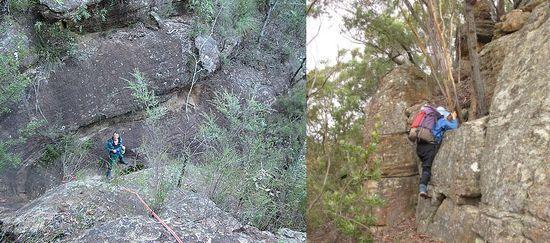
That's not how we use light joggers and friction shoes. Typically a 'smearing' technique works much better. From our last trip (it was a bit extreme):
Rockwork Main Ck 0363

Left pic: me getting water in the evening from a small pool at the bottom of a sandstone sluice box: the cliffs between us and the creek below were about 50 metres. I just frictioned back up (New Balance MT910GT joggers). Would have been much harder to do in boots though. We would have been a bit embarrassed without that pool…

Right pic: Sue going up some cliffs on the way home (MT910GTs).

Cheers

PostedApr 28, 2010 at 7:19 pm

"I just frictioned back up"

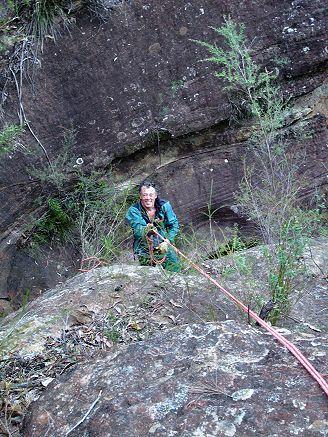
Is that pink line in the foreground a hand line/rappel setup of some sort?

Nate Davis BPL Member
PostedApr 28, 2010 at 7:26 pm

Derek, wet socks suck WAY less in trail runners. When I wore boots, I had to take them off every time I crossed a stream and change into my crocs. Now I just ford the stream and keep on hiking. My shoes and socks are dry in ten minutes on a warm day and maybe fifteen or twenty when it's colder.

When it's rainy, your feet are going to get wet no matter what. Might as well have lightweight shoes that breathe easily!

I use trail runners on EVERYTHING. Some of the terrain around here is super hard, but the trail runners hold up. They tend to wear out a bit faster than boots, but they're less expensive and make the trips more enjoyable. Buy a pair and I'd wager you'll never go back.

PostedApr 29, 2010 at 2:37 am

Roger C wrote regarding hiking boots:

"their main benefits are that they return a good profit margin to the shops that sell them, and to the companies that make them. Far better return than for joggers."

I'm in the midst of a conversion from boots to shoes, and so far have no regrets. But I do wonder whether the economics are as favourable as some think. Boots are MUCH longer lasting than runners, so I'm currently thinking that over a decade, my new taste for runners will cost me much MORE than hiking boots would have. I know Roger C walks happily in very cheap Dunlop KT26s, but they don't suit me, and the profit margins on fast wearing specialist hiking shoes seem more than enough to make up any shortfall in profits from boots.

Roger Caffin BPL Member
PostedApr 29, 2010 at 3:12 am

Hi Tom

>Is that pink line in the foreground a hand line/rappel setup of some sort?
Yep, too right.

Bear in mind that there was about 50 metres of vertical cliff below me, with very little protection and no handholds down there, and I was trying to fill several water bottles. So Sue was adamant that I use the abseil rope we always carry in that country, at least as a safety line.

Also, it was getting very late in the evening and we couldn't fool around – or we would have been on the cliff in the dark. As it was, I pitched the tent a little higher up the ridge almost in the dark. At least we had some water for the night.

Main Creek abseil 0364

Double 6 mm alpine rope – quite strong enough but a bit more difficult to hold compared to 10 mm. Leather riggers gloves with commando-style abseil technique.

Caution to the inexperienced: please don't attempt this without expert instruction!

Cheers

Roger Caffin BPL Member
PostedApr 29, 2010 at 3:14 am

> I know Roger C walks happily in very cheap Dunlop KT26s, but they don't suit me,
> and the profit margins on fast wearing specialist hiking shoes seem more than
> enough to make up any shortfall in profits from boots.
Yeah, I know, but the (lack of) weight on my feet!

cheers

Nate Davis BPL Member
PostedApr 29, 2010 at 4:25 am

Trail runners can be pretty expensive, but there are ways about that.

My Inov-8 Roclite 315's have just over 200 miles on them. The tread is wearing, but the shoes are holding together well and I expect I'll get another 50-75 miles on this pair. Maybe more. A pair of boots tends to be good for perhaps 800-1000 miles. So it's fair to say that these shoes are wearing out 3 to 4 times as fast as a pair of boots.

The Inov-8's run from $80-$100 new, but on sale they were about $55. For a new, good pair of boots, you're talking at least $140. Suddenly, the differences aren't all that big. If they make your trips that much better, the shoes are worth it.

Robert Carver BPL Member
PostedApr 29, 2010 at 6:29 am

I got 1000 miles on my first pair of Montrail Namches. Bought them for $80. The uppers are still in good shape. The sole is a little flat. I still wear them to kick around in.

Dale Wambaugh BPL Member
PostedApr 29, 2010 at 8:00 am

For me, trail runners work for day hikes, but UL "boots" like the Montrail Namches are more my preference. For Winter/ early Spring hikes, where there is a lot of water and mud on the trail, I wear some "heavier" Merrell Pulse II Gore-Tex mid-high boots that are a whopping 2lbs 12oz pair.

The main issues are my weight, the pack weight (always trying to reduce both), trail conditions, and my aging feet. Most of my hiking is on the western slopes of the Cascades with plenty of rocks, mud, and streams flowing right down the trail when there is snow run-off. Stone bruising is my main complaint with lighter shoes.

The scene below is a local trail in early June with snow fields 1500 feet above. Rough in any weather, and 35F flowing water at this time of year. Far different than than a nice little roller-coaster trail with a carpet of forest duff where you can hear your footsteps "echo" in the low density earth. Envision doing a face plant going down this mess!

Rough trail -- not for night hiking!

Viewing 25 posts - 1 through 25 (of 34 total)
Loading...