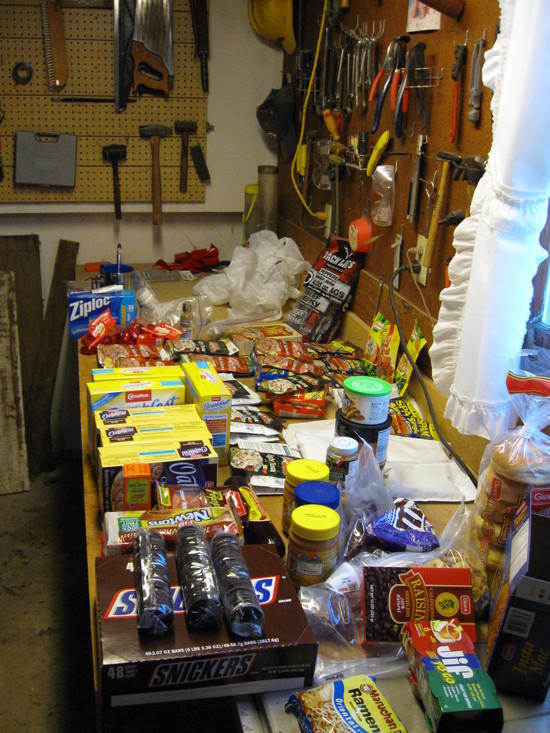
I was just in the "food" forum and posted this. Hopefully I'll get some feedback from everyone.
This website (which I LOVE) spends far too much time on gear and not nearly enough on consumables. Maybe it's a guy thing. Think about it- with a 5-7 lb. "base weight" , more than half our "trailhead" weight is consumables. On a weeklong trip, it's way more. We obsess on 3 1/2 ounces difference on two different quilts ( costing $200 to $400 or more) yet we could easily loose that PER DAY (or maybe as much as 8 ounces or more!) in our food (costing a few dollars) we're carrying with intelligent choices in our diet.
We need to discuss more how many calories are really needed for trip length. our weight, how fast we're moving, etc. Which foods are best to achieve our goal (vegetarian or carnivore).
How much water is needed to be carried in different situations, locals.
Techniques like "cameling up", etc. Water is heavy! Do we need to always carry 2 quart containers?
Fuel isn't as big a load yet it could be addressed better also. Roger has done an excellent job on the canister stove fuel stats but we haven't really gotten really anal on other fuel types.
Anyhow, you get my drift. What do you think? Any suggestions?
Personally, I think "Trailhead " weight should be the real bragging rights.
Topic
Base Weight Vs. Consumables Discussion
Become a member to post in the forums.
- This topic is empty.
Good points, Cole.
Moi, I subsist on instant oakmeal (breakfast), Clif bars (lunch and snacks) and Mountain House freeze dried dinners. My food weight/calorie per day are 25oz / 2,140 calories:
o 3 oatmeal packets – 1.3 x 3 = 3.9oz / 390 cal
o 5 Clif bars
3.0 x 5 = 15.0oz / 1,250 cal
o 1 MH dinner
6.0 x 1 = 6.0oz / 500 cal
I am definitely open to food that's tastier, provides higher calories for the weight, and just as easy to prepare — esp. the dinner part.
As for water, I'll stick my neck out by saying that the oft-repeated mantras for so many gallons per day seem excessive to me — truly hot/dry desert environs excepted.
Mark,
This is a great topic. Some time ago I recognized that I was spending all of my time working on reducing gear weight and when it came to food, I just packed whatever I felt I needed to get through my hike. Not really the smartest approach when weight is the primary objective.
I can't find my old post in the food forum, but I had asked what people found was the highest cal/oz foods that were still stomach-able. Since then, I now make a gear list (that most people want to see) and a food list (that no one wants to see) with weights and calories of all my food I am bringing. After my trip, I can analyze if I was hungry or tired or needed more of something. Since then, I almost always nail my food down pretty close and I have learned plenty about nutrition. No more bringing home a few dinners and a bunch of power bars.
For reference, someone gave me the below info a while back. I'd love to give them credit but can't remember or find out who it is…my apologies. It's just an example of how you can calculate/look at your intake on trips and whatnot.
Cal/oz Description
251 – Olive Oil
170 – Smucker's natural peanut butter with honey
170 – Planters lightly salted cocktail peanuts
160 – Pringles original
150 – Hershey's milk chocolate with almonds
142 – M&M's with peanuts
140 – Mountain House scrambled eggs with ham
135 – Snickers bar
131 – Maruchan ramen noodles
127 – Mountain House beef stroganoff
117 – Balance Bar Gold chocolate peanut butter
114 – Cheddar cheese
110 – Honey Nut Cheerios
105 – BPL gourmet peanut butter fudge
103 – Quaker instant oatmeal maple brown sugar
102 – Tang drink mix
100 – Carnation instant breakfast milk chocolate
100 – Clif Bar carrot cake
100 – Non-fat powdered milk
90 – Sun-Maid raisins
85 – Whole milk mozzarella cheese
70 – Outpost peppered beef jerkey
35 – Soy beans
30 – Bumble Bee tuna
25 – Banana
12 – Apple Sauce
Now, calculating cal/oz is one of the first things I do before picking a new meal for hiking.
That's my $0.02
Good start. I didn't even mention the whole "food value" aspect of our food choices. Personally, I'm not going to eat something "just" because it's loaded with calories.(Pringles is a good example).
And then there's the whole GMO foods can of worms, which I personally follow very closely and try to avoid any GMO foods in my diet. Which pretty much means no processed foods!
Go to Calorie King and plug in the item by name or description -e.g. Snickers or Chocolate- to get calories per unit of measure and the nutritional breakdown.
I spent a lot of time and money trying to lower my base weight. Two years after I started, I finally took a look at my food weight. I saved large amounts of weight in just a weekend of study. The hard part is finding light, high calorie foods that taste good. Here is an example of a meal I now use regularly. ¾ cup of Mary Jane’s Organic Chili Mac (vegetarian) with ¼ oz of Hot Chili Oil and a ¼ of olive oil. This meal is about the size of a cell phone (dry), weighs less than 4oz, has 475kcal, and is delicious. I would love to see more on reducing food/water weight on BPL.
I agree too much time is spent on gear vs. food.
I have been trying to get my food right for about three years now. Right is the proper number of calories that can actually be eaten with nothing brought out of the woods.
My experience:
1) Two years ago I did the JMT and targeted 3000 calories per day of stuff like nuts, oatmeal, snickers and peanut butter. I averaged about 125 calories per ounce but I didn't come close to eating everything due to altitude and just plain not WANTING to eat it.
2) Last year on a 10 day Sierra High Route trip I looked to completely maximize calories. I had an average calories per ounce up close to 150 but again it was difficult to eat and I ended up with extra food.
3) Lately I have been targeting 130 calories per ounce and a very structured 4000 calorie per day menu. This has been successful for my weekend trips and I will see if it holds up on my 5 day Tahoe Rim Trail trip this summer.
I have been able to eat many more calories by having the following meals:
First Breakfast
Second Breakast
Snack
Lunch
Snack
Dinner
Snack
First Breakfast is usually something like honey buns, little donuts etc. (500 calories)
Second Breakfast is granola with whole milk, FD Scrambled eggs with bacon etc. (Target about 800 calories)
Snacks are 300-400 calories usually fritos, pringles etc. This has been very successful in getting extra calories in me.
Lunch and Dinner are cooked and may consist of a number of menu items. Many start with either Mashed potatos, stovetop stuffing or hamburger helper. To that I add whole milk, olive oil, fd hamburger or chicken and bacon. (800 calories each)
This gives me a total of 4000 calories and all the food is yummy.
One thing I dicovered is making my own "mh meals." You can get fd ground beef and chicken in #10 cans from mountainhouse. Add this to hamburger helper and you can get meals that are as good or better than mountainhouse (IMHO) at a fraction of the cost. I am also getting ready to order dehydrated butter, cheese and hash browns and that will allow some interesting possibilities. Also a great powdered milk is Nido which is whole milk and usually sold in Hispanic food sections. A great way to load up calories.
+1 on a studied and structured plan.
Coming from the cycling world, I learned that it is imperative to eat and drink on time, every time. Once you get behind, you are cooked.
Most hiking is not that intense, but I think the approach is valid if you want to cruise big miles day after day. I learned that when 2 pm rolls around I eat that 250 calorie portion whether I want to or not. And again at 4pm, and at 6pm. The reward comes when you end each successful day with a smile on your face.
Yeah, on longer hikes I try to figure calories, basic nutrition and ounces for food. It does tend to pay off, though my psychological comfort level tends to be taking somewhere between an extra meal and an extra day worth of food, which means I'm carrying around an extra 1.5 lb.
The other thing I've worked on is water. I switched to using a steripen from aqua mira because I figured that I'd be carrying around a liter less most of the time with not having to be waiting on water to become potable, or about 1.7 lbs less for the duration of my hike when you account for the added weight of the steripen.
OTOH, it's more fun to talk about gear/new toys than eating dried food :).
My latest food list (add more snackage the longer the day):
Breakfast: granola cereal (cold)
Morning snack: almond M&M's
Lunch: peanut butter ritz crackers, granola bar, fruit bar
Afternoon snack: almond M&M's
Dinner: instant oatmeal, ramen with meat packet (salmon or tuna)
Comments: I am liking it mostly, but I think I may tire of the almond M&M's.
"For reference, someone gave me the below info a while back. I'd love to give them credit but can't remember or find out who it is…my apologies."
Steve,
I thought that list looked awfully familiar to me :-)
My process is I know a rough idea of my daily caloric needs based on expected activity. If I figure I need 3500 calories per day, my next goal is to get that 3500 calories in the lightest possible amount of total food weight. I use the list I created to help guide me in picking foods that are calorie dense. Of course, the most calorie dense foods are often not the "healthiest", so there is a balancing act between eating healthy, tasty, and easy meals all while keeping the weight in my pack as low as possible.
Chris
A bunch of us X-C skiers was heading out on a ski trip along part of the JMT (six nights out from South Lake and Bishop Pass up to Lamarck Col and North Lake). On the first day, this one guy (Jim) has a huge pack, larger than the rest of us. We got to our first snow camp, and he pulls out a large can of Guinness. That got some stares, but odd stuff like that can happen on a first night out. He drank it, crushed the can, and threw it in his pack. We got to the second night's camp, and he pulled out another large Guinness, drank it, etc. That got more stares. The third night, he had a small Guinness. Fourth night, another small Guinness. The rest of us were amazed that he would have carried that much weight in beer. Fifth night was cold, and he had _nothing_. Then on the last night out, he had his last large Guinness. If you add up the weight, that is a lot to carry. If you add up the calories, that was a lot. It was not good in terms of weight-efficiency, but it certainly attracted stares. (true story)
–B.G.–
"Personally, I think "Trailhead " weight should be the real bragging rights."
Better be careful there…that statement could turn this thread into a fat loss nightmare! But basically I agree. total weight (gear plus food plus water plus bodyweight) are all part of the equation. However gear is something that I can lighten without sacrificing comfort. Food is another matter. I wouldn't enjoy drinking olive oil or eating seal blubber :( We have our food dialed in pretty tight at 500g per person per day, and we eat well on this amount, but that's more than my sleeping bag or tent weigh!
Lynn, what do you have for 500g/day ? That's about what I'm aiming for, with 8000+ odd kJ a day intake. TIA
8000kJ per day is easily achievable at 500g per day. On longer trips when we really want max calories with minimum weight, we have stuff like cheese, salami and crackers for lunch, eggs and oats for breakfast, snacks of jerky, nuts and dried fruits, and a large dinner incorporating a balance of carbs, proteins and fats (eg pasta with turkey spam and olive oil, plus some dried veggies. There's a really good article on this site called groovy-biotic cooking that has great tasting and high calorie healthy (vegetarian) meal plans. If you're not vego, you can add dried meat to just about any of the meals. Tuna is the absolute lightest and quick rehydrating whole protein I've found…just don't. but this is really more appropriate for the nutrition forum.
We need somewhere to post food lists like we have for gear lists. I'd be more interested in food lists that gear lists!
Look Here on posting a spreadsheet.
No reason it can’t be food.
And, IMHO, inserting into a thread keeps all the info together, versus posting on you profle, which Will change.

For those of you still eating cliff bars, try these out!
125 calories/oz and non-GMO all natural, certified organic ingredients.
And they taste amazing, fill you up, and keep you going.
The energy per weight of food is somewhat fixed:
9 Kcal/gram for fat
4 Kcal/gram for carb. and protein.
(7Kcal/gram for alcohol)
The remaining variables that increase weight are packaging, fiber, and water. Water is by far the most substantial. It is possible to go on a high fat diet to save weight, but it is debatable to what level it is worth it for several reasons.
" It is possible to go on a high fat diet to save weight"
This is exactly what the sailors do in the southern ocean races. They eat a pound of butter every day (~3200 kcals) just to keep their calories up. Blech. Not just to save weight, but also to reduce the bulk of food they actually have to get in them to keep warm. Drinking olive oil would be even quicker/easier to get in the kcals!
"That's about what I'm aiming for, with 8000+ odd kJ a day intake."
Only 8000 kJ/day? That seems marginal for backpacking.
I need to bring more 151! For medicinal purposes only!
I have been using the Probar's too. They do taste pretty good.
gl
In theory the more saturated the fat, the more carbon-hydrogen bonds to be broken and thus more energy.
Become a member to post in the forums.