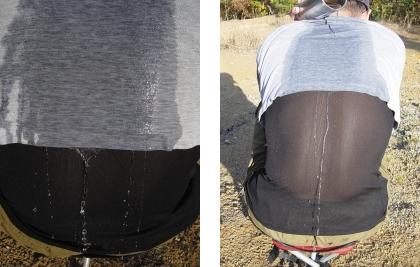
I’ve been pondering the layering system developed by the relatively new Japanese outdoor clothing company “Finetrack. Finetrack originally was started by a group of outdoor enthusiasts who worked for MontBell, but wanted to develop clothing specifically suited for sawanobori (creek climbing), which tends to be very cold and wet and aims to be as light as possible because of the climbing gear needed and the swimming in frigid and dangerous mountain pools. They’ve since rethought how layering is done and come up with some very interesting and unconventional clothes to match their system.
In the above example they first list the order and purpose of each layer in their system:
1) Dry Layer
2) Comfort Layer
3) Thermal Layer
4) Mid Shell
and, if it is raining hard 5) Outer Hard Shell.
It sounds very similar to the base, windbreaker, insulation, rain shell system advocated here in BPL, but the big difference are the first two layers.
Finetrack makes a very fine, highly water-resistant mesh base layer that you wear directly on your skin on your torso, as underpants, and inner socks. This layer breathes very well and lets out all your perspiration, but moisture from the outside doesn’t get in (you can run water over its surface and it will run off like water on a duck’s back). It thereby stops any remaining water from outside that might have made it past the two outermost layers (thermal and mid shell.
Over this layer goes the comfort layer, which consists of Finetrack’s merino wool spun with spirals of hydrophobic polyester stands, making it quick drying. This is a fine layer that spreads any moisture from the inside or the outside over a broad surface where it evaporates and prevents your skin from feeling clammy. Finetrack has its proprietary “Spilfil” fabric, but I suspect traditional merino wool baselayers do just as well (though they don’t dry as quickly).
Then is the thermal layer, which consists of a thin, highly breathable, strongly wicking layer that acts like a light outer shirt. Its outer surface blocks any moisture (including perspiration) that made it out from inside, or any mist that might have gotten past the mid shell layer. It is a 3D fabric and has a brushed surface, giving it a slight, 100 weight fleece-like warmth.
And finally the Mid Shell layer which is basically a water repellant windbreaker layer over which further insulation, like a fleece or fiber fill jacket can be worn, or a rain shell. Finetrack’s proprietary mid shell is the Pneumo Wrap, which in person feels and looks like a stretchy, athletically cut Frogg-Togg-like jacket with a slick outer surface. It even has nearly the same lightness as Frogg-Toggs, but is stronger (it can take the abrasion of the pack). It’s not as waterproof as Frogg-Toggs, though, and doesn’t have taped seams. If you look at the bottom of the web page you can see comparison charts of the advantages and disadvantages of four different shell systems, Pneumo Wrap, Gore-tex, windbreaker, and softshell. The Pneumo Wrap’s strong points are its wind-shedding and “inner humidity…ie. perspiration…controlling ability. It is not waterproof, but it is almost as light as a windbreaker, controls body humidity much better than a windbreaker, and doesn’t wet out as easily as a windbreaker.
The beauty of this system is that it is extremely light, yet protects against most rain and allows you to do strenuous exercise without getting inundated with sweat.
The site provides a number of different configurations of the system, for different times of the year, 1) a Fall/ Winter, above freezing configuration;

2) a Deep Winter configuration;

3) a Creek Climbing configuration (the first example is for very frigid water, the second image is for warmer months);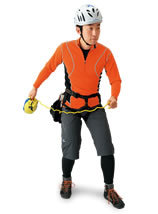
and 4) a Hot, Humid Summer configuration (it uses a special water-retaining fabric for the shirt so that it cools the body off).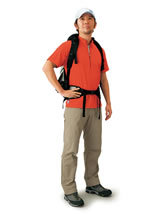
I was skeptical when I first saw this system, but have been using it for about three years now and it really works! The only problem is that clothing sizes were specifically designed for Japanese people so the pants especially don’t fit at all. Which is too bad, because their Storm Gorge Alpine Pants are some of the best mountain walking pants I’ve tried.
I wish they would market to non-Japanese and provide their site in English.
Tomorrow I’m going to trying out their Skin-Mesh base layer with an Icebreaker 150 shirt on top, thermal layer Drought Sensor jacket, and LiteSpeed Windbreaker, and below, their Drought Sensor thermal layer tights with a pair of Montane Light Speed Wind Pants, Skin Mesh inner socks with Smartwool socks, a Montbell Thermawrap jacket (in the pack), and a Paramo Velez Adventure Lite Smock. I’ll be walking at 1,500 meters so it will be cold, but not frigidly so. We’ll see how the system works…