


I'm currently seeking a strong and light CF pole for the Duomid. I don't use trekking poles and would like a CF pole that is adjustable for length.
-Sid
Topic
Become a member to post in the forums.
I'm currently seeking a strong and light CF pole for the Duomid. I don't use trekking poles and would like a CF pole that is adjustable for length.
-Sid

Lawson,
Have been experimenting with carbon pole shafts, and learned a little more.
A good reference point is the Easton .344" alloy pole, used in the Tarptent Moment and other models, that weighs between 13 and 14 grains per running inch (gpi).
I found that with my test setup, it broke at around 37# pressure. Compared to that, none of the carbon shafts tested came consistently close, except the Easton FX (used on the MSR tent) that weighs just under 12 gpi, and broke at 35#. The setup used shafts 6" in length, inserted into a close fitting tube projecting from a masonry wall, with a close fitting tube at the other shaft end with an eye hook, and a small hoist scale that was hooked to the eye hook and pulled directly downward. Primitive, I admit; but was determined to get some idea of how reliable the poles in my tent design would be before being caught in a gale. The shafts were tested once, and if they had a relatively higher break strength, twice. More than that, I cannot afford.
Of course, the break tests did not test either crush or wear and tear resistance. What concerned me most about the lighter carbon shafts were fairly wide variations in break strength. Will not name them out of caution, but I tested a number of carbon arrow shafts, kite materials, and tent supply products. Their strength was not consistent.
So, reached the same conclusion as Roger Caffin did much earlier, that a carbon tent pole design requires a very large radius bend. For this reason, settled on a product newly offered by Goodwinds Kites, named Prospar Comp, that is a combination of carbon and fiberglass, weighs around 10.5 gpi, more than a typical carbon arrow shaft, but is much stiffer than dome tent poles, having a spine (deflection of 28" span under 1.94# at center) of under .2", broke at 30#, and is reasonably priced. These shafts are a little odd, in that they taper slightly at each end, but that worked out OK using 3" external aluminum alloy ferrules that weigh no more than the internal .240" carbon ones I have previously used with carbon arrow shafts. So, I also ended up following Roger's choice to use external connecters with carbon, be they straight ferrules or elbows.
But Roger's and my solutions do not address the desire for lighter poles for dome and hoop design tents with greater pole arcs. If you can actually come up with a lighter carbon shaft construction that approximates the strength of the Easton .344" poles or better, then you should have a winner. Especially if you are going to make custom pole sets for various tents. The Easton poles are only available in wholesale quantities, and therefore would not compete with you unless they completely alter their long-standing business practice.
Tarptent's website discloses that Henry Shires uses the Easton .344" and heavier .340" alloy poles because he has concluded, correctly I think, that they are substantially stronger than the available carbon. If you could make a better pole in carbon, small scale tent manufacturers would also want it, if you can also address the issue of cost. Otherwise, you might be limited to a small niche market of individual consumers.
The reason I opted away from the Easton carbon/alloy and the Carbon Express Aramid shafts (both sold by Cabela's)was their very high cost. They might turn out to be great, but did not want to even spend the money to test them, they are so expensive.
So, I wish you the best of success, and know several folks who would buy carbon pole sets for their alloy pole tents if you can make them substantially lighter, as strong, and and not overly more expensive. Good luck to you.
Sam Farrington, Chocorua NH

Hi Josh
Fibraplex are table rolled – yes, I know. I have tried them.
Carbon Express arrows vary. Some are table rolled, some are mainly a fibreglass pultruded core. I know this because after a bunch of them split on me exactly like a pultruded tube, I dissected one, under a microscope. CF tubes by kite companies are nearly all pultruded.
> the "5 layer" carbon tube you are referring to, is almost surely made up of layers
> of uni-directional pre-preg "fabric"
Sorry, but you are emphatically wrong here. The description I gave is correct.
I have seen a photo of the winding machine, with a full technical explanation of the manufacturing process, and I have dissected the tubes under a microscope.
A mandrel is used as a core for the pultruding, and the CF tube is cured as it goes through the machine. There are only one or two of these machines in the world afaik.
The performance difference between a fabric wrap and the 5-layer 2D construction is definitely noticeable. I have used both sorts on my tents. They won't (can't) pre-bend like an Easton tube of course, which is why I use SS elbows.
On the other hand, it is possible to put 12" radius bend into an Easton arrow shaft without upsetting the temper. Working out how to do it cost me a few shafts along the way!
Cheers
Hi Lawson
> The 5-layer 2D wrapped tubes are a nice idea but I think the 3 layers of pultruted
> carbon fiber add extra weight without adding the right kind of strength.
I am going to disagree with you here. The stiffness of the tubes in bend is almost entirely derived from the fibres on the outer side of the arc. They are in tension – a huge tension. The fibres on the inner side of the tube are in compression, and I suspect the bulk properties of the epoxy or plastic would be very significant here. But the whole lot would fall to pieces without the wrapped fibres.
It is noticeable that the 5-layer 2D wrapped tubes are very high in CF content and low in epoxy content. Rather more so than for fabric wraps imho.
You mentioned the idea of using 45 degree wraps. I have seen this advertised in one place, but exactly how it was done (winding machine or fabric) I don't know. It is an interesting idea, and I would love to test the tubes.
Linus used to answer his emails fairly quickly, but that was many years ago. I guess he maybe too busy running the company now.
Cheers
Roger
Just because it breaks like pultruded, doesn't mean it is pultruded. Pultruding is a process, not the material. What is the material that is pultruded?
You may be quite right in what you are refering to with the "5 layer 2d". But, filament wound carbon over pultruded carbon makes no sense, especially for doing hooped poles.
Hi Josh
> What is the material that is pultruded?
On the Carbon Express arrows shafts I tested the bulk of the construction was pultruded fibreglass. Yes, I do know what the process involves – I have watched it being done. There was a *very* thin layer of CF over the outside.
> filament wound carbon over pultruded carbon makes no sense, especially for doing hooped poles.
Why? The tubes have worked extremely well for me for many years, and for others who have bought the small number of tents I made. Makes a lot of sense to me.
Please note that my tent poles form 'hoops', but most of the 'bend' is at the corners which are short lengths of SS tubing. You can't get a tight radius of curvature of this 5-layer 2d CF tubing: I restrict it to 2 metres. But the result is a tunnel tent which can take a hammering.
Perhaps I should explain that the pultruded layers are very close to being single-fibre layers – they are very thin. The wound layer probably is a single-fibre layer. The whole wall thickness is very thin – about 0.6 mm.
Cheers
ok
Samuel,
The Easton .344" Nanolight is one hell of a nice tube especially since it costs 1/3 of the price of the .355" Carbon Fx and it doesn't weigh that much more. The reason it was similar in strenght is because they use a uni-directional layup which is fine for fishing rods but not for tent poles. I have tried building poles with Carbon/S-glass and they are pretty bomb proof but they have alot more deflection which could either be a good thing or a bad thing depending on how you look at it. I also tried building carbon wrapped 7075 aluminum tubing but I still havn't been able to find thin enough wall tubing. I would like the wall to be around .010" but the thinnest I have been able to find is .016"
I think Easton has been affected by DAC and all the other Asian suppliers and will be hard to compete with but they do have a reputation of having long lead times and poor customer service plus I have heard they have moved some of there operations oversea's so that might be another issue they will have to face in the future.
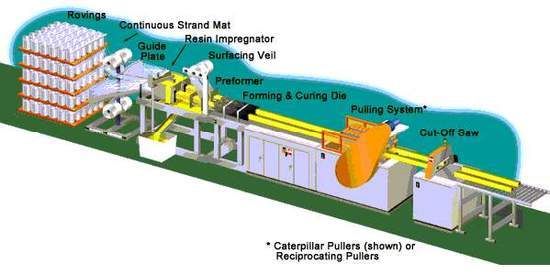
I went hunting again, with some joy. The first diagram shows a pultrusion machine – not small. You do NOT want this stuff for a tent pole as it splits when bent.
The next diagram shows the 2D process, where there is a layer wound at right angles to the pultrusion threads. In this case the diagram shows a simple 3-layer tube: the tubes I use are 5 layer.
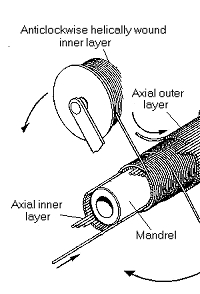
You will appreciate that when the wound layers are finished the core is under considerable compression, and this is what gives the 2D 5 layer tubes such a huge strength/weight ratio.
Cheers
Lawson,
Regarding Carbon/S-glass, suggest you take a look at the Prospar Comp shafts earlier mentioned, and very stiff. "Using a composite hybrid of carbon & S-2 glass in both axial and circumferential orientation, the CP-16-309 Prospar Comp tube is … dramatically stiffer …" (from goodwinds.com). Being much stiffer, the shafts cannot be bent in the conventional manner for a hoop or even a dome tent pole; but I concluded can be used with elbows and a very large radius bend to obtain a dome or hoop that is closer to carbon than alloy in weight, and closer to alloy than carbon in strength.
Roger,
Glad you found the picture of the machine!
You might also want to look at the product description of the above shafts on the Goodwinds web site. Sounds like a multi-layer wrap to me. Sounds also like there are a lot more than two machines running on the planet. FYI, what I do not understand, is why the other Prospar shaft Goodwinds is selling, the "PS-16-306M," which is much more flexible, slightly heavier and narrower, broke at only 23#, but is the shaft they stated they were almost sold out of. But since I'm not thinking about manufacturing these shafts as Lawson is, I don't have to understand. I only have to know what works.
Interestingly, I also broke an Avia Sport .240 O.D. pultruded carbon shaft, which I had been using for ferrules for wrapped arrow shaft tubes. It broke at 34#, and perpendicular to the shaft length. Quite strong, and not the type of break you'd expect from a pultruded shaft. As earlier stated, have decided to use DAC alloy tubing for external ferrules, and possibly external elbows if I can't purchase prebent ones at the angle needed, as it fits more snugly, reducing chance of breakage, is external, reducing chances of if splitting at ends, and at 3" is as strong and no heavier than the .240 O.D. 4" pultruded carbon ferrules I was using. FYI, also found that some alloy shafts used by Terra Nova fit the Comp poles well externally.
A word about the manufacturers. Carbon Express makes shafts from the very low-end ones found in Walmart during bow hunting season, to the high-end Kevlar ones; but I agree that the shafts Roger uses provide much better quality for the price. Dealt also with an Easton sales rep, who was willing to send me samples at no cost, as well as sell in the wholesale quantities required by the company, and provided prompt, helpful and courteous service. No complaints.
Sam Farrington, Chocorua NH
Hi Sam
Yeah, that Goodwinds kite site seems to have a whole lot of good stuff. Thanks.
The Prospar shaft may be OK, but I would prefer the SkyShark P300. It seems to be just the same as what I am currently using in fact, down to the thou'. Or possibly the P3X, although it is different by a thou or two. The web page for SkyShark seems to be SkyBurner.
I use 1/4" SS tube for the bends bends which I machine up and bend myself. I use Easton 2117 tubing for straight joiners and reinforcing.
A new Easton rep eh? The last one I had contact with lasted a few months. But one can hope …
Cheers
I went back through the comments and see a few people wrote Easton carbon fx isn't available after market. I don't know who told you that. My company is an Easton approved dealer and I can purchase them wholesale. If you are interested let me know.
Your cost from me would be:
.355" Carbon FX 18.5" Tubing
Each
$6.50
Each w/Insert
$7.99
Each w/Sunken Insert
$8.50
I am interested in just such a tent pole. I'm making a tarp tent similar to Shire's Rainbow with some modifications, and am looking for a very light carbon fiber pole that will stand up to the bowed configuration.
BS
Hi Carole
Um …. I am not sure that you should use a CF pole with the Rainbow. The curvature on the pole is pushing the limit of safety for the common 1/4" ID CF tubes. You might get away with a thinner CF tube IF you are careful and don't get in a storm.
Cheers
Become a member to post in the forums.
 Brynje Mesh BaselayersBrynje baselayers use open mesh construction to move moisture away from the skin, create insulating air pockets, and help regulate body temperature across changing conditions and activity levels.
 © Beartooth Media Group Inc.
 Loading...