Topic

Cuben Tent Question?

  • This topic is empty.
Viewing 21 posts - 101 through 121 (of 121 total)
PostedDec 31, 2009 at 6:48 pm

I bought two of the Nemo "Airbeams" to play with a couple of years ago. They work great. The problem with them was they weighed to much for a really light weight tent.

I think the airbeam idea is great! How about just using the bladders inside and covering them in a tube of noseeum mesh or silnylon to protect them and hold the shape? Would that work? It should be very light.

George Geist BPL Member
PostedDec 31, 2009 at 7:02 pm

> heat formed canopy
> It might be possible to heat form the Mylar, although
> I have some doubts. But you could not heat form the
> internal threads! I think that idea has to be abandoned.

Hi Roger,

Actually this does work. North Sails takes Cuben and heat forms it over a mold to put a permanent aerodynamic "shape" in their racing spinnakers. It's an interesting thought experiment to consider doing something similar over a dome or tunnel tent mold.

Joe Clement BPL Member
PostedDec 31, 2009 at 7:28 pm

I was going to say, North Sails does that to all their high end sails now.

Didn't think they did their spinnakers like that though.

Roger Caffin BPL Member
PostedJan 1, 2010 at 1:08 am

Interesting!

But the radius of curvature for a spinnaker might be huge compared to what might be needed for a tent? Or maybe not, depending on just what curves you want?
Hum …

Cheers

PostedJan 1, 2010 at 2:32 am

Omnipotent! That's the one I said was built like an uninsulated sleeping bag. Man that thing was warm and stormproof. If I could get my hands on a lighter one of those for winter, I would be in UL heaven. However, I would not want the inner to be non-breathable )as in Warmlite tents), having been there, done that and hating the condensation.

I also like the idea of Airbeams such as nemo uses. They are strong, could be made much lighter, and inflate quickly and can't be broken by the wine or snowfall. No reason we couldn't make a cuben tunnel tent with cuben covered air beams…and optional mesh, cuben or nylon inner?

George Geist BPL Member
PostedJan 2, 2010 at 11:14 am

> I also like the idea of Airbeams such as nemo uses.
> They are strong, could be made much lighter, and
> inflate quickly and can't be broken by the wine
> or snowfall. No reason we couldn't make a
> cuben tunnel tent with cuben covered air beams

Hi Lynn,

That is an interesting idea of a Cuben tunnel tent supported by air beams. I think I'll try sewing a 2.5" sleeve in some ripstop and slip an ultralight bicycle tube into it to see if a bike tube could form the basis of building such a tunnel tent.

The tube is 90 grams with built in high pressure valve. The valve fits readily available pumps and air pressure gauges to allow testing of various pressures and sleeve configurations.

PostedJan 14, 2010 at 6:41 pm

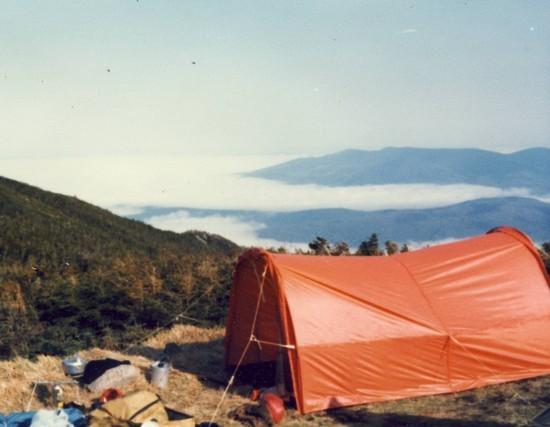
G-tent1

Given the interest in cuben tents, wanted you all to have a look at this tarp tent with hooped poles on Mount Madison NH in May '78. The tarp was a 9 by 7 foot flat Gerry tarp that came with netting sewn in at both ends, and triangular shaped extensions at both ends. Pole sleeves were sewn on where you see the hoops. In the picture, the extensions are rolled up over the hoops. In the rain, they were rolled down over the guy lines and tightened with a draw cord and cord lock. The floor was just a flat tarp about 4.5 by 7 feet that connected to the sidewalls with snaps. The poles were made in 7 sections each, the bottom four being Adventure 16 aluminum alloy, and the top three, the very flexible Early Winters fiberglass poles shown in a link previously posted on this thread. As earlier noted in this thread, one could also use prebent curved alloy poles for the three middle pole sections, and get about the same shape, and probably more strength. There was condensation on the lower inside panels in humid weather when the end covers were down. Some venting along the bottom sides would have helped. It also could have been made a foot longer to keep out the rain.
Since all this shelter required was sewing on a couple of pole sleeves and installing some snaps and cord loops, something like this might provide a relatively low labor intensive approach to trying out a hooped shelter made from a cuben tarp. Hope it will be of some interest.
Sam Farrington, Chocorua NH

Nia Schmald BPL Member
PostedJan 14, 2010 at 7:27 pm

The rivendell bombshelter with its a-frame canopy and straight support poles looks like a good candidate for cuben and carbon fiber poles. The link says it weighed under 6 pounds. How much could you shave off with modern materials?

Bill Fornshell BPL Member
PostedJan 14, 2010 at 10:26 pm

Nia,

What is the size of the Rivendell Bombshelter and do you have a link to a picture of it?

With that I could give you a very close guess.

I went to a Cuben Hammock with a Cuben Tarp. That combination will work well in the winter with my Cuben Sleeping Bag and a Cuben Down Air Mattress.

I don't think a Cuben Tent is in my future.

Nia Schmald BPL Member
PostedJan 15, 2010 at 1:22 am

Thanks Bill. All I know about the bombshelter is from the link that Franco and Miguel posted above.

Seems like it could be boiled down to a doumid + inner tent made out of 20d ripstop + carbon poles. Just a swag from MLDs numbers that would be roughly 12 for the mid + 16 for the inner + ?. Well I have no idea how strong those poles would need to be to match the original design.

One could also scrap the inner tent and just have a heavily reinforced duomid, maybe with some snow flaps to seal it up a bit.

Hammocks can be nice when there are trees. Tarps in heavy, wet snow can be a pain to continually clear. Trees of course would minimize that problem with a little extra shelter.

Did I miss the cuben down mat?

Bill Fornshell BPL Member
PostedJan 15, 2010 at 7:32 am

Franco,

I sent an email to Don Wittenberger and asked about a pattern for the Bombshelter for use as a possible "Make Your Own Gear" winter tent project. I inclosed a link to this thread so now I will wait and see if I get a reply.

Nia, I changed that reference to "and a Cuben Down Air Mattress". If I say any more the "Black Helicopters" will come and get me.

Nia Schmald BPL Member
PostedJan 15, 2010 at 9:36 am

Thanks again Bill, but it looks like the "Black Helicopters" have come down and removed your link on the cuben down air mat.

PostedJan 15, 2010 at 1:42 pm

Bill
There was on the Net a PDF of the Rivendell catalogue including specs and pictures of the various shelters , but I cannot find it now.
Franco

Ross Bleakney BPL Member
PostedJan 15, 2010 at 7:58 pm

> I also like the idea of Airbeams such as nemo uses.
> They are strong, could be made much lighter, and
> inflate quickly and can't be broken by the wine
> or snowfall. No reason we couldn't make a
> cuben tunnel tent with cuben covered air beams

That's a great idea, Lynn. If the weight of poles could be dropped by using inflatables, it opens up all sorts of cool possibilities. I've been toying with the idea of a tent I like to call a "true dome tent". By that I mean it is a geodesic dome, with all the required pieces. The big problem with such a design is that it requires lots of poles. This site, http://www.byexample.com/projects/current/dome_construction/, has several domes, and even the simpler ones use a lot of poles. Connecting the poles would be a lot of work. However, if you could just inflate it (as one big blog), it would be fairly quick. The big advantage of such a structure is that it would be extremely strong.

Bill Fornshell BPL Member
PostedJan 16, 2010 at 10:06 am

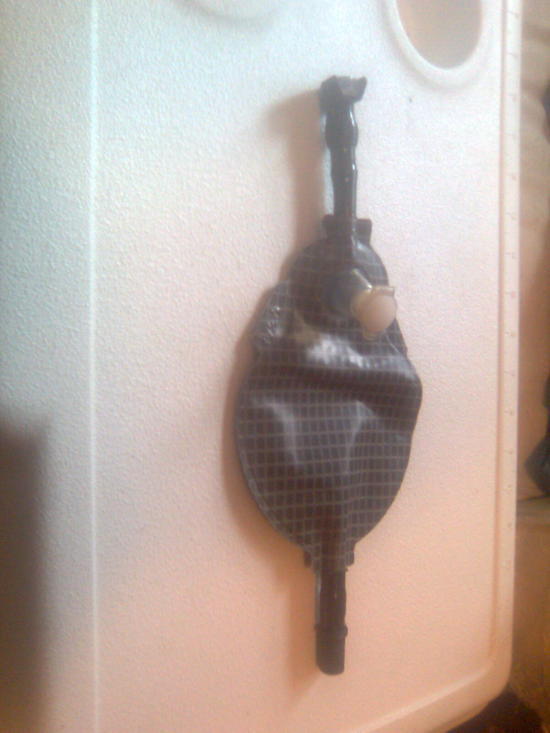
Back in Sep and Nov of 2006 I bought these Airbeams, an extra small bladder and the small air pump. I wanted to see if they might work for a light Solo Tent. After a few tries I decided they were to heavy for what I was after. In todays "material world" Cuben used for the Airbeam sleeves might bring the weight down to what I was looking for back then.

I went to a Cuben Hammock and a Cuben Tarp. If I every wanted to use a small Solo tent I think I would use a small Cuben Tarp over the tent (think rain fly) but hanging higher. I like to stay as dry as I can and a small Cuben Tarp when it was raining would let me do that.

1. Nemo Air Beam Sleeves: The Air Beam replacement bladder shown is for the smaller / thin Air Beam. It weighs 43.7 grams / 1.54 ounces and is 73.5 inches long. The smaller Air Beam Sleeve w/ Bladder weighs 145.5 grams / 5.1 ounces.

2. Air Beam Pump: Weight is 102 grams / 3.6 ounces.

PostedJan 16, 2010 at 11:51 am

If you take the extention tubes off of the NEMO small pump, it shaves almost two ounces. Mine weighs in at about 1.75oz.Nemo Pump

Bob Gross BPL Member
PostedJan 16, 2010 at 12:11 pm

The Geodesic Dome link from Ross was quite interesting.

I used a large one of those on a climbing trek on Kilimanjaro. The outfitter had supplied it for use as a 12-person dining tent, so imagine one of those with 12 people sitting down to eat inside it. Since it had to be carried to almost 19,000', weight was obviously an issue, so it had been constructed out of curved plastic water pipe pieces with a Tyvek shell. After the evening meal, the porters used it as their sleeping room, so by morning there were bodies stacked up like cordwood.
–B.G.–

Bill Fornshell BPL Member
PostedJan 16, 2010 at 6:54 pm

This is the reply I got from my email to Don Wittenberger. I sent a follow-up email and asked if I could share his answer.

Here is his email:

==========
Dear Bill,

When Larry Horton, the original owner of Rivendell Mountain Works, went bankrupt in 1981, I purchased the Rivendell assets from the bankruptcy court and went to Victor, Idaho, with a rental truck to retrieve the patterns, inventory, equipment, etc. I have been the sole owner of Rivendell Mountain Works ever since, and the original Bombshelter Tent patterns are currently stored in my home.

Eric Hardee and I have known each other for over 25 years, and he worked with me for many years to restart limited production of Jensen Packs. He now makes a few packs for public sale, using the original patterns, under a licensing agreement.

The tent is a more difficult nut to crack. It has some non-standard components that must be custom-sourced in commercial quantities (for example, the poles must be custom manufactured), which requires a substantial financial investment up front. Another obstacle has been the amount of time and work a project of this scope requires, which wasn't practical when I was working full time.

Now that I'm retired, and have income beyond our family's needs, reviving the tent is more feasible. There are, however, a number of preliminary things that have to be done. Some of the wood patterns are damaged and must be replaced. Hot cutting the fabric can't be done in the basement or garage because of the fumes; I'll have to build a shed to house a cutting table. (This is a problem for Eric, too.) Possibly prototyping work can begin next year, but an initial production run of tents for public sale is still at least a couple years away. I expect my production methodology to mimic Horton's in the 1970s, that is, the tents will be made one at a time, which means if someone wants to use a special fabric or wants custom features, that can be done, as long as my cutting and sewing equipment will handle the special fabric. The one thing I plan to do differently is that Horton didn't stock the tents and didn't make them until an order came in, whereas I plan to make a standardized product and keep several in inventory. However, even in this modus operandi, customizing requests could be accomodated.

I am, however, a proponent of a simple standard version of this tent, using the original design that had sidewalls of ordinary ripstop and a coated nylon rainfly. I have no plans to produce a Gore-Tex version. Although Horton made a few Gore-Tex Bombshelter Tents toward the end, I think he did this more to get on the Gore-Tex bandwagon than for practical reasons. From a design standpoint, I don't like the Gore-Tex idea, and try to steer people away from it, for a couple of reasons. One, the rainfly does much more than keep rain out. It stiffens the entire structure considerably, so you'll want to use the fly if strong winds are encountered, no matter what material the sidewalls are made of. It's true Don Jensen never used a fly and didn't design one (it was designed by Larry Horton), but Jensen was climbing in Alaska, where the mountain environment is arid and what precipitation there is falls as snow, so he didn't need one. This environment is more or less unique to Alaska, and almost everywhere else you'll need a fly. Second, plain ripstop breathes better than Gore-Tex, so you get less condensation.

I think the same considerations apply to exotic fabrics such as Cuben. You want to ask yourself what your reason is for using such a material. If the objective is to save weight or bulk, the savings will be minimal. The floor, poles, and fly comprise about 2/3rds of the weight and bulk of the tent; if you make the sidewalls of a fabric weighing a third as much as ripstop, you'll hardly notice the difference because you're saving less than 10% of the total weight of the tent. Once things are up and running, I'd be willing to consider making tents of special fabrics on request, but I think people should really think this through first. Another point to consider is that, in terms of strength, any failure is much more likely to be at the seams than the fabric tearing, and when you use a super-high-strength fabric made from very thin threads, there's not much for the thread to grip and no matter what the tear strength of the fabric is, this approach could significantly weaken the seams. You need a certain amount of fabric bulk to maintain seam strength.

I've spent 28 years thinking about this kind of stuff, and I really feel keeping it simple and sticking to plain materials is the way to go, not only to keep costs down, but for functional reasons as well. The materials and scantlings of the original tent are proven to work, and I'm very reluctant to fiddle with them. The axiom, "If it ain't broke, don't fix it," applies here.

The Bombshelter is a specialized tent. It's smaller than typical two-person tents, does not have the headroom of a dome or geodesic design, and is not free standing. I wouldn't call it a "survival tent" but it was designed for, and works in, extreme mountaineering conditions. It is specially designed to withstand strong winds. Almost any general backpacking tent is more comfortable, as the Bombshelter is a squeeze for two average-sized people. It originally required 11 stakes, but I figured out a simple trick that reduces this to 9 stakes. I'm looking at a possible way to increase headroom at the middle of the tent, where you sit up, without modifying the patterns but it's not fully worked out yet.

Before someone took on the task of trying to make a Bombshelter themselves, I would offer the following cautions. First, you need a pole set. I can't supply one; I have a few individual pole pieces, but not enough to make up a complete pole set. The assembly is highly complex. The tent is not as simple as it looks. There are dozens of fabric pieces, and nearly 200 individual components total. The pieces have to go together in a certain sequence, or you'll never get the thing together. The assembly sequence was never written down, or at least, I couldn't find any instructions in Victor, and I have yet to work out all the details of the precise sequence, although I more or less know what the general sequence is. It's complicated and there are dozens of steps, and you can't get them out of order. You also need commercial grade sewing equipment; there are many places where you have to sew through multiple layers of fabric and webbing, and a home sewing machine can't handle it. The tent also requires professional-class sewing skills; there several teams of seams, including felled seams along curving lines, that require much practice and are beyond the abilities of most amateur seamstresses. This definitely is not a do-it-yourself product design.

As far as sending people copies of the patterns, I won't do that, for several reasons. One, the work involved in tracing all the pattern pieces is so much that I would have to charge a lot of money. Second, and more important to my interests, this is a proprietary product that I don't want people making bootleg copies of. I paid for the patterns and legal rights, and if copies get out in public, anyone could make and sell the tent without my knowledge or permission using pirated patterns, and in all likelihood these would be inferior copies that would damage Rivendell's reputation and possibly destroy my business. So, that's something I won't do, period.

My suggestion is to be patient and stay in touch with Eric or me. I can't absolutely promise the tent is going to happen, and I certainly never dreamed back in 1981 that it would take this long, but the ducks are lining up now. Eric already has the packs in production, and I'm working on the tent, which probably will stay with me, as Eric already has his hands full. One by one, I've been removing the stumbling blocks over the years, and it's getting close now — certainly much closer than it was even 5 years ago.

I've provided a lot of information here, and I hope this gives you some things to think about in terms of what you may want to do.

Don Wittenberger
Seattle

==============

Viewing 21 posts - 101 through 121 (of 121 total)
Loading...