


> I have enough of the .75 breen cuben to make my tent design. I intend to make a cuben mid for 2
Hi Derek,
Thanks for the description of your tent design. How many yards of Cuben do you estimate it will take to make your mid for 2?
Topic
Become a member to post in the forums.
> I have enough of the .75 breen cuben to make my tent design. I intend to make a cuben mid for 2
Hi Derek,
Thanks for the description of your tent design. How many yards of Cuben do you estimate it will take to make your mid for 2?
Hi Miguel and Sam
You can see this design in the supermarket selling for $40. Having the Messner name on it means … zilch. The high price means zilch (think sunglasses, watches, fashion clothes, …). It is still just a pop-up with a door which will let the rain in. And it will still be difficult to pitch in a storm. Ventilation?
> the issue of clips versus sleeves and wonder why clips are considered inferior?
Stress concentration. May not matter when everything is 12 oz canvas, but it does matter when using UL fabrics. You must distribute the load.
All my guy rope attachments use large triangles of fabric to spread the load along the seam/stitching. Small bits of tape can pull out easily, for several reasons.
> We use tremendous force on guylines, much greater than on roof panel sleeves,
Really? I don't think so. Can you imagine hanging a 20 L bucket of water (20 kgf) off a typical guy rope attachment point? Pity the poor tent! Forces, yes, but not 'tremendous' ones.
A reality check on all this is to arrange a simple test load using a tent stake, a guy rope, a pulley and a large bucket of water. See what force is needed to move a typical small stake in snow or soil. Very few (experienced campers) report losing tent stakes.
I would guess that the forces on the roof panel sleeves (ie parallel to the poles) would be about the same as on the guy ropes, although I haven't actually measured the former. But I know what thickness bungee cord I use. A few kgf perhaps.
> roof panel sleeves, which normally pull at only one point, and yet also require
> the load to be as spread out as much as possible. Why should clips be any
> different that way?
With guy rope attachments the load is (normally) at 'right angles' to the seam (well, off sideways, at least). You can actually pull the stitching out, hole by hole. If the load is spread across a narrow bit of tape the force per stitch can be very high.
Tension on a roof sleeve (assumed parallel to the pole/sleeve) is usually applied along a length of seam (I hope) rather than just a short tape-width). Once again the load is more distributed.
> Don't clips also relieve some of the stress by not acting as wind-catches?
Yes – in principle, but in practice the wind-loading on a sleeve is very small. The wind loading on the body of the tent would be WAY bigger.
> But the sleeves must be … must be a stronger (read heavier) material.
Why so?
I have never used a heavier fabric for my tent sleeves, and they have taken a lot of use (and abuse). No signs of damage.
Can't say the seams have shown ANY sign of damage from being 'constantly poked with pole tips during threading' either. But then, I take some care when pitching the tent.
That said, it is worth noting that a sleeve has two layers of fabric going from the pole to the main fabric, and so is twice as strong as a single layer anyhow.
> little snow fences (or rain collectors)
??? Can't say I have ever seen this happening on a tunnel tent. I guess it might happen on a dome though?
Tent design – FUN stuff! :-)
(Then you get to sleep in it, while wondering …)
Cheers
Hi Al,
6 running metres for the outer only is my estimate. I have 9 metres but also have other projects planned
> That is why I'm trying to figure a way to get internal poles
> easily installed and stabilized. And as you point out,
> they don't create little snow fences (or rain collectors)
Hi Sam,
Why can't the poles be slid through sleeves sewn on the bottom side of the fabric? Am I missing something obvious?
The sleeve would stabilize the pole and there would be no snow fences/rain collectors on the outside of the tent.
Feeding the pole in from the edge, I can't envision that it is any harder with the sleeve on the inside, as long as the sleeve was continuous. (If the internal sleeve had gaps in it then yes I can see that would not work because as I threaded the pole it would get outside the sleeve, inside the tent where I could not reach it.
That sounds pretty good, Al.
Internal sleeves that are accesible from the outside at one end only are used on my Stepnensons 2R. I've wondered why other tent manufacturers don't all do it that way. I suppose there must be a reason?
Manufactures don't use internal sleeves because they could care less about making quality products plus it would cost too much money. I personally think nothing is better than internal sleeves because you can construct a stronger seam above and the sleeve can act as bridge to distribute the load across the seam.
"Manufactures don't use internal sleeves because they could care less about making quality products"
plus it would cost too much money
Yep, that is right. ALL manufacturers (they work together on how to deceive us silly consumers…) make shoddy products.
But, as you hinted at in the second part of that statement, if they did make quality products we would not buy them anyway because they would be too expensive.
Have fun with the internal sleeves…
Franco
"Ross,
Sorry I didn't address your comment earlier. Good idea on the 2 person design using both parties trekking poles. If you go alone you can bring poles for the rear.
I was thinking of going with a front width around 54" and a back width around 40" and a front height of 42" and a back height around 30". What do you think?"
No problem, there is a lot going on with this thread. In general, yes, that sounds like a good idea. I think I would make the back width about 42 inches. Two 20 inch pads makes 40 inches, plus a little room to maneuver them.
It sounds like you've just re-engineered the Squall (http://www.tarptent.com/squall2_2.html). :) That is a compliment, as I think the Squall (which is basically a two person version of the Contrail, is an outstanding design that is extremely popular for a reason. Obviously, lots of folks have contributed to the idea, but Henry, in my opinion, has crafted the best version of it. Unfortunately (for me, not you) he hasn't shown much interest in developing a Cuben version. You might be able to get a pattern from him, and then make your own tweaks as you see fit. I think there are a fair number of patterns bouncing around, if that helps you in any way (as well as a lengthy discussion here http://www.tarptent.com/projects/tarpdesign.html). Oh, and I don't mean to suggest you are stealing his design — I think this is just a logical design that comes out of a desire to use trekking poles and have ample headroom.
One practical reason for external sleeves is that, in the even of a broken pole puncturing the fabric, the hole is only in the sleeve, not the fly, so the tent remains waterproof.

Roger,
Agree that if you are careful, stakes can be critical tent supporting points and pole sleeves can be of the lightest fabric. Being alone in a gale, whiteout and/or hail storm, or just simply being exhausted from slogging, hypothermia or an unfortunate injury, do not promote being careful. Idiot proof may be a pejorative, but I'm not embarrased to admit that it works best for me and friends I make gear for. I still believe there was a good reason why Henry used heavier fabric for the sleeves on the Moment and Scarp. Hope to put a carbon pole over the Moment and find out this summer how well it works to make the tent freestanding. (Idea: Instead of twisting the one ribbon sewn perpendicularly across the pole sleeve, remove that ribbon, and sew on two ribbons crossing diagonally over the sleeve with just enough slack for the pole to slide through under the cross).
About snow fences and rain collectors. First, I should have been clear that my posts were about single wall tents, since this is BPL, and my feeling is that single wall is the only way to get the best shelter in the lightest zone, Terra Nova and others notwithstanding. Having said that, I think that anything adorning the outer tent roof or canopy is going to create some retention of snow and water, even if all the poles follow the fall line on the canopy, but even moreso if they don't. Even if a pole sleeve just channels water vertically, it is still concentrating water on a more limited area than would be the case if there were no external sleeve. That's why carpenters put flashing and/or that sticky stuff, bituthane or whatever they call it, at the points on a roof where water collects and drains. OK, and I admit that a tent just looks more aesthetically pleasing to me with a clean, unadorned outer canopy. Henry's approach to sleeves on the Scarp and Moment is about the best I've seen, because the sleeve is only at the line going directly over the apex, or highest point, to the ground, and there is only one of them. The yellow color to contrast with the rosy gray canopy is a nice touch also.
But once you start crossing poles, as must be done for a dome or freestanding design (greatly enjoyed the recent humorous BPL thread on freestanding single pole designs), a number of complications ensue, including more snow and water collection, and more difficulty with threading the poles through the sleeves; ergo, the popularity of clips on domes like the Messner. Roger, please don't get the wrong impression; I love your design, and I also love the Moment design even though I know it would not protect me anywhere near as well as your design; but that doesn't hinder me from trying to build a better mousetrap.
Al and Mike,
There is an inner pole sleeve on the fly covering my Wilderness Equipment bug hut, and it works fine. However, inner pole sleeves generally do not stabilize the pole unless it is running inside a corner seam that limits movement, and even then, some manufacturers feel that instead of an inner sleeve, Velcro or other types of ties must still be added at points along the inside of the corner seam for stability. Also, inner sleeves would be even more difficult to thread without poking through the fabric, as there is less visibility than with sleeves on the outside. And if the poles cross inside? Yikes! It always helps to be able to see what you are doing. So cannot agree that there is any fault with the manufacturers on this score. Unlike us, they have no choice except to be idiot proof. Just about every aspect of Warmlite's design has been copied except the internal sleeve. Must be a reason. Patent or prudent? William Kemsley's Backpacking Equipment Buyer's Guide (1977) stated of the Warmlite: "You plug the shock-corded sections into one another while slipping them into the pole sleeves. It is an awkward operation the first time you try it, but once mastered, goes quickly and easily." Never found out, because did not want a tent that let the rain in when the door opens.
Cheers,
Sam Farrington, Chocorua NH
Hi Sam
> Being alone in a gale, …. do not promote being careful.
Hum, well, we could argue about this at some length. There have been times when I have had some trouble getting stakes in because I was shaking, and there was one time when my wife was so cold and wet that she was not able to strip her wet clothing off inside the tent (she had to wait for me to help her). But we have never fumbled pitching the tent – it's way too important.
What I have found is that the combination of a 25 mm sleeve, a rounded peg on the end of the pole, and the slipperiness of the silnylon, has meant I have never had any problems. I suspect that PU-coated nylon and a narrow sleeve might be a bit more difficult.
But your point about keeping the tent simple is a good one.
> Even if a pole sleeve just channels water vertically, it is still concentrating
> water on a more limited area than would be the case if there were no external sleeve.
It doesn't seem to work that way. You see, when the pole (sleeve) pulls up and the rest of the tent pulls down (on a tunnel tent), the water flow is not along the seam line. The seam sticks up a bit due to the tension. The water flows elsewhere. Now on a dome – yeah, completely different situation.
> Just about every aspect of Warmlite's design has been copied except the internal sleeve.
Several people have commented about this. Obviously the Macpac Olympus design is not well known in America. This is one of the world's leading mountain tents, and it features a special 'catenary' cut along the seams and internal sleeves for all three poles. This photo is from 1993:
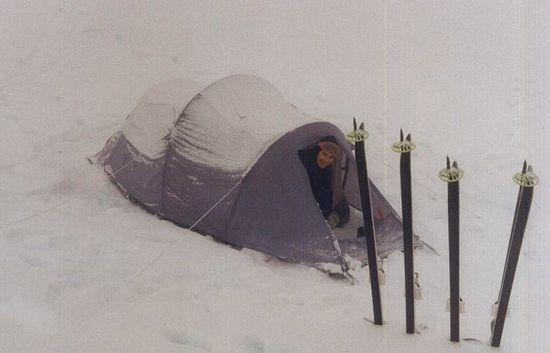
Any similarities between my orange tents and the Olympus are due to many years of sleeping in an Olympus in bad weather! The major difference is that I don't have the fabric drop as much between the poles – you lose too much headroom that way imho.
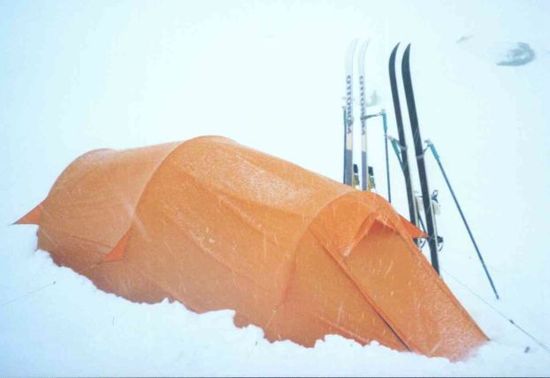
(Actually, this is an older version which also had the poles in an internal sleeve. My current winter tent has external sleeves.)
> Unlike us, they have no choice except to be idiot proof.
Sigh. True.
Cheers
You can see this design in the supermarket selling for $40. Having the Messner name on it means … zilch. The high price means zilch (think sunglasses, watches, fashion clothes, …). It is still just a pop-up with a door which will let the rain in. And it will still be difficult to pitch in a storm. Ventilation?
Erm, Roger, it’s a little off putting to be so quickly and easily dismissed. I mean, it’s not as if I know nothing about tents (in fact, as both someone who has used a lot of tents, made quite a few of my own, and as an architect who studied and built tent structures, I feel I know a little bit about them), and for someone who can’t read Japanese you certainly do assume a lot about the tents. I defer to your experience and far deeper knowledge about materials and construction, but still… o_O
The Nippin tents I show here are designed to be used atop Mt. Everest (the one in the earlier video was used by Messner on Everest and Denali… the tents were custom built for him for all the conditions he expected to encounter). Sure the design is a classic dome tent in the vein of the ID MK1, so yes it does have problems with the door opening to the sky, but the breathability is partly augmented by its custom specified proprietary Gore-tex walls, called “Sara-Sara” (which means “smooth and slick” and has something to do with its breathability) and which can’t be found anywhere else. A lot of serious Japanese mountaineers take Nippin tents as one of the most reliable tents made in Japan, and Nippin tents are not known by the average camper. And I can tell you, Japanese are VERY critical about details. That’s why quality for goods is so high here.
Also, take a look at this page. Scroll down about halfway till you see the small diagram of the cord attachment system that you saw in the video. If you look carefully you can see that it has both a clip and the cord system… This system was designed to deal with the issue of sleeves in the wind, when it is often hard to get the pole into a sleeve…you have the speed and ease of a clip, plus the wide force distribution of a sleeve… the cord even forms a similar channel to a sleeve. It is most definitely NOT a cheap Wal-mart pop-up tent!
When the need for a vestibule comes up, while not as big as that of a tunnel tent (which I have used far more extensively than domes), Nippin does offer flies with vestibules that you can throw on top. This effectively makes it a double wall tent, which makes it warmer in frigid weather.
And last, take a look at this video of the Hilleberg Soulo being set up… it is almost exactly the same as the set up of the Nippin tent you saw in the earlier video, right down to the way the pole falls down during the set up and the way the clips go onto the polls.
Oh, and this might interest many of you, the tents, with poles, weigh just 960 grams. Not too bad!
I don’t know if the debate about whether tunnel or dome tents are better will ever get settled (I prefer tunnels), but I think it is a bit obtuse to downright dismiss these offerings without knowing a bit more about them! I know cheap when I see it, and I wouldn’t do that to you guys!
As an ending note, take a look at this collection of tents in Japan (scroll down). Japanese love dome tents and they are always wary of gimmicks and so don’t easily try new ideas without proven worth. Japanese dome tents are light! Photos #6, 11, 34, and 42 are Nippin tents, By far the most used tents are by Arai Tent.
Hey Franco,
"Yep, that is right. ALL manufacturers (they work together on how to deceive us silly consumers…) make shoddy products.
But, as you hinted at in the second part of that statement, if they did make quality products we would not buy them anyway because they would be too expensive."
Don't take what I said personal. I should of used the word most and not all. (cottage gear makers are the exception) When you start buying inferior Asian raw goods and participate in unfair labor practices you no longer care about your products. The number one goal of companies that participate in these practices is the bottom line.
Getting back to the topic of trying to build a storm tent out of Cuben… if a solution to a taunt tent is a mix of silnylon and Cuben panels, then what is the best way to bond these two panels together? Tape doesn't stick to silnylon,
I read that Cuben is weakened by short stitch lengths.
Does anyone have any experience/tips they can share about sewing these two materials together where there is a fair amount of tension pulling across the seam?
thanks!
Hi Miguel
I am NOT dissing you!
I am NOT dissing you!
I am NOT dissing you!
Absolutely NO WAY! And my apologies if anything I said has come across that way!
> The Nippin tents I show here are designed to be used atop Mt. Everest
Yeah, well, forgive my cynicism, but that's a marketing claim which anyone can make. Yes, I am dissing the manufacturer's claims to some extent. Yes, of course you can use a pop-up on Everest. But you take much stronger poles! And stronger poles are heavier poles. I have a great photo of a big pyramid tent used in the Antarctic – I think the centre pole for that tent is 2.5" (60 mm) diameter! Tough stuff, but heavy.
The 960 g weight – yeah, that's pretty good.
OK, details or explanation required. Roger, explain yourself! Btw: I have absolutely no objection to being challenged to justify a claim, none whatsoever. With any luck the explanation may be of value to someone.
I have seen people struggling to pitch these two-pole pop-ups in bad weather. It has taken them a long time to get one up safely because the fabric blows around while you are trying to attach the tent to the poles. The poles fall over (as you mentioned), there is high strain on the attachment points, and so on. Sure, once the tent has been fully erected and guyed out it isn't so bad, but the intermediate stages can be a nightmare. Sometimes I have had my doubts about whether they would even succeed. Similar comments also apply to pop-ups with sleeved poles, although there are ways of doing this more safely (see below for ideas).
I have also made and used domes with internal poles. These require that one person gets inside the tent once it has been pegged down on the ground to help thread the poles through the sleeves. In bad weather this can be a real struggle, albeit one which is often amusing to onlookers outside.
I took a look at that 'collection of tents in Japan'. Yeah, they love domes! But go through the collection of photos and count how many of them seems to be taken on a wind-less day – nearly every one of them. A telling observation.
OK, so how do I pitch a UL tunnel tent safely and quickly in a storm?
First I peg the leading end down onto the ground with considerable care. In doing so I try to have the length of the tunnel oriented with the wind, at least as closely as possible. This is usually possible in the snow.
Then I insert the poles into the sleeves one at a time while laying the tent flat on the ground. I start with the upwind pole and work downwind. My wife helps by holding the inserted poles flat on the ground so they don't catch the wind. It is worth noting that the wind does not make it difficult to get the poles into the sleeves when doing it this way. Yes, this has sometimes meant I am crawling around on the snow in a gale.
When all poles have been inserted (and checked!) I take two more stakes and go to the downwind end. Then I pull the end of the tent downwind and my wife lets the poles swing upright. She usually moves to the side at the same time and helps hold at least the upwind pole in place, although this is not essential. I check for any skew and stake the down-wind end down.
In this configuration a tunnel tent is usually able to handle most any wind along its length even without guy ropes, although it is totally dependent on the integrity of the two upwind end anchors. If the wind is side-on my wife helps hold one or two poles while I quickly stake the windward guy ropes out. It helps to make sure these are not tangled beforehand.
Yes, I have done this in winds up to 100 kph. And it is actually fairly easy once you have done it once before. There is no fumbling around, no poles falling over, no flapping of fabric, and no risks with a half-assembled tent. Sorry – no photos or videos either, for obvious reasons.
Cheers
> Does anyone have any experience/tips they can share about sewing these two
> materials together where there is a fair amount of tension pulling across the seam?
I suspect this is an area where we need quite a few experiments. Actual measurements would be good. Bring it on!
Cheers
Lawson
Nothing personal about that comment, I neither make nor sell tents.
I tend to react that way every time I see someone insulting manufacturers and or retailers with "they are only there to rip you off" kind of remarks. I did that recently with the Caldera Cone (the OP conveniently forgot that there are R&D costs involved amongst other expenses) as well as the Neo Air (pretty much along the same lines)
My oppinion is that if your statment were true there would also be exceptions. However I see no single manufacturer (cottage manufacturers sell directly so they don't come into this) that consistently produces tents at a higher quality and lower sell.
As far as "inferior raw Asian goods" most tents are now made in Taiwan ,China or Vietnam. I see no evidence that they are inferior to the previously made in the US/UK/NZ versions. In a nostalgic world yes, in reality no.
Franco
I have been thinking alot about this and have come to the conclusion that silnylon probably isn't the best candidate due to the fact that it cannot be taped. When I talked to Jon with Cuben Tech he said the strongest seam is one that is taped and sewed with a long stitch.
I personally think the best option is a nylon with a light (1/4oz) double sided PU coating.
Hey Franco,
I am glad my comments didn't offend you. I thought they might of since you addressed me directly regarding a broad statement about why manufacture's don't use pole sleeves when they are a superior way to build a tent.
The reason I talked about "inferior Asian raw goods" was because the same manufactures that don't use pole sleeves when they should be used in certain applications, also participate in buying lower quality raw goods, use cheap labor and put profit in front of quality every time.
You can think what you want, but Asian made goods are inferior! There is a reason why they cost less. Here are a few examples of why. Most Asian factories use Nylon 6 over Nylon 6,6. Most Asian factories weave the fabric in mills with reconditioned outdated machines or substandard machines. Most Asian factories use outdated and inconsistent coating technique's. Most Asian factories do not test there material in a lab and meet no standards what so ever. Are there exceptions to the rule? YES.
As far as labor goes that's more of a human rights issue.
____________________________________________________________
Hey Miguel,
I am a big fan of dome and tunnel tent's but I am still convinced that the best all around tent is one that is freestanding. If the wind changes direction or your guy lines break in a tunnel your up a creek without a paddle.
About 10-12 years ago my dad and myself weathered a storm in his two man single wall aluminum pole "popup". The storm produced 70 mph sustained winds and 105+ mph gusts. Of all the different type's tents at the site the two man dome's were the only one's that made it through the night.
if by Asia you are referring to China you might be correct but to talk about all Asian made goods as being inferior is not correct. Japanese and Korean manufacturing is equal to, or in some cases better than, anything produced in either Europe or America. I spend several months a year in Korea and can tell you first hand that it is the case. Their commitment to education is far beyond ours so it isn't surprising.
I am NOT dissing you!
Roger, thanks! But, I really wasn't offended, just felt a little challenged. You've always made your take on dome and tunnel tents clear and you've always been very forthright in how you say things, and I actually like that a lot. It's easy to deal with and understand, saying things like they are.
Your methodical explanation of setting up a tunnel tent mirrors all my own experiences and ways of setting up a two-person tunnel tent… my wife would always get inside the tunnel tent after the two poles were set up oriented to the wind, to set up the inner and start preparing dinner while I stayed out in the wind and rain making sure the guylines and stakes were secure and the wall panels of the tent were drum taut. I found that the longer the guylines the more buffeting the tent could take. My Akto, which I think of as a single-person, single-pole tunnel tent, sets up in a similar way. I can see where a dome tent would make it more difficult to set up in the wind because once you raise one pole in its sleeve (and you can't, unlike a tunnel tent, put the poles into the sleeves without raising the wall fabric) the tent becomes an unsupoorted sail, until the other pole is inserted and fixed. Here is where the clip system, for a dome, makes more sense: you raise the tent walls after you set the poles.
But, back to the original question of cuben tent design, Roger, your objection to using a non-stretching material seems to refute the idea of using cuben for an extreme conditions tent, but do you think there are modifications that can allow for the stretch needed for environmental stresses? The question of silnylon not being tapeable came up and would cause a problem for a cuben shelter if taping was the only method of attaching the panels. But surely something could be implemented to make cuben more compatible with the OP's original question?
What exactly are the criteria for the cuben tent?
1) Cuben
2) Free-standing?
3) Four-season?
4) ?
5) ?
My opinions of criteria for Cuben tent.
Cuben construction, ultra light weight, shelter you from the elements, and durable enough to last a thru-hike.
Hi Miguel and Lawson
Both of you have stated that you can't tape silnylon. Sorry guys: I have been taping silnylon for the last six years – and very successfully too. Every one of my silnylon tents has tape on it – tape which has stayed firmly attached the whole time too.
OK, another Xmas exposition, on tapes this time.
Part 1: tape adhesives.
There are several adhesives used on tapes. There's 'rubber', acrylic and siloxane. I am not aware of a PU adhesive tape – I don't think you can suspend the curing of PU any way.
Rubber: this is what is used on Duct Tape. Very sticky gooey stuff, usually used in a thick layer. Sticks well (but not to silicone surfaces), but also releases. Tends to exude out the edges and leave a sticky mess.
Acrylic: this is the most common adhesive, and comes in a wide range of formulations. Think common or garden adhesive tape or packaging tape. The adhesive can be releasable, as in some 'magic' tapes (and in cheap Chinese packaging tapes as well); it can be fairly strong as in the common 'Scotch Tape' and GOOD packaging tape; and it can be 'permanent', as in the seam-stick tapes used in making spinnakers. The 3M9485 tape is a classic here – I have had the bond between that tape and the PU coating hold and the PU coating rip off the underlying nylon fabric!
Siloxane: this is mostly unknown in the consumer world (due to price), but it is quite well-known in some industries. Basically, 'siloxane' is a silicone polymer, generally not quite as strong as acrylic but able to withstand far higher temperatures. Siloxane tape is used to protect areas on printed circuit boards and steel sheets prior to plating and powder-coating. It is also used to join rolls of silicone-coated release paper (used for example on double-sided acrylic tapes).
The behaviours of acrylic and siloxane adhesives are very different. Acrylic has a high 'instant tack' and bonds quickly, but a siloxane adhesive may take up to 3 days to develop it's full bond strength. For the siloxane there is an actual polymerisation process taking place once it is exposed. However, this is where one can get lucky: if you have the right siloxane adhesive and are bonding to a silicone-coated fabric, the polymerisation can result in the tape chemically bonding to the fabric in a near-permanent manner. However, few formulations are designed this way: most are designed to be releasable, so you can peel the tape off after doing the plating. But permanent-bond silicone tapes are available.
The siloxanes are relatively new. When I started seeking suitable ones (2002-3) there was little available, and I was actually getting some new products from the labs rather than commercial products. These days far more is available.
Part 2 of the Exposition: tape design.
You can get single-sided tapes and double-sided tapes, and I am sure you are familiar with them both. The problem with using double-sided tapes on 'elastic' fabric is that the carrier film (often polyester or Mylar) brings with it properties which are very different from the fabric you are bonding. Mylar does not stretch! This can cause all sorts of stress problems.
A third form of tape is known as 'transfer tape'. The 3M9485 which has been mentioned a few times is a transfer tape. This looks like a single-sided tape but has a release paper on the adhesive. You peel off the release layer and stick the tape down on one bit of fabric. It pays to burnish it down. Then you carefully peel off the polyester carrier tape to expose the other side of the single adhesive layer. Now you can stick the second fabric layer to the first, with no carrier film in the way. (Do this very carefully: rearranging the lay of the fabric is not usually possible!) The joint has the stretch properties of the fabric only.
Bonus part of the exposition.
Take a roll of sticky tape and peel off a strip. Ever stopped to wonder why the adhesive ALWAYS sticks to the 'right' side of the carrier film (or tape) and ALWAYS lets go from the backside of the tape? Why is this so?
In fact, a simple roll of cheap sticky tape (acrylic type) bought at the local supermarket is a miracle of chemical engineering. The adhesive layer on the tape is not just one layer of adhesive: it is at least two and sometimes three layers. The first layer bonds to the (possibly treated) surface of the carrier film. There may then be an intermediate interface adhesive layer, followed by the final layer of adhesive which bonds to the rest of the world. Each layer has a different chemistry.
Errr… cheap Chinese packaging tape sometimes has just one layer of not-very-good adhesive on it. 5 minutes after you stick it down it peels off. You get what you pay for.
Mystery bonus question. Do you need a radiation suit when you use sticky tape?
Answer – possibly yes. Rip a length of sticky tape off a roll and the release edge can emit X-rays. This works best in a vacuum. Don't believe me? Google 'sticky tape X-rays'.
Merry Xmas all
Roger
X-Rays? Wow! You learn something everyday. Could it possibly have anything to do with the holidays?
Very enlightening writeup!
Hey Roger,
Thanks for the article on the different types of adhesive used in different types of tape. Unfortunately you forgot one HUGE detail. BOND STRENGTH on materials it wasn't designed to be used with. Seam stick or the acrylic tape that is used for sail laminate will not properly bond to silnylon and the self fusing silicone tape that is "unknown in the consumer world" will not properly bond to sail laminate.
Is there an issue with using something other than silnylon?
Become a member to post in the forums.
 How to Plan with Decision GatesKeep going, change your route, or turn back? Watch how decision gates help structure these choices in our YouTube video.
 © Beartooth Media Group Inc.
 Loading...