


According to this page[owareusa.com], there’s a prototype in the works… Maybe something to compete with the SpinnShelter? Or is that too obvious?
-Mark
Topic
Become a member to post in the forums.
According to this page[owareusa.com], there’s a prototype in the works… Maybe something to compete with the SpinnShelter? Or is that too obvious?
-Mark

nice find…
If I had to guess, maybe an Alphamid-type shelter made out of “nano” fabric???
Whatever it is, I’m looking forward to seeing one. :-)
-Mike
An Alphamid of ~X~ lighter fabric would be my guess too. Dr Jordan seems to be using these a lot this winter. However I’m not sold on the way the door creates a vertical/flat side when closed up — kind of like a sail. I’d prefer something more like a ‘mini-mid’ (pyramid shaped, a la Megamid, but 1+ person). But yeah, I’ll be watching this one too.
I’m really looking forward to see how this turns out. I have been tempted by the Spinnshelter for winter use.
He’s still using a bivy with it tho’. Just wondering… is that necessary? I’ve stuck with the SpinnShelter all along because I don’t feel the need to use a bivy with it… and a SpinnShelter minus bivy is still lighter (about about the same) as a tarp plus bivy. What I’d LOVE to see is the SpinnShelter made from this new nano fabric.
I want one!!!!!!!
Finaly a really Ultralight pyramid shelter.
Where can I get one?
I agree with David…I would want this type of shelter because then I wouldn’t need the bivy to. It will be interesting to see if this will be comfortable without the bivy.
What is that translucent bag/sack by the right side of the entrance? It looks a too large to be a stuff sack. It looks a lot like Bills Cuben G6 clone.
I’m not sure what it is but if you look closely there is two of them. One is at the head of the sleeping bag.
Why use a bivy in a shelter like the one pictured? Possible reasons include:
1. want to pitch it up a bit for ventilation and to minimize condensation. it’s raining or rain is expected during the night, plus it’s windy and don’t want any wind driven spray/rain to soak a down sleeping bag.
2. have the shelter sealed up pretty tight under conditions that will likely form sufficient condensation on the underside of the single wall tarptent. don’t want this dripping onto, or otherwise coming into contact with the bag should one move about or sit up.
perhaps there may not be much opportunity to dry the bag in the sun during the coming few days of the trek of the additional moisture accumulated from #’s 1 and 2 above?
just a thought. what am i missing either by omission, or by way of mistake in my reasons?
I suspect Paul’s right on. The shelter footprint is pretty small and when pitched with an air gap at ground level (typical) rain spray and spindrift will certainly come inside (although much less than with a very small tarp). There will also be splash from dripping water. (Since bigger teepee shelters allow sleeping farther from the walls, less moisture will directly strike the bag.)
Also, a bivy will increase any sleeping system’s warmth and I’ll guess it was included for that reason as well. Ryan’s always skating on the thin ice with his gear, and it looks pretty cold there :-)
ditto, need for a bivy for reasons stated. unless that shelter has some sort of peak vent, the apex of the Pyramid looks like it could be quite the condensation trap.
Remember too that with all the advantages stated for that bivy it only weighs 3.5 oz. A light groundcloth like a GG polycro weighs 1.5 oz so that extra 2.0 oz is very useful.
Dan
I have been looking for a good design for a one man tent for winter use. Several years ago I made one but it was before Cuben and it weighed more than I wanted to carry. The new and coming soon maybe 7.5oz version of the Oware Alphamid looks like it might be a good design to try.
Last year, I think, Ryan and crew did a winter ski/hike and he used an Alphamid Tarp. I went to the Oware web site to check the size they come in to see what size the Alphamid Nano might be. The Oware product comes in a small at 4.5’x9’x 5.5′ and one a little larger. I am sure Ryan would not go for the bigger model so I will guess the Alp..Nano might be the smaller size. I made a scale paper model to check the size and do a few “what-if’s” for 4 different sizes. I wanted to see if a smaller size could be made in the 7.5oz range without Cuben/Nano fabric. I have decided I don’t think so.
1. I first worked up the sq yards of the small size Oware Al.. (4.5’x9’x5.5′) and got 10 sq yards plus or minus a little. [NOTE: I did not add any material for seams etc on any of the calculations.]
2. I worked up the sq yards for 4’x8’x5.5′ and got 8.9 sq yards.
3. I worked up the sq yards for 4’x7’x5.5 and got 8.15sq yards.
4. I worked up the sq yards for 3.4’x7’x5.5′ and got 7.78 sq yards.
My guess is that the Alphamid Nano is made out of something in the .50oz per sq yard range. Cuben – Nano what ever. The common weight of easy to get Cuben is in the 0.35 to 0.44 or so weight range. If you do the math it would seem that the 7.5oz weight number could be a little lower. It looks like it has a long zipper on the door part and that might add some of the extra weight.
The Cuben at .35 oz a sq yard and making the smallest size I worked up would take less than 3oz of fabric and the largest size of 4.5’x9’x5.5′ would take 3.5oz of Cuben Fiber.
So the good news is we may see a new and very light weight 3.5 to 4 season Alphamid Nano Tarp at 7.5oz. The bad news is that 9 or 10 yards of Cuben/Nano fiber to make it that light will also cause it to cost ??? a bunch.
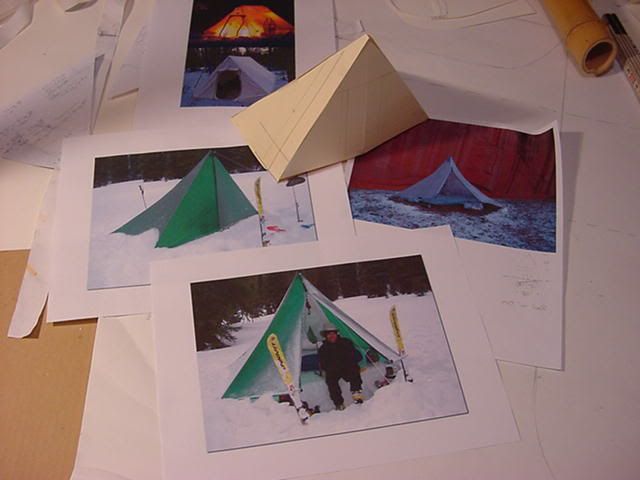
Personally, I just don’t think I could sleep inside a bivy. I’m aware of all the benefits… but I think I’ll stick with SpinnShelter alone for now. Plus that Nano bivy costs a small fortune anyway!!!!!!! Ouch!
Can a MYOG person do this without Cuben Material and stay at or very near the 7.5oz weight, cheap, maybe.
This morning I did another “what-if” and downsized the Alphamid Nano Tarp some more. I did the math for a smaller size. This one would be 3′ wide by 7′ across the front and back. It would also drop from 5.5′ high to 5′ high. The sq yards necessary for this size is (+/-) 6.18 sq yards. If I person could find some “true” 1oz or less weight waterproof spinnaker material a lot cheaper than say Cuben or other true 1oz stuff like SpinnTex that all cost in the $17 a yard range, you could still be at or under the 7.5oz mark of the Al..Nano Tarp BMW mentioned. You do have to be willing to go with a smaller footprint for this size.
I also took a look at the Stealth 1 NANO 7’x9′ tarp. It is $170 and has about 7 yards of fabric in it. This comes out to about $24 a sq yard and change. I have no reason to think this number means anything but those numbers would make an Alphamid NANO tarp at 6 to 10 sq yards cost $24 to $30 times the sq yards of the Alphmid or a total possible cost in the $160 to $240 range.
I have spent more than $24 an ounce to save an ounce before.
I am going to dig out all my “never used” so called 0.50 spinnaker material and re-weigh it. If any of it is near a true 1oz per sq yard I might try a smaller Alphmid Tarp out of some. If not then I add another project to my Cuben list.
Bill,
The pole length is 4.5′ and the length of the tarp is just over 7′. These dimensions were scaled using the height of the Ti windscreen as my baseline. Ryan wouldn’t cut down the windscreen to save a gram, would he?
Additionally I’m convinced this tarp doesn’t have a rectangular footprint like the alphamid.
FWIW,
Robert
Hi Robert, Lets play “Design an Alphamid Tarp.
Goals/Desires?
1. Big enough but no bigger than necessary.
2. Very light, 7.5 ounce range, or less which should be light enough to get the attention of all us gram counters.
3. Cost not a big problem but if a material that is cheaper than Cuben can be used go for it.
What do we think we know about the Alphamid Nano Tarp:
4. Made by Oware and modeled after their small Alphamid Tarp.
5. Oware’s small size is 4.5′ x 9′ x 5.5′.
6. Alphamid Nano Tarp color seems to be gray to transparent. Cuben/Nano material is transparent and the gray looking color could be from the background.
7. Size based on Roberts windscreen baseline idea seems to be just over 7′ long and 4.5′ high. Robert believes the tarp is not rectangular. I think the tarp is rectangular but maybe staked out in a way to distort the shape for a bit more room or to lift the edges to help vent the tarp when the front is closed.
Going with another size (3′ x 7′ and 4.5′ high) I come up with about 5.63 sq yards of material to make the Alphamid Tarp. Again this does not add material for seams etc and someone can re-check my math.
A 3′ x 7′ footprint is big enough for me and is the same size as the small winter tent I made a few years ago. My tent was 5′ high but 4′ would have been high enough to sit-up in.
Using Cuben fiber and making the tarp this smaller size, 5.63 sq yards, and using the 0.35 to 0.44 oz a sq yard product, the finished weight could be in the
(sit down) 3oz range (+/-) 0.5oz. The Cuben material at about $17 a yard would come out to $102 plus change. Add to this guy lines, stakes etc.
My next thought is I wonder how one of these would work on an AT Thru-Hike. It sure would be light and also be more private than a regular tarp.
Even made out of some of the very cheap spinnaker material available this size might still weigh less than 7.5oz.
Bill,
The reason I don’t believe the footprint is rectangular is in the picture of Ryan sitting in the door of the Alphamid you can see the short side wall on the left. The Escalante tarp from a similar angle shows no similar side wall, all I see is ridge line. I’m speculating the back half of the tarp may have clipped corners (footprint = half a hexagon) that would enhance its ability to shed wind.
I didn’t consider the camera angle in my earlier guestimate of the length. I’m going to go with a 8′ length.
I gotta go.
Robert

Hi all, some comments on the Alphamid Nano I took to Utah.
It is smaller than the standard Alphamid.
Note that the peak height is the height of the tarp when it’s pitched with the walls all the way to the ground. Raise the pole as much as you want to increase headroom, ventilation, etc.
We’ll also be doing a version with a noseeum mesh perimeter. This is the version I’ll be taking on my Arctic Trek. I’m working on a mesh door design so the front flaps can be staked outward, like in the photo, to create a psuedo-vestibule, while a mesh inner door can be completely zipped up for bug protection.
I was really happy with the performance of the tarp in Utah. We had snow and wind and staking the tarp to the ground, closing the door, and adding stakes for some of the wall perimeter guy out points (one in the rear, two on the sides) made it very stable. I think having the option of a full mesh perimeter with mesh door would provide wholesale element protection for three season use.
I’m very excited about this product. They should start shipping in 8 weeks or so.
bug mesh perimeter+bug mesh inner door = now I’m interested.
Are there ventilation options for the peak area beyond the entry zipper? If, not–do you feel that you get enough ventilation from use of the zipper and a raised perimeter to (at least partially) deal w/ condensation issues?
In cold, humid, still air, even a vent doesn’t do much. I’ve found peak vents to be useful when cooking in a tent that is completely sealed up, especially if the tent is breathable. However, I’ve used sil tents (Mandatory Gear Puppy Pile) with peak vents and they were worthless. It’s nothing to do with the vent design, it’s just that under some conditions, interior ventilation is not enough.
In cold, still, humid conditions you’re best bet is to raise the tarp a few inches and keep the doors open.
I put a beak in my regular Alphamid, because I was getting some condensation in it, especially in winter. The vent didn’t really change much.
Become a member to post in the forums.
 Brynje Mesh BaselayersBrynje baselayers use open mesh construction to move moisture away from the skin, create insulating air pockets, and help regulate body temperature across changing conditions and activity levels.
 © Beartooth Media Group Inc.
 Loading...
