


Newly update Big Agnes 3 Wire Bivy for 2010:
Topic
Become a member to post in the forums.
Newly update Big Agnes 3 Wire Bivy for 2010:
…
The 3 wire is more for:
-winter or cooler conditions
-areas where wind is an issue – i.e. mountaineering (low profile).
-adds warmth due to minimizing heat loss through convective forces thereby allowing a lighter sleep system. The Fly Creek would not do a great job in comparison as wind will find its way under the fly as it does not go down to the ground.
-fits into places that the Fly Creek wouldn't.
-better for tall folks – the Fly Creek is not kind to those over 6 foot tall.
And of course, awaking on a ridge during a sunrise and simply opening your eyes to see the sights….priceless (of course this can be done with much lighter bivvies.)
…

Aha! Good question.
It's true that a moist environment is warmer. Try a vapor barrier and you'll quickly see this fact. That is, until the insulation in your bag has lost loft because of moisture build up.
eVent is a full wind-block, so that's not an issue. And the warmth lost due to decreased moisture makes you warmer overall due to loft stability.
But I have found that eVent can feel colder and I now understand that this is due to the low moisture environment that's created.
Doug,
You just blew my mind. I thought more water in the air (humidity) made it feel colder. (Obviously not when it's warm, the humidity makes it feel warmer, hence Arizonians always shrugging off triple-digit temps with "but it's a DRY heat!"….) Is this not true?
Confused.
You just blew my mind. I thought more water in the air (humidity) made it feel colder.
I suppose YMMV but my experience is that condensing atmospheric moisture (fog/cloud, mist) will make me cooler but "mere" humidity always makes me warmer.
You just blew my mind. I thought more water in the air (humidity) made it feel colder. (Obviously not when it's warm, the humidity makes it feel warmer, hence Arizonians always shrugging off triple-digit temps with "but it's a DRY heat!"….) Is this not true?
Well, actually it's not the moisture that makes you feel cold, but the evaporation. That's why you feel cooler when you are sweating and there's a breeze, or why you don't feel cold in a bathroom after a shower until you open the door. When you trap the moisture and don't allow it to evaporate you feel warmer. Wetsuits work on this principle and since water is a better insulator than air, wetsuits keep you warmer in cold water. It's also why a thick 300 weight polarfleece jacket in which you are sweating will feel colder in a wind than a thinner base layer with windbreaker.
Think of a Gore-tex jacket on a cold rainy day and why it is hot, not cold.
And the same principle works with heat… muggy weather feels much hotter because you can't get the necessary cooling evaporation, whereas in dry heat you can. Again, water is a better insulator than air, so it always feels more unbearably hot in humid places like Florida and Indonesia, than in Arizona and the Sahara.
Branching off the original poster's topic.
Still air is a much better insulator than water. Stated another way, water conducts much more heat than still air. This is why someone surrounded by cold water becomes hyperthermic much quicker than someone surrounded by air of the same same temperature., assuming a nekkid body in both cases. A wetsuit reduces the effect of the cold water by adding insulation that remains effective when immersed in water.
Water has a 25 times higher thermal conductivity than air. Source: the table from http://en.wikipedia.org/wiki/Thermal_conductivity
Also, the following quotations are from:
Heat transfer phenomena in fibrous insulating materials
ANASTASIOS KARAMANOS, AGIS PAPADOPOULOS1, DIMITRIOS ANASTASELLOS Laboratory of Heat Transfer and Environmental Engineering, Department of Mechanical Engineering Aristotle University Thessaloniki, GR-54124 Thessaloniki, GREECE 1e-mail address: agis@eng.auth.gr, Laboratory’s URL: http://aix.meng.auth.gr
found at:
http://www.fibran.gr/sappek/docs/publications/article_6.pdf
"Dry and firm air, when not moving and in small quantities, has the lowest thermal conductivity factor (approximately λ = 0,024 W/mK) over a wide range of temperatures." [Paragraph 1]
"On the other hand, water’s thermal conductivity is significantly greater than air’s (at 20oC, kwater = 0.604 W/(m2K))." [Paragraph 3.2]
I stand corrected! Well, there goes that theory!
Still, I would think it is evaporation and not moisture itself that causes people to feel cold, no?

No, it's moisture that makes feel people cold. Feel the sweat on your skin after an exercise and you will feel that it is cold. It is a way to cool the body. But evaporation is just a proces that is much more efficient. Just what is evaporation. It's the transition from water in a liquid phase to water in a gaseous fase. This transition is an endogeneous proces which needs a lot of heat which is taken from the closest heat source, the body. That's why they speak of latent heat of evaporation. Because the temperature stays the same but there is a transfer in heat. Much more heat than you would loose by that layer of sweat as a liquid. Exactly what you want.
Don't forget, evaporation is a means developed by the body to get rid of excess warmth. When you're active, you're body produces warmth. Too much warmth because you're body can only function properly in a very narrow range from more or less 35,5°C tot 38°C. If you couldn't sweat, you're body would easily overheat. That's the problem in hot, humid weather. It's too warm for your body to function properly so you sweat but since the air contains all the moisture it can, there's no place to where sweat can evaporate.
What you do in a wetsuit is a different thing. You allow the water to take the temperature of the body and by allowing only a limited transfer between the water against the body and the water outside, you can keep your body relatively comfortable. A still layer of air against the body would be better, but imagine you're under water, the density of air is a lot less than water and if your suit wouldn't be airtight, the warm air would easily escape. Further, wetsuits are only used when the water is relatively cold. When the water is really cold, divers use a dry suit and I guess the name says enough.
Yes it's true than an airtight windbreker could feel warmer than a thick fleecejacket by not slowing down evaporation. But imagine you wet both jacket with a predetermined amount of moisture. Wouldn't it be reasonable to believe that the fleece jacket will keep you warmer because it is able to keep more air pockets than the windbreker is able to.
Yes, a gore-tex jacket will slow down evaporation making it warmer in the beginning, but that excess heat makes your body warmer, enhancing further sweating and evaporation which can't get away because the gore-tex blocks it. Two things happen: 1) liquid sweat remains sweat 2) the air can't contain any more moisture and the excess moisture condenses against a cooler surface. Condensation is an exogeneous proces by which the latent heat of evaporation (or condensation) is released again. Because it is no longer latent, it does change the temperature making you feel warmer, driving sweat production to cool the body, etc … The result is a lot of moisture build up in your system which starts to cool you because moisture is an excellent conductor of heat and because it diminishes the insulating air pockets that are all present in your clothing system. Exactly the reason why eVENT is such a succes. Yes it allows better evaporation and thus transfer of excess heat (which should make you feel cooler) but in the first place it allows you to remain dry which prevents you from getting cold.
It's the same reason why in freezing temperatures it's better to wear a highly breathable system than a rain jacket: evaporation helps you to get the moisture out of your system instead of wetting everything and making you feel cold.
Tom, thanks for that excellent explanation, it helps me understand the whole process better (in laymen’s terms)
That's the problem in hot, humid weather. It's too warm for your body to function properly so you sweat but since the air contains all the moisture it can, there's no place to where sweat can evaporate.
Tom, thanks for the explanation. I think there are a number of places where you contradict yourself after your initial statement that moisture is the cause of cooling and not evaporation, (such as the example above), but I think I understand what you were trying to convey. So it is water's conductivity that causes the cooling? Or is it also evaporation? As I reason it out from your example of the 300 weight fleece jacket compared to a baselayer/ windjacket combination, when the two systems are wetted out with the same source of water then it is the conductivity of the water which makes the baselayer/ windjacket combination cooler, since, as you stated, air is a poorer conductor than water.
I always found eVent to be too cold for me to wear in the rain. My Montane Superfly Jacket has been relegated to the closet because there have been several times in the mountains when I've worn it and began to shiver badly from the cold, but I would immediately warm up if I exchanged it for my windbreaker. I've even tried to replenish the DWR on the outside and washed the garment in Nikwax waterproofing and gently ironed the material to try and bring back the waterproofness (though I was always dry inside), but nothing worked. So there is one doubter here of the effectiveness of eVent. (I also dislike Gore-tex. Give me the Paramo system over all the others)
Miguel,
it just depends. You have to look at conduction and evaporation as just two of the modi by which heat transfer (cooling)can take place. A dead body (in physical terms) just has conduction, convection and radiation. A living body (as a human) adds evaporation.
Do I contradict myself? Possible, I am not sure. It happens when you write something long.
When you sweat you get a layer of water on your skin. Then it all depends on what the temperature of the water is. If it's colder than a human body then there is that thermophisical dogma that says there's heat transfer from the place with the highest temperature to the place with the lowest temperature untill equilibrium is being reached. The equilibrium is of course important. With equilibrium, there's no heatgradient anymore and as such no heat transfer. It's not that you sweat moisture from 32°F.It's already pretty close to skin temperature. That's also why the cooling potential of that sweat is pretty limited. But it has a cooling potential.
That eVENT is certainly not for everybody is a fact. My wife seems to need a windproof and warm jacket when I feel fine just wearing a thin shirt. Humans differ.
When the weather changes rapidly from a rainstorm into nice weather, it happens that I feel my sweat condensing on the inside of my paclite jacket because the pace at which I sweat is higher than the breathability rate of the jacket. The condensation in itself makes me wet, clammy, cold and thus uncomfortable.
Become a member to post in the forums.
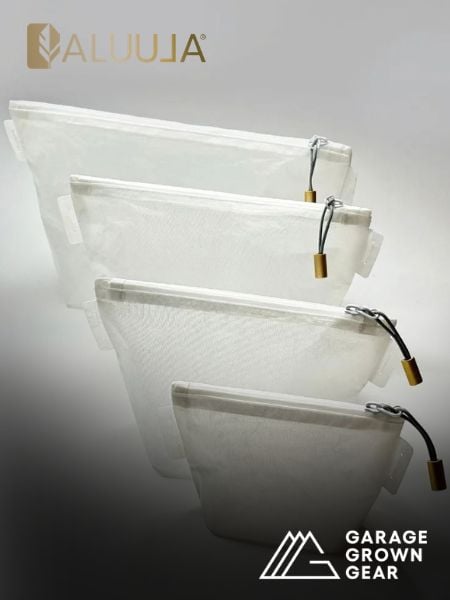 New Gear with Aluula FabricsLighter, stronger, more abrasion-resistant, and highly water-resistant - explore ultralight backpacking gear made with ALUULA Graflyte fabrics. Engineered for exceptional strength, durability, and lightweight performance, ALUULA Graflyte helps reduce pack weight without sacrificing reliability, making it ideal for demanding backcountry adventures.
 © Beartooth Media Group Inc.
 Loading...