Topic

Most efficient gravity filter system – need market update

  • This topic is empty.
Viewing 25 posts - 51 through 75 (of 177 total)
PostedJun 11, 2009 at 9:08 am

Martin,

My writing communication skills have failed me again!

What I meant by the scoop methods was not using a separate scoop to fill your platy but to use the platy its self in a scooping motion when filling it up.

This seems totally obvious but, I've seen people try to dunk the whole thing up and down and get frustrated at how the sidewalls tend to collapse on them selves and not it full all the way. If You have a big zip platy (like I do) I think its easiest just to open up the mouth and skim it horizontally over the surface of the water. Usually one sweeping/skimming/scooping motion will fill the whole bag.

If I really need a separate scoop to fill up from a tiny creek or puddle then I'll just use my mug or cook pot and let it dry out thoroughly before use.

Ah the powers of misscommunication on the internet… :)

Ian David

PostedJun 11, 2009 at 9:35 am

Tony,

I am curious about your water bag from antigravity gear. From the picture, it doesn't seem designed as a dirty bag, just a bag to haul water. Did you add a hole in the bottom? How do you ensure that the water doesn't leak and goes into your tubing?

The dirty bladder in the Clean Stream system is the best I've seen yet. It has a quick release valve where you can release the dirty tubing from the bag to pause the flow. It is open on the top, so it easier to collect water. It has handles, too. For 3 oz I think it is worth it. The problem with using a regular big-zip hydration bladder is this: You have to invert the bladder (so the output is on top), connect your dirty tubing, hoping the water doesn't spill out the zippered side, and all that. With the Clean Stream, you can start and stop the flow at will. This matters when you are filling multiple clean hydration bags.

I think I will buy the bags from the Clean Stream system if I decide to use the Sawyer filter for my trip.

Regarding the water scoop, I think even with the open zippered bags, it helps to have a scoop to get the bag to full capacity. Also, you could keep adding water while the filtration process is going on. This helps for a group situation. BTW, a Kroger water bottle with the top cut off weighs in the neighborhood of 0.3 oz.

PostedJun 11, 2009 at 1:38 pm

This is the first time I have heard of the Triton water filters from Prismedical Corp. They have an interesting set up. The only disadvantage I see in their set up is that you have a wait time of 15-30 minutes for the viruses. Some people have said in this thread that they have a virul module but I don't see that on their website. They have a virul solution with the wait time.

I think you could use the Triton MC carbon module (under 3 oz.) with a Seychelle inline filter advanced (.3 lbs). This set up would appear to have all the advantages of the Triton M3 multipurpose plus virul elimination without the wait time. The Seychelle inline filter advanced supposedly has a iodinated resin component in it so you wouldn't need that component from the Triton M3 Multipurpose. I don't know what the flow rate of this set up would be. The Seychelle inline filter advanced may already have activated carbon in it in which case you wouldn't even need the Triton MC carbon module. I cannot gather from the Seychelle website weather or not their inline filter advanced has activated carbon in it. Though it does say it is suppose to improve the aesthetics of the water, i.e., taste, odor, silt, etc. and under their FAQ page their is a question about activated carbon filters which I presume is about their own filters.

You could also probably use the Triton MC carbon module, the Triton resin module ( presuming the resin module has a hose link on the output end, the MC has an input and output hose end) with a Sawyer inline purifier. This would seem to be a complete lightweight purification system as well.

The Seychelle inline filter advanced may be a complete purification system on its own which they propose it is ("The only personal water filtration system capable of up to 99.99% reduction in all four areas of contamination!
Aesthetic, Microbiological,Chemical,Dissolved Solids").
It has the resin component, possibly the carbon component (I'll have to give them a call about this), and the filter component to remove bacteria, protozoa, and viruses. Anybody have experience with the Seychelle inline filter advanced? The flow rate?

Happy hiking, Rich

PostedJun 11, 2009 at 1:47 pm

The Seychelle filters do possess activated carbon in them. I just read that off their website "The high-tech porous plastic micro-filter is impregnated with both the finest granulated activated coconut Carbon available and Seychelle's exclusive adsorbing media for superior analyte removal capability." Somehow I missed this.

Ken Larson BPL Member
PostedJun 13, 2009 at 7:48 am

I use the ULA Amigo gravity bag with the Sawyer SP125 PURIFIER (removes viruses) into a soft sided Nalgene also and I'm wondering if you have measured the flow rate in seconds that it take to fill a 1 liter container?

This info might be of interest to you and others. I conducted several tests with the gravity bag and the Sawyer SP125 PURIFIER. ALL tests were conducted with untreated tap water, with a sample size of three in number for each trial.

FINDINGS:
Sawyer SP125 PURIFIER averaged 226.7 sec WITHOUT my internal pelon (type of sewing material prefilter; 286.7 sec WITH my internal pelon (type of sewing material prefilter.

Robert Richey BPL Member
PostedJun 28, 2009 at 8:17 pm

I experienced rapid slowing with the Frontier Pro as a gravity filter after the first day of use. I then added the bite valve, sucked a drink, and it worked as quickly as before. This was on a short trip, but so far it has worked every time.

PostedJun 29, 2009 at 1:33 pm

I used a frontier pro with a platy big zip on a recent 5 day trip in the smokies. Drove me nuts. I drink like a mule and it was hot, me and the Mrs. were going through 4 liters+ a day. Darn thing clogged every time. I did learn a trick. I had a 2 liter platy as my clean bottle, so whenever it jammed I squeezed the clean bottle and forced air and or water back into the dirty bottle. Sort of ghetto back-flushing. I did notice that as the trip went on the water tasted more and more like the micropur tabs I was using for "the small stuff".

Did I break it??? Don't know. I didn't get montezuma's revenge, but the water might have been fine.

Should the carbon remove the chem taste?

PostedJun 29, 2009 at 1:59 pm

I haven't used my frontier pro very much yet, but when you are using it in gravity mode the closure for the clean bottle needs to be left open. For Example, when I use the evernew 2 liter, the closure cap is left open with the hose running down in the bottle. If I were to tighten the closure cap then the gravity feed takes forever. Ya'll may already be doing this, but I just wanted to mention it just in case. I have only filtered maybe 10L of water through mine in gravity mode but so far so good. If I need to post a picture of what I was talking about I can do that too.

PostedJun 29, 2009 at 3:28 pm

Tony Wong:
"I simply prime the filter by sucking on the output end of the filter to start the process.

Now, I have read that the Purifier version of the Sawyer filter that removes virus need to be primed and that you can not do that in the field easily."

Ok now I'm confused because I can only find the Sawyer Inline Water Filter here: http://www.rei.com/product/778041 and it says it does filter out virus, you are saying that it does not? Or are you saying that this one needs tap primed?

PostedJul 1, 2009 at 10:09 am

Used the system outlined by Jason, but replaced the FrontierPro filter with the heavier, but more efficient MSR (same as Platy filter?) gravity filter unit. From mid April to mid May on a daily and sometimes twice daily use filtered 2-3L of clear water. Filter did slow up a bit, but not enough to be a problem. MSR claims ~1500L capacity. Time will tell.

Virus risk required treatment with the mUV or chlorine dioxide tablets. Tablets might also have keep the dirty water bag, filter & tubing from building up funky junk.

Katdyn makes an inline charcoal holder. Hauled it along, but never used it. Total weight of everything probably exceeded 11 oz.

PostedJul 1, 2009 at 1:14 pm

Gary Boyd wrote: "Ok now I'm confused because I can only find the Sawyer Inline Water Filter here: http://www.rei.com/product/778041 and it says it does filter out virus, you are saying that it does not? Or are you saying that this one needs tap primed?"
This filter does not filter out virus –'removes particles, protozoa, and bacteria down to 0.1 micron' This one does NOT need to be tap primed.

This one filters out virus (0.02 micron) and requires priming with pressure from a tap:
http://www.rei.com/product/781792
It's heavier and more expensive.

Ryan Teale BPL Member
PostedJul 15, 2009 at 11:18 am

Ran across this product which I hadn't seen before.

http://www.rei.com/product/782415

An interesting solution for improving taste of water. Weighs 1.6oz but only works with wide mouth bottles. Replaceable activated carbon pouches with a service life of 100 liters.

Tony Wong BPL Member
PostedJul 19, 2009 at 11:51 pm

I recently finished using the Sawyer inline filter for 9 days on the 168 mile Tahoe Rim Trail.

On that trip, I did have a big decrease in the rate of flow in filtration and had to back wash the filter in the field to clear it.

It took a surprising amount of force/pressure to do it, but once I did it worked just like brand new.

I have updated my User Review of the Sawyer Filter to fully describe that I did and suggestions on how to easily and more regularly back wash the filter in the field.

I did go about 6 days before needing to backwash the filter.

Hope my experience gives people a better understanding of the benefits and limitations of this system.

I would still recommend the filter and I have no plans on switching off this system.

In fact, because of the confidence that I have in this system, I changed my kit and removed carrying 1.0 oz of Aquamira drops as backup and carry just a few Chlorine-Dioxide tables for an emergency backup in the event I managed to damage the filter by crushing or cracking it.

-Tony

PostedJul 20, 2009 at 7:17 am

Tony

That's good to hear that you haven't died yet from drinking water filtered with the Sawyer Pro. Perhaps you can continue to be our test subject… :)

I have a question about backflushing: In your review, you mentioned that you rolled up your clean hydration reservoir to backflush. Did you fill it with air or fill it partially with clean water to backflush? How much water did you force back into the dirty side?

Tony Wong BPL Member
PostedJul 20, 2009 at 10:14 am

David,

Happy to be the test subject….besides, I think that my wife wants to collect on my life insurance and have a pool boy. (Might explain why she is happy to see me hit the trail with my friends…hehehehe).

I used my 1.8 L Platypus Hoser hydration system/bag as a catch bag for the clean water.

It was only about half full and no air to little air.

If there was air in the clean bag, I did not have air going into the filter….water only.

To build up pressure, I simply rolled the bottom of it up and was squeezing it by rolling it up to force the water back through the filter. Water was pushed first…any air was at the "back" of the roll towards me to avoid pushing air though the filter.

It felt like a long time….30 seconds (???) of squeezing or so before I felt and saw clean water flowing from my clean bag into the dirty bag.

The dirty water was very clear and not full of debris, so I could see a column of water slowly shooting back into the dirty bag.

It did not actually require a lot of water to back flush the filter.

Given that the "pores" on the hollow tubes must have been blocked up, I just need to blow them open/clear and the resulting improvement in flow/filter rate was immediately clear.

In gravity filter mode, I went from a trickle to a rapid/normal rate of flow.

Think that I pushed maybe less than 1 cup of water through the filter to clear it.

Using the pint bottle method on the trial, I was able to back wash the filter with just a small mouthful of water.

Hope this helps….your humble test subject.

-Tony

PostedJul 20, 2009 at 1:23 pm

I backflushed a frontier pro almost exactly the same way, with water and air squeezed from a platy (no platypuses were harmed in the making of this post). i even flushed it with just air and it worked. Did i break it? No way to tell huh?

PostedJul 20, 2009 at 2:20 pm

Tony

The manual on the Sawyer filter is rather ambiguous. I got the one from REI with the faucet hose attachment so you can backflush at home. If I remember correctly, it says NOT to reverse the flow of water in the field. However, perhaps what they really mean is not to do the obvious: don't attach the clean tubing to the dirty side and vice-versa. Have you tried contacting Sawyer about field-backflushing?

One more question: How long did you use the filter before the flow rate began to slow down? I'm thinking that if I use the facucet kit after each 5-day trip, I should be OK, no?

Tony Wong BPL Member
PostedJul 20, 2009 at 3:55 pm

David,

I have had my filter for so long, I don't even know if I still have the instructions on the filter anymore….going off my memory of what I recalling what it said.

I have not contacted Sawyer before regarding how to clean it.

As for not clean it in the field, not being able to would seem silly to me….if you can do it at home why not in the field???

Unless you did not have any clean water to perform the bashwashing in the field…that would be the only reason not to backwash in the field that I can think of.

I backwash after every trip….even if it was an overnighter. (I am anal about my gear).

I used the filter for about 5 to 6 days before I was reduced to a trickle of flow on the filter. 30-20 Liters filtered.

The water that I was using was clear and often did not have debris in it.

To me, the issue of when to backwash and reduced rate of flow through the filter is going to be based on the quality of the water that you are dealing with.

I have yet to filter mud water, which would seem to me the death of any filter.

-Tony

Joe Vigil BPL Member
PostedJul 21, 2009 at 7:11 am

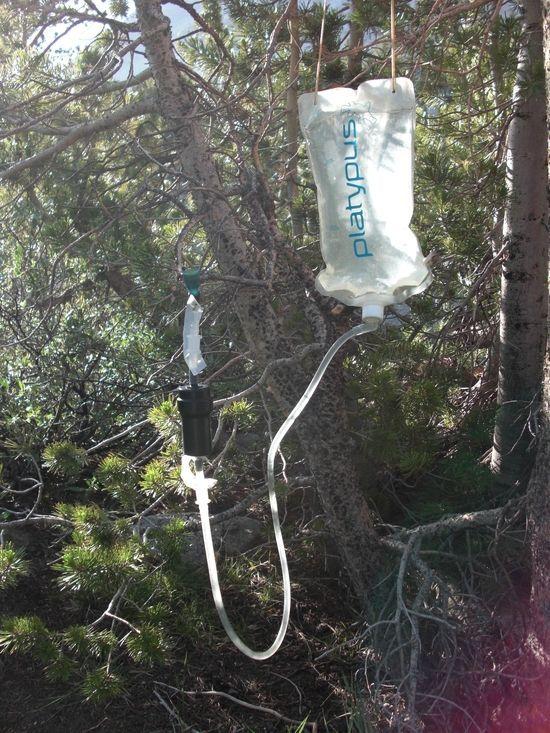
Here's a shot of my Sawyer setup:The whole Sawyer setup

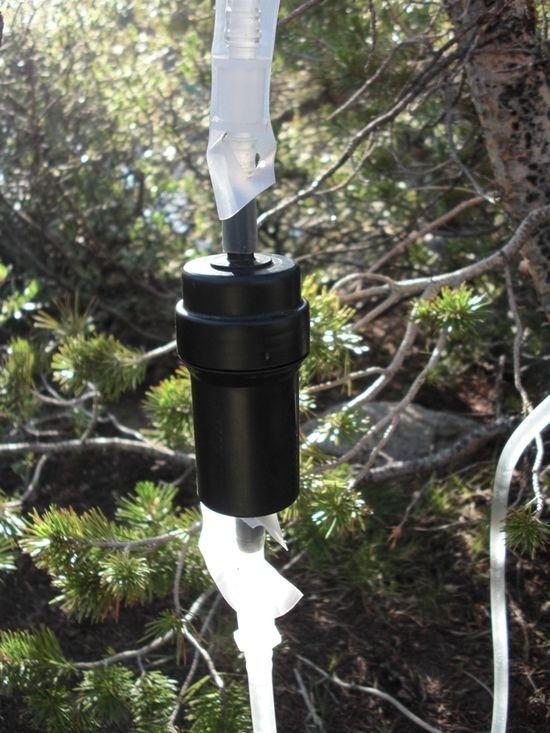
Here's just the Sawyer:Just the Sawyer

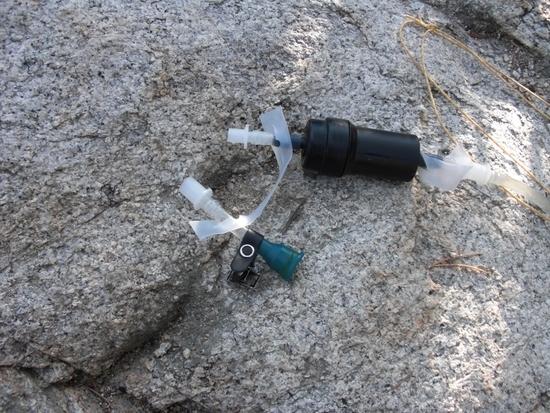
Here's a closeup of the quick disconnects I used:quick disconnect

I got the quick disconnects here: http://www.amazon.com/QUICK-DISCONNECTS-~-6-9mm/dp/B001D8T928/ref=sr_1_9?ie=UTF8&s=industrial&qid=1244814430&sr=1-9

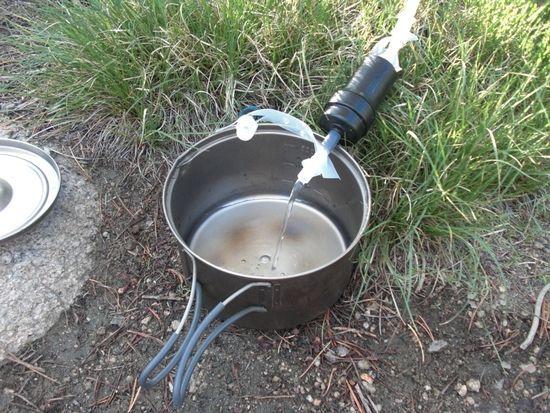
Here's it in action:Closeup in action

The plastic lanyards were made from the plastic used to hold six-packs of apple juice.
This setup gives me the best of both worlds. On the trail, I can quickly fill the Platypus, attach, and use the bite valve to suck the water through the filter. At camp, I hang it on a tree. My only concern was the quick disconnects; they rely on friction to stay closed. Cascade Designs also sells a quick disconnect: http://cascadedesigns.com/platypus/platy-accessories/quick-disconnect-kit/product

The flow rate is about 1 1/2 minutes per liter. My hiking is in the Sierras; the water already tastes good.

What do you think?

– JV

Tony Wong BPL Member
PostedJul 21, 2009 at 10:06 am

Joe,

Thanks for taking the time to post up your detailed photos of your Sawyer setup.

I like the quick disconnects.

You are getting a faster rate of flow from your setup since you have all that tubing between the dirty bag and the filter….I only have about 2 inches of tubing, which makes mine slower.

Great to see how people have setup their gravity filters.

If anyone has any photos of their gravity filter setup, please post them up and share.

It is the little differences that helps everyone else refine their own setup.

-Tony

PostedNov 24, 2009 at 6:23 am

sawyer and katadyn combination

This is my filter setup. I made it by piecing together parts from different hydration systems. It starts with a blue Platypus screw cap adapter that screws onto any Platypus bag. I have a couple of Platy bags reserved for dirty water so I can collect 6 liters at a time for filtering.

Then comes 5 or six feet of hose (the longer the hose, the more pressure you can have at the filter) which connect to a Sawyer 0.1 micron filter followed by a Katadyn charcoal filter which removes a lot of different chemicals including chlorine which I usually add to the dirty water to kill viruses. Next in line is a Platypus valve; not essential I guess, but it minimizes spillage. The last thing is a quick disconnect fitting that mates with our Nalgene hydration bladders.

It's very convenient. Hang the dirty bag, snap the other end into the Nalgene bladder, open the valve, go do something else, return to find a full hydration bladder.

Travis L BPL Member
PostedDec 2, 2009 at 2:29 pm

Experimenting with gravity filter

I just started fooling around with this today. Sorry for the crappy photo. I'm using a 32 oz nalgene widemouth canteen. I took the filter cartridge from the Katadyn Hiker Pro and stuck it in the mouth of the Nalgene. PERFECT fit! With the canteen full, and about 3 feet of hose, it will filter a liter of water in under 2 minutes. Now, there are some obvious caveats. Its difficult or impossible to hang because 1. there are no holes to attach a rope to. 2. though the filter cartridge fits very well and forms a good seal, it will come out very easily when held upside down to filter, so you kind of have to hold it there for a minute or two while filtering-or more depending on how much water you need. Water with junk in it will most likely filter slower. I'm gonna play with this a bit and see if I can improve on things. Dry it weighs about 6.5 ounces.

Oh, also: when it is inverted to filter, as long as you hold the cartridge lightly in place, there is no to very little leakage because the filter cartridge's O-ring forms a pretty good seal. A few drops at most. Just don't let it drop into the clean water!

Robert Blean BPL Member
PostedFeb 15, 2010 at 8:27 pm

Most discussion of making an inline filter setup talks of using the Sawyer filter. Why does the Sawyer seem to be the overwhelming favorite? How does using the Sawyer compare to using one of the alternatives, such as the Platypus Clean Stream filter or the MSR AutoFlow filter?

Functionally, all of these seem a lot alike. I'm not sure of the weights. Filtration seems comparable — 0.1 micron for the Sawyer, and 0.2 micron for the other two.

Prices — Sawyer is in the middle of these:
* MSR $26 @ Amazon
* Sawyer $34 @ Walmart
* Platy $40 @ Amazon

How do other inline filters with a comparable pore size compare to these three?

For that matter, how do the MSR and the Platypus filters compare? They look a lot alike (other than color) and are spec'd a lot alike.

— MV

Tony Wong BPL Member
PostedFeb 15, 2010 at 9:52 pm

Robert,

From what I can tell, all three are using the same hollow tube technology.

I think that MSR and Platypus are owned by the same company.

Both gravity filters systems are really identical, except for color, which you noted.

Why the Sawyer over the other two?

In my case, neither the MSR or Platypus gravity filters were for sale when I built my gravity filter, using Platypus parts and the sawyer inline filter.

What I have found is that by using the Sawyer filter, I have been able to save weight on the all the other associated parts, such as the dirty water back and clean water bag.

Initially, I found that both the MSR and Platypus systems were "heavy" over all.

For me, I found that I was able to get "dual" use out of my Platypus Hoser 1.8 L Hyrdation system by also using it as my clean water bag.

Even if I did not use a gravity filter system, I would still take my 4L Platypus water tank for having water in camp or for dry stretching of the trail. My dual use for this is that the water tank is my dirty water bag.

So the "weight penalty" for using a filter is about 3.5 ounces.

Something like 2.0-2.5 for the Sawyer filter, 0.5 oz for the Playtpus filter link, and a 1.0 oz disposable 1 pint bottle, which I use for scooping up dirty water on the trail and then connecting the filter link and Sawyer filter to the bottle, which allows me to use it like a Frontier Pro filter on the trail without the need for pulling out the whole gravity filter system while hiking.

Not sure about the pore size of the filters, but I am pretty sure that with the exception of the Sawyer inline filter that is designed to filter out viruses, they are all the same size as they are using the same technology.

Per the Sawyer website, it filters something like 99.999999%, which seems like a winner in my book.

Sorry that I am a little sloppy on my stats, but I haven been using this setup for so long without fail that I use trust it.

Anyway, I have a detailed review of the Sawyer system that I use on the user review area with plenty of photos to show how I use my setup in camp and on the trail.

Hope this helps.

-Tony

Viewing 25 posts - 51 through 75 (of 177 total)
Loading...