Topic

When do you leave your tarp at home?

  • This topic is empty.
Viewing 25 posts - 1 through 25 (of 28 total)
PostedJan 25, 2006 at 7:39 am

Fellow ultralighters,

I was wondering if you always take your tarps with you. Do you sometime prefer to leave the tarp at home? Substitute the tarp for a tent? Go for a bivy? Keep going without sleep?

I speak about late autumn / summer / early autumn without snow. Snow camping is a different story.

Do you take a tarp whatever the conditions? Whatever the elevation and weather? It seems people like Ryan tarp above tree-line without hesitation.

As a photographer, I admit to choose a camp site for aesthetic reasons. I prefer the great views from the ridgeline and the space of tundra at above 2 500 m (8 200 feet) in the French and Swiss Alps… Rain, wind and clouds compensate by terrific shots. However, in that kind of weather, when it’s difficult to stay upright in the wind and a poncho is blown away by sleet, I opt for an aerodynamic and amphibious eVENT bivy.

Is the weather different in the US (non-Alaska) mountains compared to the Alps? Mountains are mountains or not?

How about terrain? Smooth rock polished by the glacier above? A rock plateau reached by easy climbing? Or do you mostly encounter some soil to stick the 10 stakes into?

ANATOLY IVANOV PHOTOGRAPHY / DESIGN

PostedJan 25, 2006 at 8:19 am

Anatoly,
I use a poncho as shelter/tarp, and always carry it – as my only shelter.

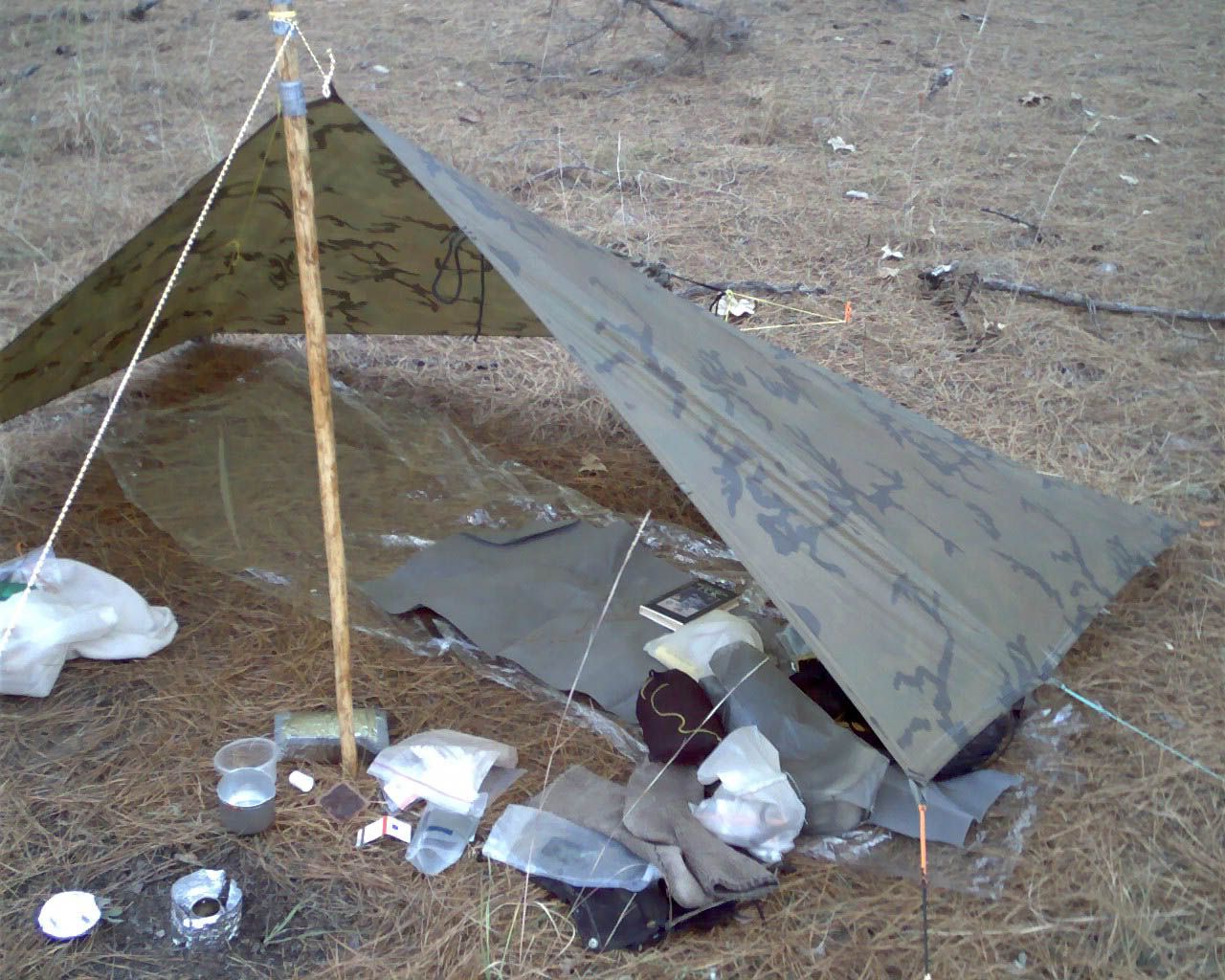
There are many ways to set up a poncho to handle the wind. Here’s one:
Image hosting by Photobucket
This is my typical sloppy campsite. One long edge of the poncho is staked to the ground, the center of the other edge is tied to the pole and staked out. This forms a tight triangle. Then the other edges are staked out as conditions dictate. For example, you can stake the ends at the center (the green line in the photo) and fold the corners toward the center to make partial flaps for the front (not shown here). You can tie a line to the hood and use it as a pull-out point to increase interior volume, decrease flapping and absorb some of the wind loading. Or as illustrated (yellow line to orange stake), you can loop a single line from the hood to the stake and back to the center pullout on the hem. That lifts the center part of the hem (for more ventillation when needed) and provides interior volume.

PostedJan 25, 2006 at 2:27 pm

Anatoly,

I take my tarp almost all year, I sometimes will switch to a floorless tent when I expect heavy snow, but I have survived under a tarp even during high wind snow storms dropping a foot of snow or more.

tarps are great, if you use enough guylines they are even more wind resistant and storm worthy than tents, I have heard alot of stories about people with tarps having to share their space with others because their tents fell down in heavy rain.

PostedJan 26, 2006 at 5:51 am

Anatoly,

I think the key difference between America and Europe is that western Eu has no real wilderness. As far as sleeping out goes, this means you have to do it high in the mountains or else you’ll be hearing the vehicles in the next road or the tv set from the last house in the upper section of the next village. When hiking in North America, I’ve always felt it was no problem to find a sheltered spot down in the valley of whatever route for that bad weather spell. In Europe I usually find myself having to camp in exposed locations if I want to be any far from civilization.
I also think (limited experience still talking here) it takes time and an adaptation process to get used to face harsh weather in a tarp. I’m still at it. I think your mind needs you go through it to actually believe it no matter how much you read about it and Europe makes this process so much difficult as there’s usually a way out. When the weather gets ugly and you have the option to sleep in a hut or even get to a village without even compromising your trip it’s difficult to say no. You need to be highly motivated. In a real wilderness, many hours or even days away from civilization you have no other option so you see it as a natural thing to do. It’s entirely psychological but it makes a difference in that learning process, or that’s what I think at least.

PostedJan 26, 2006 at 8:48 am

Inaki is absolutely right about backpacking in Europe. The infrastructure here is so dense my main problem is to find a place to sleep that is not on someone’s private lawn. Sometimes you can’t, so you ask: “Excuse me, can I sleep on your lawn?”

Even high in the Alps, you can’t walk more than 5km before seeing a restaurant and a hut. With a handy jeep taxi for tired hikers. Argh…

Even with a Vapor Trail / Virga sized pack, people look at me like at a crazy man. Most take an apple, a bottle of water and a fleece in an Eastpak. Sleeping out is considered extreme!

The solution is to know hidden valleys and trails as high as possible and as far as possible from civilization. And even then, I prefer my bivy to hide away.

ANATOLY IVANOV PHOTOGRAPHY / DESIGN

PostedJan 26, 2006 at 8:49 am

I use a tarp at lower altitude. What interests me is the less obvious use of tarps. I figured what makes tarp use less obvious includes user skill, inclement conditions, rock without soil, stealth and maybe some other factors I do not know. Bugs and warmth are easily addressed and do not count as factors.

So first, I would like to find out what are these other factors that I do not know. If any.

Second, I would like to hear your opinions on the factors I do know. Are they really limiting?

Concerning the factor of skill, it is absolutely limiting. You can’t pitch a tarp if you don’t know how to.

Concerning the factor of weather, I speak about “normal really bad mountain weather quite often encountered in late spring, summer and early autumn”. A hurricane is a hurricane.

Unfortunately, my experience is currently limited to the Alps and the Tian Shan range. I have never seen, talked or read about any tarp user in the Alps. Seeing someone use a tent is a rarity! The majority sleeps in huts and hotels.

It would be a lot easier to hear a local backpacker say: “Yeah, I was in the Valais at 3 500 m (11 500 ft) the last night when the storm broke up and lasted the whole night and morning, and my tarp was perfectly ok and I was perfectly dry and comfy.” But the sad reality is that in France, ultralight backpacking lingers in embryonic form.

So my only source of information is people somewhere in some mountains on some other continent. I have heard opinions saying weather in the Alps is worse than in the American mountains (excluding Alaska and Canada), trails in the Alps are steeper and more exposed, climbing Alps is more serious (again excluding Alaska and Canada), etc., but I have not verified, for now, by myself.

Hence my question about similarities and differences of weather. If conditions are the same, I can apply any idea from an American mountain backpacker straight to the Alps context.

What puzzles me about the factor of weather is the general communication about tarp use. When reading posts, reviews and articles, including those on BackpackingLight.com, I get the feeling most people tend to say tarps have limits.

Some seem to say that used by a skilled and experienced user, tarps do not have limits. What’s the consensus?

If the consensus is tarps can be used in any weather a 4 season tent can withstand (except heavy snow loading) and the only limiting factor is the user’s experience and skill, we should change the way we talk about tarps.

In any case, I prefer to confirm things by myself. I plan to torture my tarp as much as I can this summer, just for fun. But I am very interested in other people’s experiences and ideas.

ANATOLY IVANOV PHOTOGRAPHY / DESIGN

PostedJan 26, 2006 at 10:05 am

I can relate to what you feel about that certain difficulty to apply others’ experiences when those are from a different environment. It’s a pity UL is not so much talked about in Europe but it’s clear why: people don’t actually need to be self dependent in the mountains. UL actually means going without (and using the infraestructures). Why bother with a tent and stove when you can spend the night under a roof and a stuffed table… most people don’t see why. Most people focus on climbing peaks or highly technical stuff, not many care for the simple joy of spending the night on your own in a beautiful spot. It’s just the way things are in Europe.
Still, there are people who enjoy the closer relation to nature the self-dependance brings. And from there to UL thinking is just a matter of time (and finding the right resources). In France, you may know these people:
http://www.randonner-leger.org
Not at BPL level but they talk UL language for sure.

I’m actually very interested in this issue of tarps limits. I’ve seen too many contradictory opinions on this, probably because it’s quite a subjective thing… some just want to make it through the night alive, some need to be confortable… conditions of use vary and not everybody makes theirs clear enough when giving opinions.

Without actual good first hand knowledge, I’m sure in the US lower 48 mountains you can find conditions as harsh as anything in the Alps, at least from a 3 season backpacking perspective. I don’t think that’s a relevant factor about tarp use anyway.

PostedJan 26, 2006 at 11:45 am

I do most of my hiking in Europe and have for some years now, even though I live in the United States. The reason is that I really like the idea of camping wild but eating at nice restaurants and being able to buy gourmet grocery food every few days, and that just isn’t possible on the American long-distance trails. A tarp is perfectly possible in the Alps, even in windy conditions, provided you pitch it close to the ground. Ray Jardine speaks of using tarps on the exposed continental divide in the United States during gale conditions, which is about as severe a test as can be imagined. I should note there that the Colorado Rockies have Alpine type weather, with ferocious thunderstorms and snow possible at any time of year, whereas the Sierras, which is what many people think of as typical American mountains, have exceptionally mild weather during the summer.

The problem with tents in the Alps and Pyrenees is that you usually need a sizeable spot of flat ground in order to pitch them properly, and often there just aren’t that many such places. So everyone ends up crowded together in the same place. With a tarp or bivy, you just need a tiny piece of ground big enough for a single person to lie on and the rest of the ground underneath the tarp can be very uneven. This allows you to camp away from the crowds. Not that I’m completely unsociable, but I do like a bit of privacy at night.

Small tarps with a catenary cut pitched close to the ground will reduce wind-flapping significantly. There’s an article here on BLT about this issue. I used the Cat 2 tarp from owareusa.com last year together with a homemade bivy, and this year I’ll be using the Cat 1.5 to cut wind profile still further. One thing I strongly recommend is to use silicone seam sealer to strongly reinforce the seams and tieouts of any tarp made of silnylon. For example, with the oware cat tarps, remove some of the stitching that holds the tieout fabric reinforcements in place, then smear seam sealer between the two pieces of fabric, then press them together, then redo the stitching after the sealer has dried. This adds a little weight, but it really gives you a lot more confidence about using the tarp in strong wind conditions. Also, be sure to pitch the tarp low when the wind is strong. Be sure to use titanium stakes since alpine ground is notoriously difficult for pounding stakes into the ground. And bring some spares. I once bent one of the heavy, 15 gram supposedly unbendable titanium stakes during a fit of frustration. Also, put heavy rocks on top of the stakes to keep them from blowing away.

The big reason I bring a tarp rather than just a bivy is that I don’t always camp in the mountains. Often the trails meander between villages and mountains and I stay in campgrounds in the villages. Sleeping in just a bivy sack in a campground is likely to make you feel very silly. I added some doors to my cat tarp to give some added privacy in campgrounds.

The other reason I bring a tarp rather than just a bivy is that I only spend a portion of my time in the mountains. The rest of the time is spent hiking around the lowlands, alternating between hotels, campgrounds and wild camping. Even thought it is true that Europe is heavily developed, there are still plentiful places for wild camping, in my experience. Europe is similar to Pennsylvania or other Northeast states in this respect. What’s more, there is a long tradition in Europe of alternating villages, cultivated fields, pastures and small wooded areas. These wooded areas were used as the local wood supply for the neighboring villages. Technically it is illegal to camp in these wooded areas, but no one objects to a solo backpacker bivouacing in them, as long as you don’t make a fire and otherwise follow leave-no-trace principles. The pastures are another possibility, though not so stealthy (but watch out for bulls!). Still, it is unlikely that anyone will object to a solo backpacker bivouacing in pastures. A bivy could also be used in these wooded areas and pastures, but has the usual disadvantages of bivys in such circumstances (claustrophia, condensation) without any real advantages.

In the past I used a modified OR bivy, but now I just using a bug-bivy and rely on my tarp to keep the rain out. I also use all synthetic gear just in case everything goes wrong and I get soaked. A typical example of things going wrong is having a massive rain storm that leaves several inches of water where I am camped, even though the ground is sloped and will drain in an hour or so, and then discovering that my bivy floor has a hole that is letting in huge amounts of water, and then having the temperature drop down below freezing. With synethetic gear, I’ll merely be very cold and have to spend some time the next day drying things out. With down, a situation like this could be much more serious.

PostedJan 26, 2006 at 11:46 am

If I know I’m going to above treeline,i.e. climbing trip, I’ll take a free standing tent. Also during the heavy bug season in the Cascades.

PostedJan 26, 2006 at 12:00 pm

The limits are more a function of the user and not the tarp.

A hobby that makes you uncomfortable often is not acceptable. It needs to be fun.

I use a hammock most of the time. I use tarps, bivys or tents when I want to select sites that might not be hammock friendly. A bivy is the best choice for high exposed ridges above timberline. A tarp is the best choice for prolonged rains. A tent is best for the short intense afternoon storms. Sometime you may carry a tent for privacy.

PostedJan 26, 2006 at 1:01 pm

Not what you might think.

The real limits are the user’s skill. A freestanding tent has a short learning curve and will work sortof OK most of the time if you don’t let it blow away and if it doesn’t turn into a cloud chamber that is as wet inside as out. Hum. Sounds a lot like the objections people make regarding tarps.

Above timber in wind you still have to stake a freestanding tent or watch it disappear into the scenery. So freestanding still means whacking stakes in or using some kind of anchor. So you could use a tarp if you knew how to reduce its windage. And that is easy with a little playing around.

Condensation? All tents get wet inside when the air inside hits the dew point or insensible perspiration (breath, etc) hits cold fabric. Domes are the worst because they have the poorest ventillation, the tightest most windflapping resistant shape, and can be buttoned up tightly. So the humidity goes up and permeates all your gear…then the air hits the dew point. Instant wet. All the way through down gear and everything else.

Anecdotal evidence is always suspect, but I have seen more high-quality tents (including expedition tents – go down with both wind and snow around my tarp than you can shake a stick at. Boy! does that make the tent folks mad when they finally crawl out of the ruins.

Above timber it is useful to have treking poles or at least a tent pole. Extra line will help reach anchors if the ground is difficult. Catenary tarps work OK at the cost of some interior room. Simple rectangles with side pull-outs per Ray Jardine are probably the best in the wind.

PostedJan 26, 2006 at 3:27 pm

Hello Frank,

Your backpacking in Europe is very interesting to me. Are there any resources (books, web sites, etc.) that you could suggest for others interested in do this? Most of the obvious stuff on backpacking in Europe is the typical travel by train, hostel, keeping costs low. I like the idea of true hiking/backpacking mixed with visiting small villages every few days. Could you suggest some of the places you have gone?

Craig Shelley

PostedJan 26, 2006 at 3:47 pm

Inaki, Frank and Craig,

I am amazed and delighted to find people with European experience in the BackpackingLight.com forum! That’s really great!

I suggest we create a new thread dedicated to backpacking in Europe. Maybe in “General Lightweight Backpacking Discussion”?

And we will leave this thread dedicated to the search for the consensus on the limits of tarps.

What do you think?

ANATOLY IVANOV PHOTOGRAPHY / DESIGN

PostedJan 26, 2006 at 4:33 pm

Okay, I created a new thread “Lightweight and ultralight backpacking in Europe” in the ” General Lightweight Backpacking Discussion” forum and added an archive of Europe-relative posts as a first post.

Now let’s concentrate on the limits or lack thereof of tarps.

By the way, Vick’s camo unit is a great solution to the stealth limit factor.

Who chooses white as tarp color? You can see a white spot on tundra over 10 kilometers!

ANATOLY IVANOV PHOTOGRAPHY / DESIGN

PostedJan 26, 2006 at 4:46 pm

Euro-backpacking thread?
Avanti!

Tents vs. tarps?
Reminds me of the perrenial tele vs. alpine touring wars on some of the ski forums. And about as conclusive.

I love tarps and use them where I can, particularly for solo trips, and often above timberline, in conjunction w/ a bivy. No question that a well pitched tarp is up to snuff to some pretty gnarly conditions.
But my tarp stays home in Winter conditions–a tent provides better protection from spindrift and keeping gear drier as well as providing a few degrees of extra warmth. Not to mention a certain degree of psychlogical comfort.
A tent can also be a more comfortable arrangement for many couples ( who are on speaking terms). Bugs can be so unromantic.”Freestanding” tents also come into their own in mtneering applications where a small pitch site is often what comes w/ the territory.
Tarps can also be a lesson in frustration in unprotected sites subject to changing wind directions. Even mastering the steeper learning curve, tarps can be finicky at times.

“Dome” tents as condensation forming cloud chambers?
Many “Dome” style tents of the singlewall species allow for excellant rooftop ventilation. Biblers, BD, ID all have very effective venting options. I’ve had less condensation in some of them than I’ve ever had w/ many doublewall tents and certain tarp pitch configurations.

In short– there’s a time and place for whatever shelter system is employed. Pick your poison.
Enjoy the wilderness.

PostedJan 27, 2006 at 10:23 am

When I started this thread, my goal was to gather facts and opinions, rather than to start a “tarp vs anything” war. As in “alpine touring vs tele” or “Mac vs PC”, I think it is crucial to state as many pros and cons for both solutions. People, I mean, intelligent people like I have the pleasure to speak to on this forum, can then choose in perfect knowledge, adapting to their needs.

In the case of tarps, there is no perfect knowledge, no precise facts and opinions. The subject of tarp resistance to really bad weather is a blur. As Inaki has put it: “I’ve seen too many contradictory opinions.”

BackpackingLight.com contributes to the ambiguity. On one side, in the Bomber Tents REVIEW SUMMARY and GEAR GUIDE OVERVIEW, we read:

“A silnylon tarp or tarp/shelter with trekking pole supports won’t cut it when exposed to heavy snow and/or high winds above the treeline. What you need is a lightweight bomber tent.”

On the other side, in the Advanced Tarp Camping Techniques for Inclement Conditions, we read:

“…for the lightweight hiker that likes to travel above the treeline for long distances, having the flexibility to pitch a camp anywhere you like, and knowing that you are going to have a shelter and sleep system that can handle high winds and driving rain, opens up new possibilities in your backcountry explorations.”

So, to move forward, let me sum up some factors we seem to agree on.

## The user factor ##

It is clear that to pitch a bomb-proof tarp, more experience is required than to pitch a bomb-proof tent. To pitch a bomb-proof tent, more experience is required than to pitch a tent that flies away in the first gust of wind.

Now, let’s assume the user is an expert. In pitching a tarp, a tent, or any other technique. We will thus have one constant. Let’s examine the other factors with this constant in mind.

## Weather resistance ##

Can we say a smaller tarp pitched with a maximum number of stakes and guylines has the same weather resistance as a mountaineering tent?

My Integral Designs MK1 Lite in Event has 11 stake out points, which I use systematically. But, it has a leaner aerodynamic shape, compared to a tarp. No “air-intake” openings anywhere. And, it has a flexible and dynamic loading system of crossed poles, compared to fixed hiking poles.

A bivy is even more aerodynamic.

## Comfort factor ##

An interesting point from Richard MATTHEWS: comfort may be a factor.

Is a tent more comfortable in high winds and driving rain than a tarp? Do you just stay alive under a tarp but suffer in the silence and thunder?

I can attest that a bivy in heavy rain is not the most comfortable thing. But I personally like enclosed spaces, like cockpits of aerobatic planes.

## Surface factor ##

The absence of soil to put a stake into is a factor.

If the surface is bare rock, with little cracks, how do you pitch a tarp? Cracks rarely form a perfect rectangle around a camp site. However, the same problem holds for a tent. A bivy in these conditions is the best solution, in my opinion. Just lay down.

## Footprint factor ##

As Frank said, it’s challenging to find a level spot for a tent in the mountains, especially in the Alps, where all level spots are used for houses and such. Although less challenging, a tarp also requires some space. The best here is again a bivy. You need only a 2m by 50 cm spot.

## Ridicule factor ##

Also an interesting idea by Frank. Sleeping in a bivy at camp-grounds near Paris may seem strange. A tarp or a tent may be better.

Well, personally, I’ve done that bum-thing quite often, including sleeping just on the side of the road.

The latest funny episode was when I scared a poor lady passing by, who must have thought I was just a garbage bag. To her surprise, the bag suddenly moved!

PostedJan 27, 2006 at 10:58 am

I think that is a reasonally fair summing up of the factors, Anatoly, with one minor dissent. I find that even small tarps can take up more of a footprint (which to me also includes the real estate needed for poles and anchors) than a small “freestandinding” tent— particularly tarps w/ a catenary cut. It is possible to use a non-catenary tarp in a configuration that yields a very small footprint but site and wind constraints may not allow those very configurations.

PostedJan 27, 2006 at 6:36 pm

This just occurred to me as I was walking home today in coolish weather with the wind blowing. I was wearing just a shirt and vest and didn’t bother to put on my mittens and wouldn’t you know it, my hands got numb. Then the key got jammed in the lock of my door somehow and I had a devil of a time twisting the lock open because my hands were so weak from numbness.

Whatever sort of shelter you plan to use in the mountains, think about what would happen if you had numb hands, or even worse, a broken wrist or arm from falling.

A bivy with just a flap (like the outdoor research basic bivy) is definitely operable with just one hand.

I can easily pitch my tarp with numb hands, since all I need are clove-hitch knots, which require no dexterity if you use the double-loop method (see Jardine’s tarp book or beyond backpacking). I could probably pitch my tarp with just one working hand if necessary.

With a tent, I can easily imagine not being able to get the poles together properly with numb hands and then either breaking the poles or ripping the tent fabric. Many tents would be impossible to pitch with just one hand.

I know this sounds extreme, but I think there is a tendency for some people to worry more about bragging rights for the lightest pack than about what actually works in the mountains. Broken tent poles are not that uncommon, nor is breaking two poles in a row so that you run out of repair sleeves. Mind you, I’m the sort of person who has never carried any first-aid gear other than some tape for blisters, and I never carry emergency fire starting gear, so it isn’t like I’m paranoid about safety. Just something to think about.

Bill Fornshell BPL Member
PostedJan 27, 2006 at 7:30 pm

Frank Said:
“Mind you, I’m the sort of person who has never carried any first-aid gear other than some tape for blisters, and I never carry emergency fire starting gear, so it isn’t like I’m paranoid about safety. Just something to think about.”

So Frank, If you are not kidding you are an accident waiting to happen. I hope one day we don’t read about another death in the mountains because a backpacker didn’t want to carry a pair of gloves or maybe a HEAT pack for when his hands get numb and it turns out to be you.

No matter high light I want my pack to be (an I want it as light as I can for the season and where I will be going), I NEVER take a chance where my safety or my life might be in danger by leaving something home just because it might add a little extra weight to my pack. I do something called “Pre-Hike Risk Analysis” and “Seasonal Adjustment”. This can be called a lot of things but I want to get home alive so I can do it again.

I really hope you are joking but if your not I am not going to wish you luck because I expect you will need more than that.

PostedJan 27, 2006 at 7:44 pm

Let’s consider the most realistic disaster. I am hiking alone and fall, breaking either an arm or a leg or both. I can open my pack with one hand and pull our my polyester full-zip vest and polarguard pullover, and I can probably put them both on. I can put neoprene socks on my feet. I can then put my goretex raincoat on (handmade and very roomy–extends to past the knees). I can sit on my sandals to keep the cold away. The long raincoatt will protect me from moisture. And now I’m ready for mild conditions.

If I’m expecting severe conditions, I pull out my polarguard quilt and wrap that around me, along with my silnylon tarp and thermarest to sit on. The thermarest might have a leak, but it will still give some protection, especially when supplemented by the sandals I can sit on. There will be condensation under the tarp, but not enough to significantly lessen the insulation value of the polarguard.

Actually, I might be able to pitch the tarp with an arm or leg broken, or even with both broken.

I almost always carry about 1.5L of extra water, since I normally dry camp or need the water for bathing purposes, and that should prevent dehydration before someone finds me. If no one finds me, then I die, but I can’t imagine how first aid gear would help in that case.

The people who are taking the big risks are people with down jackets and down sleeping bags, when there is the possibility of rain. Imagine falling during a cold rainstorm and breaking your leg and then wrapping yourself in a down bag, which you chose in order to save 200grams or whatever versus a Jardine style polarguard quilt. Now that is foolhardy.

Firestarting gear is nice, but what if there is no firewood, or the firewood is all wet, or you have only one hand to work with? Same with first aid gear. Having some bandages is nice, but this won’t do much about hypothermia in the aftermath of a bad fall. That is the real danger.

I have a whistle, I have a compass, I have a mirror and a flashlight. I don’t have gloves but I have mittens (much warmer than gloves). What exactly am I missing in the way of safety gear?

Bill Fornshell BPL Member
PostedJan 27, 2006 at 8:38 pm

Frank, In the words of some guy on the radio “now you know the rest of the story”. I can see you have done a “Risk-Analysis” and I did want to think there was more to hear.

PostedJan 27, 2006 at 8:39 pm

Duct tape for repairing those broken tent poles, splinting your broken, crushed appendages ( perhaps w/ those broken poles, wrapping those half-frozen fingers for some limited protection, general wound bandaging and boot repair.

What was the question?

A tent, even w/o poles ( whether from breakage or inability of setting up the tent) can be used as an emergency bivy bag, as can a tarp.

Never have felt foolhardy relying on a down bag for primary warmth, even here in the Pacific Northwest.
I do generally carry synthetic insulated clothing which can be viewed as an emergency supplement if everything went wrong.

Viewing 25 posts - 1 through 25 (of 28 total)
Loading...