


E J,
Look here about half way down the page for a heavy duty foil approach.
Like Denis, I went back and added additional holes for better performance.
Topic
Become a member to post in the forums.
E J,
Look here about half way down the page for a heavy duty foil approach.
Like Denis, I went back and added additional holes for better performance.
The one I used last year was made entirely out of HD aluminum foil folded over 3 times. I had no problems with keeping it together. The windscreen was a fairly snug fit and the lip on the base was high enough to keep the windscreen intact. I never had any problems with the thing trying to blow apart. The pie tin that I'm making the base out of this year is a little more robust, the aluminum foil base was more of a couple trips then replace the base because the aluminum foil was weak and if not handled with care it could tear near the mounts. The pie tin on the otherhand is a lot heavier duty. It was made with the plans on BPL a couple posts up. I'll see if I can get some pictures.
Thanks Jared, would love to see the pics. Definitely plan to use a wind screen and heat shield.
sitting in storage mode
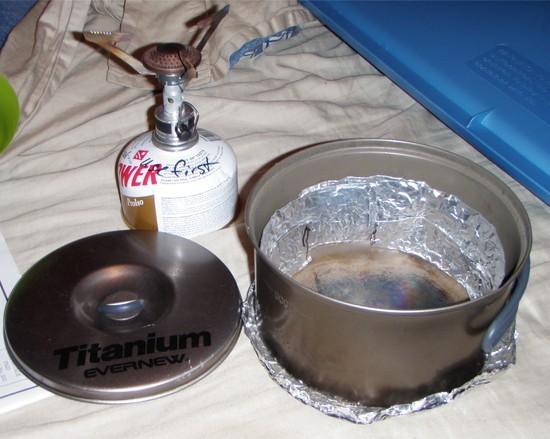
the folded over wind screen and the aluminum foil base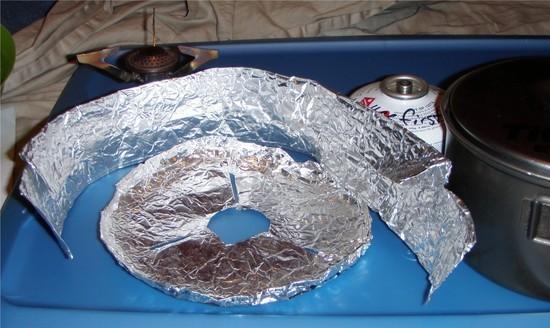
base mounted on stove
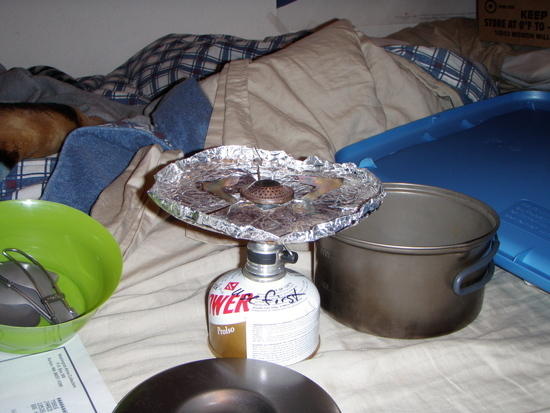
pot on stove with windscreen base
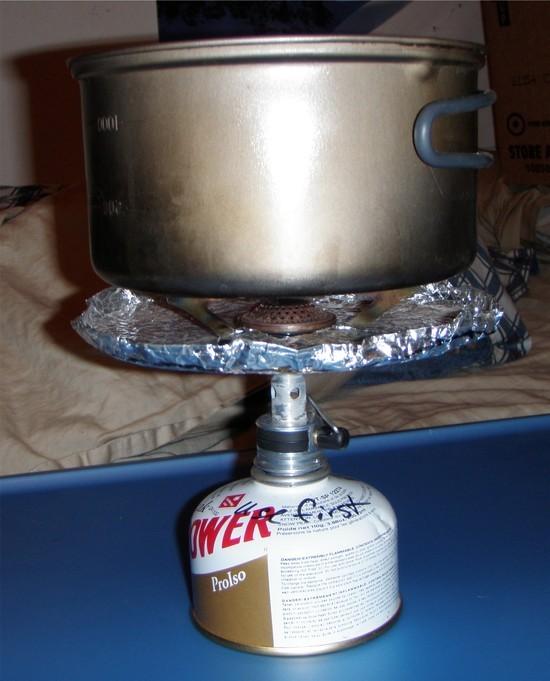
all setup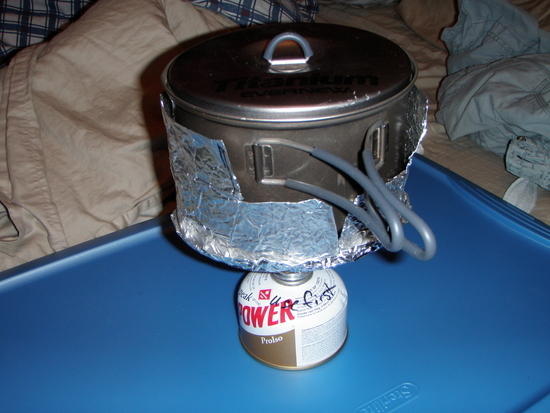
it seems to direct the heat straight up the pot as well giving it better surface area to heat the pot up with. It sped up my boil times even on low heat to conserve even more fuel, in windy conditions, it has similar if not better boil times as without using the windscreen in very calm conditions.
My MSR windscreen for burner-on-top canister stoves is customized with 8 evenly spaced, dime-sized holes about 1/4" up from the bottom. This seems to keep the canister cool enough for any cooking I've done,up to 15 minutes.
Eric
P.S.
Since I use a JetBoil 1.5 L. pot (minus steel wire handles and steel handle reciever) with its Flux Ring corrugated bottom heat exchanger some part of my Vargo Jet-Ti and Brunton Flex burner heads are a bit protected from wind. The MSR foil windscreen – placed in a C shape around the stove – conserves some heat and protects the flame from most of the wind.
But now I'm intrigued by the idea of the cut down "pie pan" material reflector under the burner head. That may help with one or both burners. I need to see how it works with 1 L. of water on each burner. I feel a test coming up tomorrow. I know a MSR burner reflector that came with my Dragonfly multi fuel stove does work to reduce boiling times – generally by 30 sec per pint of water.

Just tested an MSR Reactor. I was able to bring 1 litre of cold (5C/40F) tap water to a boil in just 2 minutes and 40 seconds using 20 grams of fuel…impressive. The water no doubt came to a boil faster (at lower temp)than the 3 minutes MSR claims on the box due elevation (~1500m). Wind was calm.
It certainly can't qualify as an ultralight (total weight on my scale was 840 grams including a 350 gram isopro fuel canister). The flameless burner heats instantly. The proprietry MSR heat exchanger pot is designed to align and rest (not lock) neatly on top of the burner. The pot could be pressed to a capacity of just over 1.5 litres, although MSR recommends filling it with no more than 1.0 litre (for stability?). If you turn off the stove as soon as the water boils you could conceivably boil 8-10 litres from a single canister. That's efficient.
Hi Patrick
> MSR recommends filling it with no more than 1.0 litre (for stability?)
Try bringing a nearly full Reactor pot to the boil without turning it down: you will quickly understand why MSR recommend only 1.0 L! The Reactor has more power than most walkers will ever need in summer, and when she boils …!
It's a legal safety/liability thing, and MSR are a touch paranoid about that.
Cheers
Re: Litemax
I run it about 1/3 throttle for max fuel efficiency, get about 22 pints boiled on an 8-oz canister. (Mid 60s temps, air and water, calm winds)
Re: Reactor
I really like this stove. Awesome bit of engineering. I just wish it didn't weigh 87 pounds. I'd imagine constructing the pot/burner interface assembly could be a pain in Ti?
I've been really, really impressed with the efficiency of my Primus Etapower stove and pots. You kind of have to ignore the lightweight part of the equation.
Anyone have any experience with the MLD TiJet Stove? Thinking of trying one of these.
I use the Snow Peak Gigapower and have been happy with it, but here is a new stove they reviewed in Backpacker magazine that looks promising. It is 2.5oz, with a auto ignighter and most importantly it has a regulator that is supposed to reduce boil times and greatly increase cold weather performance. I don't know how much I trust their marketing claims or the backpacker review, but it might be worth a look.
That TiJet stove is obviously made by Kovea as it is almost identical to my Kovea Ti. The claim to fame for my version is that the piezo works.
See also Snow Peak Lite Max
(I just dismantled and put together the one on my Jet Boil a few times, the stupid piezo on that only works as an exception)
Franco
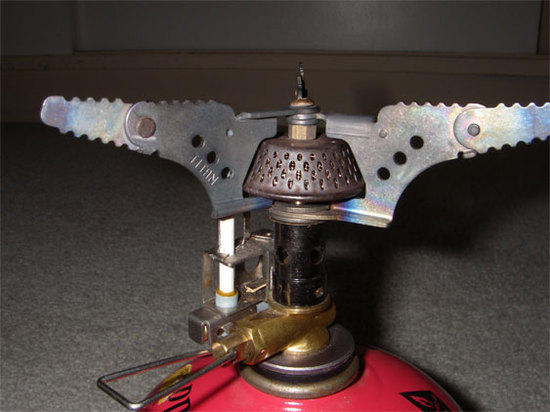
So, what's the trick? How is this "micro regulator" increasing the output of the stove? Cute video clip not withstanding, I'm more than a little sceptical. Short of a piston reducing the volume inside the canister, how does one overcome the physics of temperature and the boiling point of the LPG?
> how does one overcome the physics of temperature and the boiling point of the LPG?
Indeed…
Cheers
The regulator will make the boil times more similar over the life of the gas cylinder. ie: When the cylinder is new and has more pressure, the flame velocity is higher (more wind resistant), and has more spread (heat transfer area). However, I never use my gas stoves at full throttle – so the practical benefit is zero. ie: Opening the valve different amounts provides the same regulator effect for zero weight. When the gas cylinder is full, a flame spread that goes to the edge of my pot is achieved with the valve 1/4 of the way open. When the cylinder is 1/2 empty, the same flame performance needs the valve to be 1/3 of the way open, and when the cylinder is 3/4 empty, the valve needs to be 1/2 open.
ps: Theoretically, winter performance would improve slightly since the gas would go through a slightly larger orifice, and therefore have slightly less velocity inside the valve stem and therefore cool the valve stem slightly less, so the cylinder would cool slightly slower. However, the main cold weather performance is caused by the gas mix, and the gas removal rate caused by the user's flame setting. The heat transfer from the valve is miniscule. Marketing at it's finest…
According to the BP test
Avg Boil Times (1 liter of 68* water, windless environment, using the same nonstick aluminum pot, air temp 69-73*, Snow Peak 3.88oz canisters)
Snow Peak LiteMax 6:46
Primus Express 5:44
Optimus Crux Lite 6.26
MSR Pocket Rocket 6.28
Brunton Raptor 7:38
Soto Micro Regulator 4:52
It also noted that in tests from 15-30* boil times ranged from 4.5 to 6 minutes.
It also said that this stove arrived late and didn't get as much testing hours as the rest so it wasn't given an overall rating. (the LiteMax was rated #1)
I always take a BP test with a grain of salt, but it was a new stove that I wasn't familiar with that I thought looked interesting.
REI lists a spec for their stoves that's apparently based on some in house testing. It measures "Water boiled per 100g fuel". The Lite Max seems to be the winner amongst the basic lightweight canister stoves.
This may or may not be directly related to the boil time but it seems to be a good measure of efficiency.
John, let me see if I understand this correctly, the regulator opens up the valve further when the pressure is lower, is that how the Soto keeps the flame high when the internal pressure of the canister drops with the temperature?
That being true, then the regulator must be able to open the valve to levels beyond "full throttle." In other words, if I open the valve manually to "full throttle" (completely wide open as far as it will go), when the pressure drops, the regulator has a way to open the valve beyond the maximum amount I can open the valve. Am I understanding that correctly?
Still, when the pressure in the canister drops significantly (let's say you're cooking in 20F weather on a partially empty canister), there has to be a limit to what the regulator can do, physics being physics. I would think the regulator would help only in a very limited range. That is to say that the regulator could only compensate for minor drops in internal pressure. I would think that the regulator couldn't cope with the "big two:" nearly empty tanks and cold temperatures. Am I tracking on this here or am I missing something?
Still, an interesting idea, not without merit.
The regulator could open the valve farther than the manual "full open" amount IF it uses a pneumatically balanced valve. The cheaper spring balanced valve design would not. Even in the pneumatically balanced design, if you are operating the stove at full throttle the differences would be miniscule. If you are operating the stove at partial throttle, then the differences are non-existant – over short periods. If you are cooking long enough for a large drop in cylinder pressure to occur, then you could see the regulator as a benefit – but you could achieve the same benefit by opening the valve a little farther every 15-20 minutes. That was the point I was trying to make in my original post. The regulator provides a theoretical benefit – but no practical benefit.
Same thing for the increased cold performance. Any regulator related benefits should be extremely small compared to the performance being caused by the physics of gas.
"The regulator provides a theoretical benefit – but no practical benefit.
Any regulator related benefits should be extremely small compared to the performance being caused by the physics of gas."
OK, that makes sense. That's sort of along the lines of what I was thinking. Still, it might be interesting to see a rigorous test some time (the Backpacker article is pretty clear that the Soto was not subjected to a full battery of tests).

"That being true, then the regulator must be able to open the valve to levels beyond "full throttle."
It's just like the volume control on the Amp of the lead guitar in "This Is Spinal Tap". His control went to eleven.
Hi Guys
Hopefully a review sample will arrive in due course.
cheers
The Soto micro regulator just got an editor's award in Backpacker:
http://www.backpacker.com/editors-choice-2010-soto-micro-regulator-stove/videos/119
They seem to like it, and I admit I am tempted… but maybe I'm just a sucker for marketing!
You cant beat the Optimus crux for its size, weight, efficiency, durability, and cost. I might be biased though because not only do I sell them but I use them. Its hard to beat anything made by Optimus.
> The Soto micro regulator just got an editor's award in Backpacker:
Cough…. choke…
I wonder whether they lit it and did any measurements?
If you ignore all the crap over the regulator/valve issue and just look at it as a stove, then I have to say it is well-made. It does emit a bit too much CO for my liking though, and I think that may be due to the use of the regulator.
A Review is in the pipeline.
Cheers
Become a member to post in the forums.
 Super Thermo Zip PoloSynthetic mesh base layer with a high zip neck for venting or extra warmth and shoulder inlays for pack-carrying comfort. Weighs 6oz | 170g
 © Beartooth Media Group Inc.
 Loading...